Samsung's 7% blue light claim is real enough to take seriously, but it is narrower than the sleep promise many people hear inside it. The figure means that, in Samsung's foldable Dynamic AMOLED display, light in the 415-455 nm band accounts for 7% of total visible output. Samsung has compared that with about 12% for standard OLED and about 18% for LCD displays.[1]
That is a meaningful display-engineering difference. It is not the same thing as saying a Galaxy Z Fold or Z Flip reduces your sleep disruption by a fixed percentage, or that the phone is fine to use without trade-offs at midnight. The number describes the spectral mix of the screen. It does not measure total light reaching your eyes, how bright the phone is, how close it is to your face, what you are doing on it, or how near that use is to bedtime.
What the 7% figure actually measures
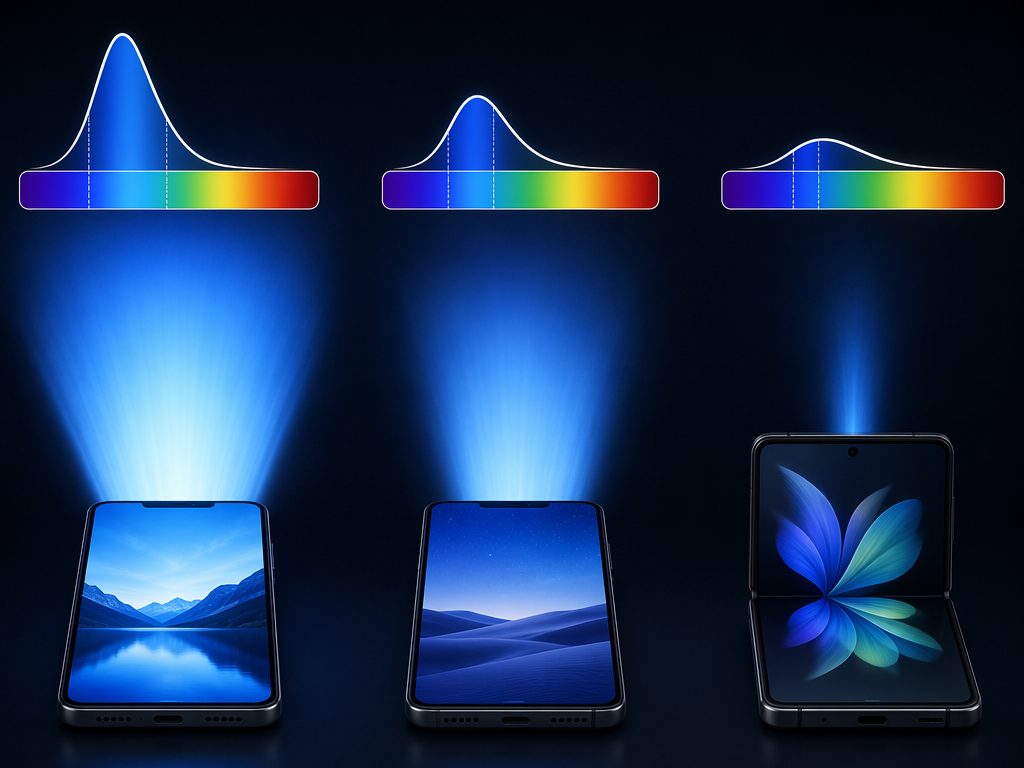
Blue light is not one single thing in display testing. Samsung's figure points to a specific wavelength range, 415-455 nm, expressed as a share of visible light. In plain terms: less of the display's visible output sits in that short-wavelength blue band than on a conventional OLED or LCD phone.[1]
| Display type | Blue light share cited in Samsung materials | What that comparison can and cannot tell you |
|---|---|---|
| Samsung foldable Dynamic AMOLED | 7% in the 415-455 nm range | Lower blue-light proportion in the tested band; not a direct sleep outcome |
| Standard OLED | About 12% | Higher blue-light proportion than Samsung's cited foldable AMOLED figure |
| LCD | About 18% | Highest comparison point in the cited Samsung materials |
The Galaxy Fold also received TÜV Rheinland Eye Comfort certification, a third-party display certification that Samsung and ZDNET described as recognition for reduced blue-light emission.[2][3] That matters because it keeps the claim from being just a software toggle with a soothing name. The display itself is being evaluated.
The boundary is just as important. Eye Comfort certification is not a clinical sleep study. It does not show that people using a foldable fall asleep faster, wake less often, preserve deep sleep, or avoid next-day grogginess. It says the display met a testing standard for comfort-related properties, including blue-light reduction. That is useful evidence for the screen; it is not proof of a bedtime outcome.
Why a lower blue-light proportion does not settle the sleep question
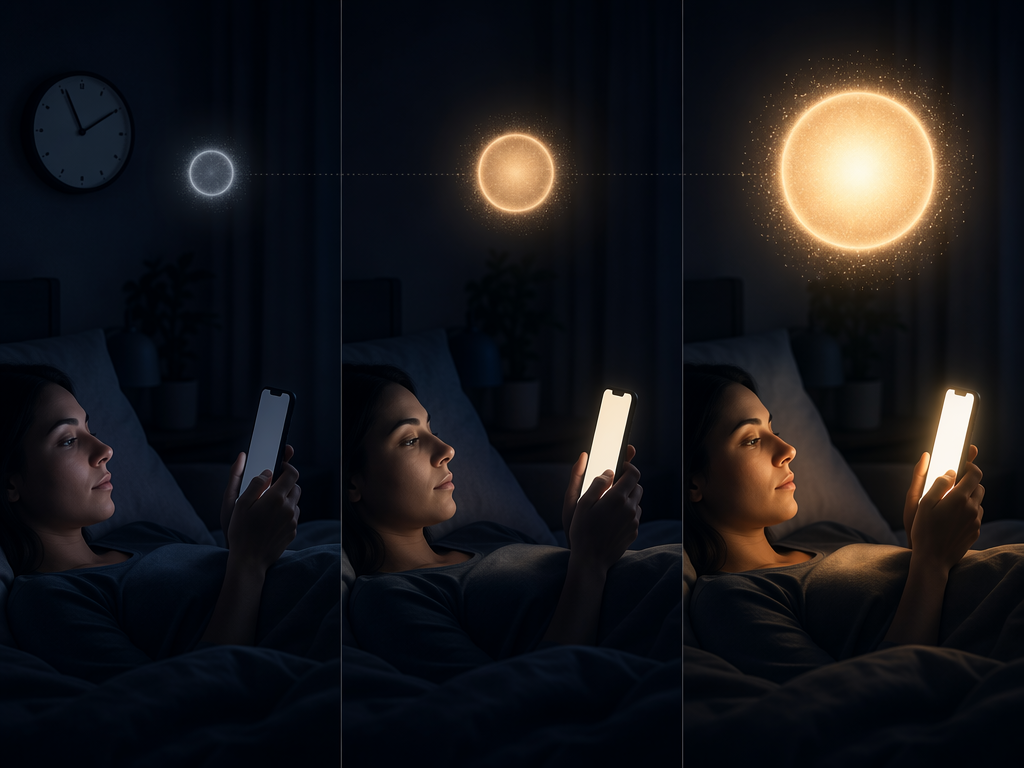
Sleep biology responds to more than the percentage of blue light in a screen. The eye and circadian system also care about the absolute amount of light, the timing of exposure, pupil state, ambient room lighting, distance from the face, and duration. A phone with a cleaner spectral profile can still be bright enough, close enough, and late enough to suppress melatonin.
This is the part that gets lost when a display specification becomes a sleep-health halo. A 7% blue-light share is better than 12% or 18% if all else is equal. But all else is rarely equal at night. A foldable at high brightness in a dark bedroom can create more biologically relevant light exposure than a less advanced screen used dimly, farther away, and earlier in the evening.
There is also a difference between reducing blue-light hazard and protecting sleep. Short-wavelength blue light can be discussed in the context of retinal phototoxicity, where lowering emission in the high-energy blue range is a more direct display-safety advantage. Circadian disruption is a different question. For sleep timing and melatonin, spectral composition matters, but it sits alongside intensity and behavior.
What phone studies show about melatonin
The best way to calibrate Samsung's claim is not to dismiss it, but to put it beside controlled phone-light research. A 2015 Scientific Reports study analyzing smartphones at night found that AMOLED smartphone displays in dark-room conditions produced circadian illuminance of 41-51 blx and were associated with estimated melatonin suppression of 7-11%.[4]
Those numbers are not trivial. Melatonin is one of the body's night signals, and measurable suppression after screen exposure is biologically relevant. But the result is also modest. It does not support the idea that every glance at an AMOLED screen wrecks sleep, and it does not support the opposite idea that a lower-blue display makes late phone use irrelevant.
The study also helps explain why the sleep question about Samsung foldables cannot be answered from the 7% figure alone. The circadian quantity being discussed in the study is not simply the display's blue-light percentage. It reflects light entering the eye under a set of viewing conditions. Change brightness, distance, duration, or room lighting, and the biological exposure changes too.
The 2024 Samsung Galaxy reading study narrows the claim further
A 2024 Brain Communications study by Höhn and colleagues used Samsung Galaxy smartphones in a controlled evening-reading experiment. Participants read on the phones for 90 minutes in the evening. The researchers found acute melatonin suppression, but sleep architecture and sleep-dependent declarative memory consolidation were largely unaffected.[5]
That pattern is the most honest shape of the evidence: a measurable biological effect, followed by a more limited translation into overnight sleep outcomes. The phone light did something. It did not, in that study, broadly dismantle sleep structure or memory consolidation.
The same study adds useful uncertainty rather than a neat rule. It reported that a 50-minute buffer allowed adolescents to recover, while adults did not show the same recovery pattern.[5] The study included male participants, so it should not be stretched into a universal estimate for all users. It also studied Samsung Galaxy phones, not current Galaxy Z Fold or Z Flip models as a foldable-display intervention.
What remains uncertain for Galaxy Z Fold and Z Flip owners
There is no independent peer-reviewed sleep-outcome study showing that current Galaxy Z Fold or Z Flip models, specifically, improve sleep compared with otherwise similar phones. The blue-light claim for Samsung foldables comes from Samsung materials, certification coverage, and technology reporting; the controlled sleep evidence comes from phone-light studies using other Samsung Galaxy models or broader smartphone display conditions.[2][3][4][5]
Display technology has also moved. Samsung announced Gen-2 low-blue-light AMOLED panels in 2023, which means older phone studies may not perfectly represent newer screens.[6] That cuts both ways. Current foldables may be better on blue-light output than older models studied in labs, but without direct sleep testing, the size of the bedtime benefit remains an inference.
The temptation is to turn the gap between 7%, 12%, and 18% into a sleep-benefit calculator. That would be false precision. The figures compare spectral composition, not the user's full evening exposure. They can tell you which display is likely to emit a lower share of short-wavelength blue light under test conditions. They cannot tell you how fast you will fall asleep after scrolling in bed.
How to use the phone if sleep is the priority
If you already own a Galaxy Z Fold or Z Flip, the display gives you a reasonable advantage over many conventional phone screens, especially LCD. You do not need to treat the 7% figure as meaningless. It is a real reduction in a biologically relevant band.
The practical sleep hierarchy still starts elsewhere. Lower the brightness. Stop earlier. Keep the phone farther from your face. Avoid using it in a fully dark room if you are trying to reduce contrast and glare. Treat stimulating content differently from calm reading, because arousal and attention can keep you awake even when the display is relatively gentle.
- Use the lowest comfortable brightness rather than relying on the display type alone.
- Move phone use earlier in the evening when possible, especially if you are sensitive to delayed sleep onset.
- Keep some gentle ambient light in the room instead of using a bright phone in complete darkness.
- Choose low-arousal tasks near bedtime; the content can be as disruptive as the photons.
- Use Samsung's comfort settings as support, not as permission for unlimited late-night use.
Samsung's own support guidance points users toward eye-comfort settings on Galaxy phones and tablets, which can reduce strain and adjust the display experience.[7] Those settings are useful, particularly when paired with lower brightness and a real cutoff. They are not a substitute for ending phone use before the final stretch of the night.
The fair verdict
A Samsung foldable is plausibly better than a conventional phone display for reducing blue-light exposure, and the advantage is clearest against LCD. The 7% figure is a legitimate hardware-level claim about the screen's spectral output, supported by certification coverage and Samsung's published comparisons.[1][2][3]
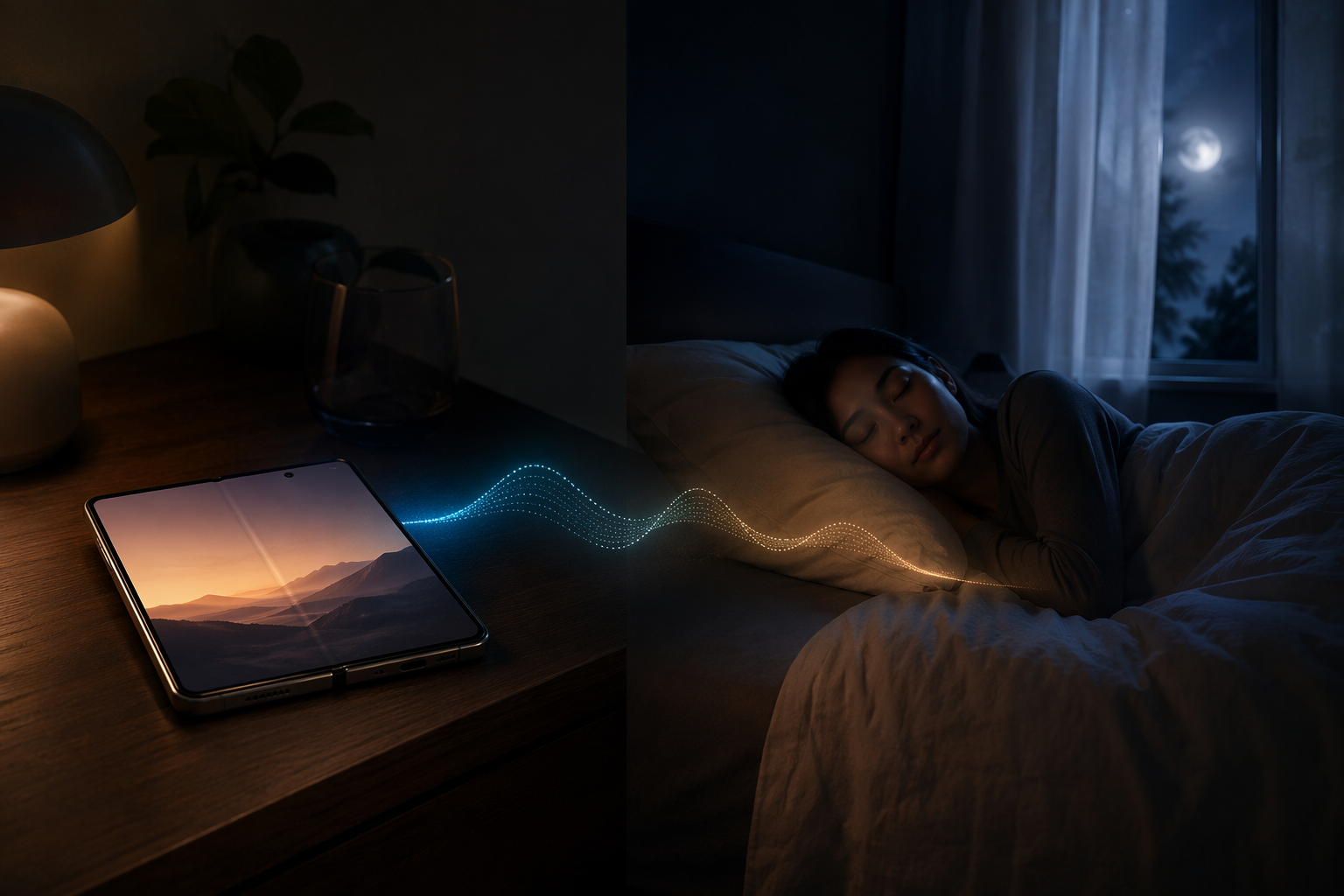
For sleep, the conclusion is smaller and more useful: the display helps at the margin, but it does not create a bedtime loophole. If the phone is bright, close, engaging, and used late, the lower blue-light share will not erase the exposure. If the phone is dim, used earlier, and not emotionally or cognitively activating, the foldable's display advantage becomes one helpful part of a better night routine.
References
- Easy on the Eyes: How the Galaxy S10's Display Protects Users from Blue Light — Samsung Global Newsroom
- Samsung Galaxy Fold gets 'Eye Comfort' certification — ZDNET, 2019
- Samsung's OLED Display on Galaxy Fold Receives International Recognition for Reduction in Eye-impairing Blue Light — Samsung US Newsroom
- Analysis of circadian properties and healthy levels of blue light from smartphones at night — Nature Scientific Reports
- Effects of evening smartphone use on sleep and declarative memory consolidation in male adolescents and young adults — Brain Communications, 2024
- Samsung Advances State-of-the-Art Display Technology for Smartphones with Sharp Reduction in Blue-light Emission from OLED Panels — Samsung US Newsroom
- Reduce eye strain on your Galaxy phone or tablet — Samsung Support
Comments
Join the discussion with an anonymous comment.