
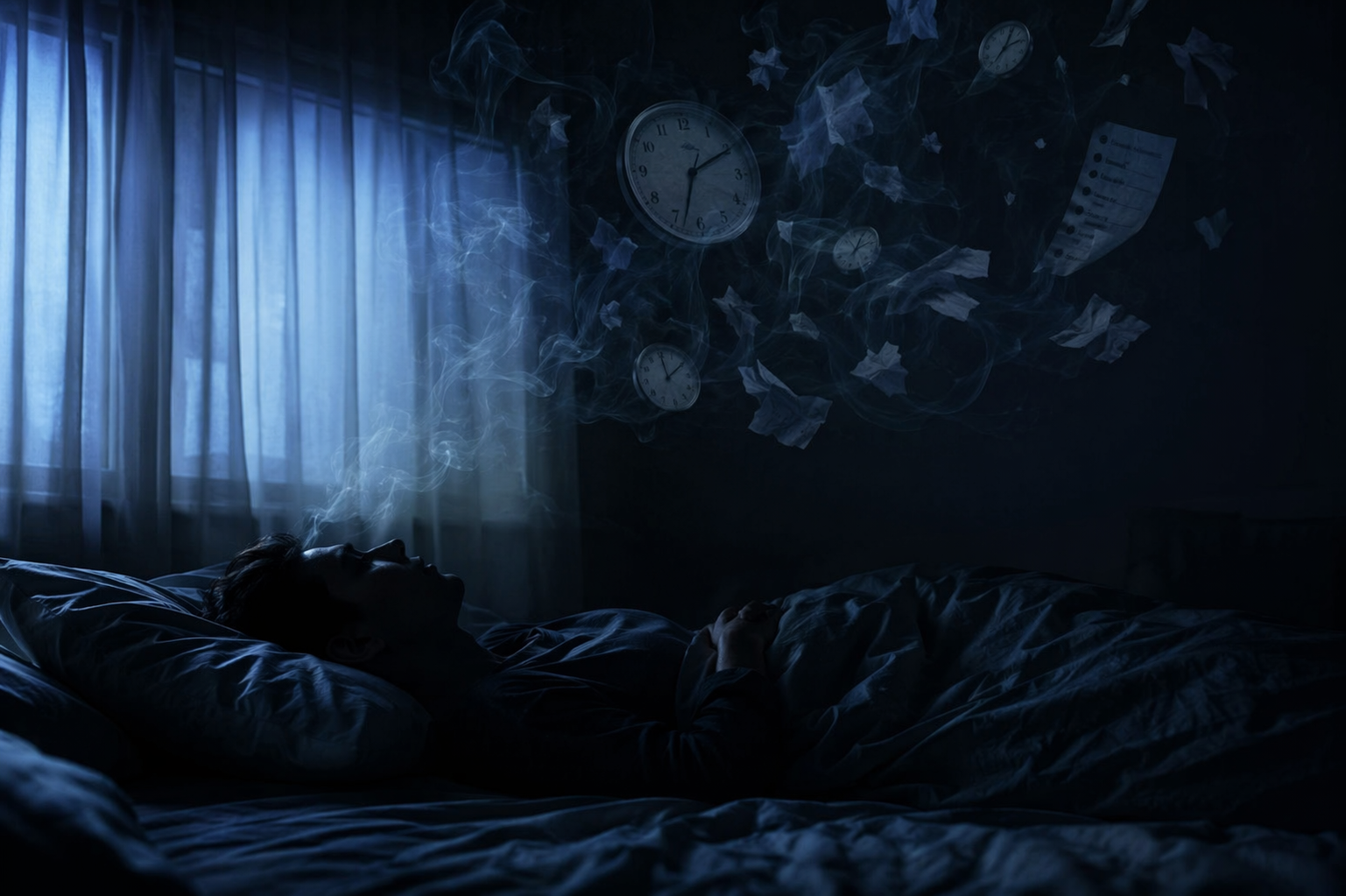
The night usually starts with a negotiation. You lie still because moving makes the sheets feel warmer. Then you turn over anyway. The pillow is damp on one side, your skin feels slightly tacky, and sleep keeps almost arriving before it backs away again. By 2 a.m., the problem no longer feels like ordinary discomfort. It feels like your body has stayed switched on.
Those are recognizable heat advisory symptoms affecting sleep: delayed sleep onset, repeated restlessness, night sweating, lighter or less restorative sleep, and a shorter night overall. In a 2026 systematic review of studies on heat-exposed workers, difficulty falling asleep appeared in 64% of included studies, restlessness in 54%, non-restorative sleep in 54%, reduced total sleep time in 45%, and night sweats in 36%.[1]
That evidence has a boundary. The review was not a survey of every adult trying to sleep in an overheated apartment; it focused on heat-exposed workers. The percentages should not be read as exact odds for a person at home during a U.S. heat advisory. Still, the symptom pattern is useful because it matches what sleep-temperature research would predict: when the room stays too warm, the body has a harder time doing the cooling work that normally helps sleep begin and stay stable.
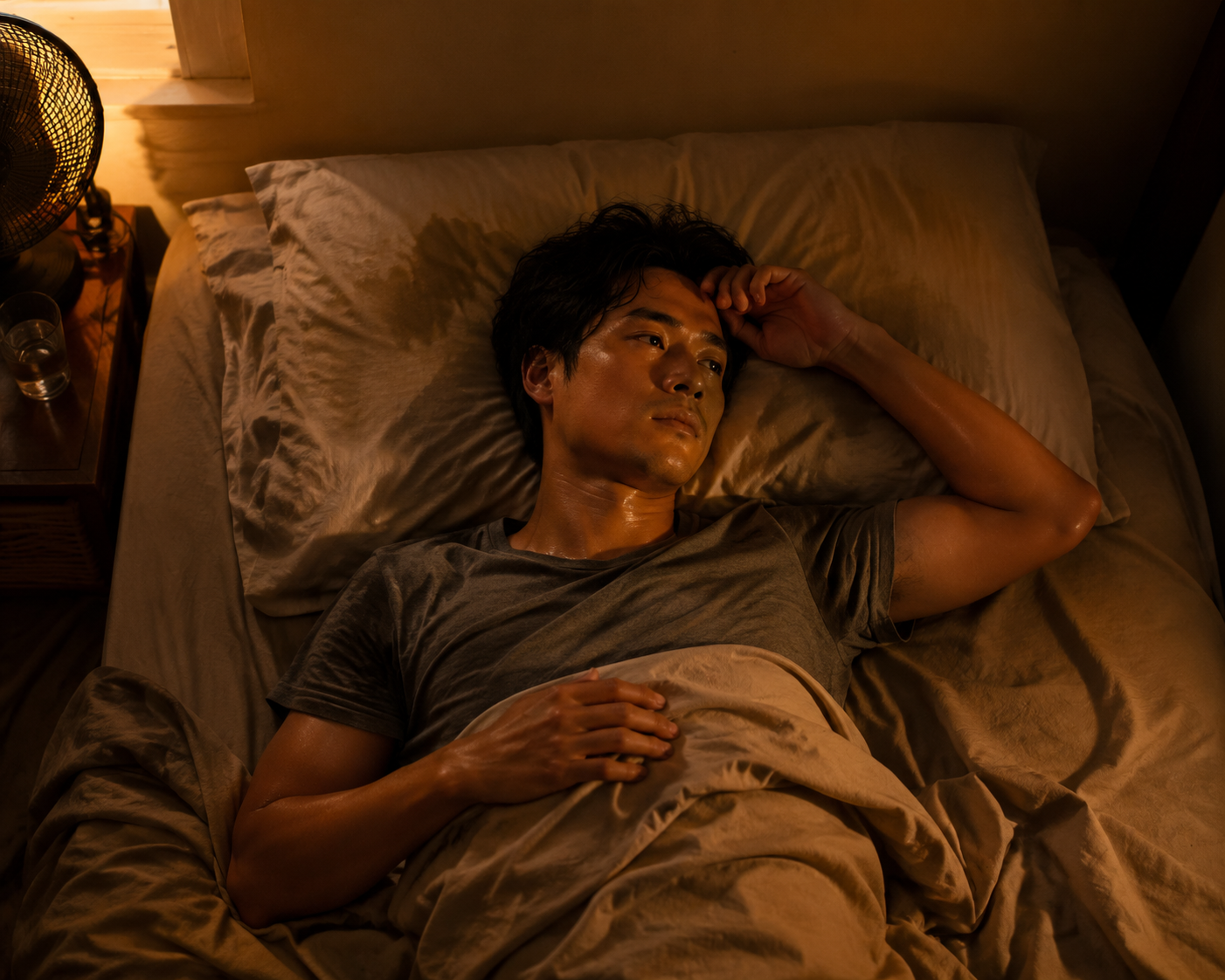
The symptom cluster is not random
Heat-related sleep disruption often feels personal because it happens in a private room, in the dark, while everyone else seems to be sleeping. But the symptoms tend to form a cluster for a reason. Heat interferes with sleep at the point where comfort, sweating, circulation, and core body temperature all meet.
| What you may notice | How it tends to show up during a hot night |
|---|---|
| Difficulty falling asleep | You feel tired but alert, and sleep keeps getting delayed. |
| Restlessness | You shift positions, kick off bedding, search for a cooler surface, or wake repeatedly. |
| Night sweats | You wake damp, change sides of the pillow, or feel chilled briefly after sweating. |
| Non-restorative sleep | You technically slept, but the next morning feels as if the night did not repair much. |
| Reduced total sleep time | The night gets shorter because sleep starts late, breaks often, or ends early. |
The most misleading part is that these symptoms can imitate a willpower problem. A person may think they are anxious, undisciplined, overreacting, or suddenly developing insomnia. Sometimes that is part of the story. But during a heat advisory, the first explanation to test is much simpler: the sleeping environment may be blocking the body’s normal nighttime cooling pathway.
That distinction matters if the sleep trouble fades when the heat breaks or when active cooling is available. Heat-triggered sleep loss is different from a persistent insomnia pattern that continues across conditions. If the problem keeps showing up after the heat exposure is gone, it belongs in a broader look at the hidden causes of insomnia, rather than being treated as only a summer-room problem.
Why heat keeps sleep from starting
Sleep onset is not just a mental shutdown. It is also a thermal event. Before and during sleep, the body shifts heat toward the skin and extremities so core temperature can fall. Distal vasodilation—more blood flow to the hands, feet, and skin surface—helps release heat, and that core temperature drop supports the transition into sleep.[2]
A hot bedroom makes that exchange less efficient. If the air around you is already warm, the body has a harder time unloading heat into the environment. Sweating may increase, but sweat only helps when evaporation can carry heat away. In a stuffy room, especially one that stays warm after sunset, the body can keep trying to cool itself while the brain remains too activated for easy sleep.
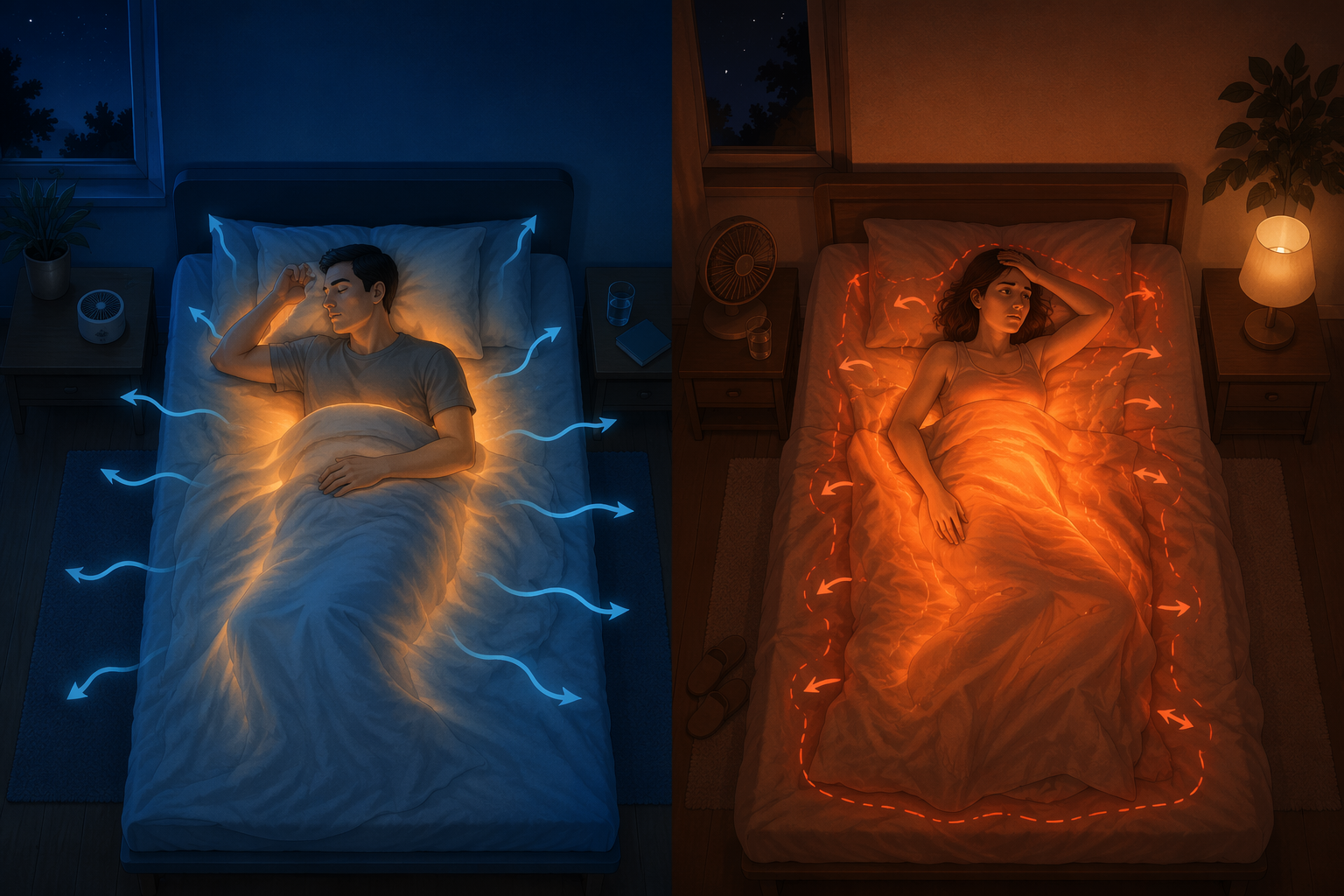
This is why the first symptom is often not waking up sweaty, but failing to fall asleep at all. The body is tired, but the conditions that normally let sleep arrive are not in place. The person in bed may read that alertness as stress. Sometimes it is simply physiology being asked to perform in the wrong thermal setting.
Temperature also matters after sleep begins. Slow-wave sleep and REM sleep are both connected to thermoregulation, which helps explain why a hot night can feel chopped up, shallow, or strangely unrecovering even when there were several hours between bedtime and morning.[2]
Why “I’ll adjust in a few nights” often fails
There is a tempting bargain during a heat streak: get through the first few nights, and the body will adapt. The evidence does not support that as a reliable sleep plan. Laboratory research cited in the heat-sleep literature found no rapid habituation after five consecutive days of heat exposure.[1]
That does not mean every person experiences every hot night the same way. It means passive waiting is a poor strategy when the room remains hot enough to keep interrupting the core temperature drop that sleep depends on. If the thermal problem remains, the sleep problem can remain with it.
How sleep erodes as nighttime temperature rises
The subjective feeling—“I barely slept”—has measurable counterparts. In a 2025 Nature Communications study using 23 million sleep records from Huawei smartwatch users in China, higher ambient temperature was associated with poorer sleep. For each 10°C increase, the odds of sleep insufficiency rose by 20.1%, total sleep duration fell by 9.67 minutes, and deep sleep declined by 2.82%.[3]
Those numbers should be used carefully. The sample came from Chinese Huawei smartwatch users, and housing, air-conditioning access, baseline climate, and wearable-user behavior may differ from those of U.S. readers. The study is also observational, so it supports association rather than proving that temperature alone caused every sleep change. Its value here is the dose-response shape: as heat rises, sleep tends to become shorter and less sufficient.[3]
The practical meaning is less abstract than the percentages. A hot night can steal time at several points: it delays sleep onset, wakes you after sweating or shifting, trims deep sleep, and may make early morning sleep more fragile. The loss may not feel dramatic on one night. Over several hot nights, the person who keeps saying “I slept some” may still be accumulating sleep debt.
Night sweats deserve a little more precision
Sweating during a heat advisory can be ordinary thermoregulation: the body is trying to unload heat. But night sweats are also easy to misread because they sit at the intersection of room temperature, hormones, bedding, illness, medication effects, and anxiety. During a hot night, the room may be the obvious trigger. It is not always the only possible one.
For people in perimenopause or menopause, the overlap can be especially frustrating. A hot room can intensify a sleep system that is already more sensitive to thermal changes. That is why menopause-related sleep disruption is not reducible to “hot flashes,” and it may be worth reading more about why menopause sleep problems are not just hot flashes.
The useful question on a heat-advisory night is not whether sweating is embarrassing or excessive by some vague standard. It is whether sweating appears with the broader heat-sleep pattern—trouble falling asleep, restlessness, shorter sleep, and a hot room—or whether it appears with symptoms that suggest the body is no longer coping safely.
Some sleepers have less margin
One room temperature does not create one universal sleep outcome. A 2025 USC analysis using All of Us data provides U.S.-specific context that some groups experience larger sleep losses as temperature rises.[4] That finding is useful, but it should not be stretched into a complete map of heat vulnerability.
The important point for a hot night is that “other people seem fine” is not a useful clinical comparison. Age, health conditions, medications, housing quality, neighborhood heat exposure, and access to cooling can all change how much stress a hot bedroom places on sleep. If you are trying to understand why a heat streak hits some people harder, the narrower question is covered in who loses the most sleep during a heat streak.
For the person awake tonight, this variability changes the tone of the decision. If a partner sleeps through the heat while you cannot, that does not prove the room is safe for your sleep system. It may only prove that two bodies are not responding identically to the same thermal load.
When it is still a sleep problem, and when it becomes a safety problem
Expected heat-related sleep disruption has a recognizable shape: you are too warm, you cannot fall asleep easily, you keep moving, you sweat, the night shortens, and the next day feels under-restored. That pattern calls for active cooling, not self-blame. The room, bedding, airflow, hydration access, and ability to reduce heat exposure matter because the mechanism is physical.
The boundary changes when the concern is no longer sleep quality but heat illness. Ordinary heat-related sleep disruption can often be approached with cooling strategies, while possible heat exhaustion or heat stroke should shift the goal from “How do I sleep?” to “How do I get safe?”
- Treat it primarily as a sleep-disruption problem when the symptoms stay within the sleep cluster: delayed sleep onset, restlessness, sweating, lighter sleep, and reduced sleep time in a hot environment.
- Escalate the concern when symptoms feel systemic rather than only sleep-related, especially if the person seems unable to cool down or is acting unlike themselves.
- Stop troubleshooting the perfect sleep setup if safety is in question; cooling the person and seeking appropriate help take priority over preserving the night’s rest.
- Plan differently when heat combines with another disruption, such as power loss, flooding, displacement, or limited access to a cool place.
That last point matters because heat rarely waits politely outside other emergencies. If sleep is being disrupted during a power outage, evacuation, or flooded-home situation, the sleep question becomes part of a broader safety plan. The practical framing in how to sleep during a flood emergency is useful because it treats rest as one need among several, not as a reason to ignore risk.
Active cooling is the rational response
A heat-advisory night is not the time to prove you can out-discipline your physiology. If the body cannot shed heat and lower core temperature, lying still in the same warm room is unlikely to restore normal sleep. The most evidence-consistent response is to change the thermal conditions: cooler air if available, better airflow, less insulating bedding, a cooler sleeping location, or another safe way to reduce heat load.
This does not promise perfect sleep. A person may still wake up, sweat, or lose time. But it puts the effort where the evidence points. The symptoms are real, patterned, and physiologically expected when nighttime heat blocks the body’s cooling pathway. If the problem is sleeplessness, sweating, restlessness, and a shortened night, cooling is the sleep intervention. If the symptoms suggest heat illness, the task changes from sleep troubleshooting to safety.
References
- Impacts of heat on sleep quality among heat-exposed workers. PMC. 2026.
- Effects of thermal environment on sleep and circadian rhythm. Journal of Physiological Anthropology. 2012.
- Temperature and sleep: evidence from 23 million sleep records. Nature Communications. 2025.
- USC All of Us study on temperature and sleep. PMC. 2025.

Comments
Join the discussion with an anonymous comment.