
The hard part is that a wake-up stroke can look, at first, like a bad morning. Someone sits up and says one arm feels dead from sleeping on it. A partner notices that the person is answering slowly but assumes they are not fully awake. Vision seems blurry, so coffee or a shower feels like the next reasonable step. New bedwetting may be treated as embarrassing rather than urgent.
That hesitation is the dangerous part. A wake-up stroke is not a special kind of stroke with a different symptom list. It is a stroke discovered after sleep, when the exact time symptoms began is unknown. The symptoms should be treated the same way they would be treated at noon: as possible stroke signs until emergency clinicians can prove otherwise.

Use B.E. F.A.S.T. Even If Symptoms Appear on Waking
The American Stroke Association’s B.E. F.A.S.T. warning signs apply to symptoms found after sleep: Balance loss, Eyes or vision changes, Face drooping, Arm weakness, Speech difficulty, and Time to call 911.[1]
- Balance: sudden dizziness, loss of coordination, trouble walking, or an unexplained fall when getting out of bed.
- Eyes: sudden blurred vision, double vision, or loss of vision in one or both eyes.
- Face: one side of the face droops, looks uneven, or does not move normally when the person smiles or speaks.
- Arm: one arm feels weak, drifts downward, cannot grip normally, or seems “asleep” in a way that does not fit ordinary pressure or position.
- Speech: slurred words, confused speech, trouble finding words, or difficulty understanding what someone else is saying.
- Time: call 911 immediately. Do not wait to see whether the person wakes up more fully.
Sleep does not create a separate stroke checklist. It changes the story around the symptoms. It gives people an easy explanation for weakness, confusion, vision changes, or poor balance. That explanation can cost time.
Morning Red Flags People Commonly Explain Away
One-sided weakness is one of the easiest symptoms to minimize after sleep. A person may say they “slept on it wrong” because the arm feels numb, heavy, or clumsy. But pressure-related numbness should not be used as a home diagnosis when one side of the body is weak, the hand cannot grip, the arm drifts, or the weakness appears with speech, face, vision, or balance changes.
Vision symptoms also get softened by morning routine. Blurry vision can be blamed on dry eyes, grogginess, a dark room, or not having glasses on yet. Sudden vision loss, double vision, or a new visual disturbance on waking belongs in the stroke checklist, not in a wait-for-coffee plan.[2]
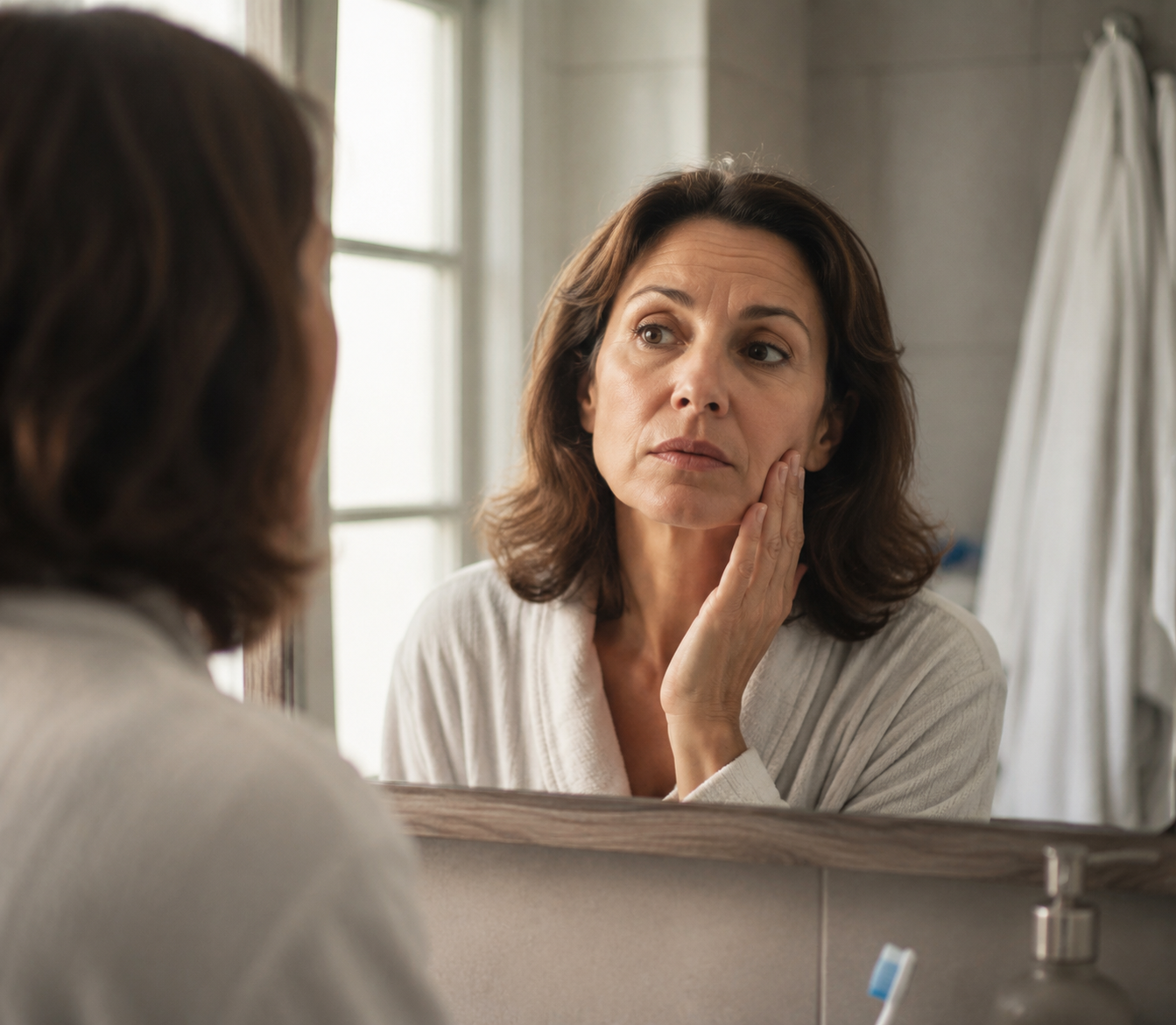
Facial droop may be subtle until the person talks, brushes their teeth, drinks water, or tries to smile. A partner may notice that one side of the mouth is lower, that liquid spills from one side, or that the face simply looks different. That is enough to act.
Speech changes can be mistaken for sleepiness, especially if the person is still in bed. Listen for slurring, odd word choices, confusion, trouble understanding simple questions, or a sudden inability to say something familiar. The issue is not whether the person seems tired. The issue is whether their speech or comprehension has changed.
New incontinence deserves particular care because it is easy to hide behind embarrassment. Bedwetting or loss of bladder control on waking is not the most famous stroke sign, but practical wake-up stroke guidance includes it among symptoms that people may fail to connect with stroke.[2] If it appears with weakness, facial change, speech trouble, vision symptoms, confusion, or balance problems, it should make the situation more urgent, not less.
Wake-Up Stroke Is Not Rare Enough to Dismiss
Wake-up strokes are common enough that emergency decisions should account for them. Published estimates place strokes during sleep at about 14% to 28% of ischemic strokes, depending on the study and method used.[2][3] One commonly cited figure describes roughly 1 in 7 strokes occurring during sleep, while other clinical overviews describe wake-up stroke as closer to about 1 in 5 ischemic strokes.[3][4]
A 2015 review in The Neurohospitalist estimated that about 58,000 people per year in the United States present to emergency departments with wake-up strokes.[5] That number is not a reason to diagnose stroke at home. It is a reason not to treat the scenario as too unusual to be plausible.
Why the Unknown Start Time Matters
When a stroke is discovered during the day, clinicians often ask when the person was last normal because treatment decisions depend heavily on time. With a wake-up stroke, the person may have gone to bed well and awakened with symptoms. The actual onset could have been shortly before waking, hours earlier, or somewhere in between.
For years, that unknown onset time often kept wake-up stroke patients outside standard thrombolysis windows, even when the morning symptoms were recognized. That history is one reason some people still assume nothing can be done if symptoms were found after sleep. In 2026, that assumption is too blunt.
What the 2026 AHA/ASA Guideline Changes—and What It Does Not
The 2026 American Heart Association/American Stroke Association guideline for early management of acute ischemic stroke includes thrombolysis recommendations for select patients with unknown-onset stroke when advanced imaging shows either DWI-FLAIR mismatch or CT perfusion mismatch.[6] In plain language, doctors may use specialized imaging to look for patterns suggesting that some brain tissue may still be in a treatable window, even though the clock time of symptom onset is unknown.
That is a meaningful change for wake-up stroke, but it is not a home-treatment promise. “Select patients” and “advanced imaging criteria” are the working parts of the recommendation. A person cannot tell from the bedroom, bathroom, or kitchen whether they have the imaging pattern that might make thrombolysis appropriate.
DWI-FLAIR mismatch refers to a pattern seen on MRI. CT perfusion mismatch refers to a pattern seen on CT-based imaging. The details matter to the stroke team because they help separate patients who may benefit from treatment from those who may face too much risk or too little expected benefit. For the person at home, the practical meaning is simpler: the chance to be considered depends on getting to an emergency department quickly enough for evaluation.
This is why reassurance based on “we do not know when it started” is unsafe. Unknown onset no longer automatically answers the treatment question. It begins a hospital imaging question. The patient still needs emergency assessment, and the sooner that starts, the more options the team can consider.
Do Not Wait for Symptoms to Prove Themselves
Stroke symptoms do not have to be dramatic to be urgent. A person may still be awake, talking, embarrassed, or annoyed. Symptoms may fluctuate. They may seem to improve. None of that makes waiting safer.
Transient stroke-like symptoms can be warning signs of a transient ischemic attack, or TIA, which can precede a major stroke.[2] The correct response is not to monitor through breakfast. It is to call 911 when B.E. F.A.S.T. signs or other concerning sudden neurological changes are discovered.
Driving the person yourself may feel faster, but if emergency medical services are available, calling 911 is usually the safer action. Paramedics can begin assessment, alert the receiving hospital, and route care more appropriately than a family member trying to manage traffic and a possible neurological emergency at the same time.
What to Say When You Call 911
Give the dispatcher the symptom, not your best guess. Say, for example, that the person woke up with one-sided arm weakness, facial droop, speech trouble, vision changes, new balance problems, confusion, or new loss of bladder control with other neurological symptoms. Use the word “stroke” if stroke is a concern.
- Report when the person was last known well, such as the time they went to bed normal.
- Report when symptoms were discovered, such as the time they woke up or were found.
- Describe what changed: face, arm, speech, balance, vision, confusion, or incontinence.
- Mention whether symptoms are improving, worsening, or coming and going, but do not let improvement delay the call.
- Do not give food, drink, or medication unless emergency professionals instruct you to do so.
If B.E. F.A.S.T. signs appear on waking, call 911 immediately. Do not wait for coffee, a shower, a nap, or proof that the symptom will last. The 2026 treatment pathway makes rapid emergency evaluation more consequential for some wake-up stroke patients, but only hospital imaging can decide whether thrombolysis applies.
References
- Stroke Symptoms: B.E. F.A.S.T. — American Stroke Association.
- Wake-Up Stroke: Causes and Treatment — Verywell Health, 2026.
- 1 in 7 Strokes Occurs During Sleep — American Academy of Neurology, 2011.
- What is a Wake-Up Stroke? — NewYork-Presbyterian Health Matters.
- What to do With Wake-Up Stroke — The Neurohospitalist, 2015.
- 2026 Guideline for the Early Management of Patients With Acute Ischemic Stroke — American Heart Association/American Stroke Association, 2026.
Comments
Join the discussion with an anonymous comment.