
If you wear the Galaxy Watch 8 overnight, the first question is not whether Samsung has added enough sleep features. It has. The watch can estimate sleep duration and stages, assign a Sleep Coaching animal, suggest a bedtime window, generate an Energy Score, monitor vascular load, work alongside the Galaxy Ring, and notify eligible adults about signs associated with moderate-to-severe obstructive sleep apnea risk.[1]
The better question is which numbers deserve your confidence. As of Q3 2026, there is no published Galaxy Watch 8-specific polysomnography validation study. The best available Samsung validation evidence comes from a Galaxy Watch 3 study that compared the watch with overnight PSG in 32 adults. In that study, sleep detection sensitivity was high at 0.954, wake specificity was much weaker at 0.524, and four-stage sleep classification accuracy was 0.651.[2] The American Academy of Sleep Medicine also describes Samsung sleep staging precision as limited compared with PSG.[3]
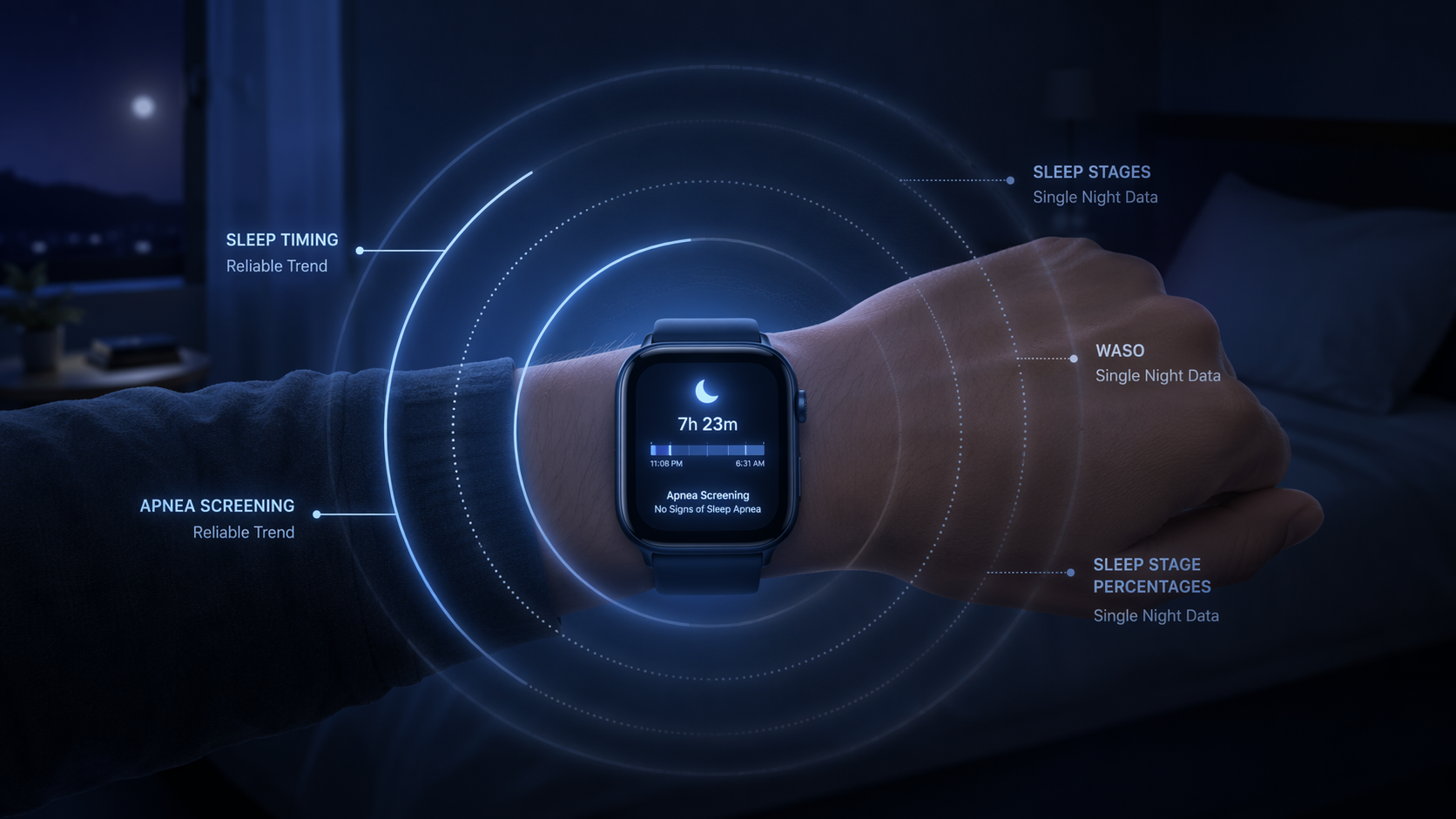
That does not make the Galaxy Watch 8 useless for sleep. It means the safest way to read it is unevenly: give more weight to repeated patterns, sleep timing, habit prompts, and apnea risk notifications; give less weight to one-night deep sleep percentages, REM minutes, and wake-after-sleep-onset estimates. A tracker can be helpful without being clinically exact.
The Trust Map: What To Believe First
| Feature or metric | What it is trying to do | How much confidence to place in it |
|---|---|---|
| Sleep schedule and duration trends | Show when you usually fall asleep, wake up, and how your nights change over time | Useful for trends, especially when worn consistently |
| Sleep apnea risk detection | Flag signs associated with moderate-to-severe obstructive sleep apnea risk in eligible adults | High-stakes screening tool, not a diagnosis |
| Sleep Coaching | Turn several nights of data into a behavioral coaching profile | Useful for habit direction, not proof that one behavior caused one result |
| Bedtime Guidance | Suggest a bedtime window from recent sleep timing and sleep latency | Reasonable as a routine prompt if your schedule allows it |
| Energy Score | Combine sleep and recovery signals into a readiness-style score | Best read as a daily context cue, not a medical measurement |
| Vascular load | Estimate overnight stress on the vascular system | Interesting trend signal, still new in this watch context |
| Sleep stages and WASO | Estimate light, deep, REM, and wake time during the night | Directional only; weak wake detection makes single-night precision shaky |
The Galaxy Watch 8’s strongest sleep features are the ones that ask for multiple nights before saying much. That is not a small design choice. Sleep is noisy: alcohol, late meals, room temperature, stress, illness, travel, medication changes, and one loose strap can all distort a single night. A feature that waits for a pattern is usually more respectful of the data than a feature that turns one rough night into a verdict.
Sleep Apnea Detection Is The Feature To Treat Most Seriously
Samsung’s sleep apnea feature is the most consequential part of the Galaxy Watch 8 sleep stack because the possible next step is not “go to bed earlier.” It is “consider medical evaluation.” The feature is FDA-authorized to detect signs associated with moderate-to-severe obstructive sleep apnea risk in adults age 22 and older, and Samsung says it needs two nights of at least four hours of sleep within a 10-day period.[4]
The wording matters. This is a risk notification tool. It is not a diagnosis, it does not grade your condition, and it does not rule out sleep apnea if it stays quiet. A person can have symptoms, poor sleep, or cardiovascular risk factors and still need a clinician’s judgment even if the watch never raises an alert.
It is also not the same kind of metric as a sleep score. If your sleep score drops, you might look at bedtime, caffeine, exercise, or stress. If the watch repeatedly flags possible moderate-to-severe obstructive sleep apnea risk, the appropriate response is more formal: save the notification, note your symptoms, and discuss it with a qualified health professional. Snoring, witnessed breathing pauses, morning headaches, daytime sleepiness, and high blood pressure are not things a smartwatch should be asked to adjudicate alone.
Samsung was first to receive this smartwatch clearance, which is meaningful, but clearance for a screening-style notification is still not permission to treat the watch as a sleep lab.[5] The value is in lowering the chance that a person ignores a pattern worth checking.
Sleep Coaching: Useful Because It Waits
Sleep Coaching is Samsung’s most approachable sleep feature, partly because it does not pretend to be a lab result. After seven nights of wear, including at least one workday and one off-day, Samsung assigns one of eight sleep animals across four levels and then offers coaching inside Samsung Health.[6]
The animal labels are easy to over-discuss, but the rule behind them is the important part. Samsung is trying to separate a one-off bad night from a pattern. A person who sleeps differently on work nights and weekends may need a different prompt than someone who sleeps long enough but at irregular times. Seven nights is not a full clinical portrait, but it is better than pretending Tuesday night alone explains your sleep life.
The coaching is also free. That stands out because some sleep-focused wearable ecosystems place advanced guidance behind recurring subscriptions, including Oura at $5.99 per month and Whoop at $30 per month.[6] Free coaching does not make the advice automatically better, but it does make the feature easier to recommend to someone who already bought the watch.
There is a nice human example here, with a Digital Trends writer reporting a move from Shark to Penguin over roughly two years while using Samsung sleep coaching across devices.[7] That is encouraging, but it should stay in its lane: it shows that the system can give a user a language for progress over time, not that the Galaxy Watch 8 alone caused the change.
Bedtime Guidance Is A Nudge, Not A Command
Bedtime Guidance needs three consecutive nights of data. It analyzes your circadian rhythm and sleep latency, then suggests an optimal bedtime window and can send a notification two hours before that window.[1]
This is one of the more practical Galaxy Watch 8 sleep tracking features because it targets a behavior you can actually change. You cannot directly decide to get 18 more minutes of deep sleep. You can decide whether to start dimming lights, stop work, or move your phone away before the bedtime window arrives.
The right way to use it is to compare the suggested window with your real life. If the watch keeps recommending a bedtime that collides with childcare, shift work, medication timing, or a partner’s schedule, the recommendation may be physiologically tidy and practically impossible. In that case, the useful signal is not the exact time; it is the gap between the sleep schedule your body seems to prefer and the schedule your life currently permits.
Energy Score Is A Morning Context Cue
Energy Score is Samsung’s readiness-style feature. It combines sleep and other health signals to give a daily number meant to help you judge how prepared you may be for the day.[4]
This kind of score can be useful when it changes your behavior gently. If your score is low after a short night, you might choose an easier workout, protect a lunch break, or avoid scheduling your hardest cognitive work at the end of the day. The mistake is treating the number as a moral grade or a medical clearance. A high score does not mean you are invulnerable; a low score does not mean the day is lost.
Energy Score is also downstream of the same sensor limitations as the rest of the watch. If the watch under-detects wake time or misclassifies stages, the score may still point in the right direction over time, but the single morning number should not outrank how you feel, how safely you can drive, or whether you are ill.
Vascular Load Is Interesting, But Still A Trend Signal
Vascular load is one of the newer Galaxy Watch 8 sleep-related measurements. Samsung describes it as a way to monitor stress on the vascular system during sleep, extending the watch’s overnight health picture beyond standard sleep duration and stages.[1]
That sounds more clinical than a sleep animal, so it deserves a steadier reading. The useful question is not “Is my vascular load number good tonight?” It is “Does this trend move when my sleep, alcohol intake, late meals, illness, training load, or stress changes?” A repeated upward pattern may be worth paying attention to, especially if it appears alongside symptoms or other health concerns. A single odd night is a prompt to look for context, not a reason to self-diagnose.
Sleep Stages Are The Most Tempting Numbers To Overread
Deep sleep and REM percentages look precise because they arrive in tidy charts. They are also where consumer wearables tend to invite the most overconfidence. In the Galaxy Watch 3 validation study, stage-specific sensitivity was 0.695 for light sleep, 0.612 for deep sleep, and 0.598 for REM sleep.[2] Those numbers support moderate usefulness, not clinical certainty.
The wake number is even more delicate. The same study found wake specificity of 0.524, meaning wake detection was much weaker than sleep detection.[2] That matters for wake-after-sleep-onset, or WASO. If the watch is not very good at identifying wakefulness, then a single-night WASO estimate can be wrong in exactly the way an anxious sleeper will notice: it may make the night look cleaner or more fragmented than it felt.
For most users, the better hierarchy is simple: trust broad sleep timing more than stage percentages, trust multi-week patterns more than one-night charts, and trust symptoms enough to seek care even when the watch looks normal. That same distinction is why a device can land well in consumer rankings while still having validation limits; if you want the broader framework, see this guide to top-rated sleep tracker accuracy.
Galaxy Ring Integration Can Help, If You Own Both
If you wear both the Galaxy Watch 8 and Galaxy Ring, Samsung Health can automatically select the cleaner data stream rather than forcing you to decide which device to believe.[6] That is a sensible approach because wrists and fingers can behave differently overnight. A watch can shift on the wrist; a ring can fit differently with temperature, swelling, or movement.
Dual-device tracking is not automatically more accurate in every situation, and it is not necessary for most people. It is most appealing for users who already like ring-based sleep tracking but want the watch’s screen, coaching, apnea notification, and broader smartwatch features. For a deeper look at the ring side of that equation, read the separate guide to Samsung Galaxy Ring sleep tracking accuracy.
Comfort And Battery Matter More Than They Sound

Sleep tracking accuracy starts with a boring requirement: the device has to stay on your body. Samsung says the Galaxy Watch 8 is 11% thinner than the Galaxy Watch 7, at 8.6 mm, and uses a dynamic lug system intended to improve comfort.[1] That kind of redesign is not just aesthetic. A watch that feels bulky at 2 a.m. becomes a watch left on the charger.
Battery estimates need source context. Samsung’s materials point to roughly 30 to 40 hours depending on settings, while PCMag recorded about 26 hours with always-on display enabled and 39 hours without it.[8] For sleep tracking, the practical question is whether your charging routine leaves enough buffer to wear it overnight. If you usually charge while showering or working at a desk, the Watch 8’s sleep features are easier to live with. If you want several nights without thinking about a charger, this is still a smartwatch, not a long-haul fitness band.
What To Do If The Numbers Look Wrong
A bad sleep reading is not always a revelation about your body. Sometimes it is a strap issue, a software issue, a battery issue, or a night when the sensor had poor contact. Samsung has previously acknowledged sleep tracking problems affecting Galaxy Watch 4 through Watch 7 and Ultra models, with a reported fix for affected users; whether every lesson from that issue fully carries into the Watch 8 is not something the available material proves.[9]
Before changing your routine around a strange night, check the basics: the watch should sit snugly but not painfully, the sensor should stay against skin, the battery should last through the night, Samsung Health should be updated, and the result should repeat before you treat it as meaningful. If a metric looks wrong but you feel fine, wait for the pattern. If you feel unwell but the metric looks fine, do not let the watch talk you out of getting help.
The Practical Verdict
The Samsung Galaxy Watch 8 sleep tracking features are strongest when they are used as pattern tools: sleep timing, bedtime consistency, coaching prompts, Energy Score context, vascular load trends, and apnea risk notification. The watch is especially compelling for people who want a no-subscription sleep coaching system and a comfortable smartwatch they can actually tolerate overnight.
The weak spot is not that the Watch 8 has sleep stages. It is that sleep stages look more certain than the current validation evidence supports. Until there is published Galaxy Watch 8-specific PSG validation, single-night stage breakdowns and wake estimates should stay in the directional category. Use them to notice patterns. Do not use them to diagnose yourself, overrule symptoms, or decide that one night’s chart knows your body better than you do.
References
- Samsung Galaxy Watch8 Series Unlocks Ultra-Comfort from Sleep to Workout — Samsung Newsroom
- Comparison of Sleep Measurements Between the Samsung Galaxy Watch 3 and Polysomnography — Journal of Sleep Medicine, 2023
- Comparing sleep features of popular smartwatches — American Academy of Sleep Medicine
- Samsung Galaxy Watch8 — Samsung
- Samsung Galaxy Watch 8 laps Google and Apple on health features, but how will they work? — CNET
- Samsung Galaxy Watch 8 is my favorite smartwatch for sleep tracking — Android Authority
- I tried Sleep Coaching on Galaxy Watch 8 — Digital Trends
- Galaxy Watch 8 vs. Watch 7: What's New and Is It Worth Upgrading? — PCMag
- Samsung confirms Galaxy Watches aren't tracking sleep properly - here's the fix if you're affected — TechRadar

Comments
Join the discussion with an anonymous comment.