
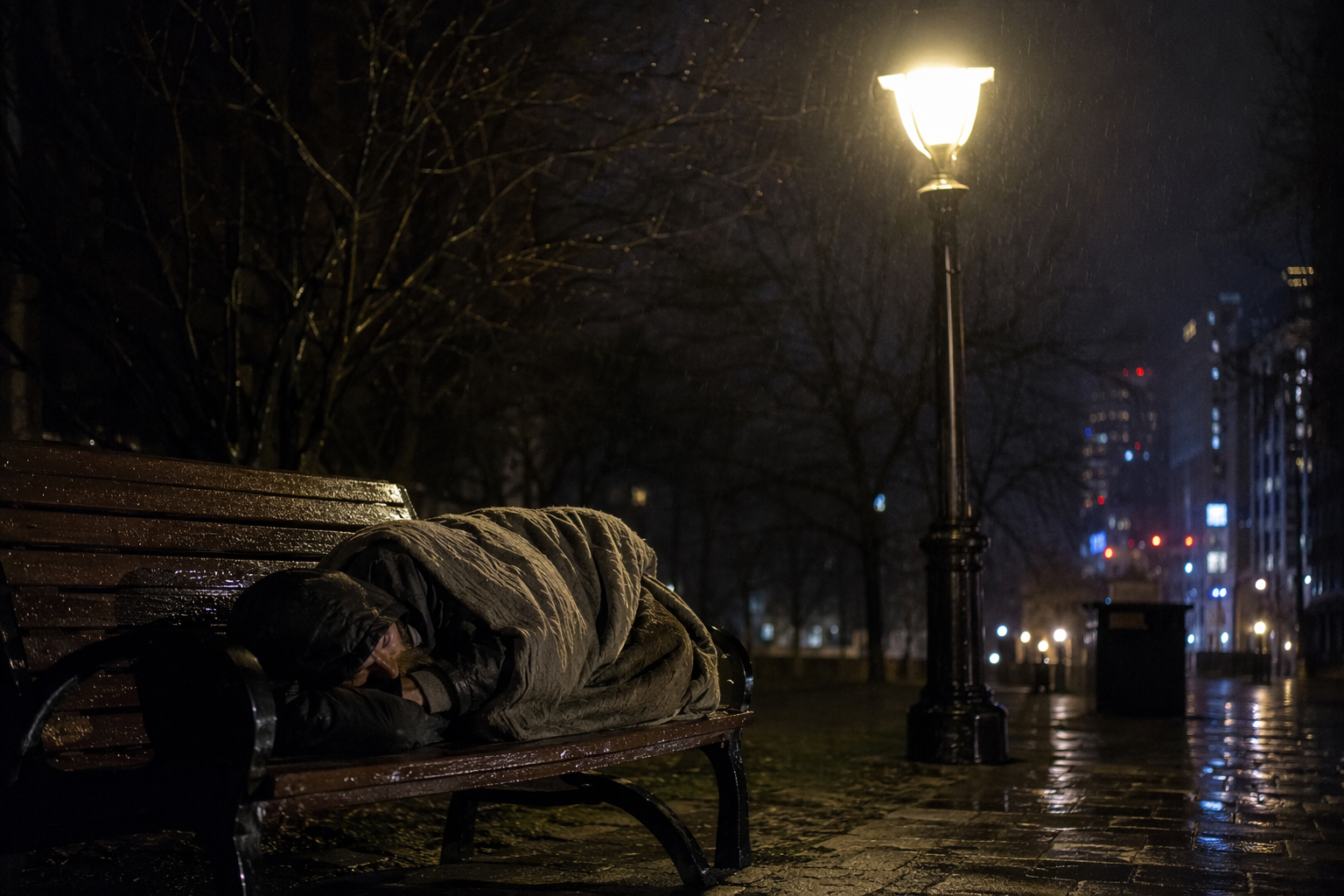
In a Denver study of 484 adults experiencing homelessness, average sleep was 3.6 hours per 24-hour period, and only 2.87 hours were uninterrupted [1]. That is not a mild deficit. It is sleep broken into fragments before the night is even over.
| Study | What was measured | What it showed |
|---|---|---|
| Denver ecological study [1] | N=484; sleep quantity and continuity | 3.6 hours total sleep, 2.87 uninterrupted hours |
| Sheltered vs. unsheltered TAY study [2] | n=103; sleep disturbance, safety, food insecurity | Perceived safety predicted disturbance more strongly than sheltered status; severe food insecurity was associated with about a 0.5 SD increase in disturbance |
| Scoping review [3] | 101 studies on sleep in homelessness | Safety/security, weather, comfort, and privacy were the most common barriers; no CBT-I or brief behavioral treatment trials were found |
| HOPE HOME study [4] | Homeless-experienced older adults | 67.2% had clinically poor sleep quality; disturbance persisted after housing |
| Homeless adult sample [5] | n=32; self-reported sleep duration | 75% slept less than the recommended 7 to 9 hours, and the authors described sleep deprivation as a barrier to obtaining housing |
Safety comes before sleep hygiene
The strongest predictor in the Redline study was not a housing label but whether the sleep environment felt safe. Once perceived safety was in the model, sheltered status was no longer significantly associated with disturbance [2]. Severe food insecurity was also associated with about a 0.5 SD increase in sleep disturbance scores [2]. That is the part public advice usually skips: the body does not relax on command in a place it reads as risky.
A shelter bed can still be noisy, exposed, monitored, and unpredictable. An unsheltered person can sometimes find a corner that feels marginally less threatening. The category matters less than the actual threat level, because sleep is a permission state as much as it is a biological one.
What the environment keeps interrupting
- Safety and security were cited in 75.5% of studies in the scoping review [3].
- Weather exposure appeared in 63.3% [3].
- Lack of comfort appeared in 57.1% [3].
- Lack of privacy appeared in 51.0% [3].
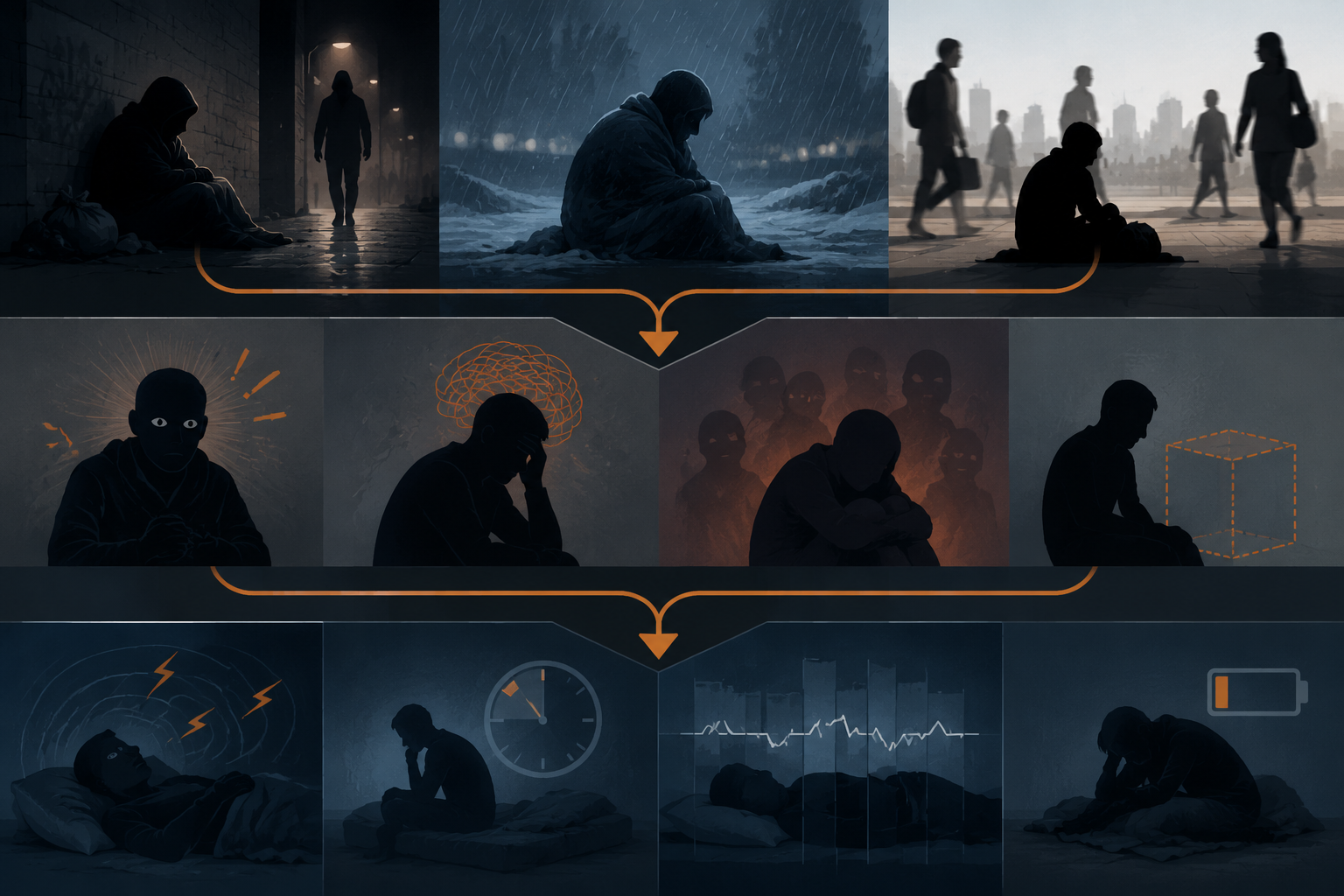
Those are not four different flavors of inconvenience. They are four ways sleep gets permission to happen, or not happen. Safety keeps the nervous system on watch. Weather keeps the body negotiating cold, dampness, and heat. Comfort and privacy determine whether a person can settle down without constant adjustment or exposure.
The same review also shows how thin the literature still is: only 2 of 101 studies used objective actigraphy, only 34% had sleep as a core objective, 56 of the studies came from the United States, and none examined CBT-I or brief behavioral treatment for insomnia in homeless populations [3].
That is why sleep hygiene advice lands so poorly here. Dark room, fixed bedtime, cooler temperature, fewer interruptions: those are instructions for someone who can control the room.
The damage moves inward
Environmental threat is only the first layer. Sleep also gets pulled apart by hunger, pain, and mental load. Redline found that severe food insecurity tracked with worse disturbance [2], and pain is widely reported as a sleep disruptor in homeless populations. In the HOPE HOME study of homeless-experienced older adults, 67.2% scored at or above the PSQI threshold for clinically poor sleep quality [4].
Sleep does not immediately reset when housing appears. In that same study, 28% of formerly homeless adults in supportive housing still had moderate to severe disturbance, compared with 20% of adults who had never been homeless [4]. Housing helps, but it does not erase the consequences of prolonged vigilance, pain, and disrupted routines overnight.
The sleep loss can also become part of the housing problem. In a smaller study of 32 homeless adults, 75% reported sleeping less than the recommended 7 to 9 hours per night, and the authors described sleep deprivation as a barrier to obtaining housing [5]. When people are exhausted, interviews, paperwork, transport, and daily persistence all get harder.
Homelessness affects sleep quality through interacting environmental, psychological, and physiological mechanisms, and conventional sleep advice is mostly beside the point unless the conditions of sleep become safer, warmer, quieter, and more private. The intervention literature remains nearly empty: the field has documented the damage more thoroughly than it has tested ways to repair it [3].
References
- Sleep quality and quantity among adults experiencing homelessness: An ecological systems approach - Taylor & Francis, 2022
- Examining sleep disturbance among sheltered and unsheltered TAY - PMC, 2021
- Sleep Health in People Experiencing Homelessness: A Scoping Review - Wiley, 2025
- Sleep quality among homeless-experienced older adults - Springer, 2023
- Sleep deprivation in an American homeless population - PubMed, 2020

Comments
Join the discussion with an anonymous comment.