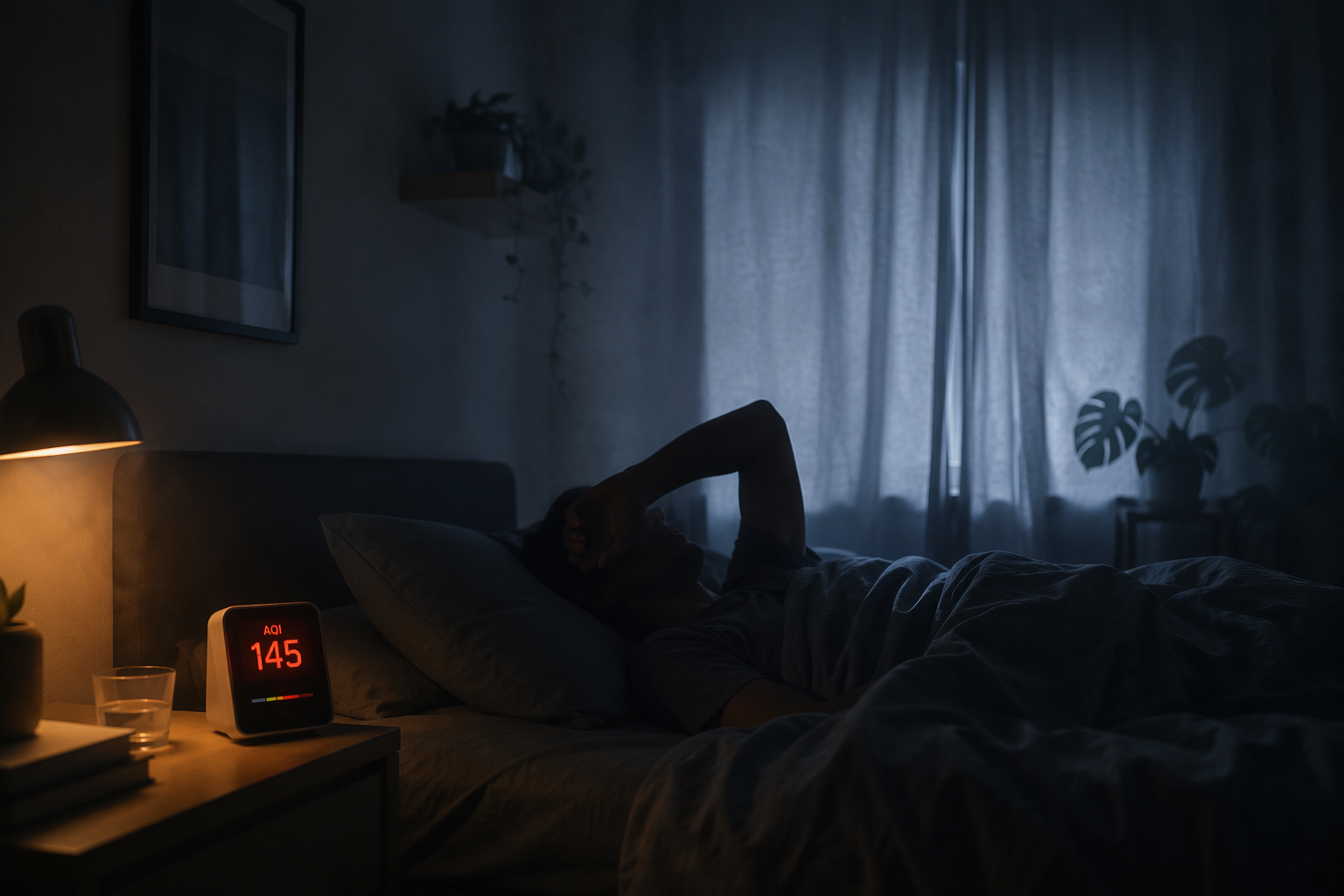
If your sleep falls apart every hurricane season even when you keep a regular bedtime, limit alcohol, cool the bedroom, and avoid late caffeine, the problem may not be your discipline. Sleep quality during tropical disturbances is different from ordinary bad sleep because the disturbance does not have to become a named storm before it starts changing the night around you.
A tropical disturbance is an organized area of convection, often 100 to 300 miles across, that lasts at least 24 hours and is distinct from a tropical depression, tropical storm, or hurricane.[1][2] For sleep, that matters because the trouble can begin before landfall talk becomes urgent: pressure shifts, forecast-checking, household noise, emergency lighting, generator plans, evacuation uncertainty, and CPAP power questions can all arrive before the storm has a name.
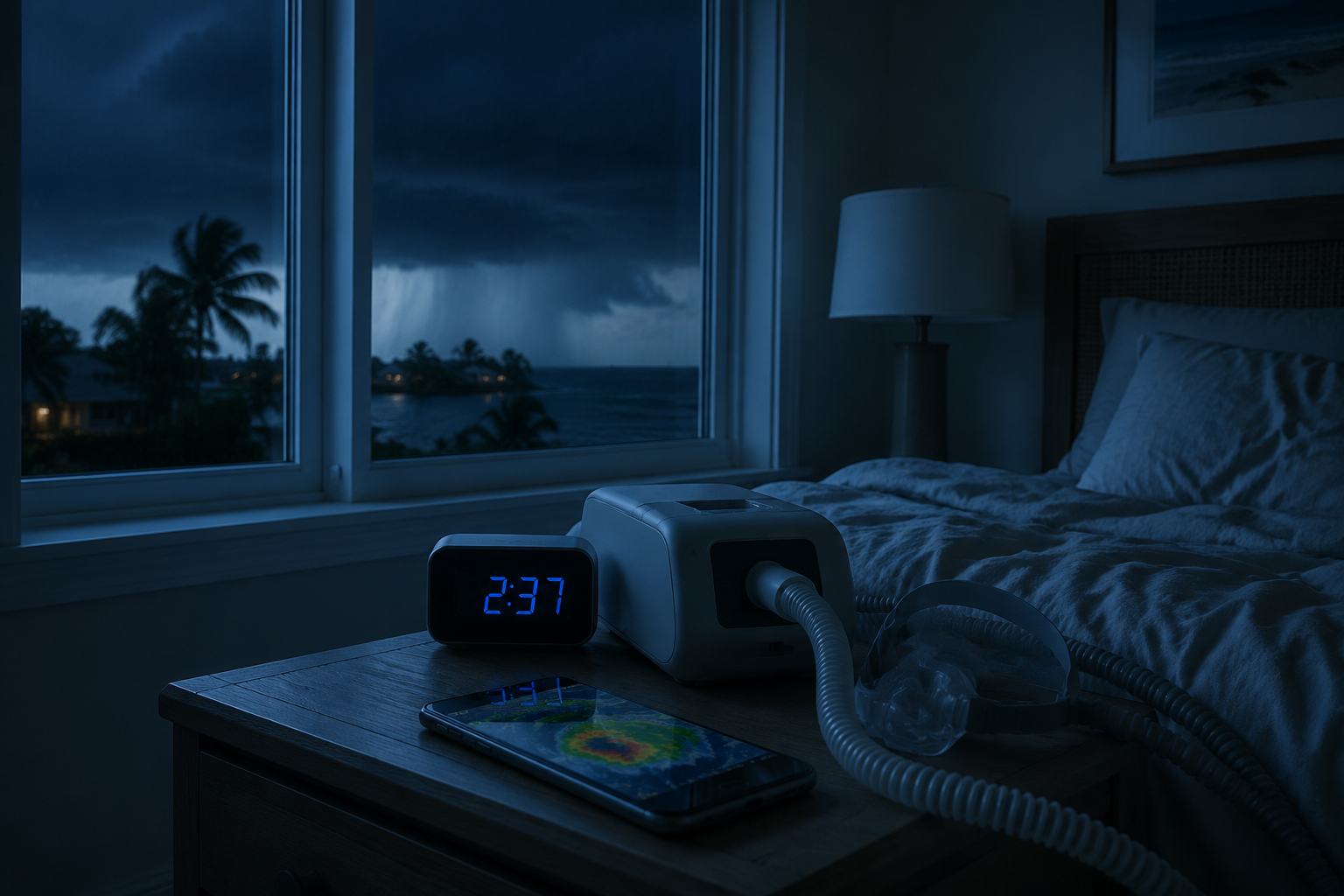
That is why the usual sleep-hygiene script can feel insulting in July, August, September, or any other storm-heavy stretch. It addresses controllable habits inside a stable bedroom. Tropical weather can remove the stable bedroom.
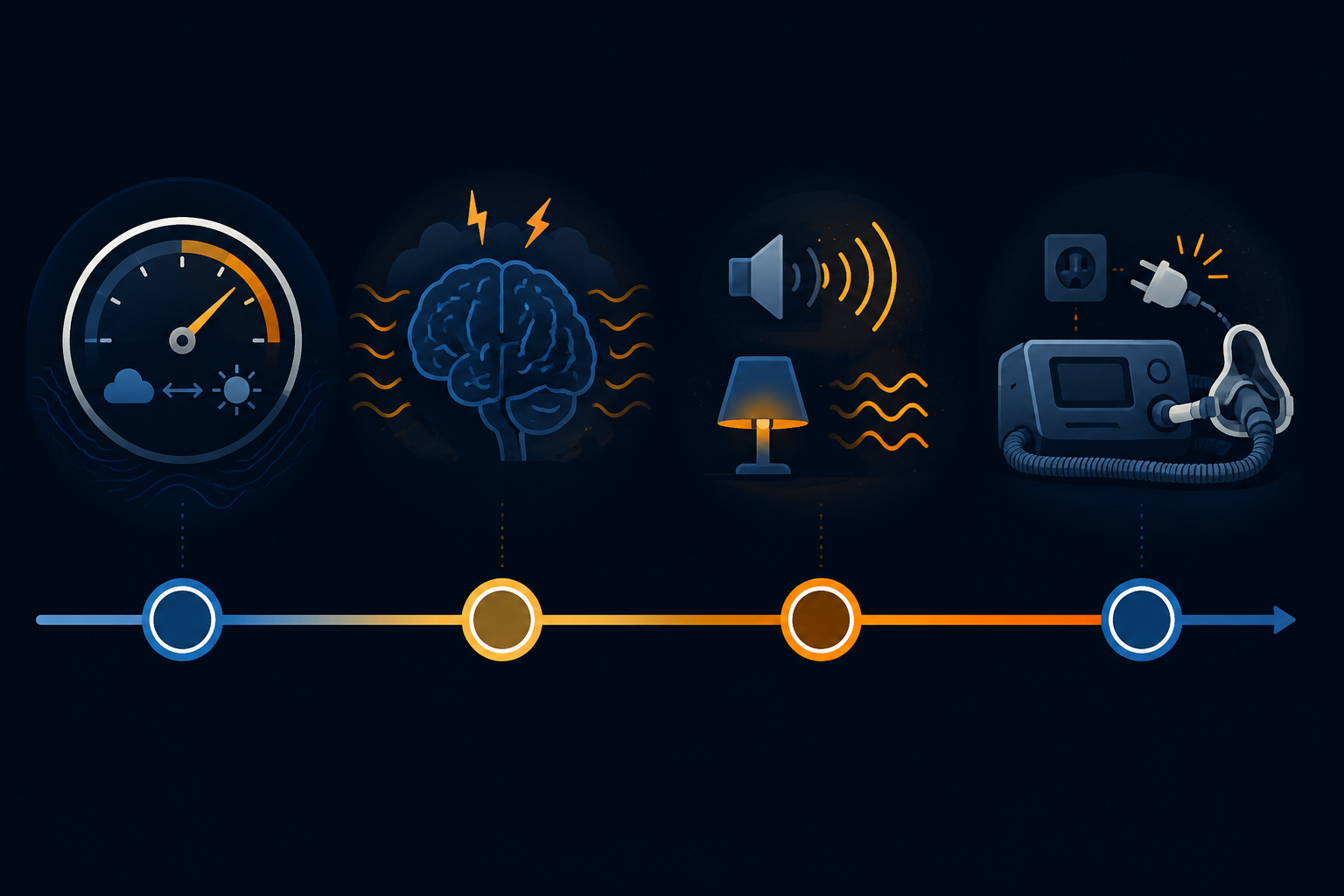
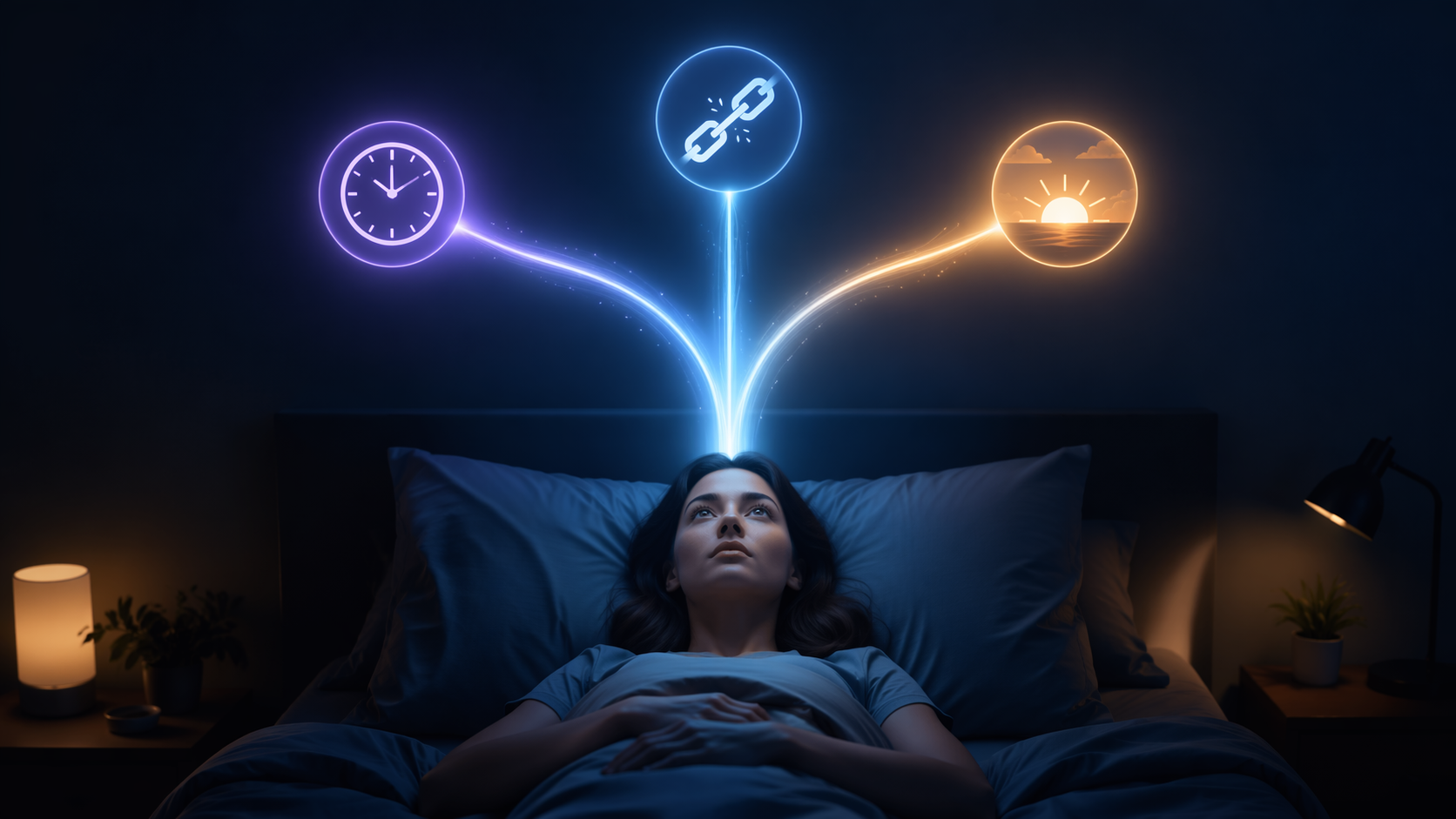
Four Disruptions Can Arrive on Different Clocks
The practical mistake is treating storm-season sleep as one problem. It is usually several problems that overlap. A person with obstructive sleep apnea may be dealing with airway instability before the lights go out, then treatment interruption after the power fails. A person with insomnia may start losing sleep days before the rain bands arrive. A circadian-sensitive sleeper may manage bedtime well until watches, warnings, shelter decisions, and overnight alerts scramble light exposure and timing.
| Disruptor | When it may show up | What ordinary sleep hygiene misses |
|---|---|---|
| Barometric pressure changes | Before and during the weather system | The bedroom can be quiet and dark while breathing events still worsen. |
| Anticipatory anxiety | Days before expected impact | The body may be responding to threat appraisal, not poor bedtime habits. |
| Noise, light, and schedule disruption | During watches, warnings, sheltering, or evacuation | The sleep environment may no longer be under normal control. |
| CPAP or PAP power loss | During and after outages or displacement | Treatment can stop for days unless backup power and supplies are ready. |
The useful plan does not ask one bedtime routine to solve all four. It assigns each risk to the part of the season where action is still possible.
Pressure Changes Are Not Just a Mood Story
People with sleep-disordered breathing sometimes describe feeling worse before the storm is obvious outside. That should not be waved away as imagination, but it also should not be oversold. The best available evidence here is adjacent, not tropical-cyclone-specific.
In a Journal of Clinical Sleep Medicine study, Doherty and colleagues examined whether weather-related atmospheric-pressure changes influenced sleep-disordered breathing. They found that for every 1-millibar drop in nightly minimum atmospheric pressure, the obstructive apnea index increased by 0.3 events per hour. Nights in the lowest-pressure quartile averaged 23.9 obstructive events per hour compared with 17.1 events per hour in the highest-pressure quartile.[3]
That is a meaningful signal, especially for someone already living near a treatment threshold. It does not prove that every tropical disturbance will worsen apnea. The study was conducted at 200 feet elevation in Seattle, not in a Gulf Coast, Atlantic Seaboard, Caribbean, or Hawaii tropical-cyclone setting, and the pressure patterns were not the same as a tropical system.[3] The careful conclusion is narrower: pressure drops may be one reason some people with obstructive sleep apnea feel their sleep quality degrade before the more visible disruption begins.
The countermeasure is not to panic-watch the barometer. It is to tighten the parts of apnea care that are already supposed to be boring: use PAP consistently before the weather deteriorates, avoid sedating alcohol when the forecast is active, sleep in the position your clinician recommends, and make sure masks, tubing, filters, humidifier water, and power plans are not being solved at midnight.
Anxiety Can Start Before the First Feeder Band
Storm anxiety does not always wait for dangerous weather. Forecast cones, school closure rumors, grocery runs, insurance memories, and evacuation questions can begin pulling sleep apart days ahead of impact. That is not automatically a disorder. It is a nervous system trying to make decisions under uncertainty.
Sleep-reactivity research gives a useful way to understand why some people are hit harder than others. Kalmbach and colleagues describe high sleep reactivity as a vulnerability in which stress is more likely to trigger insomnia and circadian disruption. People with high FIRST scores, estimated at about 15% to 30% of the population, show roughly twice the risk of developing insomnia under stress.[4] Weather threat was not the specific trigger validated in that framework, so the application to tropical systems is an inference. It is still a practical one for anyone who reliably stops sleeping when the forecast turns serious.
Clinical guidance from Baylor College of Medicine describes pre-storm anxiety as including sleep changes, irritability, and concentration problems before storms arrive.[5] Nashville Psych frames storm reactions on a spectrum: normal stress, anticipatory anxiety where sleep disruption can begin days before, phobia, and trauma or PTSD.[6] That spectrum matters because it protects two truths at once. Strong weather reactions are not something to mock, and not every sleepless night before a storm needs a diagnosis.
For the watch period, the sleep plan should reduce decision loops. Decide in advance which forecast sources count, when you will check them, who in the household makes evacuation calls, where medications and PAP supplies go, and what time storm tasks stop unless a warning changes. The goal is not to suppress concern. The goal is to keep concern from becoming an all-night shift.
The Bedroom May Stop Being a Controlled Environment
A good sleeper can sometimes absorb one bad night. People with insomnia, sleep apnea, hypersomnia, restless sleep, or circadian rhythm disorders often do not get that luxury. During an active disturbance, the bedroom may include phone alerts, wind, rain, sump pumps, family movement, pets, emergency radios, generator vibration, flashlights, hallway lights, or the decision to sleep somewhere less exposed.
This is where ordinary advice such as “keep the room dark and quiet” becomes directionally correct but operationally thin. A better storm-season version is specific: keep earplugs or noise-reducing headphones where you can reach them, set emergency alerts to come through without leaving every app notification active, use a small red or amber light for necessary overnight movement, and identify the safest sleeping location before fatigue makes the decision sloppy.
Circadian timing deserves special protection. If you evacuate, shelter with relatives, or move to an interior room, anchor the next morning with light exposure as soon as it is safe. Keep medication timing consistent unless a clinician has told you otherwise. If the night is broken, avoid turning the next day into an accidental full reset with a long late nap unless safety demands it.
CPAP Power Loss Is a Treatment Interruption, Not an Inconvenience
For PAP users, the most concrete hurricane-season sleep risk is not vague discomfort. It is losing therapy.
After Hurricane Irma, nearly 80% of PAP users in a University of Miami report lost therapy for an average of 4.3 days. Snoring returned for 64% of users, 42% reported daytime sleepiness, and therapy did not return to pre-storm levels until after more than 7 days.[7] Those numbers are hard to reconcile with casual advice to “get rest when you can.” Untreated sleep apnea can come back quickly when the machine stops.
This evidence is about named-hurricane disruption, especially power loss and displacement, not about barometric pressure. That distinction matters. Pressure may contribute to worse breathing before or during a system; power loss can remove treatment altogether after infrastructure fails. A seasonal plan has to cover both.
The PAP checklist belongs in pre-season, not in the final grocery run. Confirm your machine’s power requirements, battery compatibility, expected runtime, charging method, extension-cord safety, and whether your humidifier should be turned off to conserve power. Keep a travel-ready bag with mask, hose, filters, distilled water if needed, cleaning supplies, prescription documentation, and a copy of settings if your clinician provides them. For a deeper CPAP-specific preparation plan, see why hurricane preparedness is critical for your sleep with CPAP.
Build the Plan by Season, Not by Symptom
A storm-season sleep plan works best when it is arranged around the moments when choices are still available. Waiting until the forecast cone tightens leaves too many decisions competing with fatigue.
| Season moment | Main sleep task | What to prepare |
|---|---|---|
| Pre-season | Prevent predictable treatment failures | PAP backup power, spare supplies, medication refills, evacuation sleep kit, alert settings, clinician questions |
| Watch period | Reduce anticipatory sleep loss | Forecast-check schedule, task cutoff time, evacuation decision rules, calming routine that does not depend on denial |
| Active disturbance | Protect safety and minimize environmental disruption | Safe sleep location, light control, noise control, essential alerts only, PAP battery conservation |
| Post-disturbance | Restart treatment and stabilize timing | PAP use tracking, morning light, limited recovery naps, replacement supplies, clinical follow-up if symptoms persist |
Pre-season: make the fragile parts visible
Before the season is active, write down what would break your sleep first. For one person, it is PAP power. For another, it is the first serious model run. For someone with a circadian rhythm disorder, it may be evacuation to a bright, noisy house where meals, light, and wake time are all different.
- List your nonnegotiables: PAP machine, medications, oral appliance, positional aids, earplugs, eye mask, chargers, and written settings or prescriptions.
- Test backup power on an ordinary night rather than discovering battery limits during an outage.
- Decide where you would sleep if your usual bedroom becomes unsafe, too loud, too hot, or too exposed.
- Ask your sleep clinician what symptoms should trigger follow-up after several disrupted nights.
Watch period: stop the forecast from becoming bedtime
When a disturbance is being watched, information is useful until it becomes repetitive arousal. Pick a small number of trusted sources and a final planned check before bed unless official warnings require attention. Put the next practical action on paper: fill the tank, charge the battery, pack the PAP bag, move outdoor items, call the relative. A written list is not glamorous, but it gets the task out of the bed.
If storm anxiety is severe, narrowing the forecast routine may not be enough. Persistent inability to sleep, panic symptoms, intrusive memories from prior storms, or avoidance that interferes with safety planning are reasons to involve a mental-health professional. Post-storm insomnia can last days to weeks, according to the Anxiety and Depression Association of America, so escalation does not have to wait until the season is over.[8]
Active disturbance: keep safety first, then protect the sleep you can
During the event itself, sleep quality is secondary to physical safety. Still, some choices reduce the damage. Use the safest available sleeping area, keep only essential alerts active, dim necessary lights, and use noise control if it does not interfere with hearing emergency information. PAP users running on battery may need to conserve power by disabling nonessential comfort features if their clinician or equipment guidance allows it.
Post-disturbance: restart treatment before the week disappears
The recovery period is where sleep debt becomes cumulative. The storm passes, but power may still be out, the house may be hot, school and work may be irregular, and PAP use may not automatically resume. The Irma findings are a warning here: treatment recovery lagged beyond the immediate event.[7]
As soon as conditions allow, return to PAP or prescribed therapy, re-anchor wake time, get morning light safely, and keep naps short enough that they do not push the next night later. If snoring, witnessed apneas, morning headaches, daytime sleepiness, or insomnia remain worse than usual after the disruption resolves, that is not a character flaw. It is follow-up material.
What the Evidence Can and Cannot Say
There is no single study proving that a NOAA-defined tropical disturbance directly lowers sleep quality in diagnosed sleep-disorder patients. The case for preparation is assembled from nearby evidence: atmospheric pressure and sleep-disordered breathing, stress reactivity and insomnia vulnerability, clinical storm-anxiety guidance, and post-hurricane PAP interruption.
Broad climate-and-sleep claims should stay in the background. A 2018 systematic review on climate change and sleep included 16 studies, with 7 addressing extreme weather, and concluded that the evidence base was limited and needed further research.[9] That is enough to justify attention, not enough to turn every storm-season sleep problem into a climate conclusion.
The more defensible point is also the more useful one: a coastal sleeper with OSA, insomnia, or circadian vulnerability is exposed to repeated, partly predictable disruption across the season. Generic sleep hygiene still helps, but it cannot charge a battery, quiet a generator, interpret a forecast, restart PAP therapy, or decide when anxiety needs care. Sleep improves when the plan is built before the night gets complicated.
References
- Tropical Definitions. National Weather Service.
- NHC Glossary. National Hurricane Center.
- Do Weather-Related Ambient Atmospheric-Pressure Changes Influence Sleep Disordered Breathing?. Journal of Clinical Sleep Medicine. 2010.
- The Impact of Stress on Sleep: Pathogenic Sleep Reactivity as a Vulnerability to Insomnia and Circadian Disorders. 2018.
- Navigating Pre-Storm Anxiety. Baylor College of Medicine.
- Understanding Storm Stress, Anxiety, & Trauma. Nashville Psych.
- Hurricanes Likely to Disrupt At-Home Obstructive Sleep Apnea Treatment. University of Miami.
- Severe Storms: How to Reduce Your Anxiety. Anxiety and Depression Association of America.
- Climate Change and Sleep: A Systematic Review. ScienceDirect. 2018.
Comments
Join the discussion with an anonymous comment.