
Trying to sleep after an earthquake can feel wrong in a very specific way: sleep means taking your hands off the controls. The room is dark, the house is quiet, and your brain keeps asking whether the next jolt will come while you are barefoot, half-awake, and trying to find your glasses.
That reaction is not weakness, and it is not “just stress.” After the 2010 Haiti earthquake, an American Academy of Sleep Medicine report found that 94% of surveyed survivors reported insomnia symptoms, and 42% had clinically significant PTSD symptoms two years later.[1] Your nervous system is doing something understandable: it is trying to keep watch after a real physical threat.
The way back to sleep is usually not to argue yourself into calm. Start by making the sleeping area safer, then give your body a repeatable way to come down from alarm. Relaxation works better when the part of you scanning the room can see that the room has actually changed.
First, Make the Bedroom Less Chaotic in an Aftershock
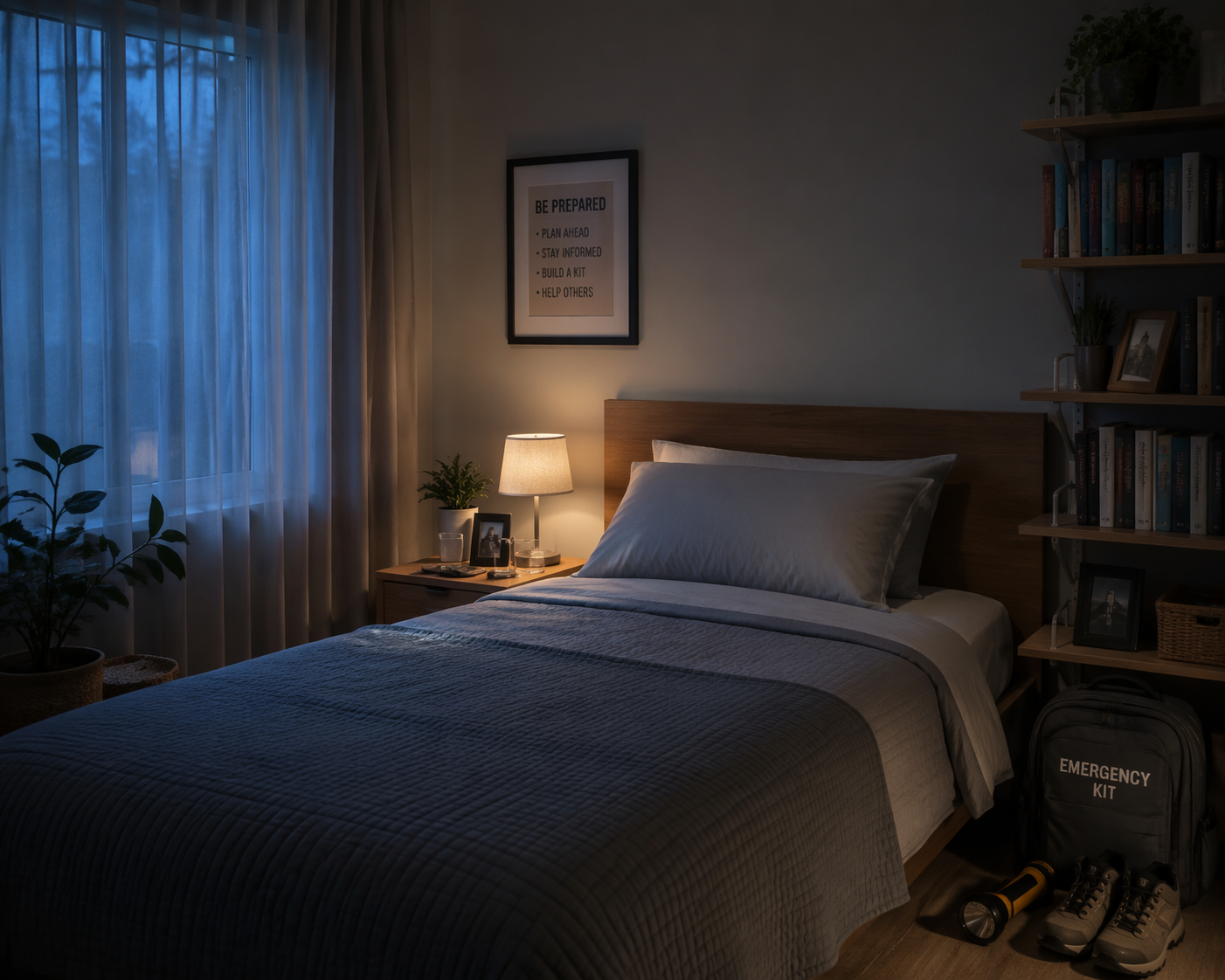
Before breathing exercises, check the room. Not the whole house tonight. The sleeping area. The goal is not to create a perfect emergency plan at midnight; it is to remove the obvious reasons your brain refuses to stand down.
Start with the things that could fall, block you, or leave you unable to move safely in the dark. The Red Cross recommends keeping sturdy shoes, a flashlight, a whistle, and glasses by the bed as part of earthquake preparedness.[2] The CDC also advises securing heavy furniture and clearing pathways so people are less likely to be injured or trapped by falling objects during an earthquake.[3]
- Move framed glass, shelves, plants, mirrors, and heavy decor away from the wall above the bed.
- Anchor tall furniture, especially bookcases, wardrobes, and dressers that could tip toward the bed or doorway.
- Keep the floor route from bed to door clear of laundry baskets, cords, shoes, and storage bins.
- Put sturdy shoes where you can reach them without standing on broken glass.
- Place a flashlight, whistle, glasses or contacts, and any essential nighttime medical item in the same bedside spot every night.
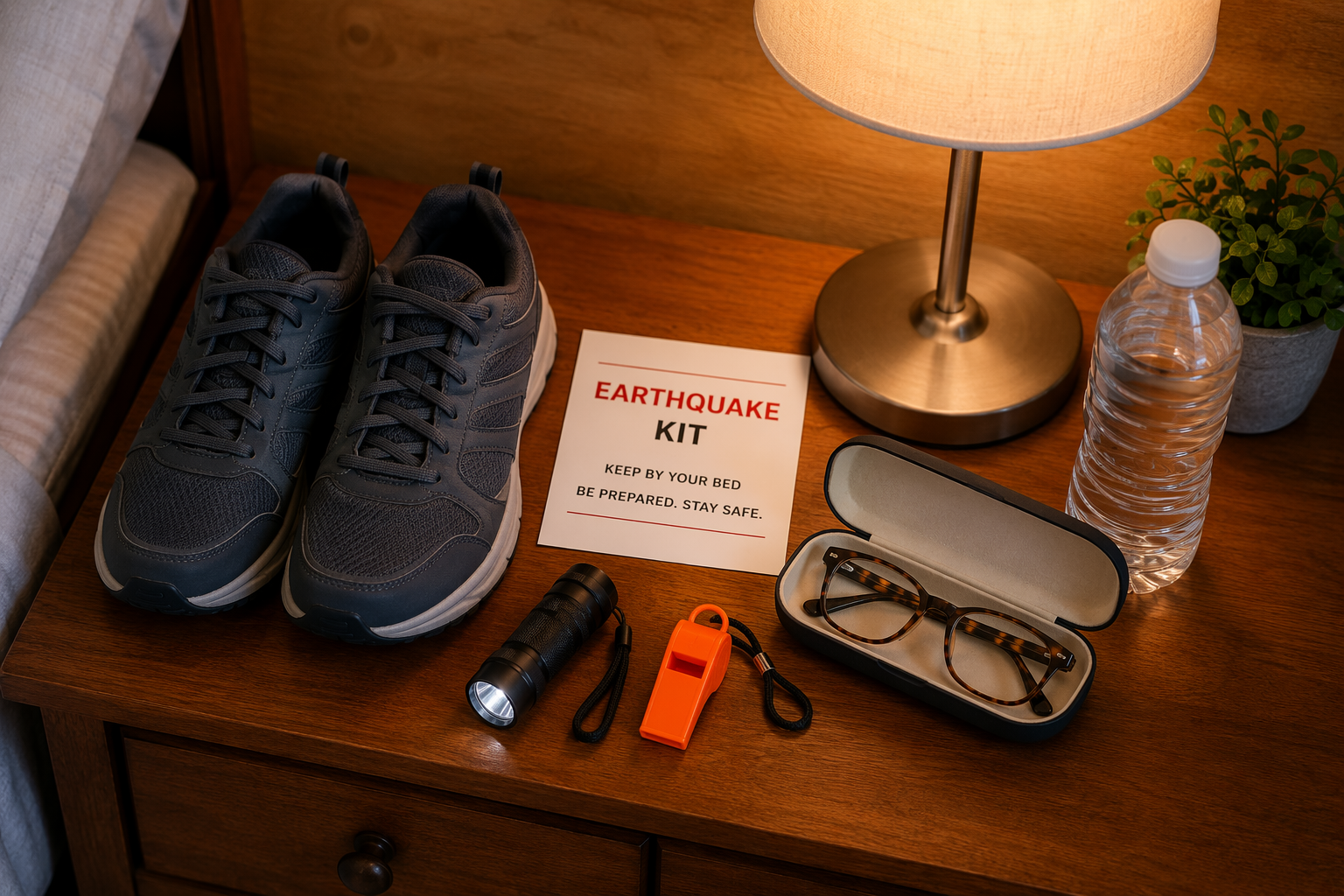
This is not disaster theater. A bedside kit answers the most immediate nighttime fear: “If I have to move, can I protect my feet, see, signal, and function?” Once those answers are visible, the bed stops feeling quite so much like a trap.
Know the Nighttime Move Before You Need It
If shaking starts while you are in bed, the Earthquake Country Alliance recommends staying in bed, lying face down, and covering your head and neck with a pillow.[4] That may feel counterintuitive if your first instinct is to run, but the point is to avoid being thrown, stepping into broken glass, or moving through the room while objects are falling.
Rehearse it once while awake: roll face down, pull the pillow over the back of your head and neck, keep your body low, and wait for the shaking to stop. You do not need to dramatize it. You are giving your half-asleep brain a script.
| Before bed | Why it helps sleep |
|---|---|
| Shoes, flashlight, whistle, and glasses stay within arm's reach | Reduces the fear of being helpless in the dark |
| Heavy furniture is anchored or moved away from the bed | Removes obvious falling hazards from the sleep space |
| Exit path is clear | Stops the brain from rehearsing obstacles all night |
| Nighttime response is rehearsed once | Turns panic into a known sequence: stay in bed, cover head and neck, wait |
There is also some evidence, though informal, that preparedness itself can reduce anxiety. The Utah Earthquake Center reported that in a Twitter poll, 65% of respondents said taking preparedness actions reduced their earthquake anxiety; that is not clinical proof, but it matches what many people notice after they stop relying on reassurance alone.[5]
Why Your Body Still Acts Like the Quake Is Happening
After an earthquake, the body often keeps listening. A truck passes and the mattress seems to shift. The refrigerator hum starts to sound like a warning. You replay the first seconds of shaking because those were the seconds when your brain had to decide what mattered.
That watchfulness can be especially strong at night. Darkness removes visual confirmation. Quiet makes small sounds louder. Lying still gives the body more room to notice internal sensations: heartbeat, muscle tension, a brief floating feeling, the bed settling. If you are also experiencing a rocking or swaying sensation after the quake, that may overlap with a different post-earthquake sleep problem; see Earthquake Near Me? Why You Can't Sleep and What Works for that sensation-focused pattern.
Research on adolescents after earthquakes points in the same direction, though it should not be stretched too far. A 2025 Scientific Reports study of 12- to 18-year-olds found that high earthquake anxiety was associated with much higher odds of poor sleep quality, with an odds ratio of 5.721.[6] Because the sample was adolescents, it does not prove the same number applies to adults. It does support the basic clinical sense that earthquake fear and poor sleep can travel together.
The practical consequence is simple: you may not be able to think your way into sleep while your body is still assigned to night watch. You need a physical safety answer and a physiological downshift.
Use a Downshift Routine After the Safety Pass
Once the room is handled for tonight, stop checking it. Rechecking the same shelf, doorway, and flashlight can keep the alarm loop alive. Instead, move into a short routine that tells the body the scan is complete.
- Do one final safety scan: bedside kit, shoes, clear path, no obvious overhead hazard.
- Turn lights low rather than bright; you are ending the check, not starting a project.
- Use slow breathing for several minutes.
- If your mind starts replaying the quake, label it as replaying, then return attention to the breath or the mattress under you.
- If you are still wide awake after about 20 minutes, leave the bed briefly and reset in low light.
One breathing pattern is the 5-4-7 style described by psychiatrist Gail Saltz: inhale for five counts, hold briefly, and exhale for seven counts, with the longer exhale intended to engage the parasympathetic nervous system.[7] Treat it as a body cue, not a test. If counting makes you more tense, use the simpler rule: make the exhale longer than the inhale.
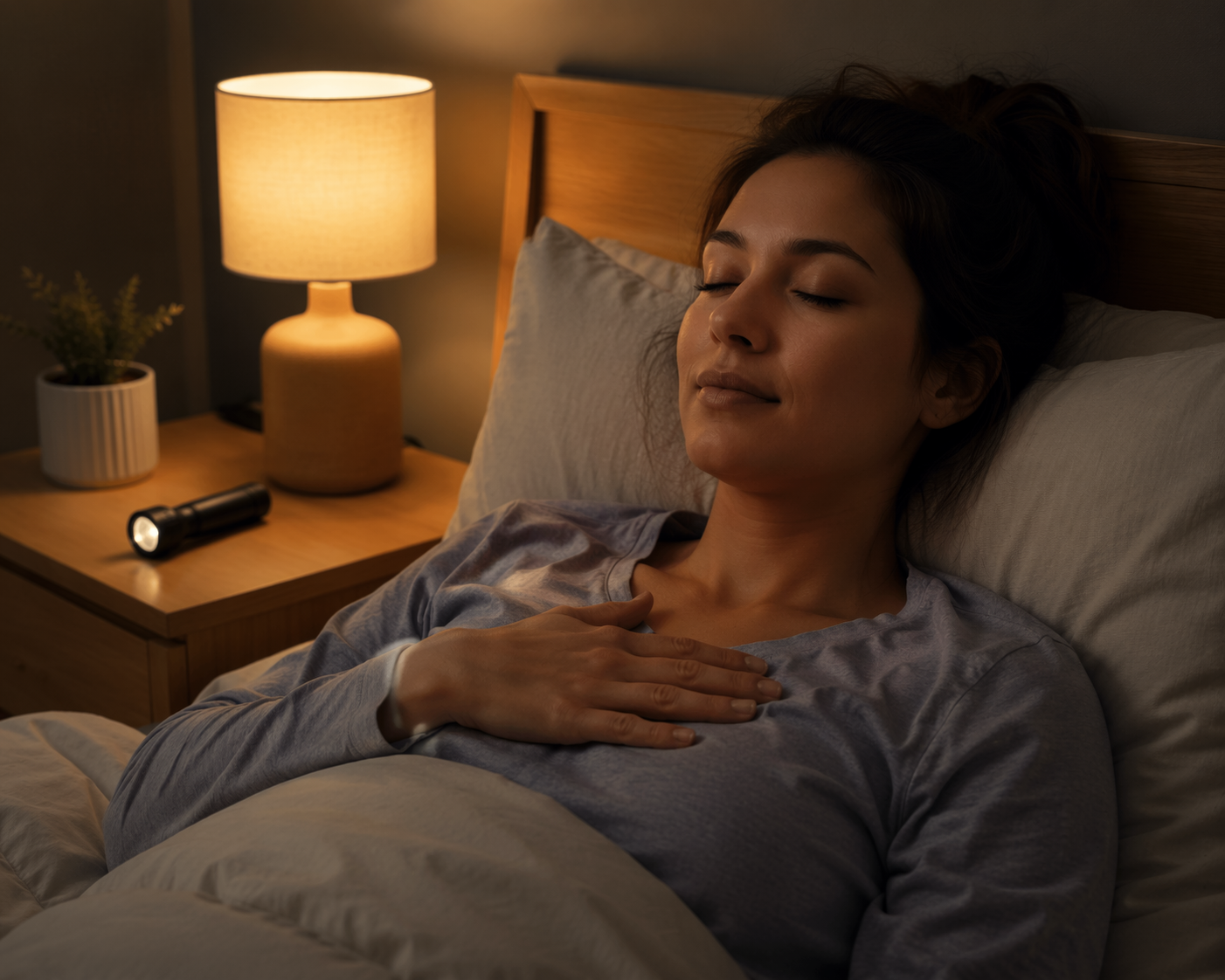
A useful version looks like this: breathe in gently, pause only if that feels comfortable, then breathe out slowly as if you are fogging a mirror without making sound. Let the shoulders drop on the exhale. Repeat long enough for the body to notice the pattern, not just the idea.
When the Bed Starts Feeling Like the Place You Fail to Sleep
If you cannot fall asleep or fall back asleep after about 20 minutes, Harvard Health recommends getting out of bed and doing something calming in low light until you feel sleepy again.[8] This is not punishment, and it is not giving up. It protects the bed from becoming the place where your brain practices earthquake fear for hours.
Keep the reset boring: sit in a chair, read something undemanding, listen to quiet audio, or sip water. Do not open earthquake maps, social feeds, damage videos, or local alert threads unless there is an actual emergency notification you need to respond to. If your phone is part of your alert system, put it where you can hear it and stop using it as a scanning device.
For a fuller middle-of-the-night plan, the same principle is covered in What to Do When You Wake Up at 3 a.m. and Can't Sleep. If your main problem is a racing mind rather than the room itself, Why You Can't Sleep at Night and How to Stop a Racing Mind goes deeper into that pattern.
Keep General Sleep Hygiene Small and Useful
After an earthquake, standard sleep hygiene still matters, but it should not be the whole answer. A consistent wake time, less caffeine late in the day, dimmer light before bed, and a cooler bedroom can help. They just do not answer the specific fear of being asleep when the room moves.
Use the basics as support: keep the same wake time if you can, avoid turning the evening into an aftershock news shift, and give yourself a wind-down period that is not also a structural inspection. If you want the broader routine without the earthquake-specific layer, see Sleep Hygiene Fundamentals.
What you want to avoid is using “good sleep habits” as a way to scold yourself. If the bed is under a glass frame, if your shoes are across the room, or if your only plan is to run in the dark, your body is not being irrational when it resists sleep.
What to Do Tonight, Tomorrow, and Next Week
Tonight, keep the task narrow. Make the area around the bed safer, place the kit, rehearse the stay-in-bed response once, then switch to the downshift routine. Do not try to solve every cabinet, window, and emergency supply question before sleep. That can wait for daylight.
Tomorrow, choose one preparedness task that is visible from the bedroom: anchor the bookcase, move the mirror, replace dead flashlight batteries, or clear the path to the door. The Utah Earthquake Center describes a “Facts + Action + Time” approach to disaster anxiety: get accurate information, take a useful action, and give the plan a time boundary so worry does not expand to fill the whole day.[5]
Next week, finish the larger preparedness list during daylight hours. That is when it makes sense to think about water, supplies, family communication, and furniture in the rest of the home. Night is for the sleep plan, not for turning every aftershock possibility into a new project.
When Self-Help Is Not Enough
Some post-earthquake sleep disruption settles as aftershocks fade and the room feels safer. Get more help if insomnia persists, escalates, or comes with trauma symptoms such as intrusive memories, panic, avoidance of normal activities, feeling constantly on guard, or being unable to sleep in your home even after immediate hazards are addressed.
UCI Health has identified cognitive behavioral therapy as a recommended treatment for persistent post-earthquake anxiety.[9] For chronic insomnia, the American Academy of Sleep Medicine recommends CBT-I as first-line treatment.[10] If you are reaching that line, Sleep Anxiety Before Bed? CBT-I Is the Proven Treatment and What to Do When Anxiety Keeps You Up at Night can help you understand what structured care looks like.
The line is not whether you “should be over it.” The line is whether your life is getting smaller, your sleep is not recovering, or your body keeps responding as if the earthquake is still in progress. Post-trauma insomnia after other sudden threats can work in similar ways; Car accident stress causes insomnia explains the same hyperarousal pattern after a different event.
For now, give fear two answers. The physical answer: the room is safer, the kit is reachable, and the nighttime move is known. The physiological answer: the lights are low, the breath is slow, and if sleep does not come, you know how to reset without feeding the alarm. That is a realistic plan for tonight, and a workable one for the week ahead.
References
- Sleep Disturbances After the 2010 Haiti Earthquake, American Academy of Sleep Medicine.
- Earthquake Safety, American Red Cross.
- Earthquakes and Natural Disasters, Centers for Disease Control and Prevention.
- If You Are in Bed: Stay There and Cover Your Head and Neck with a Pillow, Earthquake Country Alliance.
- Managing Earthquake Anxiety, University of Utah Seismograph Stations.
- The relationship between earthquake anxiety and sleep quality in adolescents, Scientific Reports, 2025.
- How to calm anxiety after an earthquake, CNN.
- Insomnia: Restoring restful sleep, Harvard Health Publishing.
- Coping with earthquake anxiety, UCI Health.
- Clinical Practice Guideline for the Behavioral and Psychological Treatments for Chronic Insomnia Disorder in Adults, American Academy of Sleep Medicine.


Comments
Join the discussion with an anonymous comment.