
The useful answer to how to sleep during a tornado warning is not “be brave” and it is not “stay awake all night.” If a warning is already active for your location, you should not be asleep in a regular bedroom hoping you will hear something. You should be in your shelter location, or as close to it as your housing allows, with your alerts still on. If there is a tornado watch or an overnight severe-weather setup, sleep becomes reasonable only after the work has been moved out of the 2 a.m. moment: alerts set, shelter chosen, shoes and flashlight reachable, and no debate left about what happens when an alarm sounds.
The fear behind that question is not silly. Recent research summarized by The Weather Channel reports that nocturnal tornadoes are about twice as likely to be fatal as daytime tornadoes, and that 38% of tornado deaths now occur at night.[1] Older research from 1950 to 2005 found that 27.3% of tornadoes occurred at night but accounted for 39.3% of fatalities and 42.1% of killer tornado events.[1] Sleep is part of the risk because people are indoors, disconnected from visual cues, and slower to receive or act on warnings.
That does not make the night hopeless. The National Weather Service says 97% of EF3 to EF5 tornadoes receive a warning, with an average lead time of about 16 minutes.[2] That number is not a personal guarantee, and it does not make a mobile home safe. It does mean the practical problem is often not whether warnings exist. It is whether the warning can wake the right person, in the right room, with enough of a plan to move without thinking.
| Situation before bed | What to do |
|---|---|
| Tornado watch or overnight severe-weather risk | Prepare alerts, choose the shelter route, place the bedside kit, then sleep if your housing lets you reach shelter within seconds. |
| Tornado warning for your location | Move to your shelter area now. Do not remain asleep in a normal bedroom while the warning is active. |
| Alert wakes you | Get to the preselected shelter spot immediately, get low, protect your head, and wait for official all-clear information. |
| You are in a mobile home | Do not plan to shelter there. Arrange to be in a sturdy building before the dangerous period begins. |
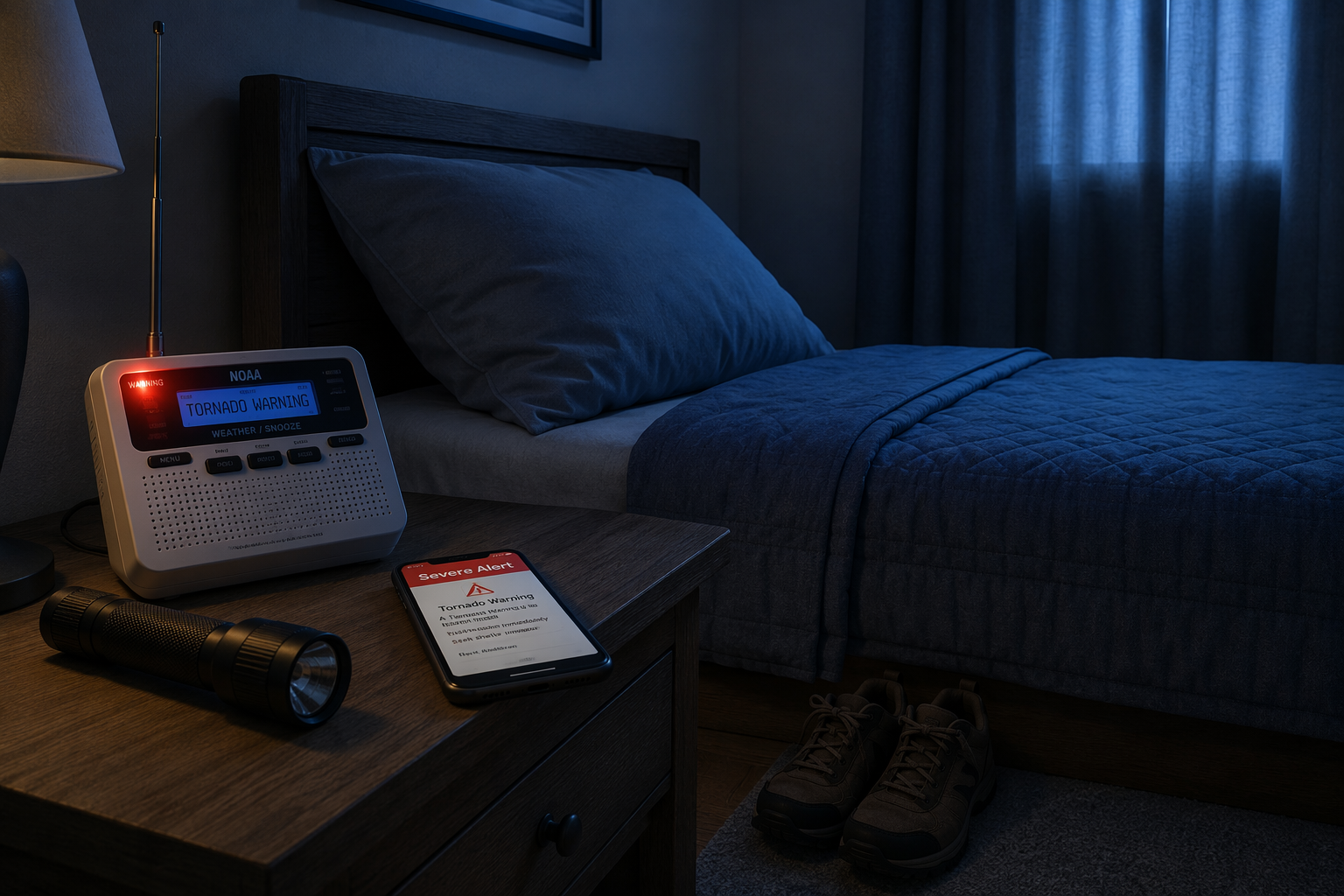
Set alerts that can actually wake you
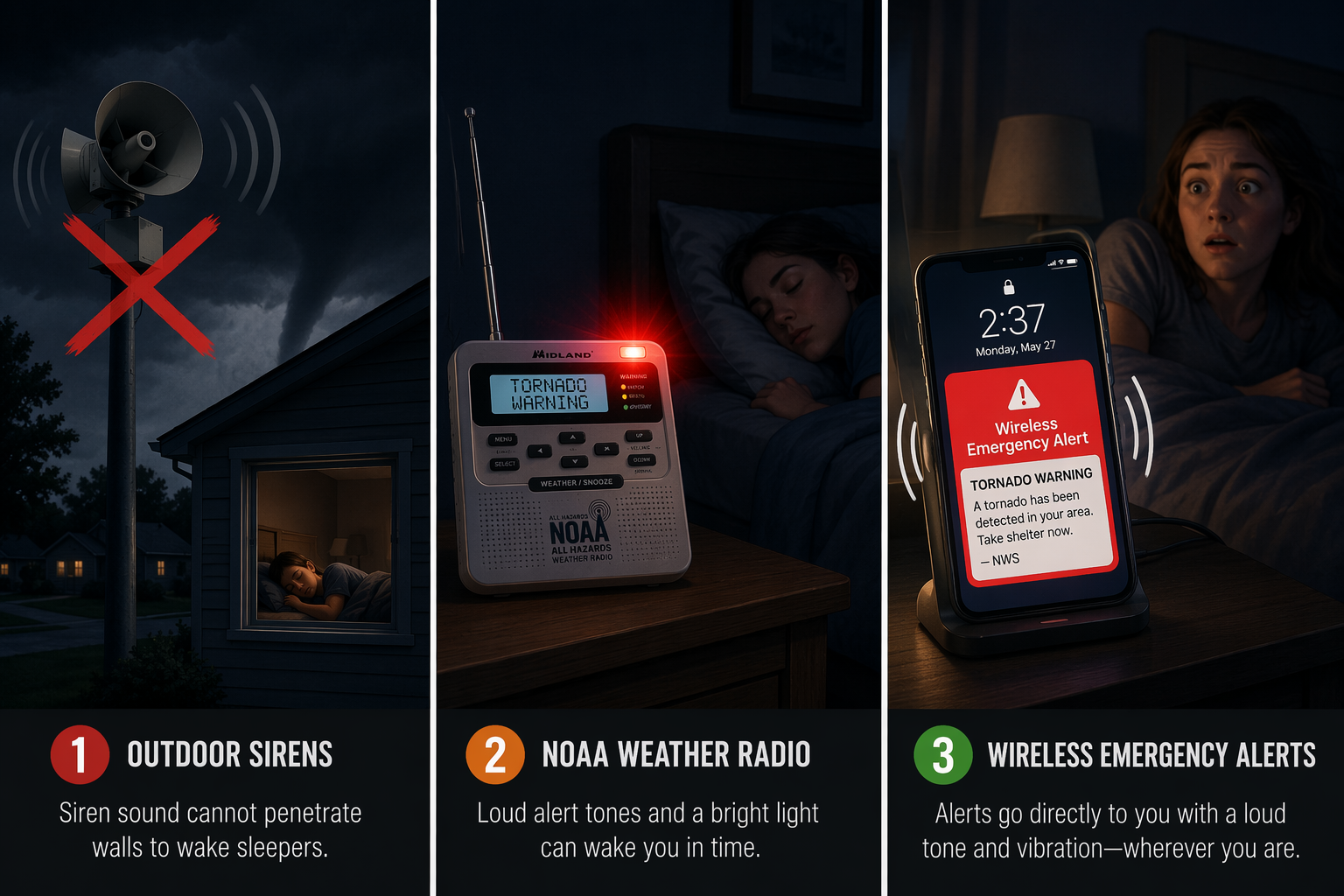
The weakest nighttime plan is the one that depends on outdoor sirens. The National Weather Service is blunt about this: outdoor warning sirens are designed to alert people who are outdoors, not to serve as a reliable indoor wake-up system for sleepers.[3] If your bedroom plan begins and ends with “I’ll hear the siren,” the plan has a hole in it.
Use layers instead. A NOAA Weather Radio with battery backup should be set to alert mode and loud enough to wake the household. Your phone should have Wireless Emergency Alerts enabled, volume up, and emergency bypass settings checked if your device uses sleep focus or do-not-disturb modes. Keep the phone charged and close enough that vibration and sound are useful, not buried under a pillow or left across the house.
Two alert paths are not overkill at night. They cover different failure points: a phone can be muted, a battery can die, a radio can be set incorrectly, a signal can be spotty. The purpose is not to create a noisy command center. It is to make one job reliable: wake the person who has to move everyone else.
Choose the room before fatigue gets a vote
The safe-room decision should be made while the lights are on. The National Weather Service’s tornado safety guidance is consistent: go to the lowest floor, choose an interior room or hallway without windows, and protect your head.[4] At night, the added requirement is speed. A technically good shelter location that requires sleepy adults, children, pets, or an older relative to cross the house in the dark may not be the best practical choice.
For a house with a basement, the route should be cleared before bed. For a slab home, the target may be an interior bathroom, closet, or hallway. For an apartment, ask before storm season where residents are expected to shelter; if there is no designated shelter, look for the lowest-floor interior hallway, stairwell, or windowless common area you can reach quickly. Do not wait until the warning tone is sounding to decide whether the third-floor bedroom is acceptable.
Mobile homes require a different answer. The National Weather Service and the Red Cross both warn against staying in a mobile home during tornado conditions; residents need a plan to get to a sturdy building before the storm arrives, not after the warning wakes them.[4][5] That is the hard caveat for sleeping during tornado weather. If your shelter plan depends on leaving a mobile home at 2 a.m. after a warning is issued, the plan is already late.
Make the bedside kit small enough to use
A nighttime tornado kit is not a garage full of supplies. It is the handful of things that keep you from wasting the warning lead time on bare feet, dead batteries, or searching for keys. Put them where your hand naturally goes when you get out of bed.
- Shoes with hard soles, not flip-flops, placed beside the bed.
- Phone on a charger, with emergency alerts enabled and volume high.
- Keys and photo ID, especially if you may need to leave a damaged building afterward.
- Flashlight or headlamp with working batteries.
- Helmet or other sturdy head protection for each person, if available.
- Whistle and a small bottle of water.
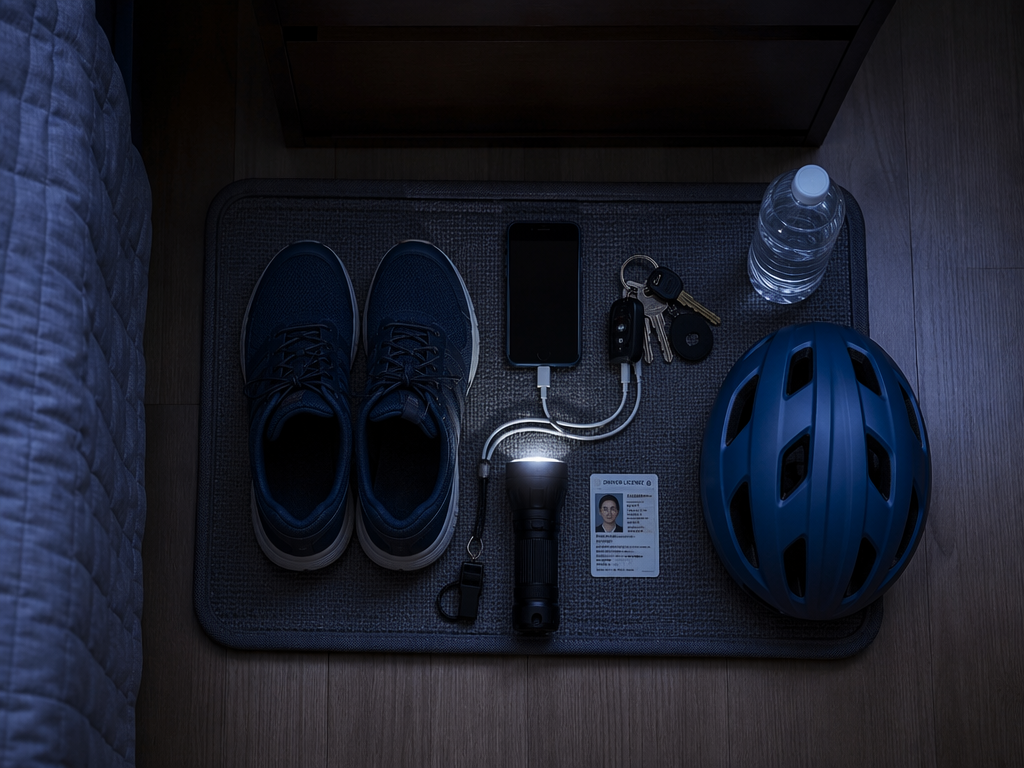
The shoes matter more than people expect. Tornado damage can leave glass, splintered wood, nails, insulation, and wet debris between the shelter spot and the exit. The flashlight matters because power failure is not a side issue at night; it changes how fast a calm plan turns into fumbling.
Use a watch-versus-warning rule
The rule should be simple enough to follow while half awake. During a tornado watch, conditions are favorable for tornadoes, so the job is preparation: check the forecast source, set the NOAA Weather Radio, enable phone alerts, charge devices, clear the shelter route, and move the bedside kit into place. If all of that is done and your shelter is reachable within seconds, sleep is a reasonable choice for many households.
During a tornado warning for your location, the job changes. A warning means a tornado has been indicated by radar or reported, and you should act as though the threat is real. Move to the shelter area. If the warning covers a broad county and your trusted local source provides more specific timing, use that information, but do not turn specificity into delay. The point of the pre-bed plan is that the decision has already been made.
If warnings are possible for several hours, some households choose to sleep in or next to the shelter room rather than stay fully awake. That can be a practical compromise for a basement family room, an interior hallway setup, or a child’s mattress moved away from windows. It is not the same as ignoring the warning; it is moving sleep into the safest available location while keeping alerts active.
If the alert wakes you, do not start researching
The first minute after an overnight alert is not for scrolling radar loops, checking five apps, or deciding whether the warning “looks serious.” The sequence should already be rehearsed.
- Wake the household with the same phrase each time, such as “Tornado warning. Shelter now.”
- Put on shoes, grab the phone and flashlight, and move to the preselected shelter spot.
- Get as low as possible, away from windows and exterior walls.
- Cover your head and neck with a helmet, pillow, mattress, or your arms.
- Stay there until the warning expires or a trusted official source says the threat has passed.
Parents should practice this once on a calm evening, not as a dramatic drill, just as a route check. Children do better when they have already walked the path. Adults do better too. The first time anyone discovers that the hallway is blocked by laundry or the helmet is in the garage should not be during a warning.
Adjust the plan for the place you actually sleep
Apartment dwellers have two problems: height and access. If you live above the ground floor, identify the lowest interior space you can reach without going outside into the storm. A stairwell may be better than a room with windows, but not every stairwell is equally protected, and locked access can ruin a plan. Ask building management now, not during the warning.
Rural residents often have longer distances to sturdy public buildings and fewer nearby neighbors. That makes the evening decision more important. If your only safe shelter requires a drive, the decision point is the watch or the forecasted overnight risk, not the moment the warning arrives. A ditch or low area is a last-resort option when caught outside with no shelter, not a preferred nighttime plan.
Households with older adults, people with mobility limits, babies, or a nurse who has to function after sunrise need a plan that respects time. Move walkers, medications, glasses, hearing aids, baby carriers, and essential medical devices into the route before bed. If one person is the designated alert monitor, name a backup. A plan that only works when the most exhausted adult hears the first tone is too fragile.
Keep storm anxiety inside the protocol
Storm anxiety can keep people awake even when the physical setup is good. The National Weather Service’s storm anxiety guidance recognizes that severe weather fear can become intense enough to interfere with decision-making and sleep.[6] The fix is not to shame yourself into calm. The fix is to reduce open loops.
Before bed, give yourself a closing routine: check one trusted forecast source, set the two alert layers, place the kit, confirm the shelter route, and then stop refreshing unless a warning arrives. If you need a written note, make it literal: “If the radio or phone alerts, I go to the hallway bathroom with shoes, phone, flashlight, and helmet.” The note is not emotional therapy. It is a handoff from your awake brain to your 2 a.m. brain.
If you cannot sleep at all during every storm setup, or if severe-weather fear is routinely disrupting work, caregiving, or health, that is worth taking seriously beyond tornado season. But on the night itself, the most useful target is smaller: remove decisions, remove searching, and let the alert system carry the job it was built to carry.
When sleeping is reasonable, and when it is not
Sleeping during tornado weather is reasonable when the threat is still at the watch or forecast stage, your NOAA Weather Radio and phone alerts can wake you, your shelter location is reachable within seconds, and your housing is sturdy enough that sheltering in place follows official guidance. It is also reasonable, in some homes, to doze in the shelter area during a long warning period while alerts remain active and everyone is already positioned.
Sleeping is not reasonable in a normal bedroom while a tornado warning is active for your location. It is not reasonable if your only alert is an outdoor siren. It is not reasonable if you are in a mobile home and have not already relocated to a sturdy building. It is not reasonable if the path to shelter is blocked, unknown, or too far for the people who have to use it.
The standard is not perfect safety. Tornadoes do not offer that. The standard is whether the night has a working chain of command: alert, wake, move, cover, wait. When that chain is built before bed, sleep is not a failure of vigilance. It is part of getting through the night without spending every storm season in a state of exhaustion.
References
- Tornadoes At Night Are Especially Deadly In The South, The Weather Channel, March 9, 2026.
- During a Tornado, National Weather Service.
- Severe Weather and Tornado Safety at Night, National Weather Service.
- Tornado Safety Rules, National Weather Service.
- Tornado Safety, American Red Cross.
- Storm Anxiety, National Weather Service.



Comments
Join the discussion with an anonymous comment.