
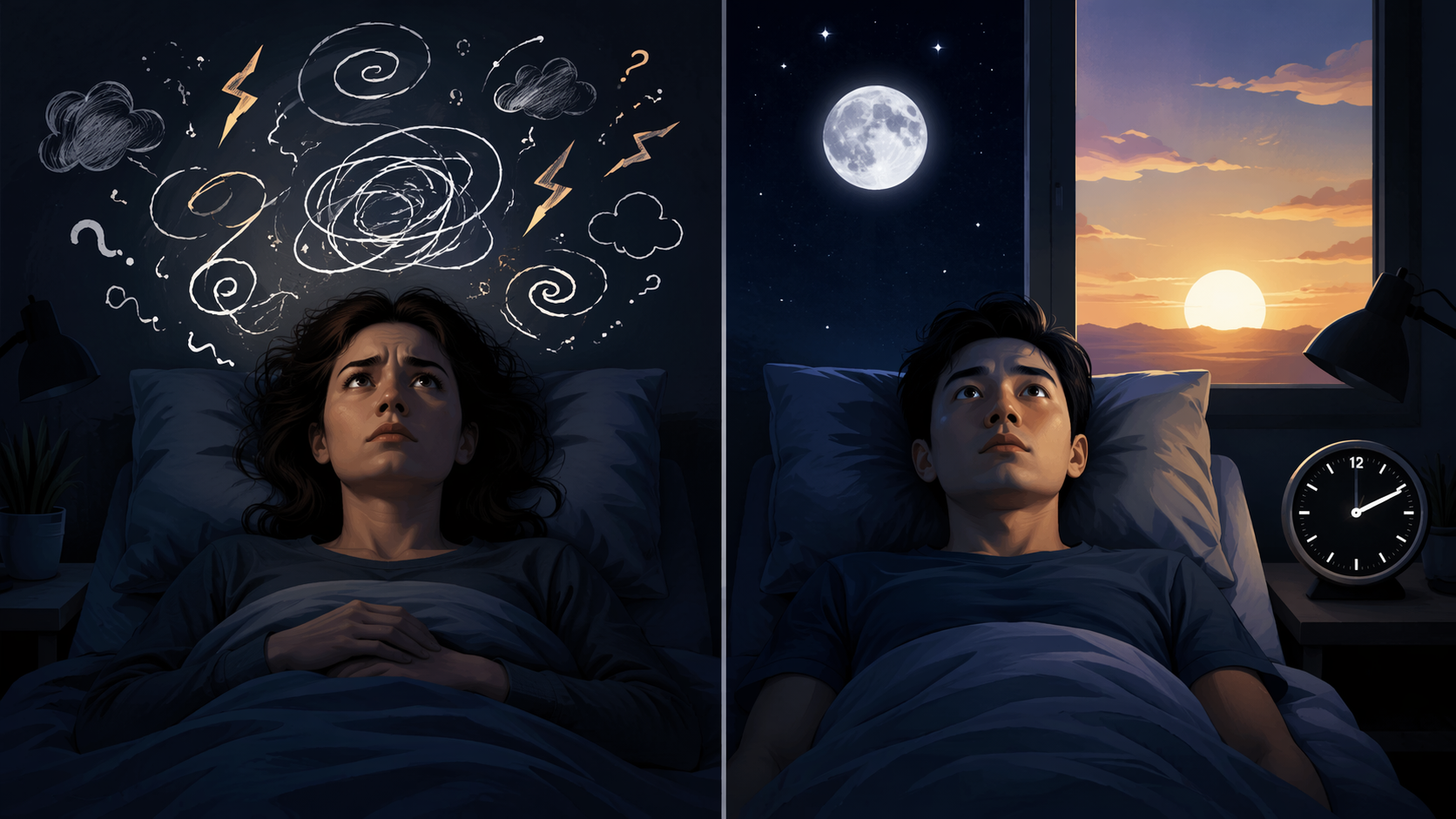
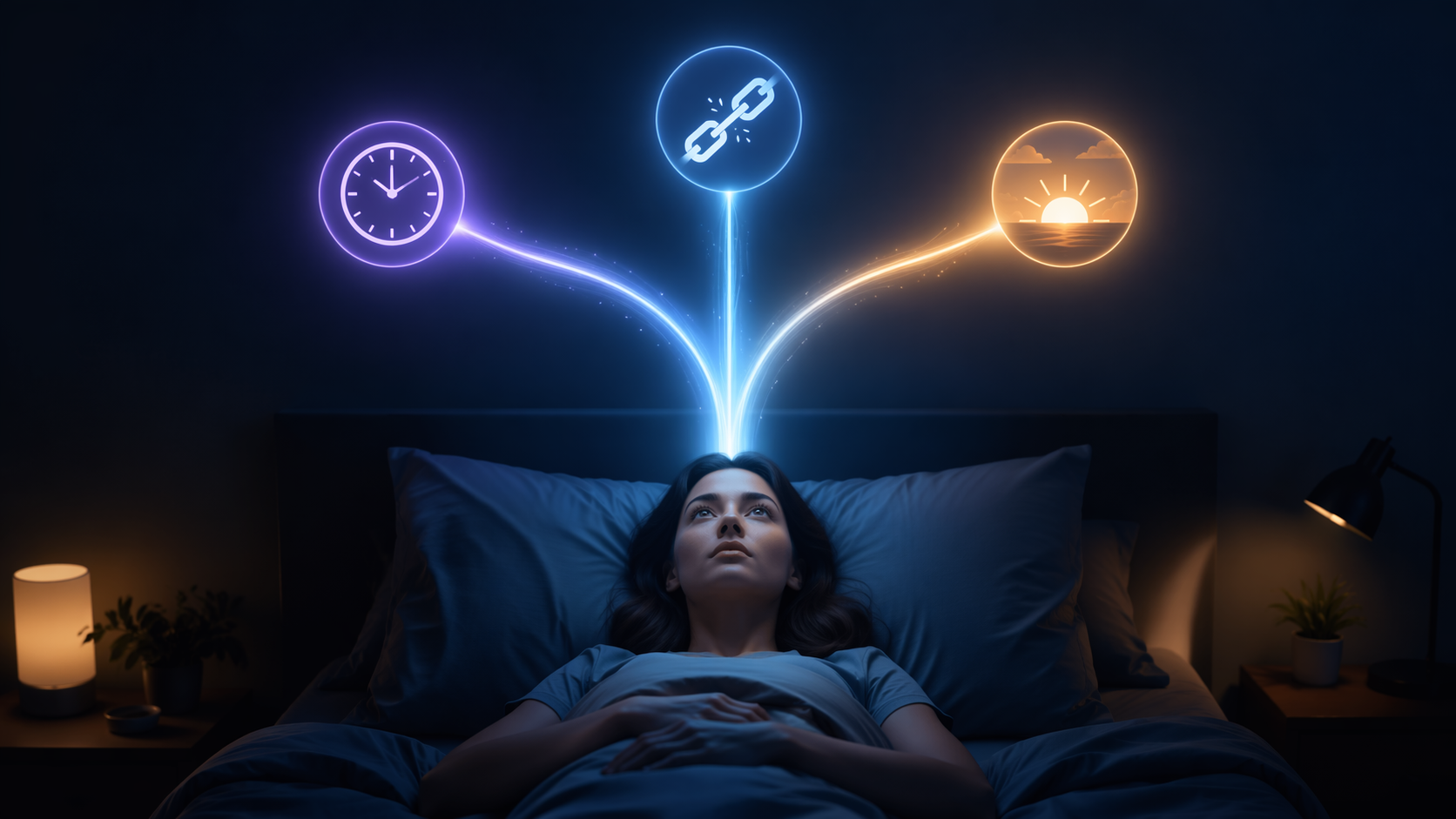
If the sentence in your head is “I can’t fall asleep,” the next useful question is not whether you have tried harder to relax. It is whether bedtime is arriving before your brain is quiet, or before your body clock is ready.
Those can feel similar from the outside. Both leave you awake in bed. Both can make the next day harder. But they point to different first moves. A racing, threat-scanning mind usually belongs to cognitive hyperarousal: the bed has become a place where thinking, monitoring, and effort switch on. A strangely alert body at a conventional bedtime often points toward circadian misalignment: your internal night is scheduled later than the clock on the wall.
That distinction matters because common sleep advice often treats sleep onset as one problem. In 2020, 14.5% of U.S. adults reported trouble falling asleep most days or every day in the previous 30 days, according to the CDC’s National Center for Health Statistics.[1] That number is useful, but it also hides the problem: the same symptom label can include people whose nervous systems are overactivated and people whose circadian timing is simply late.
The first split: sleepy but wired, or awake because it is too early for you
Start with the feeling at the moment you turn out the light. Not the story you tell the next morning. Not whether you had caffeine or looked at a screen. The bodily feel of bedtime is often the cleanest clue.
| What bedtime feels like | More likely mechanism | What to test next |
|---|---|---|
| You are sleepy, but your mind starts reviewing, planning, rehearsing, or monitoring whether sleep is happening. | Cognitive hyperarousal or conditioned arousal | Ask whether the bed itself seems to trigger alertness, and whether you sleep better away from your usual room. |
| You do not feel sleepy yet. You feel alert, productive, or oddly normal at the bedtime you are trying to keep. | Circadian misalignment or delayed sleep timing | Ask whether sleep comes more easily when bedtime shifts several hours later. |
| You feel exhausted but still cannot sleep, and the pattern changes by week, stress level, or schedule. | Mixed pattern | Identify which clue is strongest first; mixed cases need a directional starting point, not a perfect label. |
Racing thoughts are a common sleep-onset complaint. The American Academy of Sleep Medicine’s Sleep Education site describes the “mind won’t shut off” pattern as a frequent barrier to falling asleep, and Cleveland Clinic frames it as a problem of mental activation that can be addressed partly by moving worry out of bedtime.[2][3] In this pattern, the body may be ready enough for sleep, but the bed has become paired with effort: calculating how much sleep is left, solving tomorrow, reliving a conversation, checking whether you feel drowsy yet.
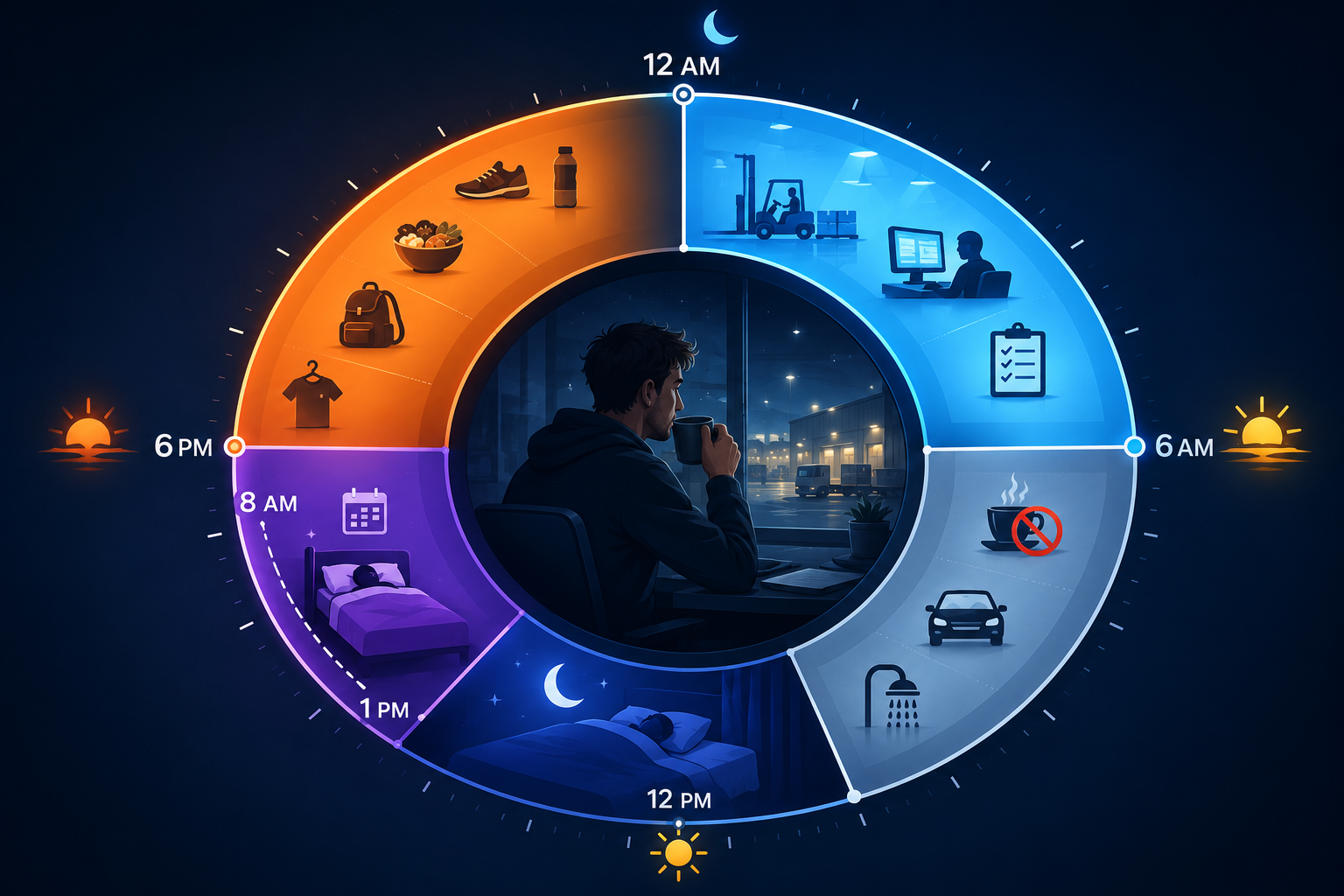
Circadian delay feels different. The complaint is less “my thoughts attack me” and more “everyone says it is bedtime, but my system disagrees.” Cleveland Clinic describes delayed sleep phase syndrome as a circadian rhythm disorder in which a person’s sleep-wake schedule is shifted later than conventional or required schedules; Mayo Clinic similarly notes that people with delayed sleep phase can often sleep well when allowed to follow their preferred later schedule.[4][5]
The hotel paradox is a serious clue
One of the most useful questions is almost embarrassingly simple: do you sometimes sleep better in a hotel, guest room, or on the couch than in your own bed?
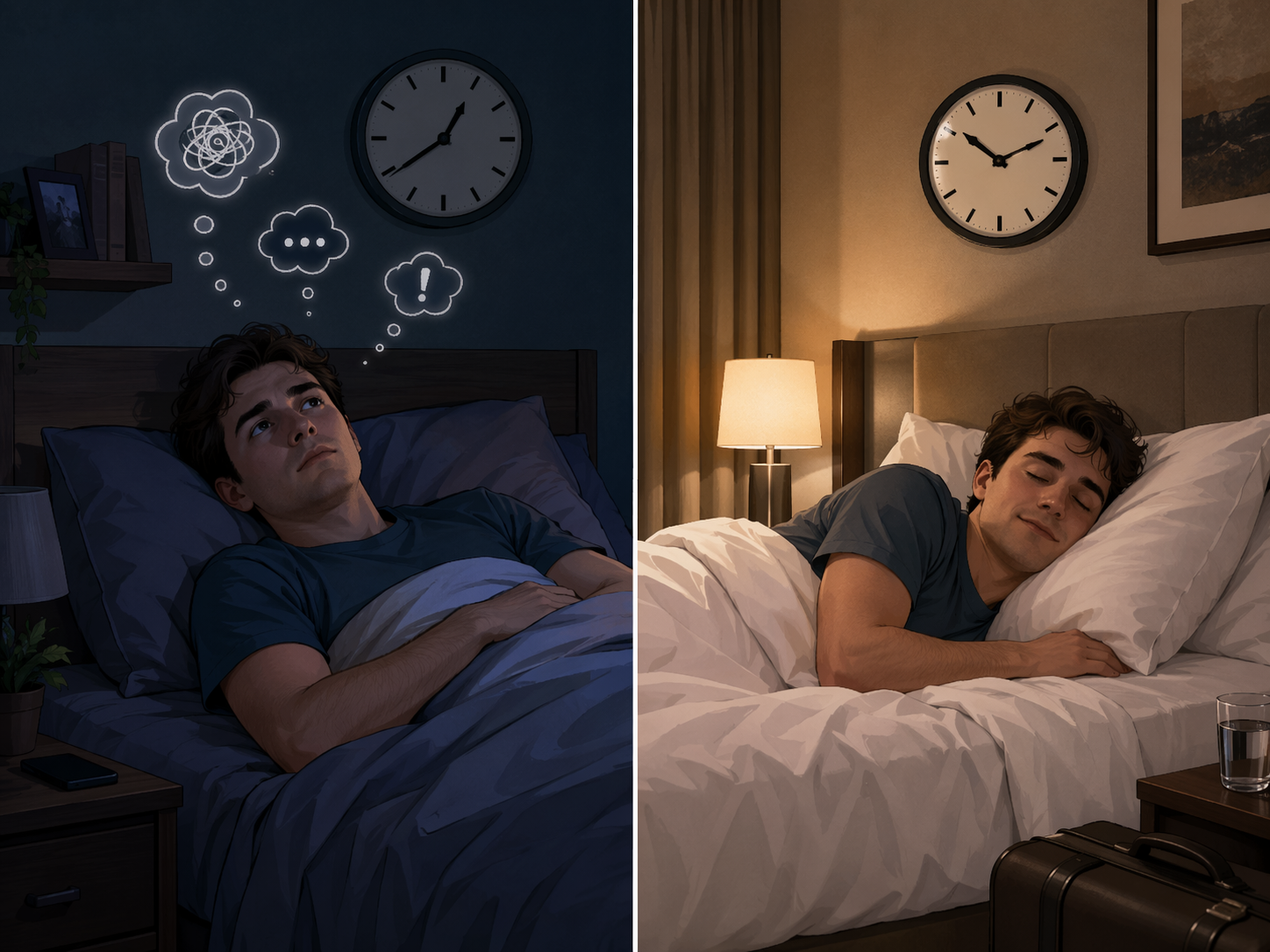
If the answer is yes, pay attention. Sleeping better away from your usual bedroom points toward conditioned arousal: your own bed, clock, room, or bedtime sequence has become a cue for alertness. Sleep Foundation describes psychophysiological insomnia as a pattern in which worry about sleep and learned arousal around the sleep environment help maintain insomnia.[6] That does not mean the problem is imaginary. It means the cue is real.
This is why the hotel paradox separates mechanisms better than another general paragraph about stress. If your clock is truly running late, a hotel room at the same local bedtime should not magically move your circadian rhythm earlier. You may still be awake there. But if your own bed has become the place where sleep effort begins, a different room can temporarily remove the learned signal.
The reverse is also useful. If you struggle in your own bed, in hotels, on vacation, and anywhere else whenever the target bedtime is 10:30 or 11 p.m., but you fall asleep smoothly at 2 or 3 a.m., the room is probably not the main signal. Timing deserves more suspicion.
What happens when you stop forcing the early bedtime?
A delayed body clock announces itself most clearly when the schedule is allowed to drift. Someone with delayed sleep timing may look like an insomniac on work nights and like a sound sleeper on a later free-day schedule. The key clue is not simply staying up late. It is sleeping more normally when sleep is scheduled later.
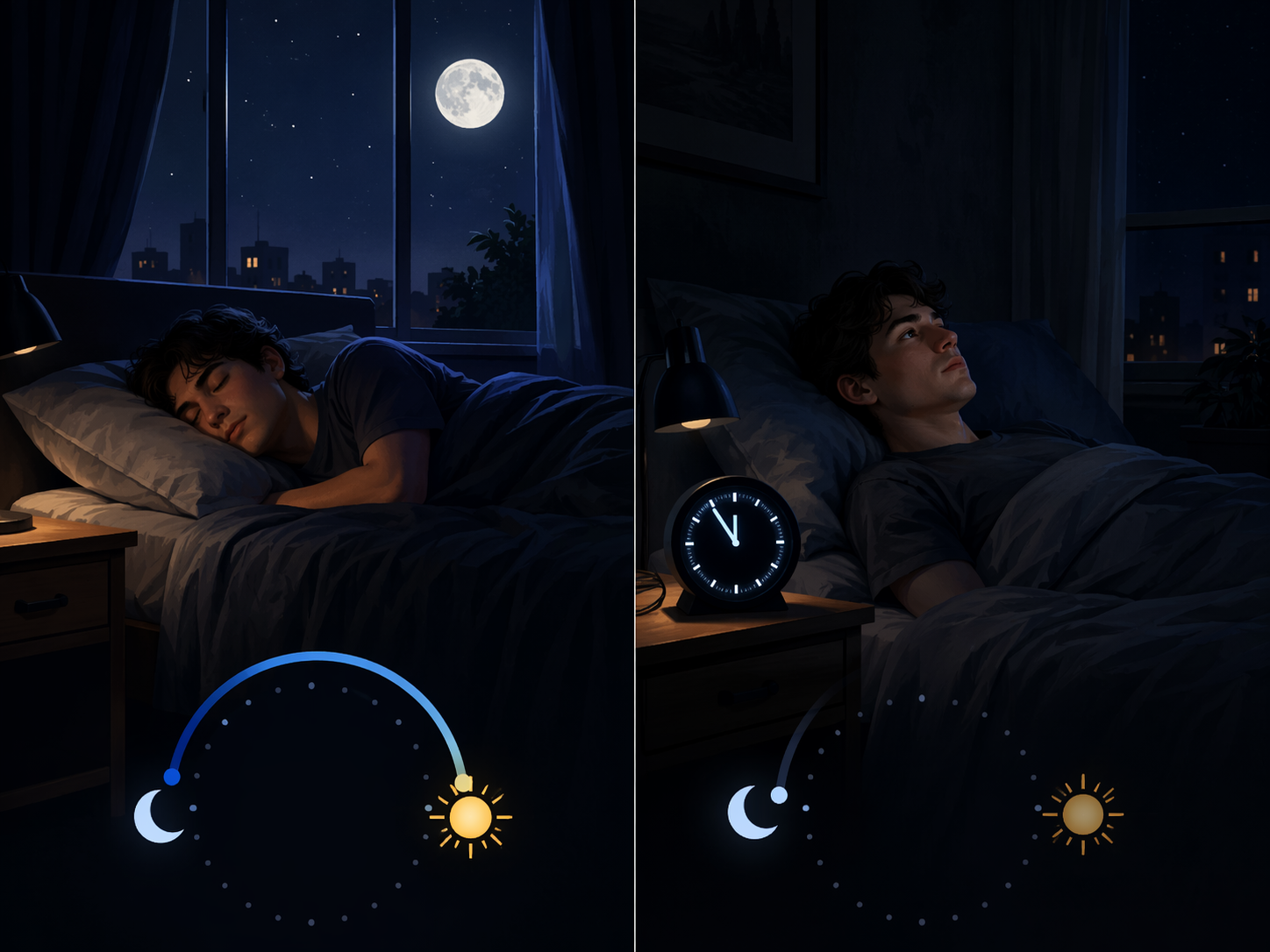
Cleveland Clinic estimates delayed sleep phase syndrome affects about 0.2% to 10% of adults, a wide range that reflects differences in definitions and study methods rather than a single settled rate.[4] The range should keep the claim modest. Circadian delay is real, but not every late bedtime is a disorder. The practical question is whether your sleep becomes easier, longer, and more stable when it is allowed to occur on a later schedule.
A useful home observation is the “three-hour shift” test. This is not a diagnosis, and it is not an instruction to wreck your schedule. It is a way to read your recent life. On nights when you went to bed much later than usual, did sleep arrive quickly and feel consolidated? On mornings when you could wake later, did the whole system work better? If yes, read more about delayed sleep phase syndrome in adults before assuming your main problem is failure to relax.
The clue cuts both ways. If pushing bedtime later does not help much because the same monitoring, dread, or mental review follows you to midnight, 1 a.m., and 2 a.m., the dominant problem may be arousal rather than clock timing. People can have both, but the treatment should start where the strongest pattern points.
A compact self-triage sequence
Use the last one to two weeks, not your worst night. A single bad night can be explained by almost anything. A repeating pattern is more informative.
- At lights-out, name the state: sleepy-but-wired, or awake-as-if-it-is-not-night-yet.
- Look for the hotel paradox: better sleep away from your own bed points toward conditioned arousal.
- Look for the late-schedule clue: easier sleep when shifted several hours later points toward circadian delay.
- Check whether the struggle follows the room or follows the clock. Room-specific alertness suggests learned arousal; clock-specific alertness suggests timing.
- Notice whether the pattern is stable across weekdays, weekends, travel, stress, and obligations. Instability often means the case is mixed.
This sequence is deliberately plain. It is not trying to replace a clinician, a sleep diary, or actigraphy. It is trying to prevent the most common mismatch: using a relaxation script for a late-running clock, or using circadian tools while continuing to train the bed as a place for wakefulness.
If your main complaint is falling asleep rather than staying asleep, it can also help to compare your pattern with trouble falling asleep vs. staying asleep. Sleep onset problems and middle-of-the-night waking are often maintained by different pressures, even when they coexist.
If the bed has become a cue for alertness
When cognitive hyperarousal is dominant, the first-line logic is not to make the bed more comfortable, more sacred, or more morally protected. It is to break the learned pairing between bed and wakeful effort.
Stimulus control is the cleanest example. In CBT-I, stimulus control asks people to use the bed for sleep and sex, go to bed only when sleepy, leave the bed when unable to sleep, return only when sleepy again, keep a consistent wake time, and avoid daytime napping; Stanford’s insomnia program describes this as a way to re-associate the bed with rapid sleep onset rather than prolonged wakefulness.[7] The point is not punishment. The point is removing rehearsal time.
CBT-I has evidence behind that logic. Sleep Foundation summarizes CBT-I as a structured treatment that commonly includes stimulus control, sleep restriction, cognitive restructuring, relaxation, and sleep hygiene education, and reports improvement in roughly 70% to 80% of people with primary insomnia.[8] A Journal of Sleep Research systematic review and meta-analysis also supports stimulus control as an evidence-based intervention for insomnia symptoms.[9]
For racing thoughts specifically, scheduled worry time is often more useful than trying to solve life at 11:47 p.m. Cleveland Clinic describes setting aside about 15 minutes earlier in the day to write worries, list next steps, and close the loop before bedtime.[3] The mechanism is simple: give the planning brain an appointment that is not your pillow.
- Use a consistent wake time, because sleeping in after a bad night can weaken the next night’s sleep pressure.
- Do not stay in bed for long stretches practicing frustration; get up briefly and return when sleepy.
- Move problem-solving earlier in the day with a written worry period.
- Consider CBT-I rather than adding more bedtime rituals if this has lasted for weeks or months.
If this profile fits, a deeper explanation of the alarm-learning loop is available in the neurobiology of sleep anxiety. The operational move, though, is already visible: stop giving your bed long nightly lessons in being awake.
If your clock is late
When circadian misalignment is dominant, relaxation can be pleasant and still miss the target. A person whose biological night starts at 2 a.m. may not be helped much by being calmer at 10:30 p.m. Calm is not the same as circadian readiness.
The first anchor is wake time. A consistent wake time gives the circadian system a repeated morning signal. Sleeping late on free days may feel like recovery, but for a delayed clock it can also reinforce the late schedule. The second anchor is morning bright light, timed soon after waking, because light is one of the strongest signals the circadian system uses to set timing. The third tool, when appropriate, is low-dose melatonin timed correctly; taken at the wrong clock time, melatonin can be ineffective or counterproductive. Cleveland Clinic lists light therapy and melatonin among treatment approaches for delayed sleep phase syndrome.[4]
This is where many self-help plans become too casual. “Take melatonin” is not a circadian plan. “Get sunlight” is not a schedule. For a late-running clock, timing is the treatment. If your obligations require an earlier schedule, the change usually has to be gradual and anchored in the morning, not negotiated anew each night at bedtime.
- Keep wake time steady enough that the body receives the same morning cue repeatedly.
- Use bright morning light soon after waking rather than relying only on dim evening relaxation.
- Discuss melatonin timing and dose with a clinician or pharmacist if you use it for circadian shifting.
- Reduce late-night light exposure if it is clearly pushing your sleep timing later, but do not mistake screen rules for the whole treatment.
For a more detailed mechanism-level explanation, see how your body clock controls sleep and wake cycles. The important distinction here is narrower: a late clock needs phase-shifting signals, not just a quieter bedtime.
Mixed patterns are common enough to plan for
The split between mind and clock is useful, but it is not a wall. Stress can push a late chronotype into a worse delay. A delayed schedule that repeatedly collides with work or school can teach the brain to dread bedtime. After enough failed nights, the person with a late clock may also develop conditioned arousal.
In mixed cases, do not try to fix everything on the same night. Choose the mechanism that is most visible. If you sleep soundly from 2 a.m. to 10 a.m. whenever life permits, start with circadian anchoring. If every bedtime has become a performance review and you sleep better in a different room, start with stimulus control and CBT-I logic. If exhaustion without sleep is the confusing part, the sleep drive mismatch may help separate fatigue from actual sleep readiness.
Also be careful with generic sleep hygiene. A regular wind-down, less alcohol, and a darker room can help at the margins. But if you have already tried the standard list and still cannot fall asleep, the failure may be in the match, not in your effort. The limits of sleep hygiene are especially obvious when the mechanism is conditioned arousal or circadian delay.
When to bring in clinical help
Self-triage is a starting point, not a diagnosis. Bring in a clinician, sleep specialist, or behavioral sleep medicine provider if trouble falling asleep is chronic, if it is impairing work or driving, if anxiety or depression is active, if you rely heavily on alcohol or sedatives to initiate sleep, or if your schedule cannot be adjusted safely without guidance.
The American Academy of Sleep Medicine reported survey findings in 2024 that 12% of Americans said they had been diagnosed with chronic insomnia, which is a reminder that persistent insomnia is not just a preference for late nights or a weak evening routine.[10] It is reasonable to ask for treatment that matches the pattern.
Choose the first intervention from the dominant clue. Better sleep away from your own bed points toward conditioned arousal: start with stimulus control, scheduled worry time, and CBT-I. Sound sleep on a later schedule points toward circadian delay: start with wake anchoring, morning bright light, and carefully timed circadian tools. If both are present, reassess after addressing the clearer one rather than adding more bedtime rules.
References
- Sleep Difficulties in Adults: United States, 2020, CDC NCHS, 2020
- Why your mind won’t shut off at night, Sleep Education / AASM
- How To Stop Your Mind From Racing and Get To Sleep, Cleveland Clinic
- Delayed Sleep Phase Syndrome (DSPS), Cleveland Clinic
- Delayed Sleep Phase, Mayo Clinic
- Psychophysiological Insomnia: Symptoms, Causes, and Treatment, Sleep Foundation
- Stimulus Control Procedures, Stanford Health Care
- Cognitive Behavioral Therapy for Insomnia (CBT-I), Sleep Foundation
- Stimulus Control for Insomnia: A Systematic Review and Meta-Analysis, Journal of Sleep Research
- Survey shows 12% of Americans have been diagnosed with chronic insomnia, AASM

Comments
Join the discussion with an anonymous comment.