
When wildfire smoke is outside your window at bedtime, the job is not to clean the whole home. The job is to make the room where you will spend the next seven or eight hours meaningfully cleaner than the air around it. That usually means choosing one sleep room, closing and sealing what you can, running active filtration before you get into bed, setting ventilation to recirculate if your system allows it, and stopping every indoor activity that adds particles back into the room.
The fastest version looks like this: pick the bedroom with the fewest openings, preferably one with an attached bathroom so fewer door trips are needed overnight; close windows and doors; block obvious drafts; run a correctly sized portable HEPA purifier or a safer DIY box-fan filter option; keep smoky outdoor air from being pulled in through HVAC settings; and do not burn candles, incense, or anything else for atmosphere. The practical center is simple: fewer leaks, continuous filtration, and fewer indoor particle sources while you are trying to recover.
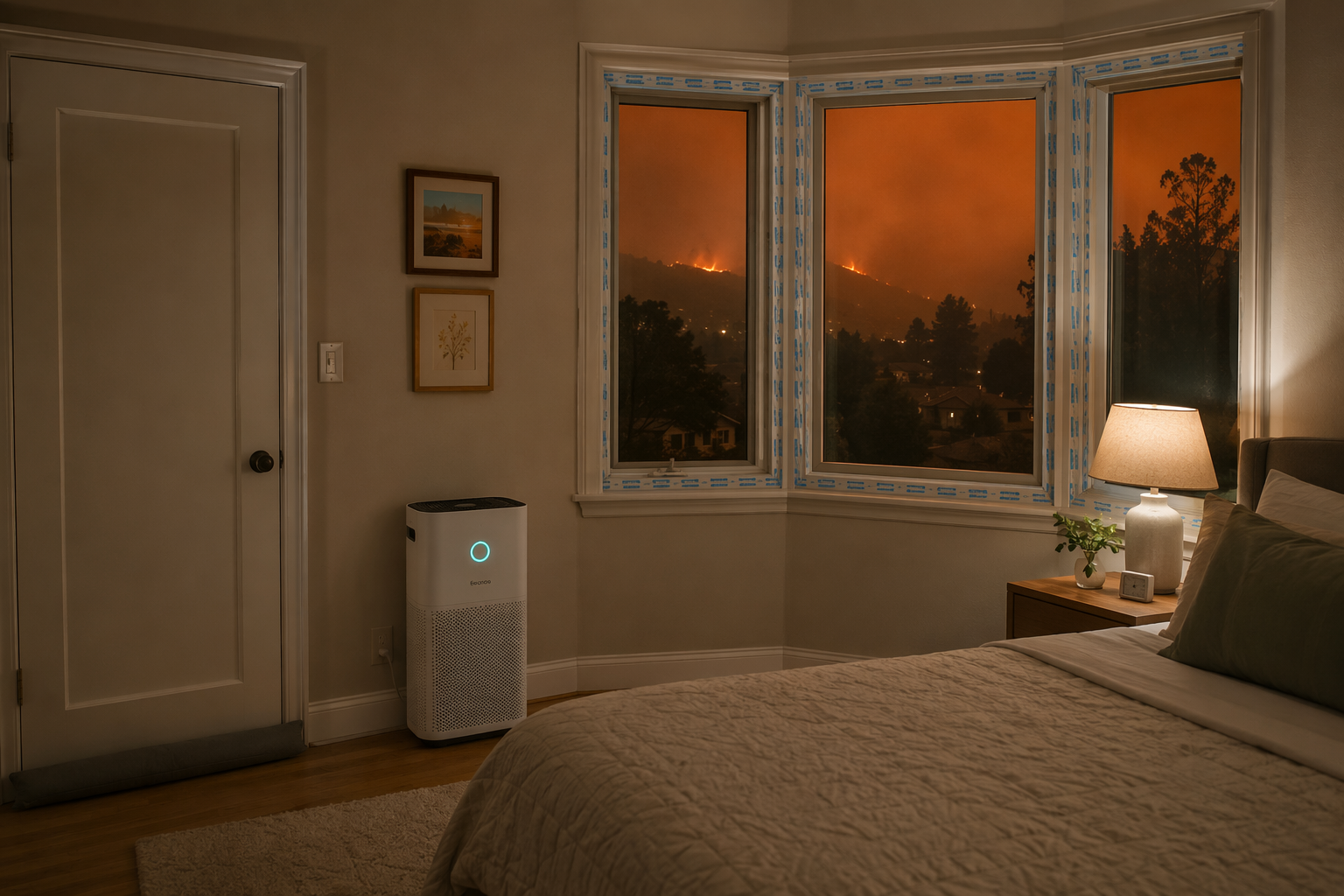
Make One Sleep Room Do the Work
A clean sleep room is not a fantasy version of your house. It is a smaller target. The Environmental Protection Agency describes the clean room approach as selecting a room that can be closed off from the rest of the home and kept cleaner during smoke events; for sleep, that room needs to be usable for the whole night, not just for an hour in the afternoon.
Portable air cleaners are worth the trouble because the evidence is no longer just theoretical. A 2025 National Collaborating Centre for Environmental Health rapid review found that portable air cleaners with HEPA filters reduced indoor PM2.5 by an average of 57% across wildfire-specific studies, with reported reductions ranging from 5.3% to 99%; the same review found the indoor/outdoor PM2.5 ratio dropped from 0.68 to 0.34 with filtration.[1]
That average does not mean your bedroom will automatically be 57% cleaner the second a purifier turns on. It means filtration can make a real dent when the room, equipment, and habits are working in the same direction. A purifier fighting an open window, a leaky hallway door, a bathroom exhaust fan, and a scented candle is being asked to do too much.
Pick the Room Before You Pick the Machine
The best smoke-sleep room is usually not the biggest bedroom or the prettiest one. It is the room with the fewest ways for smoky air to enter and the fewest reasons for people to open the door. The American Lung Association points to a bedroom with an attached bathroom as ideal for a clean room because it reduces the number of door openings.[2]
If you have options, choose in this order: a room with few windows, a tight-closing door, no fireplace, no direct door to the outside, no obvious shared ventilation problem, and enough floor or tabletop space for filtration away from bedding and curtains. If the only room with an attached bathroom has old windows that leak badly, do not treat the bathroom rule as sacred. A smaller interior room with a tighter envelope may be the better sleep room.
| Situation | Best choice | Why it matters overnight |
|---|---|---|
| You have several bedrooms | Use the smallest comfortable room with the fewest windows and an attached bathroom if available | Less air volume and fewer door openings make filtration easier |
| You rent and windows are drafty | Choose the room where gaps can be blocked most reliably, even if it is not the main bedroom | A purifier works better when it is not constantly diluted by new smoky air |
| You share ventilation with other units | Pick the room farthest from smoke entry points and avoid using exhaust fans unless necessary | Shared airflow can bring in particles you cannot control at the source |
| You cannot create an ideal room | Create a minimum sleep zone: closed door, blocked gaps, filtration near the sleeper, no indoor particle sources | Partial control is still better than treating the whole home as one exposure space |
Close the Room Like You Mean It
Start sealing before the room smells smoky. Close windows fully. Lock them if locking tightens the seal. Shut the bedroom door. Put a draft stopper, rolled towel, or temporary door sweep at the bottom edge. If you can feel air moving around a window frame, use painter's tape, removable weatherstripping, or plastic film if you already have it. The goal is not a laboratory seal. The goal is to slow the constant replacement of filtered room air with smoky air.
Be careful with the bathroom. An attached bathroom is helpful because it can keep people from opening the bedroom door, but the exhaust fan can pull air through gaps elsewhere in the home. Use the bathroom door as a buffer when you can. If the bathroom fan is needed, run it only as long as necessary rather than leaving it on all night.
Apartment doors deserve the same attention as windows. Smoke can enter through hallways, stairwells, shared garages, and neighboring units. If the bedroom is your clean room, the bedroom door matters more than the front door once you are inside for the night. Keep hallway trips short, and avoid turning the bedroom into the place everyone enters and exits while the purifier tries to catch up.
Start Filtration Early, Not After You Wake Up Coughing
Move the purifier into the sleep room before bedtime and let it run with the door closed. If the room has been open all evening, it needs time to turn over the air. Place the unit where air can move freely through it, not wedged behind a curtain, buried beside laundry, or pressed against the wall unless the manufacturer allows that placement.
For a commercial unit, look for a true HEPA purifier and size it to the room using its clean air delivery rate, or CADR. CADR is not a beauty score or a brand score; it is a practical measure of how much filtered air the unit can deliver. A small purifier in a large primary bedroom may still help, but it will not behave like a correctly sized unit in a smaller, tighter room.
Filter terms are easy to overread. True HEPA filters are rated to capture 99.97% of particles at 0.3 microns, while MERV13 filters capture roughly 95% of PM2.5 particles; those capture figures describe filter performance, not a guaranteed overnight room reduction in every home.[3] Room leakage, fan speed, filter fit, door openings, and indoor sources still decide how much cleaner the bedroom becomes.
If a Purifier Is Not Available
A DIY box-fan filter can be a useful lower-cost option when commercial purifiers are unavailable or unaffordable. The EPA has found that DIY air cleaners made with box fans and high-efficiency filters can reduce wildfire smoke particles indoors and describes them as a cost-effective alternative.[3]
The safety caveat is not fine print. Use a newer UL-listed box fan, follow the design instructions carefully, keep the fan away from bedding and curtains, check it for heat, and do not leave a homemade box-fan filter running unattended. The EPA notes that DIY air cleaners may pose a fire risk if a fan motor overheats and can increase electricity use.[3]
For sleep, that creates a tradeoff. A certified portable purifier designed for continuous operation is the cleaner overnight choice when you have one. A DIY filter may be reasonable while someone is awake in the room, or in the evening before bed, but it should not be treated casually as an all-night appliance unless the setup and supervision are appropriate.
Put HVAC and Ventilation on Your Side
If your home has central air, check whether the system is bringing in outdoor air. During smoke events, the EPA advises setting HVAC systems to recirculate rather than using a fresh-air intake, and using a MERV13 filter in the HVAC system if possible.[4] In a house with good controls, that can reduce how much outdoor smoke gets distributed indoors.
Many homes do not give you that kind of control. Some apartments have shared ventilation. Some older systems have no obvious recirculate setting. Some window units leak around the sides even when they are off. If you cannot confidently manage the whole-home system, return to the smaller target: close the bedroom, block the gaps you can see or feel, and run filtration inside that room.
Avoid using fans in ways that pull smoky air into the bedroom. A fan blowing across the room can help comfort if the air is already being filtered, but a fan in a window or a fan pointed from a smoky hallway into the room defeats the purpose. Comfort matters for sleep, especially on hot nights, but airflow direction matters during smoke.
Stop Adding Particles Indoors
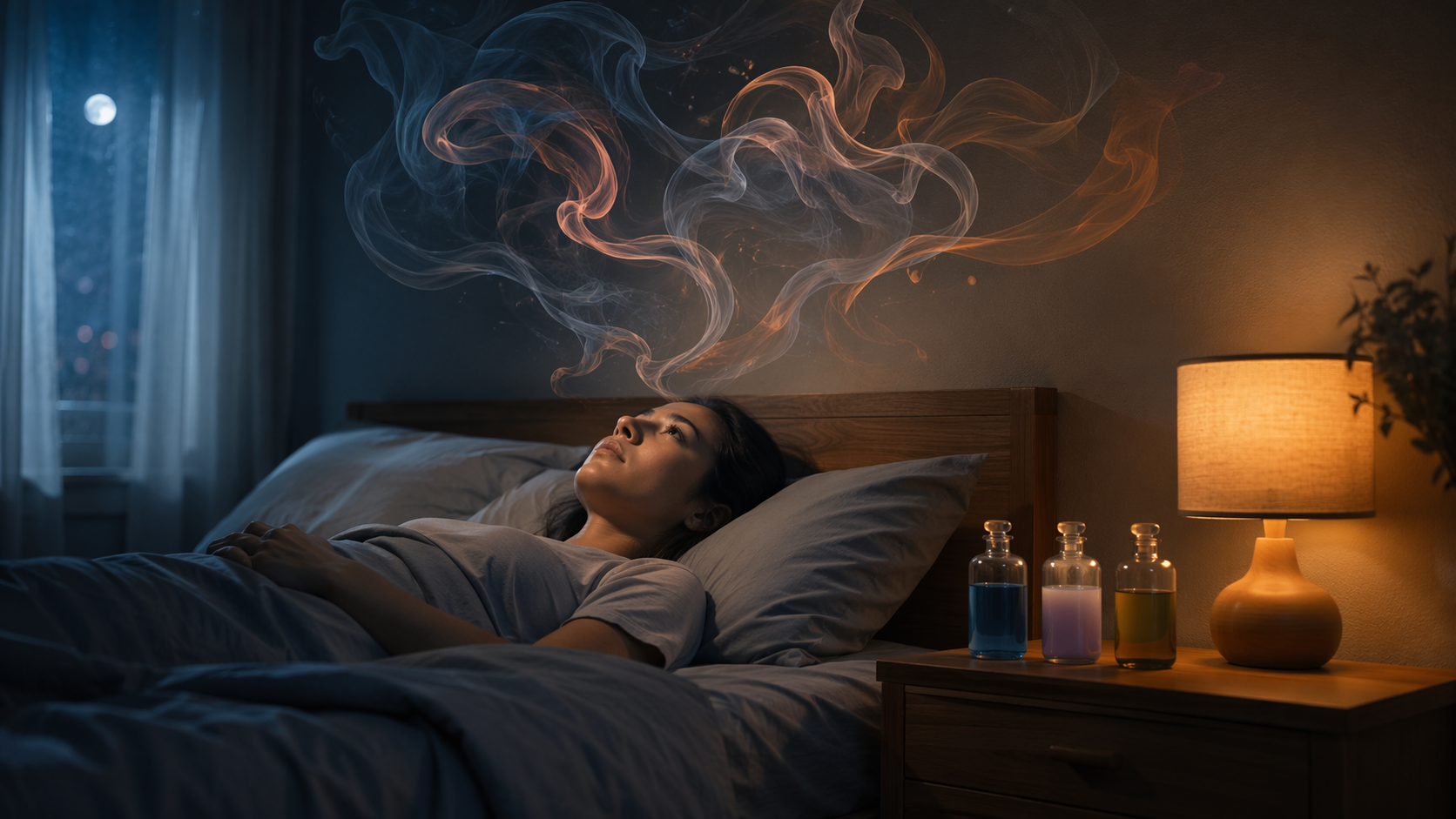
Once the sleep room is closed and filtration is running, do not make the purifier clean up avoidable messes. South Coast AQMD advises against burning candles or incense, using gas stoves, vacuuming because it can stir up settled particles, and using essential oil diffusers during wildfire smoke events.[5]
This is where smoke preparation can feel annoyingly domestic, because the important moves are small: skip the candle, cook earlier or avoid gas cooking, do not vacuum the bedroom before bed, leave dusty sorting projects alone, and keep pets from tracking ash or debris onto bedding if they have been outside. These are not sleep-hygiene niceties. They keep the room from becoming its own particle source.
- Do not use candles, incense, essential oil diffusers, or other scented combustion or aerosol products in the sleep room.
- Do not vacuum right before bed during a smoke event; wait until conditions improve or use appropriate filtration if cleaning is unavoidable.
- Do not run a bathroom or kitchen exhaust fan longer than necessary if it pulls replacement air through smoky gaps.
- Do not keep opening the bedroom door to check the rest of the house; decide what needs to be inside the room before the night starts.
- Do not ignore the filter itself; a clogged or incorrectly installed filter cannot do the job you bought it for.
Set Up the Night So You Do Not Keep Breaking the Seal
A clean sleep room fails in ordinary ways. Someone gets thirsty. A child needs a charger. The dog wants out. A medication is in the kitchen. Every door opening mixes the room you worked on with the air outside it. Before bed, bring in water, medications, chargers, tissues, glasses, pet supplies, and anything else that would otherwise send someone into the hallway.
Run the purifier on the highest setting you can sleep through, then adjust if noise becomes its own problem. For some people, steady fan noise is easier to sleep with than intermittent coughing, hallway trips, or waking up to a smoke smell. For others, the highest speed is too loud. The useful setting is the one that keeps filtration going through the night.
Keep bedding and pillows away from the purifier intake and outlet. If you are using temporary sealing materials, make sure they do not create a tripping hazard for nighttime bathroom trips. If there are children, older adults, or anyone with mobility concerns in the home, the clean room still has to be safely usable in the dark.
What This Can and Cannot Protect You From
Wildfire smoke deserves this level of attention because exposure is becoming harder to treat as an occasional inconvenience. Climate Central reported in 2025 that per-person smoke exposure from 2020 to 2024 was four times higher than the 2006 to 2019 average, and attributed 164,000 premature deaths to wildfire smoke over the past decade.[6] A Nature Communications study also found that wildfire PM2.5 has greater respiratory toxicity than PM2.5 from other sources.[7]
Those facts explain why the bedroom is worth defending, but they do not turn a closed room into medical-grade protection. A clean sleep room reduces exposure; it does not erase outdoor conditions, make a leaky apartment airtight, or replace medical advice for people with asthma, COPD, heart disease, pregnancy, or other higher-risk conditions.
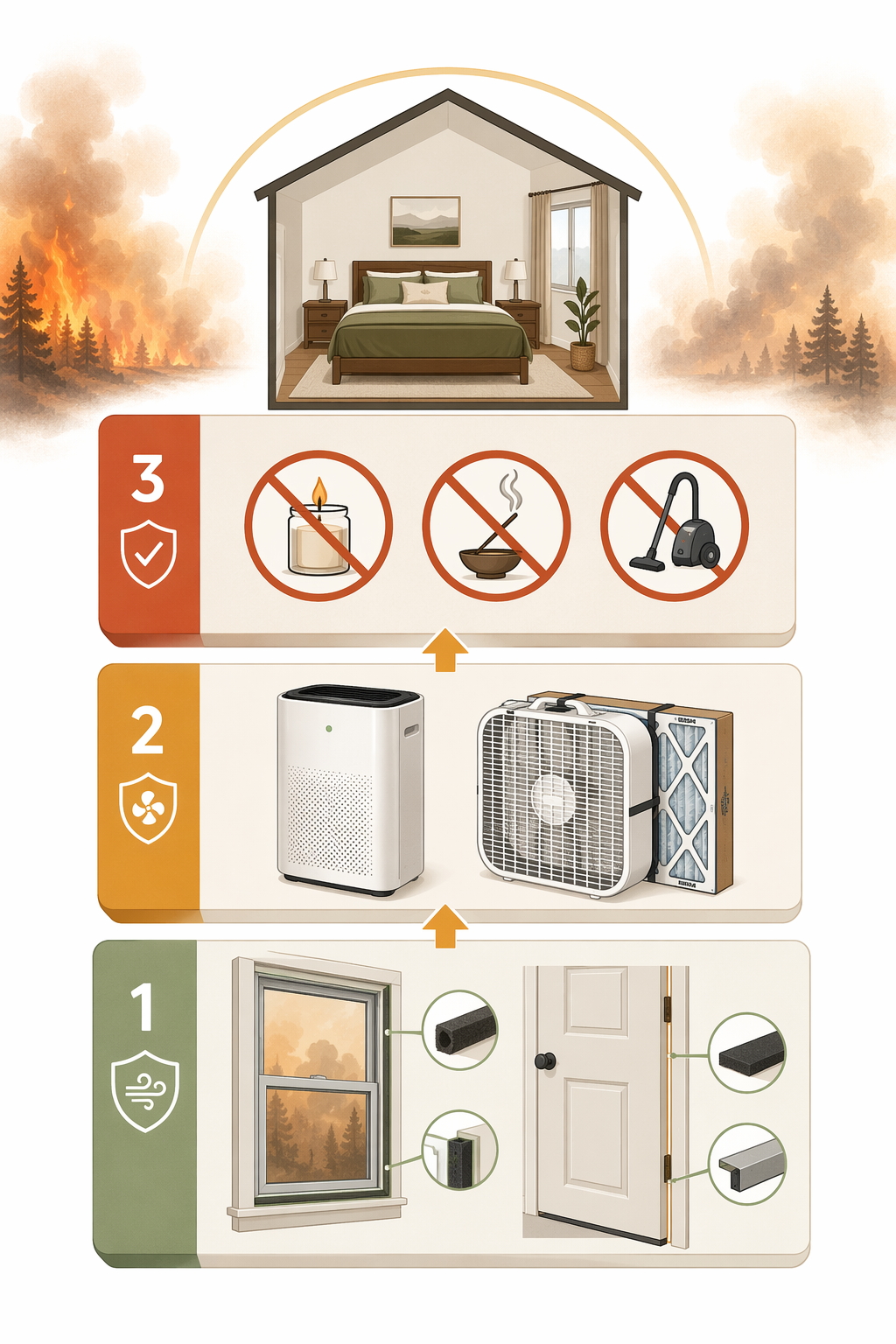
The realistic standard is still useful: by bedtime, the room is closed, obvious gaps are blocked, filtration is running, HVAC is not deliberately pulling in outdoor air, and nobody is adding smoke, fragrance, combustion, or dust inside. Each layer covers a weakness in the others. Sealing slows the incoming load. Filtration removes particles that get in. Behavior keeps the room from generating its own pollution.
A Practical Bedtime Sequence
If smoke is already in the forecast, do not wait until you are exhausted. Use the evening to build the room in order, because the order matters more than making any single step perfect.
- Choose the sleep room with the fewest openings and the least need for overnight door traffic.
- Close windows and doors, then block obvious drafts with temporary materials that are safe and removable.
- Move the purifier into the room early, install the correct filter, and run it with clear space around the intake and outlet.
- Set HVAC to recirculate if available, close fresh-air intakes if your system allows it, and avoid exhaust fans except when necessary.
- Remove indoor particle sources: no candles, incense, diffusers, smoking, unnecessary gas cooking, or last-minute vacuuming.
- Bring in what people need for the night so the door stays closed as much as possible.
This setup will not make indoor air smoke-free. It can make the bedroom meaningfully cleaner when whole-house filtration is unavailable, and that is the point. A sealed bedroom plus appropriately sized filtration plus no indoor particle sources gives the night a better chance to be a recovery period instead of eight more hours of exposure.
References
- Indoor Air Filtration During Wildfires: Impacts on Air Quality and Health, National Collaborating Centre for Environmental Health, 2025.
- Create a Clean Room to Protect Indoor Air During a Wildfire, American Lung Association, 2023.
- Research on DIY Air Cleaners to Reduce Wildfire Smoke Indoors, EPA, 2022.
- Wildfires and Indoor Air Quality (IAQ), EPA.
- Wildfire Health Info and Smoke Tips, South Coast AQMD.
- Climate Central, 2025.
- Wildfire Smoke Impacts Respiratory Health More Than Fine Particles from Other Sources: Observational Evidence from Southern California, Nature Communications, 2021.

Comments
Join the discussion with an anonymous comment.