
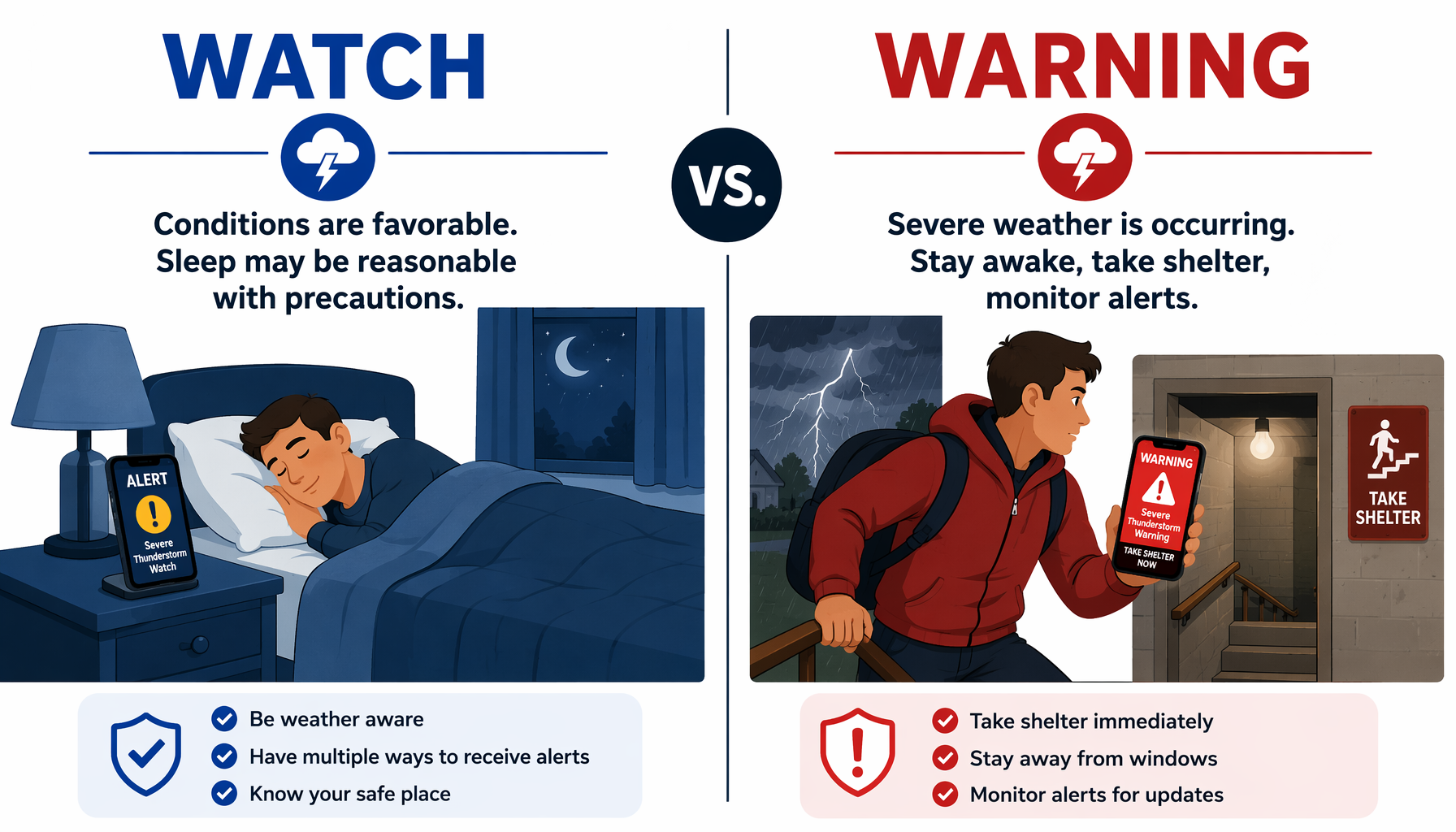
Before trying to sleep through a severe thunderstorm, check the alert type. A Severe Thunderstorm Watch means conditions are favorable for severe weather; sleep can be reasonable if you set up alerts and keep your shelter plan ready. A Severe Thunderstorm Warning means severe weather is occurring or imminent; the safer job is to stay awake, take shelter as instructed, and monitor alerts, especially if tornado potential is mentioned.[1]
That distinction matters more than any sound machine setting. The point is not to prove you are calm enough to sleep. The point is to separate a safety problem from a sleep-disruption problem. If the forecast is still in watch territory, or the storm is ordinary thunder without an active warning, then a layered sleep plan can help: preserve your ability to receive warnings, reduce thunder spikes, soften lightning flashes, and keep anxiety from turning into an all-night radar loop.
First Decide Whether Sleep Is the Right Goal
Use this rule before you dim the lights:
| What you see | What it means tonight | Sleep decision |
|---|---|---|
| Severe Thunderstorm Watch | Conditions are favorable for severe weather | You may attempt sleep after setting at least two alert sources and clearing your shelter route |
| Severe Thunderstorm Warning | Severe weather is occurring or imminent | Stay awake, take shelter as instructed, and keep monitoring alerts |
| Tornado Watch | Conditions are favorable for tornadoes | Use extra caution; sleep only if alerts are reliable and shelter access is immediate |
| Tornado Warning | A tornado is indicated or occurring | Do not try to sleep; shelter immediately |
| No active watch or warning, but thunder nearby | Sensory disruption is the main issue | Use the noise, light, and anxiety layers below |
Set at least two alert sources before bed. A phone with Wireless Emergency Alerts enabled is one layer. A NOAA Weather Radio, a trusted weather app with push alerts, or a second charged phone in the household can be another. Redundancy is not overreacting here; it prevents one dead battery, silenced app, weak signal, or missed notification from becoming the whole safety system.[1]
- Charge your phone and keep it loud enough to wake you.
- Turn off nonessential notifications so weather alerts stand out.
- Place shoes, glasses, medications, keys, and a flashlight where you can reach them quickly.
- Know the lowest, most interior shelter spot you would move to if a warning arrives.
- Keep pets or children’s essentials close enough that a warning does not become a search mission.
Once that is handled, do not keep negotiating with the forecast every few minutes. If the alert status changes, your alerts should tell you. If it does not change, the next job is sleep.
Identify What Is Actually Waking You
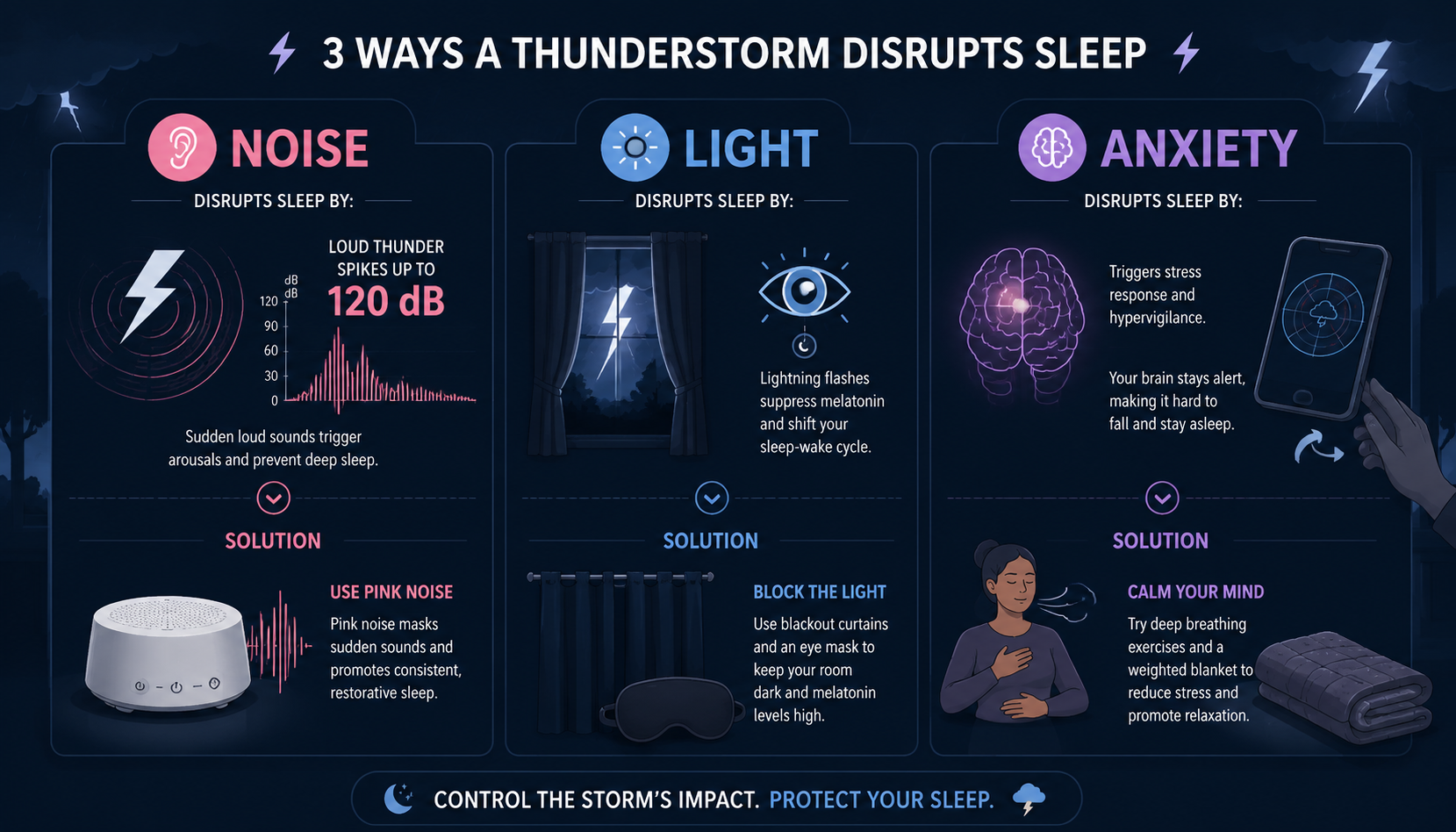
Severe thunderstorms are poor sleep conditions because they attack sleep through different channels at once. Thunder is not just “noise”; it is a sudden sound spike. Lightning is not just “brightness”; it is abrupt contrast in a dark room. Anxiety is not just a thought; it can become hypervigilance, where the brain keeps scanning for the next clap, flash, or alert.
Those mechanisms need different fixes. A louder fan may help with thunder but do almost nothing for radar checking. Blackout curtains may blunt lightning but will not reassure someone who has no alert plan. A breathing exercise may calm the body but will not solve a phone that is on silent across the room.
Mask Thunder Without Blocking Alerts
Thunder is hard to sleep through because it arrives as a peak, not a steady background. Some thunder claps can reach up to 120 dB, which is why “just relax” is a weak answer for someone being startled awake by the roof and windows.[2]
The practical goal is not to drown out thunder completely. It is to reduce the contrast between a quiet bedroom and a sudden crash. A steady sound source—pink noise, brown noise, a fan, rain sounds, or a low air purifier—can make thunder feel less abrupt. A commonly suggested range is about 50–60 dB, loud enough to create a stable acoustic floor but not so loud that it masks emergency alerts or becomes its own sleep problem.[3]
There is some evidence that continuous background sound can help sleep in noisy environments. One cited 2021 PubMed study reported sleep-onset improvement up to 38% with pink noise in noisy settings, but that is not the same as proving pink noise neutralizes severe thunderstorm noise.[3] Treat it as a reasonable masking tool, not a guarantee.
- Place the sound source between you and the window if possible.
- Use one steady sound rather than switching tracks every few minutes.
- Avoid noise-canceling headphones if they could keep you from hearing alerts, children, pets, or household movement.
- Test your alert volume after turning on the sound source.
Earplugs are a judgment call. If another adult is awake and responsible for alerts, light earplugs may be reasonable. If you are the person who must wake to warnings, do not make your alert system compete with sealed ears and a loud machine.
Reduce Lightning Contrast, Not the Whole Night
Lightning disrupts sleep because the bedroom repeatedly flips from dark to bright. That sudden contrast can be more activating than a steady low light. The fix is simple: lower the contrast before you lie down.
- Close blackout curtains or layer regular curtains with a shade.
- Move to the side of the bed farther from the window if that is safer and practical.
- Use a comfortable eye mask if you can still respond quickly to alerts.
- Keep a small flashlight or charged lamp nearby in case the power goes out.
Do not create a room so sealed and disorienting that you cannot move safely if a warning arrives. Curtains and an eye mask are useful because they reduce flashes while keeping the rest of the safety setup intact.
Stop the Radar Loop Before It Becomes the Main Sleep Problem
Storm anxiety often looks responsible from the outside: one more radar check, one more forecast discussion, one more look at the warning polygon. The problem is that repeated checking can train the brain to stay on duty. Baylor College of Medicine describes pre-storm anxiety as a pattern where uncertainty, past experiences, and constant monitoring can increase distress rather than settle it.[4] HealthCentral similarly notes that repeated checking is common in astraphobia and can reinforce fear.[5]
This is where the safety setup earns its keep. Once two alert sources are active and the shelter route is clear, set a checking rule. For example: one final look at the official alert status, one look at the radar if it helps you understand timing, then the phone goes face down or across the room with emergency alerts audible. If you keep reopening the radar, you are no longer gathering new safety information; you are feeding the part of the nervous system that believes wakefulness is protection.
Weather-related fear is not rare. A Ball State University study cited by Tom’s Guide found that about 1 in 10 Americans has severe weather phobia, and clinical sources describe astraphobia—fear of thunder and lightning—as a recognized specific phobia.[2][6] The number does not mean every restless storm night is a phobia. It does mean that a reader stuck in bed at midnight, unable to stop checking, is not experiencing some strange personal failure.
Use a Body-Based Downshift
After the checking boundary, pick one regulation technique and stay with it long enough for it to work. Switching techniques every minute becomes another form of monitoring.
- Slow breathing: lengthen the exhale and count gently, without trying to force sleep.
- Cognitive distraction: choose a low-stakes mental task, such as naming neutral objects by category, instead of tracking each thunderclap.
- Progressive muscle release: tense and release one area at a time, starting with the feet or hands.
- Weighted blanket: use it only if it feels calming, does not trap heat, and would not slow you down if you needed to move.
Weighted blankets have better evidence than many cozy-sounding storm tips, but the evidence still needs a boundary. In a controlled study of 120 patients, weighted blankets at 8% of body weight, used for 30 minutes before bed over 4 weeks, reduced insomnia severity along with daytime anxiety and depression symptoms.[7] That does not prove a weighted blanket works during a thunderstorm tonight. It supports the idea that deep-pressure input can be part of a calming routine for some people.
Be Careful With Anything That Makes You Harder to Wake
During severe weather, sedating yourself is not the same as sleeping safely. Alcohol, extra doses of over-the-counter sleep aids, or combining sedating products can make it harder to wake, think clearly, or move quickly. If there is any meaningful chance that you will need to respond to a warning, the default should be alert-preserving sleep hygiene: sound masking, light control, temperature comfort, and anxiety regulation.
Melatonin is sometimes discussed for storm nights, but it does not solve the central problem of thunder spikes, lightning flashes, or warning response. If you use any sleep aid regularly, follow medical guidance and avoid improvising during active severe weather.
A Same-Night Severe Thunderstorm Sleep Protocol
If the storm is approaching and you are trying to decide what to do now, use this order. It keeps safety decisions separate from comfort decisions.
- Check the official alert status: watch, warning, tornado mention, flood threat, or no active alert.
- If there is a warning affecting you, stay awake and shelter as instructed.
- If sleep is reasonable, set two alert sources and test that you can hear them.
- Clear the route to your shelter spot and place essentials within reach.
- Start steady background sound at a moderate level.
- Reduce lightning contrast with curtains, room position, or an eye mask.
- Make one final radar or alert check, then stop checking unless an alert sounds.
- Use one calming technique for at least several minutes instead of rotating through fixes.
Some storm-related sleep disruption may also come from lower-confidence factors, such as pressure changes, humidity, heat after a power outage, or breathing discomfort. Those can matter, especially for people with existing sleep or respiratory issues, but they should not outrank the obvious drivers tonight: warnings, thunder, lightning, and hypervigilance.
Sleeping through a severe thunderstorm is not about pretending the storm is harmless. It is about making the safety decision first, then treating the remaining problem accurately. During a watch, that can mean sleeping with alerts, shelter access, sound masking, light control, and a firm boundary around checking. During a warning, the sleep tip is to wait.
References
- Storm Stress and Anxiety, National Weather Service.
- How to Sleep During a Storm, Tom's Guide.
- How to Use Rain Sounds for Sleep, BetterSleep.
- Navigating Pre-Storm Anxiety, Baylor College of Medicine.
- Astraphobia: Overcoming Fear of Thunder and Lightning, HealthCentral.
- Astraphobia: Diagnosis, Causes & Treatment, Cleveland Clinic.
- A randomized controlled study of weighted chain blankets for insomnia in psychiatric disorders, Journal of Clinical Sleep Medicine, 2020.


Comments
Join the discussion with an anonymous comment.