
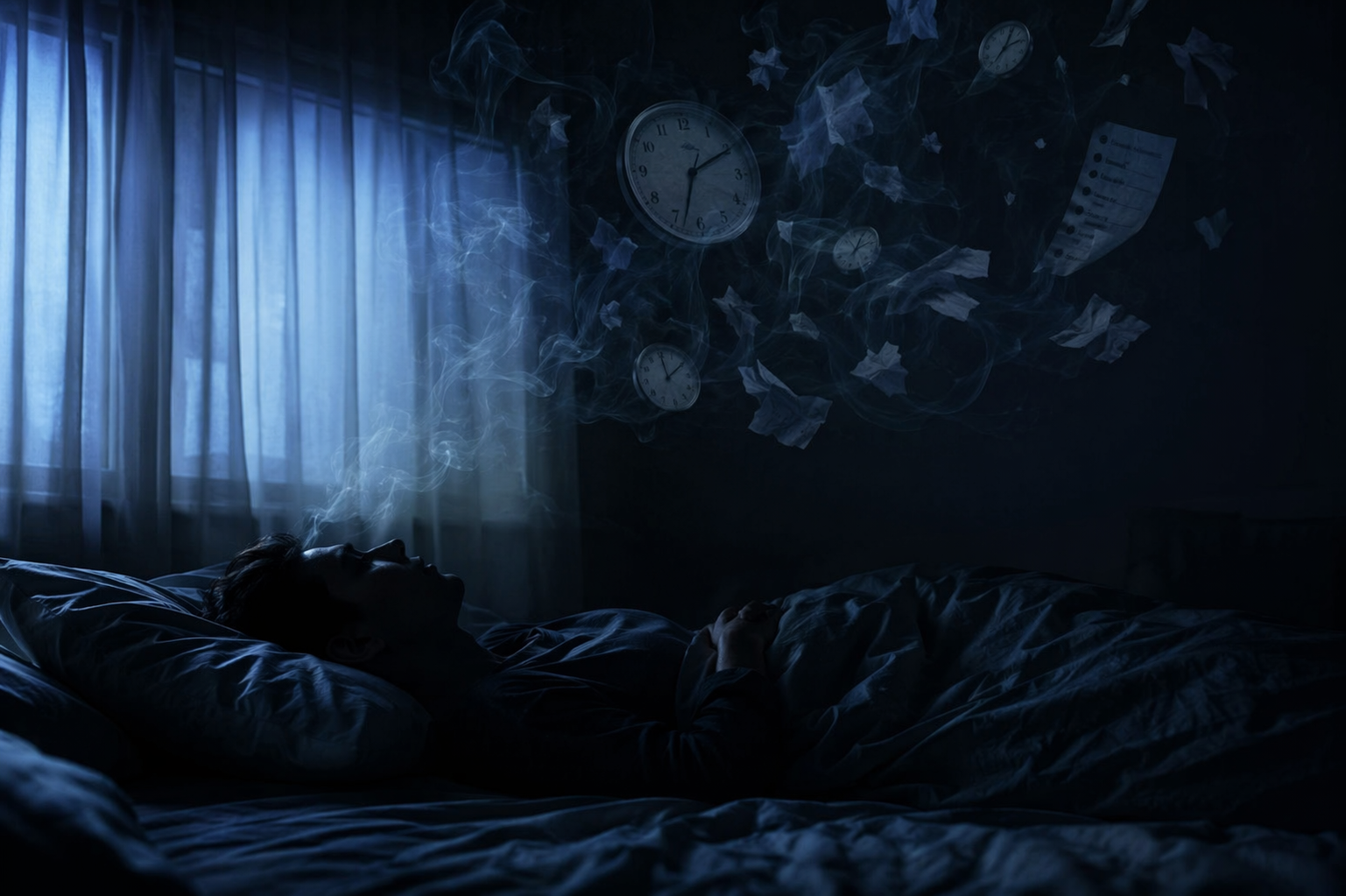
The storm may still be offshore, the shutters may not be up, and the forecast cone may not have shifted much since dinner. Still, bedtime starts to feel different. The phone is close enough to check. The window sounds louder than it should. A gust that would have been background noise last week now gets sorted as information. Sleep stops being a place to leave the day and starts looking like a time when something could change without you noticing.
That is the clearest answer to how hurricane anxiety affects sleep: storm cues can push the brain into a threat-monitoring state before direct danger arrives. For some sleepers, that state is especially sticky. The brain becomes more reactive to signs of possible harm, the body keeps arousal systems running, and sleep initiation and sleep maintenance both become harder. Then the lost sleep feeds back into the same threat system, making the next advisory, wind sound, or uncertainty feel more biologically urgent.
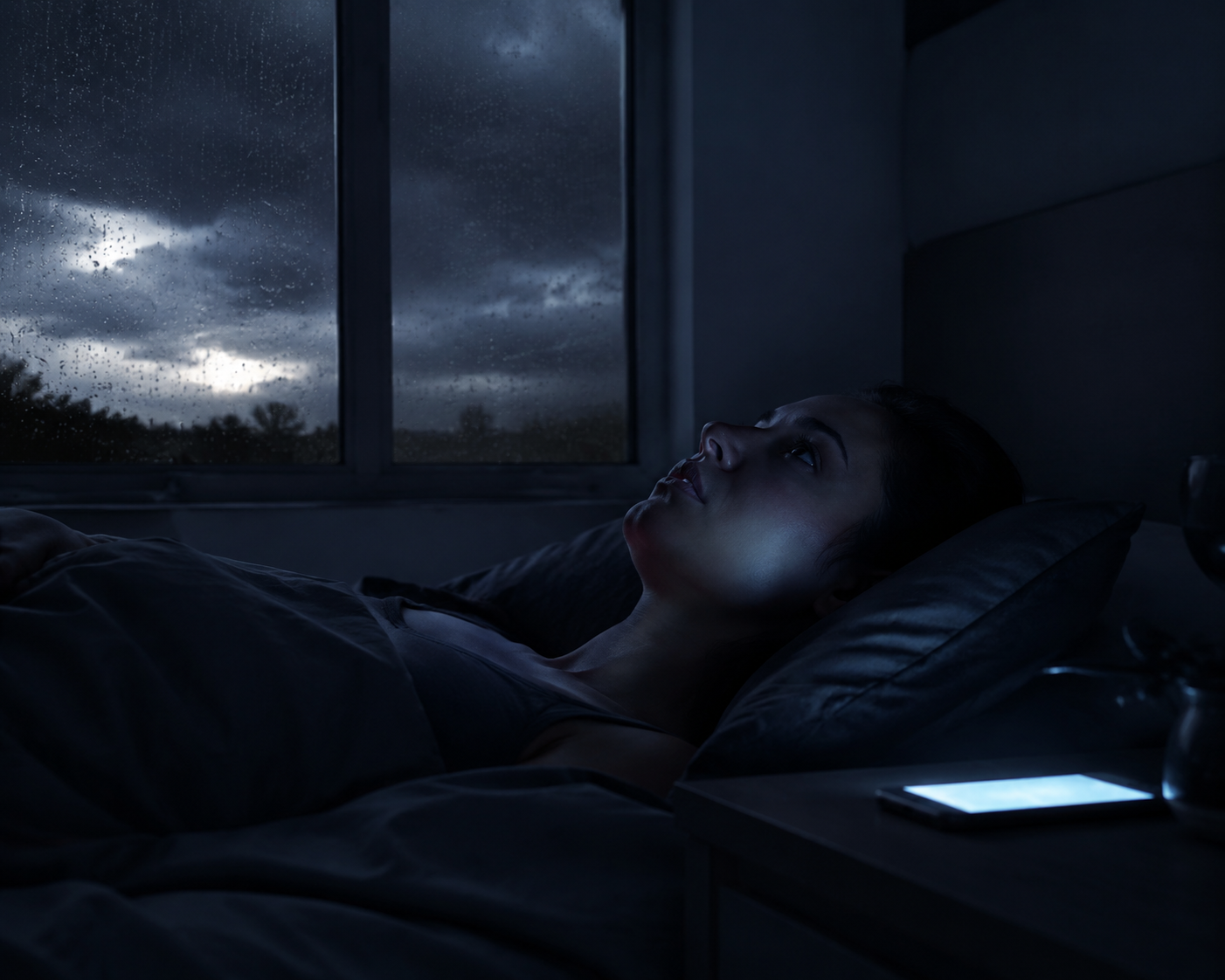
Why the bed starts to feel like a monitoring station
Hurricane anxiety is not just an idea in the mind. It has obvious practical content: evacuation timing, fuel, pets, elderly relatives, prescription refills, missed work, flood zones, trees, roof damage, power loss. The problem at night is that the brain does not need all of those outcomes to happen before it starts preparing for them.
Threat cues arrive through ordinary channels. A radar image, a push alert, a neighbor testing a generator, or rain beginning against the glass can become signals that deserve attention. In a reactive sleeper, those cues are less likely to fade into the background. They are more likely to recruit brain systems involved in detecting salience and anticipating harm, especially the amygdala and the insular cortex.
The amygdala is often discussed as a fear center, but that shorthand is too small for what matters here. It helps decide what deserves rapid attention. The insular cortex helps represent internal body states and anticipated discomfort. When those systems are turned up, a sleeper is not simply “thinking too much.” The body may be reading the night as a situation that still requires readiness.
From there, the stress response can keep moving through the hypothalamic-pituitary-adrenal axis and the sympathetic nervous system. Those systems support alertness, mobilization, and threat response. They are useful when a person needs to act. They are poorly matched to falling asleep, which depends on a lowered threshold for disengagement from the environment.
Sleep reactivity makes the difference between concern and insomnia
People in the same neighborhood can face the same forecast and have very different nights. One person checks the advisory, makes a plan, and sleeps lightly but adequately. Another lies there with the same information and cannot get the body to stand down. That difference is part of what sleep researchers call sleep reactivity: the tendency for stress exposure to disturb sleep.
Sleep reactivity is not the same as caring more, preparing less, or lacking discipline. A 2018 review in Nature and Science of Sleep described insomnia vulnerability and sleep reactivity as partly heritable, with estimates in the 29–37% range.[1] That does not mean a storm-season sleeper is genetically locked into insomnia. It means sensitivity varies, and some of that variation is built into the way the sleep system responds under stress.
This matters because hurricane season repeatedly presents exactly the kind of stressor that can expose sleep reactivity. The threat is uncertain, time-bound, updated often, and hard to fully resolve before bedtime. A person can do the right practical things and still be left with a nervous system that treats the night as unfinished business.
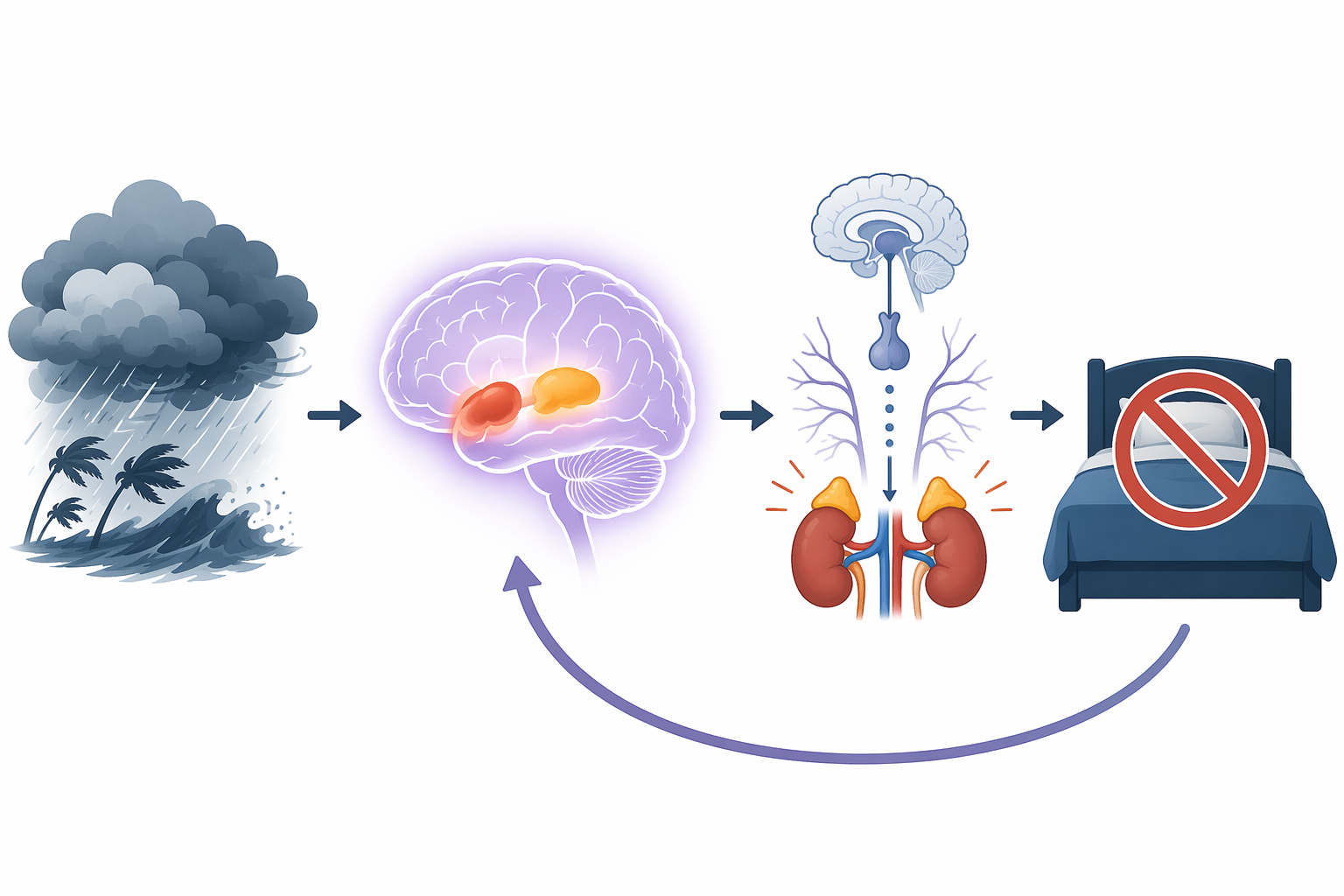
The path from storm cue to wakefulness
The pathway is easier to understand if the pieces stay in order. Hurricane-related cues increase threat monitoring. Threat monitoring activates brain regions that prioritize danger and body-state awareness. Those regions can sustain HPA-axis and sympathetic arousal. That arousal makes the sleeper more likely to delay sleep onset, wake more easily, and return to monitoring after waking.
| Part of the loop | What it changes at night |
|---|---|
| Storm cue | Forecast updates, wind, rain, alerts, or evacuation uncertainty become information the brain keeps sampling. |
| Threat reactivity | Amygdala and insular cortex activity can increase attention to danger and internal body signals. |
| Stress-system arousal | HPA-axis and sympathetic activation keep the body closer to readiness than rest. |
| Sleep disruption | Sleep onset takes longer, awakenings feel more significant, and returning to sleep becomes harder. |
| Next-day anxiety | Poor sleep can make the next round of threat cues feel sharper and harder to dismiss. |
That last step is the one many people recognize only after several bad nights. The first night may be understandable because the forecast changed. The second night may feel disproportionate. By the third, the person is not only responding to the storm; they are responding with a sleep-deprived threat system.
Poor sleep can make the next wave of anxiety stronger
The strongest mechanistic bridge here comes from a UC Berkeley fMRI study published in 2013. In that study, sleep deprivation amplified anticipatory anxiety and was associated with hyperactivation in the amygdala and insular cortex while healthy young adults anticipated disturbing images.[2] The boundary matters: this was not a study of hurricane-exposed residents lying awake during a landfall threat. It was a laboratory study using disturbing images, so applying it to hurricane anxiety requires inference from general anxiety and sleep-loss mechanisms.
Even with that boundary, the study helps explain a familiar storm-season pattern. A night of poor sleep does not simply leave someone tired. It can make the brain more reactive to the possibility of something bad happening. The next advisory may not be objectively worse, but it lands in a nervous system with less sleep behind it and less margin for uncertainty.
This is why hurricane anxiety and sleep loss can become bidirectional. Worry about the storm disrupts sleep. Reduced sleep then amplifies anticipatory anxiety. That heightened anxiety makes the following night more vulnerable, especially if the forecast remains unresolved or home conditions start to deteriorate.
High-reactivity sleepers are not imagining the pattern
The Ford Insomnia Response to Stress Test, often shortened to FIRST, was developed to measure sleep reactivity. In 2014, Drake and colleagues reported that people with high sleep reactivity were 2–3 times more likely to develop sleep-onset insomnia during major life stress.[3] A hurricane threat is not identical to every stressor in that research, but it fits the relevant category: a significant stress exposure with uncertainty, possible loss, and a need to remain ready.
Sleep-onset insomnia is especially important during storm season because the person may still be able to explain every individual delay. One more advisory. One more check of the county alert page. One more pass through the supply list. None of those actions is irrational by itself. The condition pattern appears when the sleep system repeatedly fails to disengage even after the useful decision points are over for the night.
That distinction keeps the problem from being minimized. The issue is not whether the storm is “worth” worrying about. The issue is whether the body has shifted into sustained arousal in a way that makes sleep biologically difficult. High sleep reactivity gives that experience a measurable frame instead of reducing it to personality.
Disaster studies show that the sleep problem is not confined to the lab
Population and clinical observations after disasters do not prove every step of the brain pathway, but they show why the pathway matters outside a scanner. After Hurricane Katrina, sleep-center findings presented through the American Academy of Sleep Medicine described sleep disturbance among people affected by the disaster.[4] The point is not that Katrina represents every hurricane season. It is that a major hurricane can leave sleep disturbance visible enough to appear in clinical sleep settings.
A Korean disaster victim panel study, with a sample of 1,358 people, also linked disaster exposure with poor sleep quality.[5] Within that analysis, typhoons—the regional equivalent of hurricanes—were the strongest predictor of poor sleep quality among disaster types.[5] That finding does not tell us what any single coastal resident will experience in a given season, but it supports the narrower conclusion that tropical-cyclone disasters are meaningfully associated with sleep disruption.
These disaster findings should not replace the mechanism. They do something more modest and useful: they keep the mechanism from sounding abstract. The lab evidence helps explain why sleep loss can amplify threat reactivity. The disaster evidence shows that sleep disruption appears in real communities after severe natural hazards, including hurricane-equivalent events.
Why storm-season sleep can stay disrupted after the immediate danger passes
A hurricane threat rarely ends cleanly at bedtime. Before landfall, uncertainty keeps changing. During the storm, noise, pressure changes, alerts, and power loss can keep the body alert. Afterward, the question may shift from “Will it hit?” to “Is the roof leaking?”, “When will power return?”, “Can I get to work?”, or “Is everyone reachable?” The content changes, but the monitoring demand can continue.
That helps explain why some people sleep poorly even once the map no longer looks frightening. The threat system may still be sampling the environment for evidence that conditions are safe enough to stand down. If sleep has already been shortened for several nights, the same brain that is supposed to evaluate safety is now doing so with reduced recovery.
There is also a memory component that does not require dramatic language. A person who has previously lost a roof, evacuated late, gone days without power, or cared for a medically vulnerable relative during an outage may not respond to a forecast cone as a neutral graphic. The cue carries practical history. The body can begin preparing before the person has consciously decided that this storm is different from the last one.
What the mechanism implies in practice
Understanding the mechanism changes the tone of the response. If hurricane anxiety affects sleep through threat-cue hyperarousal, then the sleep problem deserves to be treated as a real pattern, not as a nightly character test. The person lying awake may be dealing with a nervous system that is trying to protect them and overshooting the sleep window.
Practical choices still matter. It can help to separate actual decision points from repeated monitoring, to move necessary preparedness earlier in the day when possible, and to notice which cues keep reactivating the body after useful action is done. But those choices work best when they are matched to the biology: the goal is not to pretend the storm is harmless; it is to reduce unnecessary threat signaling once the next reasonable action has already been taken.
For some people, especially those with repeated storm exposure, panic symptoms, trauma history, or insomnia that continues outside storm season, this pattern may need more than self-management. Cognitive behavioral therapy for insomnia, anxiety-focused treatment, and disaster-related mental health support all make more sense when the pattern is treated as more than ordinary worry.
Related reading on tropical storm sleep barriers, tornado-watch anxiety, earthquake-related CBT-I, flood emergencies, loneliness and hypervigilance, and wildfire smoke can all sit beside this topic because they share part of the same terrain. Different hazards use different cues, but the sleep system often struggles when the night becomes a surveillance task.
Hurricane anxiety affects sleep because reactive sleepers can experience storm cues as biologically urgent long before direct danger arrives. The amygdala and insular cortex help turn those cues into threat monitoring; the HPA axis and sympathetic nervous system help keep the body ready; sleep becomes harder to enter and easier to lose. Once sleep is shortened, the next wave of anxiety has a louder system to work with.
References
- Genetic and environmental influences on sleep reactivity and insomnia vulnerability, Nature and Science of Sleep, 2018, link
- Tired and Apprehensive: Anxiety Amplifies the Impact of Sleep Loss on Aversive Brain Anticipation, Journal of Neuroscience, 2013, link
- Sleep Reactivity and Insomnia: Genetic and Environmental Influences, Sleep, 2014, link
- Sleep Disturbances Following Hurricane Katrina, American Academy of Sleep Medicine, 2007, link
- Disaster experience and sleep quality among disaster victims: A panel data analysis, PMC, link
Comments
Join the discussion with an anonymous comment.