
A Jersey Shore tornado warning at bedtime is not a cue to lie in bed and “keep an eye on it.” It means a tornado has been indicated by radar or reported, and you should move to shelter immediately. A tornado watch is different: conditions are favorable, so you can sleep if your alerts are set up to wake you and your shelter plan is already decided.
That distinction mattered on Long Beach Island on July 16, 2026, when a severe storm hit during a tornado warning, bringing flooding, hail, and an 84 mph wind gust recorded at Surf City Yacht Club. That was not a confirmed tornado strike; it was the kind of coastal severe-weather night that exposes a practical problem: many Shore houses do not have basements, and many people inside them are renters, guests, children, older adults, or half-asleep family members who need simple instructions fast.[1]
The Night Rule: Sleep During a Watch, Shelter During a Warning
If the alert on your phone says tornado watch, your job before bed is to make sure you will wake up if the situation changes. Charge the phone. Turn the ringer on. Place a weather radio where it can be heard from the bedroom. Decide where everyone will go. Then sleep.
If the alert says tornado warning, sleep waits. The National Weather Service’s tornado safety guidance is blunt: go to a basement if one is available, or to a small interior room on the lowest floor, away from windows.[2] At the Shore, the basement part often does not apply. The action still does.
| Alert | What It Means Tonight | What To Do Before Sleeping |
|---|---|---|
| Tornado watch | Conditions could produce tornadoes | Sleep only after alerts, shelter, and household instructions are set |
| Tornado warning | A tornado is indicated or reported | Move immediately to the safest available shelter area |
The hard part is not understanding the vocabulary in the afternoon. The hard part is acting on it at 1 a.m., when the hallway is dark, the rental layout is unfamiliar, and the person who knows where the flashlights are may be sleeping in another room.
Why Overnight Warnings Need More Than Willpower
Trying to stay awake all night is a fragile safety plan. People fall asleep. Phones get set to silent. Guests assume the host is watching the weather. A tired person may waste the first minute deciding whether an alarm is serious, then another minute finding glasses, shoes, or a child’s bedroom.
Nighttime tornadoes are more dangerous in part because people are asleep, visibility is lower, and warnings must interrupt normal household routines. Weather.com, citing recent tornado-safety research, reported in March 2026 that nocturnal tornadoes are nearly twice as deadly as daytime events, and that the share of tornado fatalities occurring at night has risen from 34% to 38% over the last 30 years.[3]
Warnings can still provide useful time. National Weather Service statistics cited in tornado-safety material from Oklahoma indicate that 97% of the most dangerous tornadoes, rated EF3 to EF5, are preceded by a tornado warning, with about 16 minutes of average advance notice.[3] Sixteen minutes is generous only if the household has already answered the basic questions: who wakes whom, where everyone goes, and what has to be grabbed in the dark.
Set Up Alerts That Can Actually Wake You
For overnight tornado risk at the Jersey Shore, this is the first non-negotiable step: do not depend on one device. A phone can die. A guest can turn on Do Not Disturb. A weather app can be muted. A summer rental can have thick walls, window air conditioners, and fans that make a quiet alert useless.
Use at least two alert paths before going to bed during a tornado watch or a severe overnight setup:
- NOAA Weather Radio with battery backup, placed where the alarm can be heard from sleeping areas.
- Wireless Emergency Alerts enabled on every smartphone in the house.
- A trusted weather app with severe weather notifications turned on for the exact town or island where you are sleeping.
- At least one phone charging outside silent-only habits, with volume high enough to cut through fans, air conditioning, and closed bedroom doors.
The National Weather Service, American Red Cross, and CDC all emphasize moving quickly to appropriate shelter during tornado warnings, but that advice depends on receiving the warning in time.[2][4][5] For an overnight Shore household, “alerts are on” is not enough. Stand in the bedroom, close the door, turn on the fan or air conditioner you will actually use, and confirm the alert source is loud enough to wake someone from real sleep.
If several people have phones, do not make one person the entire warning system. Keep alerts enabled on multiple devices. If an older adult is sleeping in a back bedroom, or children are in bunk beds at the other end of a rental, decide before bed who is responsible for waking them. The person who gets the alert should not have to invent a chain of command while the warning clock is already running.
Do Not Let Sleep Settings Defeat the Plan
Phone settings deserve a real check, not a guess. Confirm that emergency alerts are enabled. Confirm that the weather app has permission to send notifications. Confirm that location settings are correct if you are staying in a rental away from your usual home. Then plug the phone in close enough to hear but not so far under a pillow or blanket that the sound is muffled.
A NOAA weather radio with battery backup is especially useful in a Shore house because it does not depend on one person’s phone habits. If cell service is spotty, a phone battery fails, or a guest silences an app, the radio is still there as a separate alarm. Put fresh batteries in it before the storm window, not after thunder starts.
Choose the Safe Room Before Bed, Not After the Alert
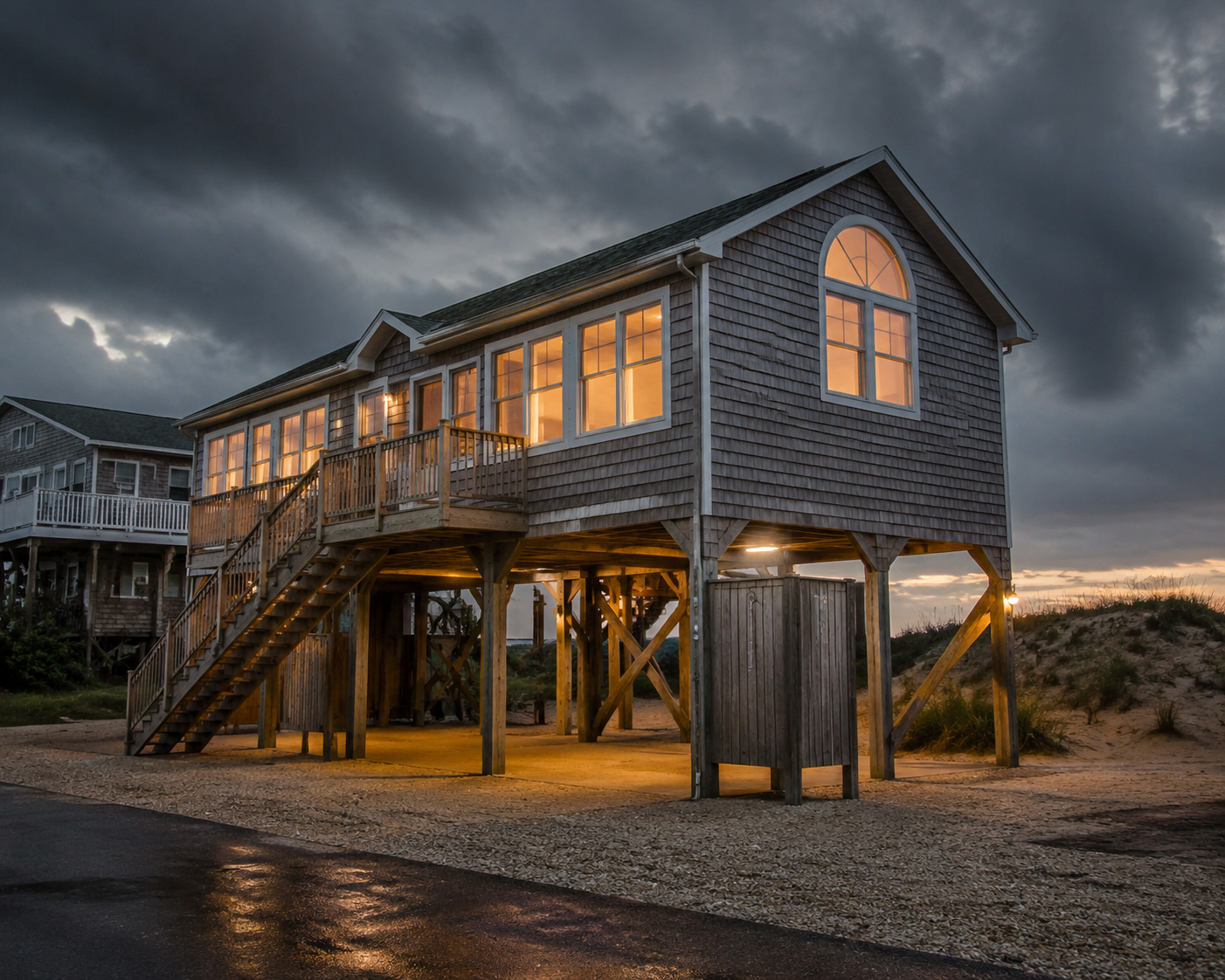
Generic tornado advice often begins with “go to the basement.” Along much of the Jersey Shore, especially on barrier islands, that may be impossible. Basements are uncommon in many coastal and barrier-island homes because the high water table and flood exposure make them impractical. Raised houses, narrow cottages, duplex rentals, and homes built over parking or storage space need a different version of the same safety principle: get as low as practical, as interior as practical, and away from glass.
Walk the house while you are fully awake. Look for the lowest usable level that is enclosed and structurally part of the living space. In many raised Shore homes, that may be the first occupied floor rather than the open area under the house. Avoid rooms with large windows, sliding glass doors, skylights, and exterior walls. A small interior bathroom, hallway, closet, or laundry area may be better than a larger bedroom with ocean-facing windows.
The CDC advises getting to the lowest level of a building and staying away from windows during a tornado; the Red Cross similarly recommends a basement, storm cellar, or interior room on the lowest floor when no underground shelter is available.[4][5] At the Shore, that often means accepting “best available” rather than “perfect.” The point is to remove the delay caused by searching for a nonexistent basement in the middle of the warning.
| Shore Housing Situation | Better Overnight Shelter Choice | Avoid |
|---|---|---|
| Raised beach house with no basement | Small interior room on the lowest occupied floor | Open area under the house, decks, rooms with large windows |
| Narrow cottage or older summer house | Interior hallway, closet, or bathroom away from windows | Front porch, sunroom, glass doors |
| Multi-story rental | Lowest practical interior room everyone can reach quickly | Top-floor bedrooms during a warning |
| Mobile home or very lightweight structure | A sturdier nearby building or designated shelter if it can be reached before storms arrive | Waiting until the warning to figure out where to go |
Mobile homes require special caution. Tornado safety guidance from the National Weather Service and Red Cross warns against staying in mobile homes during tornado conditions when a safer shelter is available.[2][5] If you are sleeping in one during a tornado watch, identify a sturdier shelter before bedtime and decide how you will get there before the storm reaches the area. Do not plan on driving around during a warning in wind, flooding rain, and poor visibility.
When Coastal Flooding Is Also in the Forecast
Shore storms can layer hazards. The July 16 LBI storm brought flooding along with severe wind during the warning window.[1] That does not change the tornado rule to move away from windows and into the lowest safe interior space, but it does affect choices made earlier. If the only low area is flood-prone, exposed, or underneath an elevated house, choose the safest enclosed interior room in the occupied structure instead. A plan that ignores water is not a Shore plan.
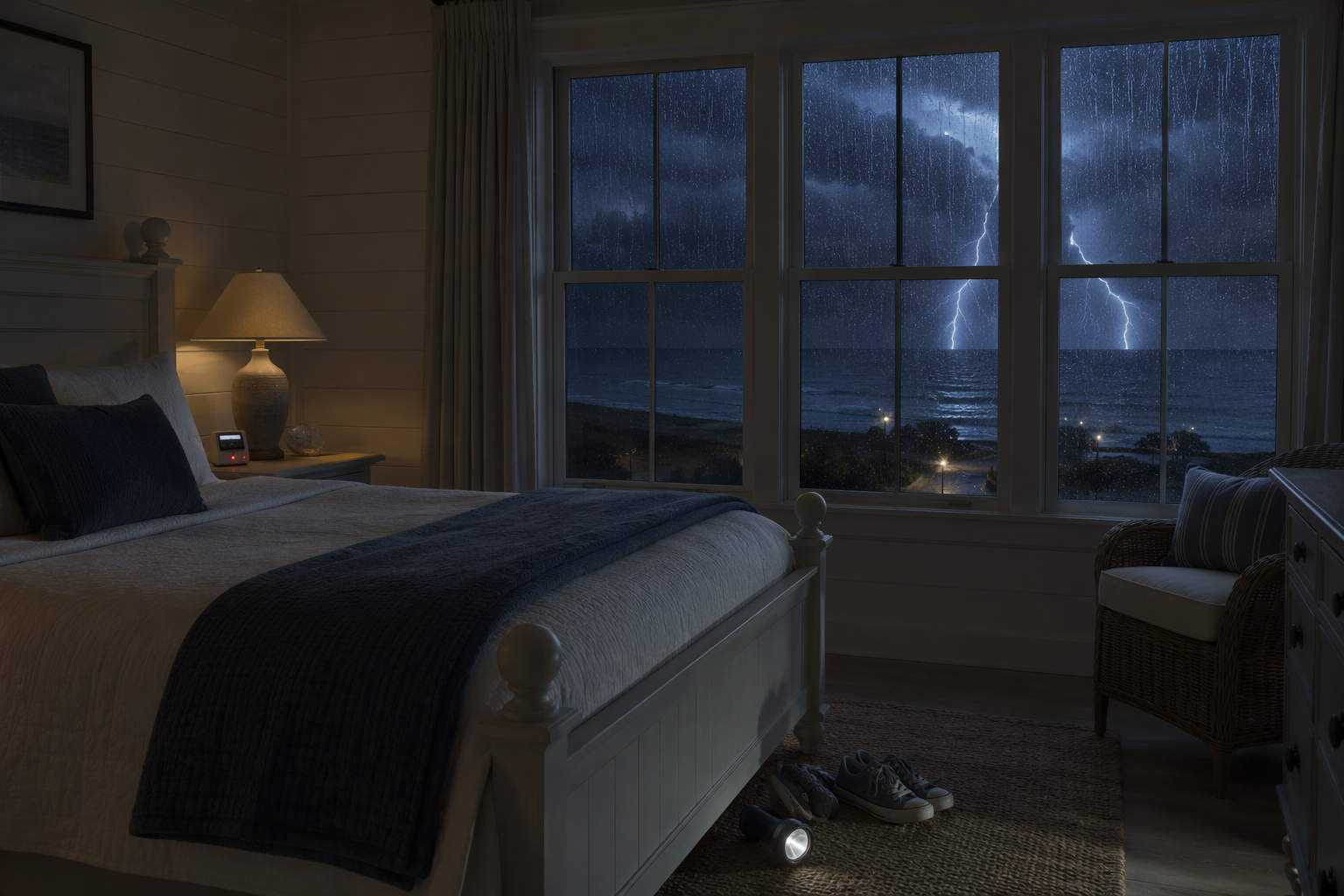
Stage the Bedroom So Half-Asleep People Can Move
Once alerts and shelter are settled, the bedroom setup should reduce friction. This is not about packing for a disaster movie. It is about removing the small delays that make a short warning feel shorter.
- Place closed-toe shoes beside the bed so no one walks through broken glass barefoot.
- Keep a flashlight within arm’s reach, with working batteries.
- Put a bicycle helmet or construction helmet near each sleeper if available.
- Move bags, beach chairs, laundry baskets, and toys out of the path to the safe room.
- Keep blankets or pillows in or near the shelter area to protect heads and bodies from debris.
- Sleep on the lowest practical floor, closest to the identified shelter room, when storms are possible overnight.
Helmets are not magic, but head protection is sensible when the main concern is debris. The CDC recommends covering your head and neck during a tornado, including with your arms and available protective materials.[4] A helmet beside the bed is useful because it is easy to grab without opening a closet or turning on every light in the house.
The cleared path matters more than it sounds. Shore rentals often collect obstacles in exactly the wrong places: flip-flops by the door, coolers in the hallway, charging cords across the floor, suitcases half-open near the beds. Move them before sleep. A warning at night should trigger motion, not housekeeping.
Tell Everyone the Plan in One Minute
A household plan does not need a meeting. It needs one clear sentence repeated before people scatter to bedrooms: “If a tornado warning goes off, we go to the first-floor interior bathroom; shoes on, helmets if you can grab them, no one goes outside.”
For a rental, add directions that match the actual house: which staircase, which hallway, which door sticks, which room has no windows. Visitors should not have to remember the architecture under stress. Children need to know whether an adult will come get them or whether they should move immediately to the safe room. Older adults may need shoes, glasses, medication, or a mobility aid staged in a predictable place.
Hosts have a particular responsibility here. If you invited people to a Shore house, do not assume they understand the layout, the local alert names, or the reason a raised home has no basement. Give them the safe-room plan the same way you would point out the Wi-Fi password or the spare key.
What To Do When the Warning Sounds
When the warning wakes you, do not spend the first minute checking multiple radar screens from bed. Wake the assigned people, put on shoes if they are beside you, grab the flashlight and helmet if they are within reach, and move to the chosen shelter room. Stay away from windows. Get low. Cover your head and neck with arms, pillows, blankets, or a helmet.
If you are already in the safe room, stay there until the warning expires or trusted local alerts say the immediate danger has passed. Do not step onto a deck or under the house to look at the sky. Nighttime storms remove the one thing curiosity depends on: visibility.
If the safest room is crowded, crowded is acceptable. A small bathroom with too many people is still usually better than separate bedrooms with windows. If a pet is easy to grab, bring it; if chasing the pet would delay people, get the people sheltered first.
How Much Should New Jersey Worry About Tornadoes?
New Jersey is not Oklahoma, and treating every summer thunderstorm like a tornado emergency would wear people down quickly. Rutgers Climate Lab’s New Jersey tornado climatology lists a historical average of about two tornadoes per year in the state from 1950 to the present.[6] That is enough to take warnings seriously without pretending tornadoes are the dominant Shore hazard every week.
Recent severe-weather days still deserve attention. On June 22, 2026, forecasts called for severe thunderstorms with a tornado possible across New Jersey, and less than a month later the LBI storm arrived during a tornado warning.[7][1] Those events do not prove a new local normal by themselves. They do show why a bedtime routine for warnings belongs in the same practical category as knowing the evacuation route, the flood-prone streets, and where the flashlights are.
If Storm Anxiety Keeps You Awake
Some people will not sleep easily under a tornado watch, especially after a loud recent storm or a close warning. The National Weather Service’s storm-anxiety guidance recognizes that severe weather can cause real distress and recommends using reliable information, having a plan, and avoiding rumor-driven monitoring.[8]
Preparation is not a guarantee, and it should not be sold as one. It is a way to stop asking the same questions in the dark. Once the alerts are loud, the safe room is chosen, the path is clear, and everyone knows the plan, staying awake to refresh radar every few minutes usually adds less safety than people think. It may simply make the next decision slower.
Safe sleep during a Jersey Shore tornado warning is not deep relaxation through danger. It is rest made possible by decisions already made before the phone screams: the alert can wake you, the room is already picked, the shoes and flashlight are beside the bed, and the household knows where to go.
References
- Wild storm brings hail, 75 mph wind gusts and flooding to Jersey Shore during tornado warning, NJ.com, July 17, 2026
- Tornado Safety, National Weather Service
- Nighttime Tornadoes Are More Likely To Be Deadly, Weather.com, March 9, 2026
- Stay Safe During a Tornado, CDC
- Tornado Safety, American Red Cross
- New Jersey Tornado Climatology, Rutgers Climate Lab
- Severe thunderstorms, tornado possible across New Jersey today, Asbury Park Press, June 22, 2026
- Storm Anxiety, National Weather Service





Comments
Join the discussion with an anonymous comment.