
If a flood alert wakes you up at night, do not start by asking whether you are being dramatic. Start with the alert type. For anyone searching “how to sleep during flood warning” from bed, the safe answer is blunt: if this is an active flood warning, flash flood warning, flash flood emergency, a high-risk flood location, a weak alert setup, or a situation you cannot clearly identify, do not go back to normal sleep. Stay awake, monitor official updates, and be ready to leave.
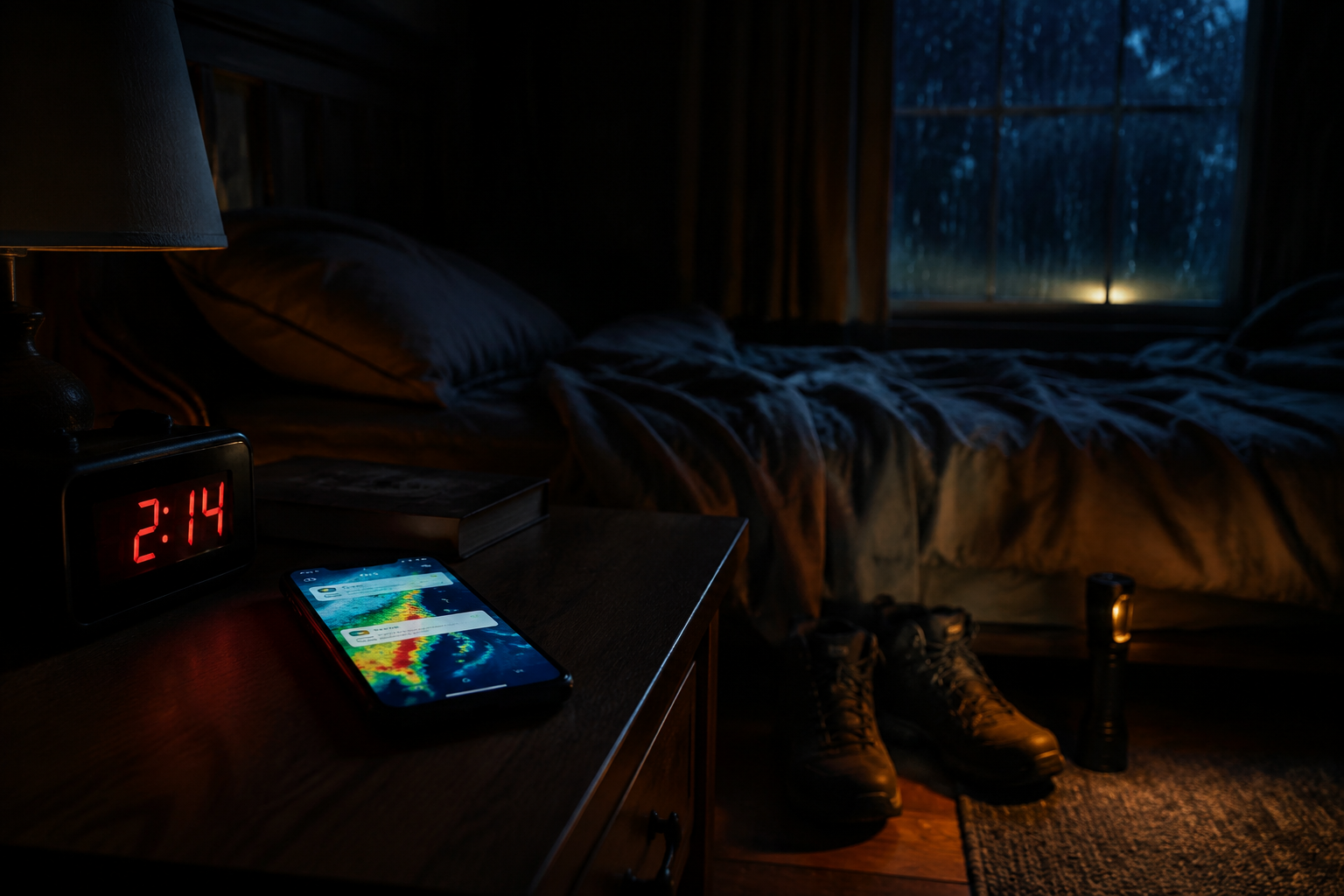
Night is the bad time to bargain with water. The National Weather Service puts the reason plainly: “Be especially cautious at night — it is harder to recognize flood dangers.” A road that looked passable at dinner can be covered after midnight; a ditch or creek you normally ignore can be invisible in rain and darkness; a half-awake person can miss the difference between “watch” and “warning.” [1]
There is a narrower situation where sleep may be reasonable: the alert is watch-level, not warning-level; your home is not in a mapped or obvious flood-prone location; you have more than one alarm system that can wake a sleeping person; and your room is staged so you can leave quickly. Even then, think shift sleep, not deep, everyone-unconscious sleep.
First, identify what alert woke you up
The public confusion point is simple and dangerous: a watch and a warning are not two versions of the same message. They are different instructions.
| Alert language | What it means for sleep |
|---|---|
| Flood Watch or Flash Flood Watch | Conditions are possible. You may be able to use staged, shift-based sleep if every other safety factor is favorable. |
| Flood Warning | Flooding is occurring or will occur soon. Do not treat this as a routine night of sleep. |
| Flash Flood Warning | Act now. Flash flooding is occurring or imminent, and rapid water rise can leave little decision time. |
| Flash Flood Emergency | This is the highest-end message for severe threat to life and catastrophic damage. Sleeping through it is not a safety plan. |
Use the source alert, not a neighbor’s summary or a social post. Check the National Weather Service alert text, your local emergency management feed, NOAA Weather Radio, or the weather app notification itself. If the wording says warning, emergency, “move to higher ground,” “avoid travel,” or “act now,” the decision has already moved out of the normal-sleep category. [1]
A watch can still keep you awake. Uncertainty is its own alarm bell, and weather-event anxiety often spikes before anything visible happens outside. That does not mean every watch requires an all-night vigil; it means the rest of the safety system has to carry the monitoring load. The same hyperarousal pattern shows up with other nighttime alerts, including tornado watch sleep disruption, where the body reacts to “possible” as if it were already “now.”
Use four checks before you decide
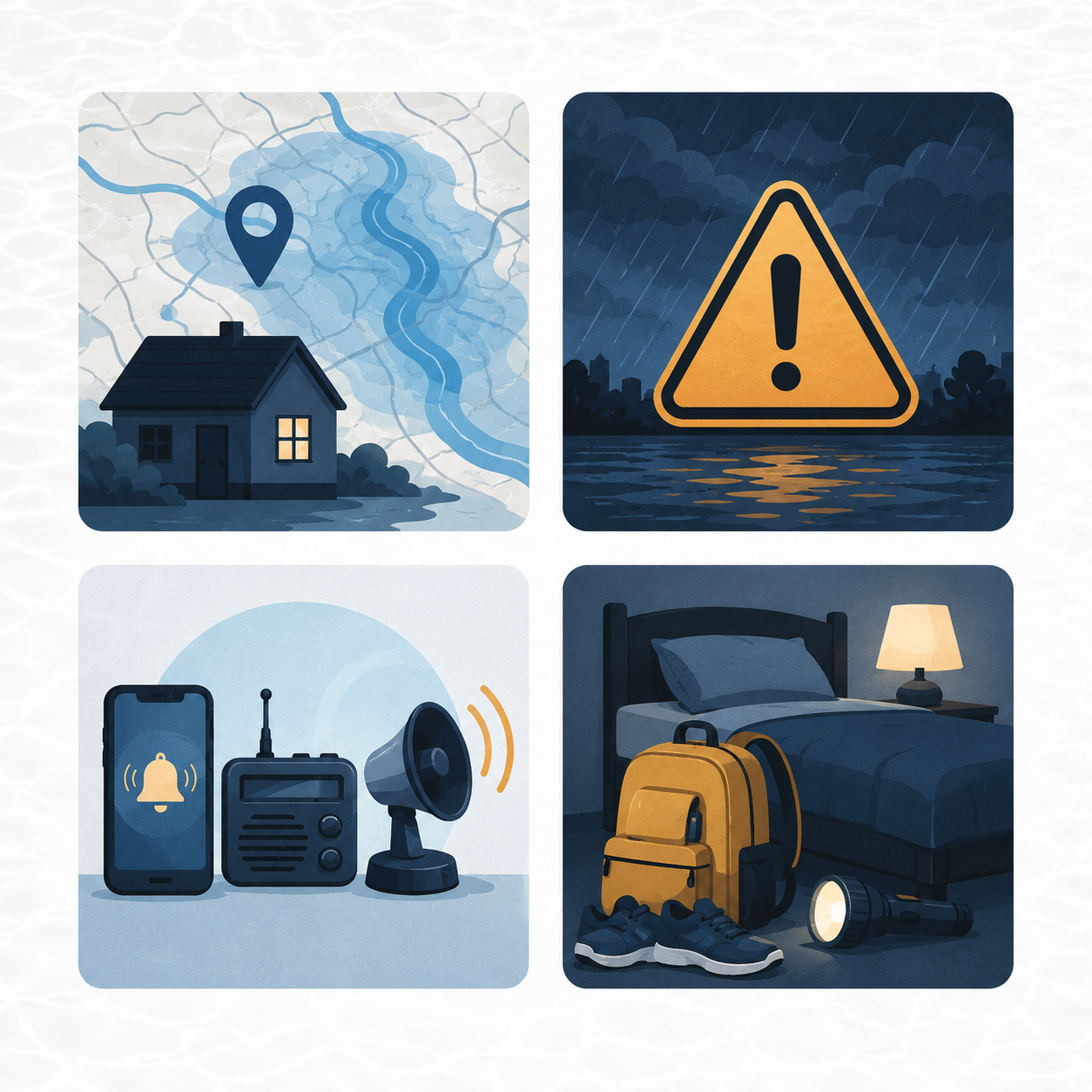
A safe nighttime decision is not based on whether the rain sounds lighter. It is based on four checks you can make quickly: where the house sits, what the alert says, whether alarms can wake you, and whether the bedroom is ready for evacuation.
1. Locate your home risk, not your mood
Pull up your address in FEMA’s Flood Map Service Center if you do not already know your mapped flood risk. FEMA recommends knowing your flood risk and using flood maps as part of household preparation. [2]
The map is not the only clue. A basement apartment, a home beside a creek, a low-water crossing at the end of the street, a mobile home park near a drainage channel, or a road that has flooded before all deserve more caution than a house on higher ground. If you cannot confirm the location risk because the power is out, the site will not load, or you are new to the area, treat that uncertainty as a failed check.
This is where flood risk differs from general storm fear. Flash floods kill an average of 88 people per year in the United States, and most flood deaths occur in vehicles, according to NOAA’s National Severe Storms Laboratory. A person already on high ground in a sturdy home faces a different decision than someone who would need to drive across low water at 2 a.m. [3]
2. Let the alert severity overrule your sleepiness
A flash flood warning is not a suggestion to check again after one more sleep cycle. It means conditions are dangerous enough that action may be needed now. If the alert is for your immediate area, stay awake. If officials tell you to evacuate, move to higher ground, or avoid a flooded route, follow that instruction rather than trying to finish the night at home. [1]
Do not use your past luck as evidence. Many people have slept through heavy rain before. That history does not tell you whether this particular basin, storm track, culvert, creek, or road is behaving tonight.
The physical thresholds are smaller than tired brains like to believe. Six inches of moving water can knock an adult off their feet, and 12 inches can carry away many cars. Those numbers matter because the sleepy mistake is often not “I ignored a disaster.” It is “I thought I could make it across.” [4]
3. Make sure alerts can wake a sleeping person
An alert system does not count because it exists on your phone. It counts if it is loud enough, charged enough, enabled enough, and close enough to wake you.
- Keep Wireless Emergency Alerts enabled on your phone, with the phone charged and volume settings checked.
- Use a weather app that sends audible warnings, not only silent banners.
- Consider a NOAA Weather Radio with SAME coding so alerts can be targeted to your county and wake the room only when relevant warnings are issued.
- If two adults are home, assign one person as the first listener for a defined block of time rather than assuming both of you will somehow wake up.
NOAA Weather Radio is useful because it can sit on the nightstand and sound for official warnings, including alerts set through Specific Area Message Encoding. It is not magic. Reception can be affected by transmitter range, terrain, steel construction, basement placement, and where the radio sits in the house, so test it before you rely on it for sleep. [1]
4. Stage the bedroom as if leaving may become necessary
Evacuation-ready sleep is not normal sleep with a weather tab open. It is a room arranged so nobody has to hunt for shoes, glasses, keys, medication, a leash, or a flashlight while water is rising or an evacuation message is sounding.
- Sleep on the highest safe floor available, not in a basement or lowest-level room during flood risk.
- Put shoes, flashlight, phone, charger, keys, wallet, glasses, and essential medication within arm’s reach.
- Place a go-bag where you can grab it in the dark.
- Know the route to higher ground before you lie down, including which roads you will not take if water is over them.
- Keep pets, children, and mobility needs in the plan, not as an afterthought once an alert escalates.
The route matters as much as the room. Since most flood deaths happen in vehicles, the wrong overnight plan can create more danger by sending a half-awake driver onto flooded roads. If local officials are telling people to stay put on higher ground, do not improvise a drive through water to “get ahead of it.” [3]
When shift sleep is a reasonable compromise
If all four checks are favorable, sleep does not have to mean the whole household goes offline. It can mean controlled rest while the safety system stays awake.
| Condition | Minimum standard before sleeping |
|---|---|
| Location | Home is outside the known high-risk flood area, not in a basement or low-lying structure, and has a safe vertical refuge or route. |
| Alert | Current message is watch-level only for your area, with no active warning or emergency. |
| Alarms | At least two wake-capable alert systems are working, charged, audible, and near the sleeping area. |
| Room setup | Shoes, light, phone, keys, medicine, go-bag, and route plan are ready before anyone sleeps. |
| Human monitoring | One adult is the designated listener for a set period, or sleep is staggered so someone can respond quickly. |
That kind of sleep may be shallow and interrupted. That is still useful. The goal is not perfect sleep hygiene; it is to prevent the worst combination: everyone exhausted, every device muted, no shoes ready, no route chosen, and a warning treated like background noise.
Preparedness can also lower distress, though the evidence should not be stretched into a promise that sleeping through flood risk is safe. One flood-related study found that lack of warning before a flood was associated with higher anxiety and PTSD scores among affected people. That supports the practical value of warning and preparation; it does not prove that a prepared person can ignore an active warning. [5]
If storm fear has been building for days, the sleep problem may not start with the alert tone. People often move through anticipation, impact, and aftermath with different kinds of arousal; that pattern is familiar in hurricane anxiety and sleep disruption as well. Still, in the middle of the night, emotional reassurance comes after the safety checks, not before them.
When staying awake is the safer answer
Stay awake and monitor if any one of these is true: the alert is a flood warning, flash flood warning, or flash flood emergency for your area; you are in a mapped flood zone or low-lying place; you cannot confirm your risk; you have only one fragile alert source; you would need to drive through flood-prone roads to leave; or your evacuation items are scattered around the house.
An overnight vigilance plan can be simple. Turn on official alerts. Keep the phone charging. Put the weather radio where it receives. Move people out of basement rooms. Put shoes on or beside feet. Open the local emergency management page. Decide who is awake for the next block of time. If authorities order evacuation, leave by the safest available route and never drive through water.
This is also the point to stop doom-scrolling. Social feeds can lag, contradict each other, or reassure the wrong neighborhood. The hierarchy is official warning text, local emergency management instructions, local forecast office updates, then everything else.
The sleep loss may feel costly, especially if you work early or care for others. But a single night of monitored rest is different from the sleep disruption that can follow disaster exposure. After the 2010 Haiti earthquake, 94% of surveyed survivors reported insomnia symptoms, according to the American Academy of Sleep Medicine; that evidence is earthquake-specific, not flood-specific, but it shows how strongly disasters can disturb sleep once safety is broken. [6]
For people whose weather anxiety remains high outside the immediate event, preparedness routines, reliable information, and support can help reduce the cycle of fear. The National Weather Service’s storm anxiety guidance emphasizes planning and knowing where to get warnings; that is useful after the acute flood threat is over, not a substitute for acting during one. [7]
Once the safety framework is complete, it may help to understand why your body is still keyed up even if the worst of the storm misses you. Severe weather can disrupt sleep through stress arousal and other physiological pathways, which is covered more broadly in severe-weather sleep science. During an active flood threat, though, the body’s alarm may be annoying and useful at the same time.
The decision
You can consider sleeping only when the alert is watch-level, your location risk is low, redundant wake-up alerts are working, and the bedroom is ready for a fast exit. Make it shift sleep if another adult is present.
If the alert is a warning or emergency, if the home is flood-prone, if alarms may not wake you, or if you are unsure what is happening, stay awake and monitor. Uncertainty is not a loophole. At night, uncertainty is one of the reasons not to sleep.
References
- During a Flood, National Weather Service.
- 7 Flood Safety Tips, FEMA.
- Severe Weather 101: Floods, NOAA National Severe Storms Laboratory.
- Flood Safety, American Red Cross.
- Flood warnings and mental health: exploring the association between flood warnings and anxiety and PTSD scores, International Journal of Environmental Research and Public Health, 2020.
- Disturbed sleep linked to mental health problems in earthquake survivors, American Academy of Sleep Medicine.
- Storm Stress and Anxiety, National Weather Service.



Comments
Join the discussion with an anonymous comment.