
A person with Lewy body dementia may shout, punch, or kick during a dream, then spend the next morning unable to stay awake. Another may lie awake for hours, wake repeatedly, or stop breathing in a way no one noticed until the bed partner started listening for it. Calling all of this “sleep problems” is tidy, but it is not very useful. In Lewy body dementia, sleep disturbance can be early, frequent, dangerous, and diagnostically meaningful.
Across Lewy body dementia, up to 90% of patients have at least one significant sleep disturbance, compared with about 40% in Alzheimer’s disease.[1] That gap matters because the sleep complaint is often not a side nuisance waiting behind memory loss. In dementia with Lewy bodies, some sleep features can appear before major cognitive decline and can help separate DLB from Alzheimer’s disease, depression, medication effects, and ordinary exhaustion.
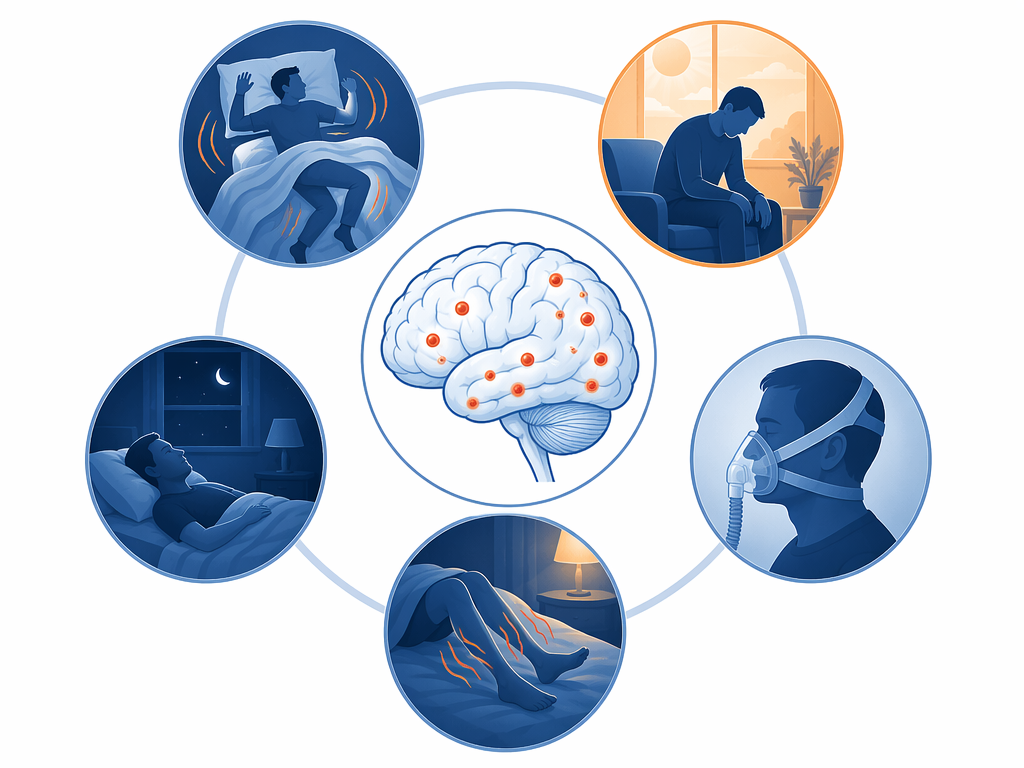
The practical task is to name the disorder. REM sleep behavior disorder, excessive daytime sleepiness, insomnia, obstructive sleep apnea, and restless legs syndrome do not share one mechanism or one treatment. A safer bedroom will not treat apnea. CPAP will not stop dream enactment. A sedating drug may quiet a night while worsening falls, confusion, or daytime sleepiness. The first useful question is not “How do we improve sleep?” but “Which sleep disorder is this?”
Why sleep is so fragile in Lewy body dementia
Lewy body dementia is an umbrella term that includes dementia with Lewy bodies and Parkinson’s disease dementia. The distinction is not academic when sleep is the problem. Much of the strongest sleep data comes from DLB cohorts, while PDD may have a somewhat different pattern, including more restless legs syndrome in some reports.[1] A caregiver does not need to memorize every subtype, but clinicians should be careful about applying a DLB statistic to every person with LBD as if the evidence were uniform.
The sleep disruption fits the anatomy of the disease. Dream enactment is tied to degeneration in pontomedullary circuits that normally keep muscles quiet during REM sleep, including the subcoeruleus or SLD region and ventromedial medulla.[1] Daytime sleepiness has been linked to degeneration in wake-promoting and arousal systems, including the nucleus basalis of Meynert, locus coeruleus, and ventral periaqueductal gray.[1] Severe fragmentation appears more often when Lewy body pathology has reached neocortical stages; in one pathology-based analysis, excessive daytime sleepiness was present in 52% of people with neocortical Lewy body pathology versus 10% with brainstem-only pathology.[1]
| Sleep disorder | What caregivers often notice | First clinical move |
|---|---|---|
| REM sleep behavior disorder | Shouting, punching, kicking, falling out of bed, or injuring a bed partner during dream enactment | Make the sleep space safe; ask about RBD and whether video-polysomnography or treatment is needed |
| Excessive daytime sleepiness | Sudden naps, dozing during conversation or meals, sleeping despite adequate time in bed | Review medications and nighttime sleep; consider objective sleepiness testing or targeted treatment |
| Insomnia and fragmentation | Long awakenings, repeated nighttime wandering or wakefulness, very little consolidated sleep | Look for pain, urinary symptoms, RBD, apnea, medication timing, and realistic behavioral supports |
| Obstructive sleep apnea | Snoring, witnessed pauses, gasping, morning headaches, or persistent sleepiness | Refer for sleep testing and discuss whether CPAP can be supported at home |
| Restless legs syndrome | Urge to move the legs at rest, worse in the evening, relieved by movement | Check iron status, including ferritin, before jumping to medication |
REM sleep behavior disorder: the clue that can also hurt someone
REM sleep behavior disorder is the LBD sleep symptom that most urgently needs to be recognized. In normal REM sleep, the brain is active while most skeletal muscles are effectively switched off. In RBD, that REM atonia fails. The person may talk, shout, grab, punch, kick, leap from bed, or appear to fight an attacker in a dream. The bed partner may be the first injured person in the story.
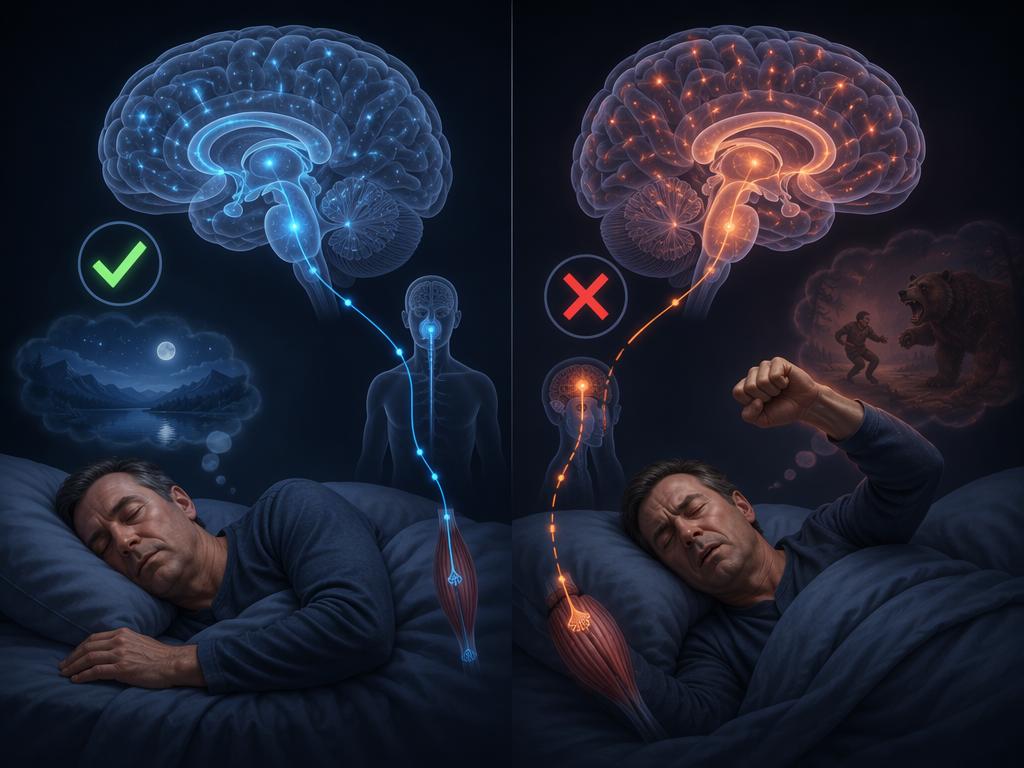
RBD is not merely common in DLB; it is part of how clinicians think about the diagnosis. The 2017 DLB Consortium criteria list REM sleep behavior disorder as a core clinical feature of dementia with Lewy bodies.[2] In research cohorts, RBD affected 76% of people with autopsy-confirmed DLB, and video-polysomnography studies have reported rates up to 89%.[1] Injury to the patient or bed partner occurs in roughly one-third of cases.[1]
That does not mean every vivid dream or restless night is RBD. Periodic limb movements, untreated apnea, medication effects, nocturnal confusion, and ordinary nightmares can be mistaken for it. The history should be specific: Does movement occur during dreams? Is there punching, kicking, falling, or defensive behavior? Can the person recall a matching dream? Has anyone been injured? If the answer suggests RBD, a sleep clinician may use video-polysomnography to document REM sleep without atonia and to look for other disorders that can worsen the same night.
What to do first
The first treatment is not a pill. It is injury prevention. Remove weapons and sharp objects from the bedroom, pad corners, lower the bed if falls are possible, move furniture away from the bed, consider a mattress on the floor in severe cases, and protect the bed partner. Some couples temporarily sleep separately. That decision can feel emotionally loaded, but an elbow to the face or a fall with fracture is not a small marital inconvenience.
When medication is needed, melatonin is commonly used first because its safety profile is more favorable in older adults and neurodegenerative disease. LBD management reviews describe melatonin in the 3–12 mg range for RBD and insomnia.[3] That range is higher than the small doses many people use for routine sleep timing, so it should still be treated as a clinical decision, especially when the person is already taking multiple medications.
Clonazepam can reduce severe RBD behaviors, but it carries the exact risks that matter in LBD: sedation, worsened cognition, unsteadiness, and falls. LBD guidance describes clonazepam doses of 0.25–1 mg for refractory RBD, while also noting the need for caution in older adults.[3] In a person who is already hallucinating, fainting, falling, or sleeping through the day, “effective” is not the same as “safe enough.”
Excessive daytime sleepiness: not just poor sleep the night before
Excessive daytime sleepiness in Lewy body dementia can look like laziness to an impatient observer and like depression to a worried family. It may be neither. The person may fall asleep during meals, conversation, television, appointments, or shortly after getting up. They may have slept enough hours on paper and still be unable to sustain wakefulness.
The contrast with Alzheimer’s disease is one of the most clinically useful parts of the LBD sleep picture. In a Multiple Sleep Latency Test study, about 80% of DLB patients had objective daytime sleepiness. Mean sleep latency was 6.4 minutes in DLB versus 11.3 minutes in Alzheimer’s disease, and 81% of DLB patients fell asleep in less than 10 minutes during nap testing compared with 39% of patients with Alzheimer’s disease.[4] The Lewy Body Dementia Association describes daytime sleepiness as more common in LBD than Alzheimer’s disease and notes that it can appear earlier in the disease course.[5]
That early timing is the point. In Alzheimer’s disease, marked daytime sleepiness is often a later feature. In DLB, it may show up when cognitive symptoms are still subtle. For a family doctor with a short visit, this can change the next question: not only “Are they sleeping badly?” but “Are they falling asleep too easily, too early in the illness, and in a pattern that fits DLB?”
Management starts by separating sleepiness from sedation. Review antipsychotics, benzodiazepines, antihistamines, opioids, some bladder medicines, and other sedating drugs. Ask whether RBD, apnea, nocturia, pain, or nighttime wandering is breaking up sleep. Ask whether the person is actually sleeping most of the day because the night has become unsafe or chaotic. The answer affects whether treatment should target daytime arousal, nighttime consolidation, or a medication list that has quietly become part of the problem.
Bright light therapy has broader dementia evidence, including a meta-analysis of 18 randomized controlled trials, and may be considered when circadian rhythm and daytime alertness are part of the problem.[1] Armodafinil improved sleepiness in an open-label DLB pilot study, but that is not the same as strong trial evidence.[1] Stimulant-like treatment in LBD should be cautious, monitored, and explicit about goals: more alert time, less unsafe dozing, and no worsening of hallucinations, agitation, blood pressure, or nighttime sleep.
Insomnia and sleep fragmentation: when the night never consolidates
Insomnia in LBD is often less like a simple complaint of taking too long to fall asleep and more like a night that will not hold together. The person wakes repeatedly, stays awake for long stretches, wanders, becomes confused, or sleeps in pieces that exhaust the household. Reported insomnia prevalence ranges widely, from 23% to 75%, depending on how studies define and measure it.[1]
Objective sleep studies show why caregivers may describe the nights as brutal. In DLB cohorts, average sleep efficiency on polysomnography has been reported around 55–56%, with wake-after-sleep-onset of 183–241 minutes per night; healthy older adults are often closer to about 80% sleep efficiency.[1] In plain terms, the person may be in bed for the night but awake for hours of it.
The first pass should look for fixable drivers rather than treating “insomnia” as a single target. Pain, urinary frequency, constipation, nighttime hallucinations, restless legs, apnea, RBD, late-day naps, alcohol, caffeine, and medication timing can all fragment sleep. Cholinesterase inhibitors, antidepressants, dopaminergic medications, and sedatives may also shift sleep in ways that deserve review rather than guesswork.
Melatonin is often favored before sedative-hypnotics because of the safety issues in older adults with cognitive impairment, and LBD reviews describe 3–12 mg use for sleep symptoms.[3] Behavioral insomnia treatment can still help, but standard CBT-I may need modification when memory, insight, mobility, hallucinations, or caregiver burden limit what the patient can carry out independently. A sleep restriction plan that is elegant on paper can be miserable or unsafe if it leaves a confused person awake and wandering while a spouse is trying to survive the night.
Obstructive sleep apnea: a treatable comorbidity that should not be missed
Obstructive sleep apnea is not specific to Lewy body dementia, but it is common enough to look for and treat. Studies report OSA in about 18–35% of people with LBD.[1] Snoring, witnessed pauses, gasping, morning headaches, high blood pressure, and persistent daytime sleepiness should push the conversation toward sleep testing, not another round of vague reassurance.
Polysomnography is useful here because it can identify apnea while also clarifying RBD, periodic limb movements, sleep efficiency, and other contributors to the same exhausted daytime picture. If OSA is present, CPAP is the usual treatment path. The complication in LBD is not whether CPAP can work physiologically; it is whether the person can tolerate the mask, remember the routine, avoid panic or confusion, and get enough caregiver support to use it consistently.
A practical CPAP trial may need more setup than usual: daytime mask practice, simplified equipment, humidification, careful pressure adjustment, and a caregiver who knows whom to call when the machine becomes another nighttime battle. If CPAP fails, the failure should be interpreted carefully. It may reflect cognitive impairment, mask discomfort, nasal obstruction, or inadequate coaching rather than proof that apnea was irrelevant.
Restless legs syndrome: ask the right question before prescribing
Restless legs syndrome can be easy to miss because the complaint may be vague: leg discomfort, agitation in bed, repeated getting up, or an inability to settle. The key features are an urge to move the legs, worse at rest, worse in the evening or night, and relieved by movement. Without those features, leg movements in sleep, neuropathy, cramps, pain, akathisia, or nocturnal confusion may be more likely.
The LBD evidence is thinner than for RBD or daytime sleepiness. One reported figure is about 11% in Parkinson’s disease dementia.[1] That number should not be stretched into a sweeping claim about all LBD patients, but it is enough to justify asking about the symptom pattern when nights are restless.
Iron studies, including ferritin, should be checked before treatment. If iron deficiency is present, correcting it may be more appropriate than starting a dopamine agonist or sedating medication. This is especially important in LBD, where drugs that affect dopamine, alertness, blood pressure, impulse control, or hallucinations can have consequences beyond the legs.
What to bring to the clinician
A useful sleep history in LBD is concrete. “Bad sleep” is too broad. A clinician can act faster when the caregiver can describe what happens, when it happens, who is at risk, and what has changed.
- For possible RBD: describe dream enactment, injuries, falls from bed, weapons or sharp objects nearby, and whether movements match dream recall.
- For daytime sleepiness: note when the person falls asleep, whether it happens despite adequate time in bed, and whether it appeared early in the illness.
- For insomnia: track bedtime, wake time, long awakenings, wandering, nocturia, pain, hallucinations, naps, caffeine, alcohol, and medication timing.
- For possible apnea: report snoring, witnessed pauses, gasping, morning headaches, and whether sleepiness persists after other causes are addressed.
- For restless legs: ask whether there is an urge to move, whether it is worse at rest and in the evening, and whether movement relieves it.
Video from a phone can be useful when it is safe and respectful to obtain, especially for dream enactment or unusual nighttime movements. A medication list is just as important. Include prescription drugs, over-the-counter sleep aids, antihistamines, supplements, alcohol, and recent dose changes. In LBD, the difference between disease symptom and medication effect is often not visible from the doorway.
The evidence base still has limits. A systematic review found that LBD sleep research is heterogeneous, with wide prevalence ranges, small single-center studies, and variable definitions across sleep disorders.[1] Treatment evidence specific to LBD is also thin; much of the pharmacologic approach is extrapolated from Parkinson’s disease, idiopathic RBD, open-label studies, case reports, or broader dementia research rather than large LBD sleep trials.[1][3]
That uncertainty should not lead to inaction. It should lead to sharper questions. Is this REM sleep behavior disorder, and is anyone getting hurt? Is daytime sleepiness early and objective enough to support the LBD picture? Is the person awake for hours because of fragmented sleep, apnea, pain, urinary symptoms, medications, or hallucinations? Is a sedative being considered because it is truly needed, or because no one has separated the disorders yet? In Lewy body dementia, sleep can be treated in parts, but only after it is named with care.
References
- Sleep disturbances in Lewy body dementia: A systematic review. PMC. 2022.
- DLB Consortium diagnostic criteria. DLB Consortium. 2017.
- New evidence on the management of Lewy body dementia. Lancet Neurology. 2020.
- Abnormal daytime sleepiness in dementia with Lewy bodies compared to Alzheimer's disease using the Multiple Sleep Latency Test. Alzheimer's Research & Therapy. 2014.
- Daytime Sleepiness is More Common in Lewy Body Dementia than Alzheimer's disease. Lewy Body Dementia Association.



Comments
Join the discussion with an anonymous comment.