
The promise is easiest to believe after midnight, when the cabin lights are low, the motorway has settled into a steady hum, and the seat is no longer pretending to be an airline recliner. A lie-flat bus seat changes the basic bargain of overnight ground travel: your spine is horizontal, your legs are not folded under the seat in front of you, and the motion that usually feels like a nuisance can begin to feel like a sleep cue. For travelers weighing overnight comfort in a lie-flat bus seat, the question is not whether the marketing photographs look restful. It is whether the body that gets off the bus in the morning has actually recovered.
Early accounts suggest the answer can be yes, within limits. On Twiliner’s Amsterdam–Zurich service, reviewers have described getting real sleep across a roughly 12-hour overnight journey, helped by a cabin built around lie-flat seats and a quiet policy that excludes children under 5.[1][2] In the United States, Napaway’s premium coach drew attention for a different configuration: the Butterfly seat, specified as a 78-inch-long bed with 40 inches of width and a 2.5-inch memory-foam topper.[3][4] Those details matter because they move the experience out of the category of “better than nothing” and into something closer to an intentionally engineered sleep environment.
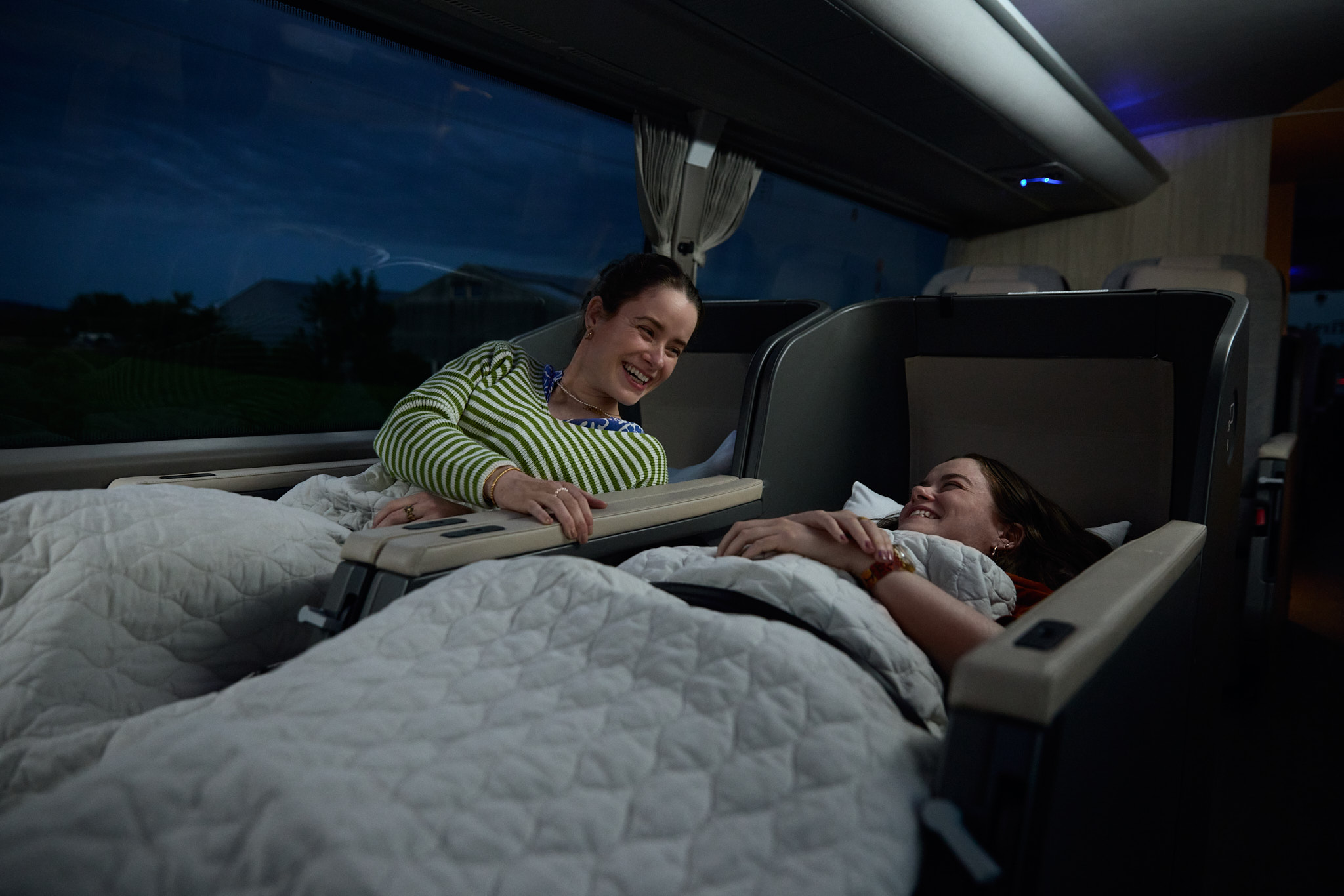
But “I slept” and “I woke restored” are not the same claim. A modern sleeper bus can help a passenger get several continuous hours that would be unlikely in a standard upright coach seat. It cannot yet claim, on the available evidence, to reproduce the architecture of a normal night in bed.
Why a moving bus can make sleep easier
There is a good reason many passengers feel sleepy before they mean to. Low-frequency vibration, white noise, and gentle rocking can all push the nervous system toward drowsiness. A 2017 driving-simulation study found that low-frequency vibration under 20 Hz was associated with drowsiness within about 15 minutes, with researchers linking the effect to parasympathetic nervous system activity.[5] That is a plausible explanation for why a smooth motorway segment can feel almost sedating once a passenger is lying down.
The important word is “onset.” The study involved 15 participants in a simulated driving task, not sleeping passengers monitored overnight on a bus.[5] It helps explain why a person may drift off more easily in a moving vehicle. It does not prove that REM sleep, deep sleep, or normal sleep-cycle timing remains intact across a full night of road travel.
That distinction is where a lot of sleeper-bus discussion gets too loose. Falling asleep is only the first gate. Sleep quality also depends on how often the sleeper wakes, how long awakenings last, whether temperature and light stay stable, and whether the body can cycle through lighter sleep, deeper non-REM sleep, and REM sleep without repeated interruption. There is no peer-reviewed polysomnography study in the available evidence measuring sleep architecture on a moving lie-flat bus seat, so any claim that these buses preserve normal REM or deep sleep would be speculation.
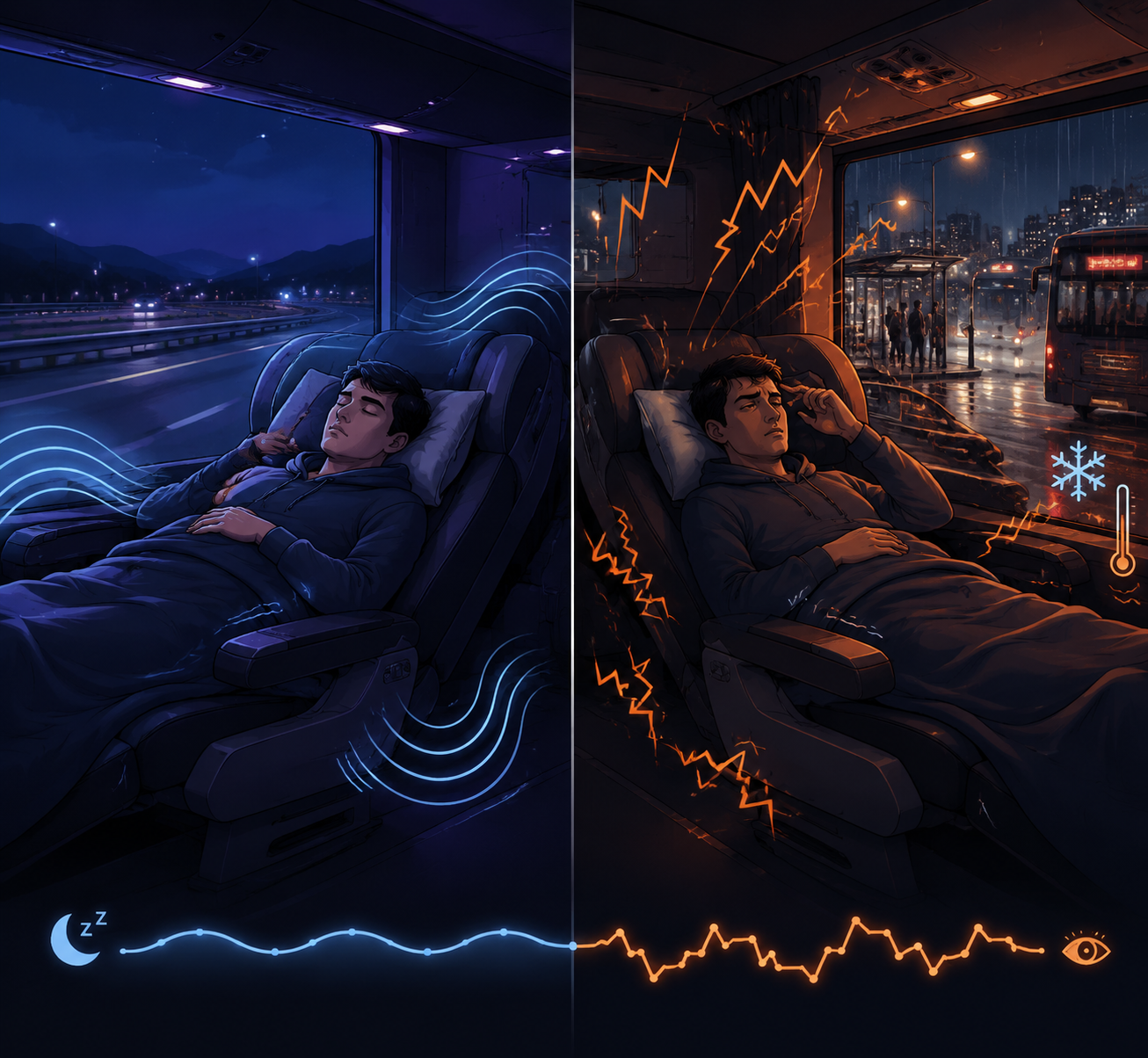
Still, the sleep-onset advantage is not trivial. Against an ordinary bus seat or a short-haul plane seat, a lie-flat surface removes several predictable barriers: the head no longer drops forward, the hips are not held in a semi-seated angle, and the traveler does not have to keep waking to rearrange knees, shoulders, and neck. The bus does not become a bedroom, but it stops asking the body to sleep in a posture that fights sleep.
The seat helps most when the road stays boring
A premium sleeper bus is at its best on long, steady stretches where the driver is holding speed, the cabin is dark, and no one is climbing over anyone else. This is where the reviews of Twiliner and Napaway become useful. The positive reports are not just reactions to novelty; they describe the specific conditions under which sleep becomes possible: a horizontal or near-horizontal position, fewer cabin disturbances, and enough personal space to stop guarding the body all night.[1][2][6]
Twiliner’s quiet rules are part of the sleep product, not a minor etiquette note. A policy barring children under 5 narrows one common source of unpredictable overnight noise.[1] That does not guarantee silence, and it says nothing about snoring, coughing, phone screens, or the ordinary restlessness of adults sharing a vehicle. But it shows that the operator understands something airlines often leave to luck: sleep is a group behavior in a shared cabin.
Napaway approached the same problem through a more private-feeling seat. Its Butterfly configuration, as documented by Business Insider and the manufacturer’s own product specifications, gave each passenger a wider bed-like footprint than a conventional coach seat.[3][4] Napaway also described its service as a premium coach rather than a traditional sleeper bus, emphasizing the lie-flat suite, privacy, and overnight convenience.[6] Those claims should be kept attached to Napaway’s own configuration. They should not be casually transferred to Twiliner, which uses a different seat supplied by Airline Services Interiors.
| Service | What the available material supports | What it does not prove |
|---|---|---|
| Twiliner | Passengers on Amsterdam-Zurich have reported genuine sleep on a roughly 12-hour overnight ride, with lie-flat seating and a no-children-under-5 quiet policy. | It does not prove bed-equivalent sleep architecture or guarantee the same result for light sleepers. |
| Napaway | The Butterfly seat configuration offers a 78-inch bed, 40-inch width, and 2.5-inch memory-foam topper in Napaway’s premium coach setup. | Those dimensions do not describe Twiliner’s seat, and Napaway’s former scheduled route should not be treated as broadly available. |
| Ordinary night buses | They can be cheap and time-efficient, but accounts of standard night-bus travel often describe frequent waking and physical discomfort. | They are not a fair proxy for the newest lie-flat products. |
Where the night breaks apart
The same bus that rocks you to sleep can wake you when the surface changes. Smooth motorway vibration is one thing; city streets, turns, braking, acceleration, and stop-start traffic are another. Many overnight rides contain both. A passenger may sleep soundly for a long central portion of the route, then wake as the coach leaves the motorway, enters a town, pulls into a stop, or negotiates the last urban miles before arrival.
This is the main difference between a successful sleeper-bus night and a good night in bed. In bed, a brief awakening may barely register because the environment stays still. On a bus, an awakening often comes with new information: the engine tone changes, the cabin temperature shifts, a door opens, someone moves in the aisle, condensation gathers near the window, or the vehicle tilts through a turn. The mind may not be fully awake, but the body has already logged the change.
Standard night-bus accounts show how severe this fragmentation can become. Adventure.com’s 24-hour night-bus survival account describes waking “at least once every half hour” on conventional bus travel.[7] A premium lie-flat cabin is meant to reduce that pattern, and Twiliner’s early reviews suggest it can. But reducing fragmentation is not the same as eliminating it.
Temperature is the quieter spoiler. Buses are difficult microclimates: the window-side passenger may feel cold or damp while the aisle feels warmer; ventilation changes as the coach fills, empties, or stops; and a blanket that works at 1 a.m. may be too much by 5 a.m. Condensation near windows is not dramatic enough to dominate a glossy review, but it matters to sleep because it turns a settled posture into a series of small corrections.
Stops are another boundary. Even if no one speaks, a stop changes light, sound, motion, and social alertness. The sleeping passenger has to decide, however briefly, whether the disturbance concerns them. That tiny review process is one reason a person can truthfully say they slept for several hours and still feel less restored than they would after the same number of hours in a quiet room.
First-person reviews are useful, with a bias warning
For this topic, first-person accounts deserve more respect than they sometimes get. A sleeper bus is not just a product specification; it is a night lived through. The useful review is the one that notices whether the passenger slept through the middle of the route, woke at stops, felt too warm, heard other travelers, or arrived capable of doing something more demanding than finding coffee.
The Guardian’s 2025 Twiliner review, The Washington Post’s 2026 account, and Wandering and Wine’s 2026 review all help because they describe actual overnight use rather than only seat renderings or operator claims.[1][2][8] They also need to be read with the press-trip caveat in view. When a journey is arranged for coverage, the cabin may be newer, the operator more attentive, and the reviewer more primed to notice what works. That does not make the sleep false. It does mean the accounts should be treated as evidence of possibility, not as a guarantee for every paid passenger on every departure.
Consumer-oriented Napaway reviews point in a similar direction: the setup can feel materially better than an ordinary overnight bus, but the experience remains travel sleep, with trade-offs around schedule, motion, and personal tolerance.[9] The traveler most likely to be satisfied is not the one expecting a hotel room on wheels. It is the one who can bank several hours of rest, accept some broken sleep near departure and arrival, and still value waking up in another city without losing a daytime travel block.
Availability is still narrower than the buzz
There is also a booking reality that sleep discussions can blur. Twiliner launched in November 2025 and, as of July 2026, operates only two routes; its plan for 30 cities and 25 routes through 2028 is an expansion target, not the present network.[1] Frommer’s has highlighted the service’s lie-flat bed concept and no-kids policy, but the practical question remains whether the route a traveler needs actually exists on the date they need it.[10]
Napaway is even more important to separate from its early scheduled-service image. Its DC–Nashville route was commonly discussed as a 9.5-hour overnight service, but the scheduled operation appears to have been suspended, with reports from 2024 indicating that the company now operates primarily as a charter.[6] The seat may be real, and the sleep concept may be useful, but a traveler cannot treat it like a broadly available intercity timetable unless the operator is actively selling that trip.
Who should expect a good enough night
A lie-flat sleeper bus makes the most sense for travelers who already sleep reasonably well in motion: people who nap on trains, tolerate white noise, do not need a perfectly cool room, and can recover from one or two short awakenings without feeling ruined. For them, the shift from upright seat to lie-flat surface is meaningful. Several hours of continuous sleep on a long overnight route can be the difference between arriving merely transported and arriving functional.
It is a weaker bet for light sleepers, people with medical insomnia, passengers sensitive to motion or temperature, and anyone who needs to perform at a high level immediately after arrival. In those cases, the relevant comparison is not whether the bus is more comfortable than an ordinary coach. It is whether the traveler can afford a night of uncertain continuity.
The fairest comparison is usually not a hotel bed. A hotel bed wins on stillness, climate control, privacy, bathroom access, and the absence of route events. The fairer comparison is an upright bus seat, a cramped economy flight, or a daytime trip that consumes usable hours. Against those options, a true lie-flat bus seat can be a serious improvement.
The booking judgment is simple: a modern lie-flat bus seat can be a legitimate way to get several hours of sleep while moving between cities, especially if the route is long, the cabin is quiet, and the traveler tolerates some fragmentation. It should not be sold or understood as a replacement for bed sleep until full-night sleep-architecture data exists.
References
- Twiliner Amsterdam-Zurich review, The Guardian, 2025-12-04.
- Twiliner 12-hour journey review, The Washington Post, 2026-07-19.
- Napaway lie-flat suites photos and Butterfly seat specifications, Business Insider.
- Butterfly Seating product page, Butterfly Seating.
- Why Riding in Cars Makes You Sleepy, Sleep.com.
- Napaway premium coach comparison, Napaway.
- 24-hour night bus survival guide, Adventure.com.
- Honest Twiliner review, Wandering and Wine, 2026-07-08.
- Napaway review, TravelAwaits.
- Twiliner no-kids policy and lie-flat bed tip, Frommer's.





Comments
Join the discussion with an anonymous comment.