
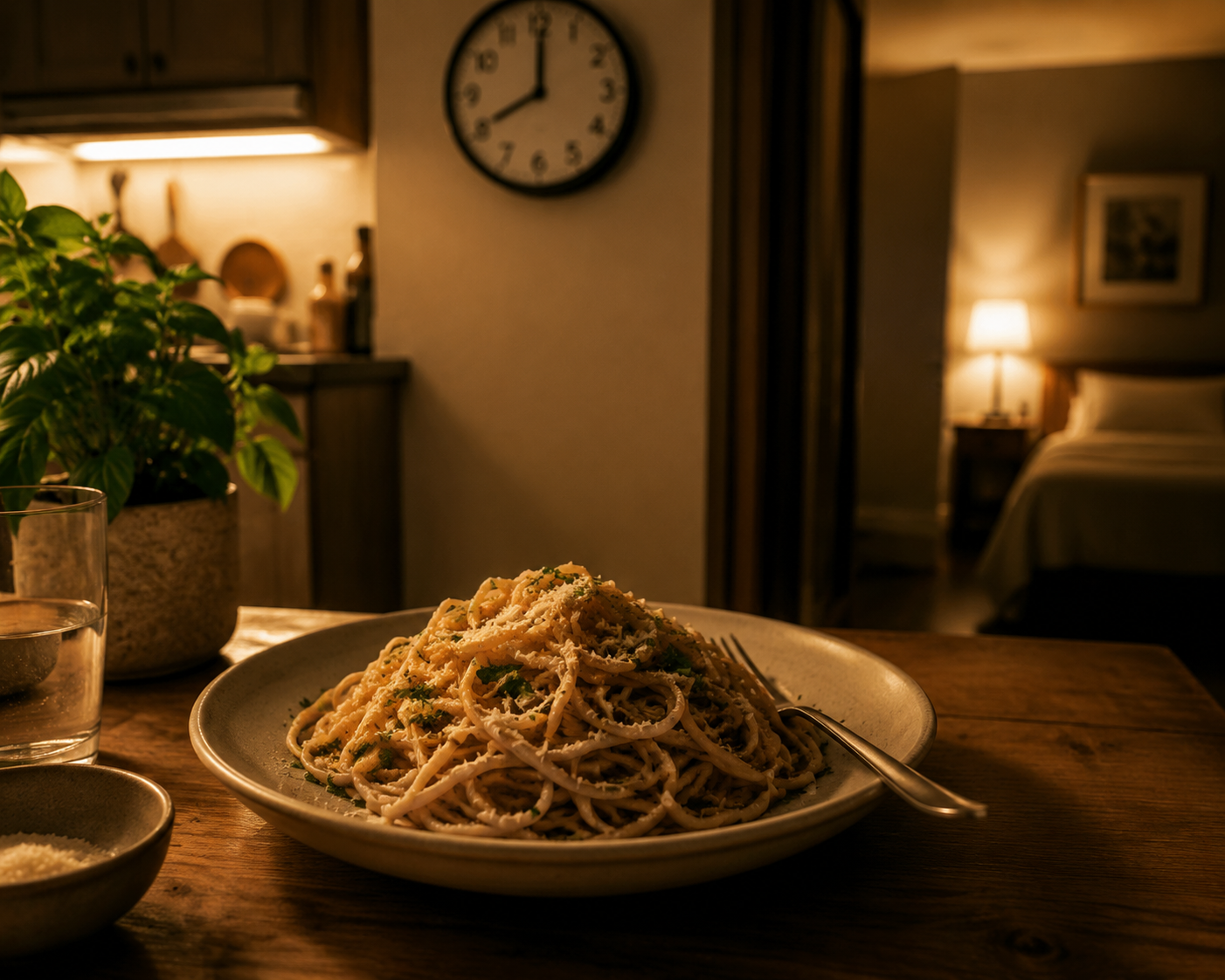
Pasta at dinner is not automatically bad for sleep. The version that causes trouble is usually more specific: a large refined pasta meal, eaten late, with a heavy sauce, close enough to bedtime that digestion and blood sugar are still doing most of the evening's work. If someone is looking for the best pasta for better sleep at night, the answer is less glamorous than a wellness headline: choose a whole-grain or otherwise complex-carb pasta, keep the portion moderate, pair it like dinner rather than dessert, and give it a few hours before bed.
That answer is still more cautious than the internet's two favorite positions. Pasta is not a magic sleep food. It is also not a sleep-hygiene failure just because it contains carbohydrates. The interesting question is whether a normal pasta dinner can sit inside a routine that supports sleep onset and sleep quality. Scientists are now testing that question directly: a University of Florence randomized controlled trial protocol published in 2025 is designed to compare pasta eaten at lunch versus dinner, using actigraphy and dim-light melatonin onset among its sleep measures. It is important to say the quiet part first: this is a protocol, not published outcome data, so it validates the question rather than answering it yet.[1]
Why the pasta-and-sleep story gets exaggerated
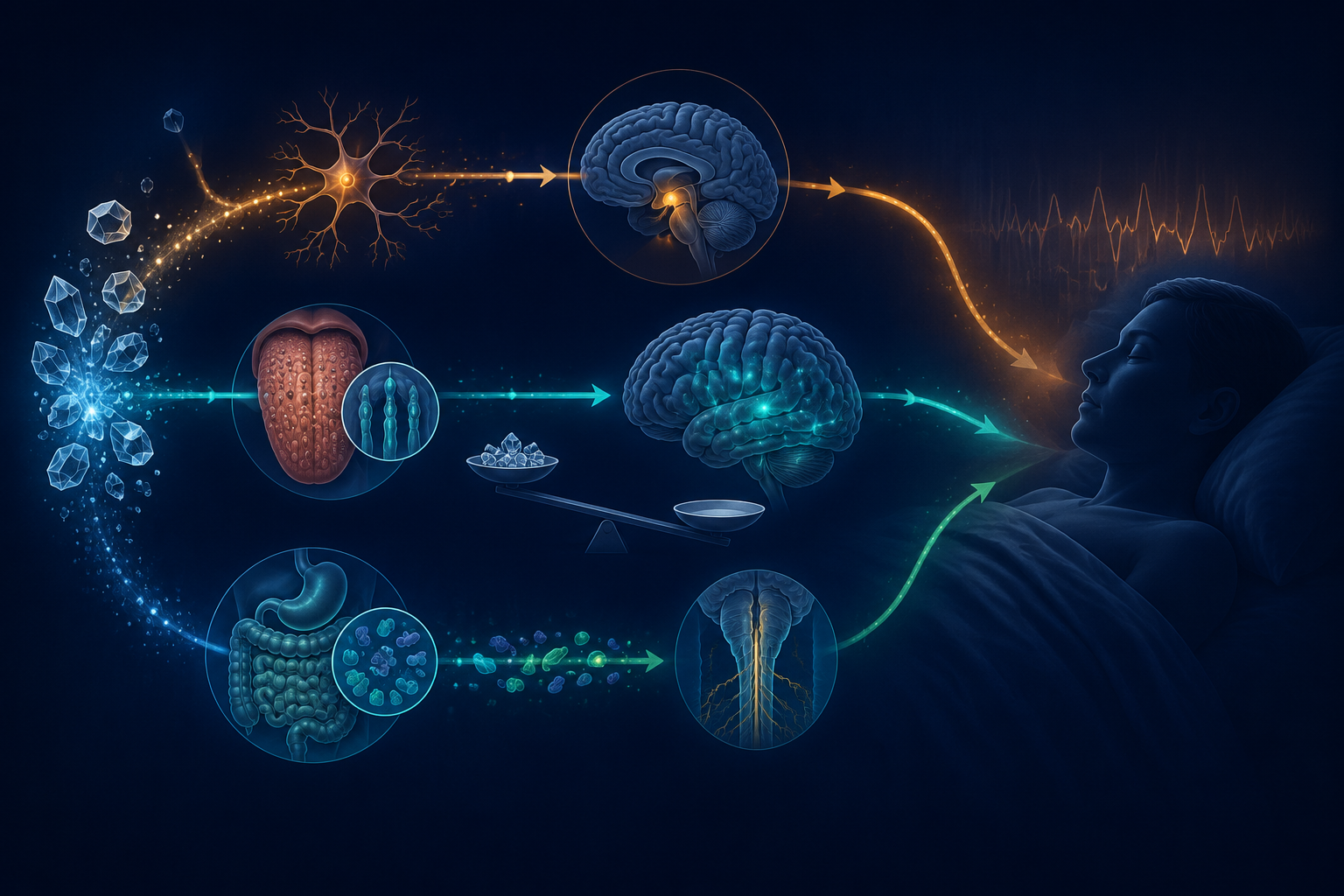
The common explanation goes like this: carbohydrates trigger insulin, insulin helps tryptophan get into the brain, tryptophan becomes serotonin, serotonin becomes melatonin, and then sleep comes more easily. As a diagram, it is tidy. As dinner advice, it is too tidy.
A 2022 systematic review by Benton and colleagues is useful because it does not throw the mechanism away, but it sharply limits where it applies. The review notes that the tryptophan-to-large-neutral-amino-acid ratio appears most favorable when carbohydrate is consumed with very little protein; it specifically describes the protein condition as below 2% of the meal. That is not a normal pasta dinner with chicken, seafood, beans, cheese, or even a modest amount of wheat protein in the pasta itself.[2]
This matters because a lot of consumer sleep advice quietly borrows from low-protein carbohydrate experiments and then applies the conclusion to a mixed meal. A bowl of pasta with lentils and vegetables is not the same metabolic event as a carbohydrate drink. A plate of spaghetti with meat sauce is not a low-protein tryptophan delivery system. If pasta helps someone fall asleep, the strongest explanation is not necessarily that the meal has produced a direct melatonin shortcut.
There is still a plausible carbohydrate-and-sleep pathway, just a less bumper-sticker-friendly one. Benton et al. describe evidence that carbohydrate intake may affect sleep through glucose-sensing neurons, including neurons involved in sleep-wake regulation.[2] In animal research, glucose-sensitive neurons in the ventrolateral preoptic nucleus, a sleep-promoting brain area, responded rapidly to glucose changes; higher glucose excited these sleep-promoting neurons and inhibited orexin neurons that help maintain wakefulness.[3] That does not prove that Tuesday night's pasta will work like a sedative. It does explain why evening carbohydrates can reasonably affect sleep onset without leaning on an overextended tryptophan story.
The pasta type changes the sleep question
The sleep question is different for whole-wheat pasta than it is for a large bowl of refined pasta. Whole-grain pasta brings more fiber and usually a slower, steadier carbohydrate release. Refined pasta, especially in a large portion or paired with other quick-digesting carbohydrates, pushes the meal toward a higher glycemic load. Those are not moral categories. They are different post-dinner experiences.
Cleveland Clinic's sleep nutrition guidance makes the same practical distinction: it includes whole-grain pasta among foods that may support sleep, while advising people to avoid refined and simple carbohydrates close to bedtime.[4] That recommendation is not a pasta-specific clinical trial result. It is a reasonable application of the broader carbohydrate-quality evidence to an ordinary dinner choice.
Pasta also contains tryptophan and B vitamins, a composition point noted by the International Pasta Organisation.[5] That source is an advocacy organization, so it should not be treated as independent proof that pasta improves sleep. The composition fact is modestly relevant; it is not the main reason to turn dinner into a sleep strategy.
The stronger reason to prefer whole-grain or complex pasta is that sleep appears to respond differently to carbohydrate quality. In a study of postmenopausal women, higher dietary glycemic load was associated with greater insomnia risk, while higher fiber intake was associated with lower insomnia risk.[6] That finding does not mean refined pasta causes insomnia in everyone, and it does not mean whole-wheat pasta treats insomnia. It does make the blanket phrase "carbs at night" almost useless. Fiber-rich, complex carbohydrates and high-glycemic-load patterns should not be discussed as if they are the same dinner.
Timing may matter as much as the pasta itself
A plate of pasta at 6:30 p.m. and the same plate at 10:15 p.m. are not the same sleep decision. This is where a lot of advice loses contact with kitchens. People do not just eat foods; they eat them at specific times, in specific portions, before specific bedtimes.
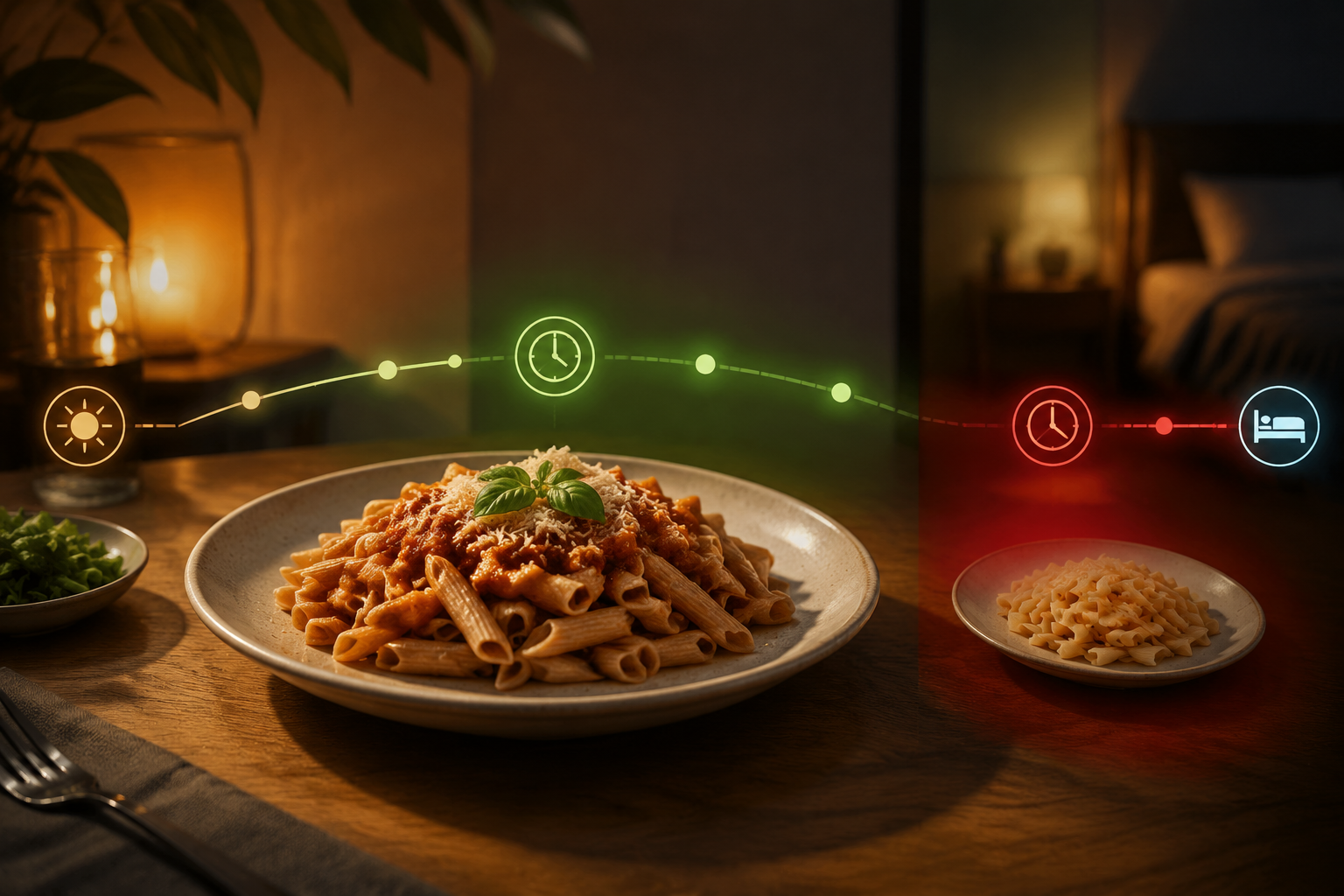
Meal timing research points in two directions that are not actually contradictory. In one study, eating within 3 hours of bedtime was associated with more nighttime awakenings.[7] Separately, an earlier controlled study found that a high-glycemic-index meal eaten 4 hours before bedtime shortened sleep onset compared with the same kind of meal eaten 1 hour before bedtime.[8] The practical reading is not "eat a huge high-GI dinner for sleep." It is that carbohydrate timing can influence sleep onset, and that eating too close to bed can change the tradeoff.
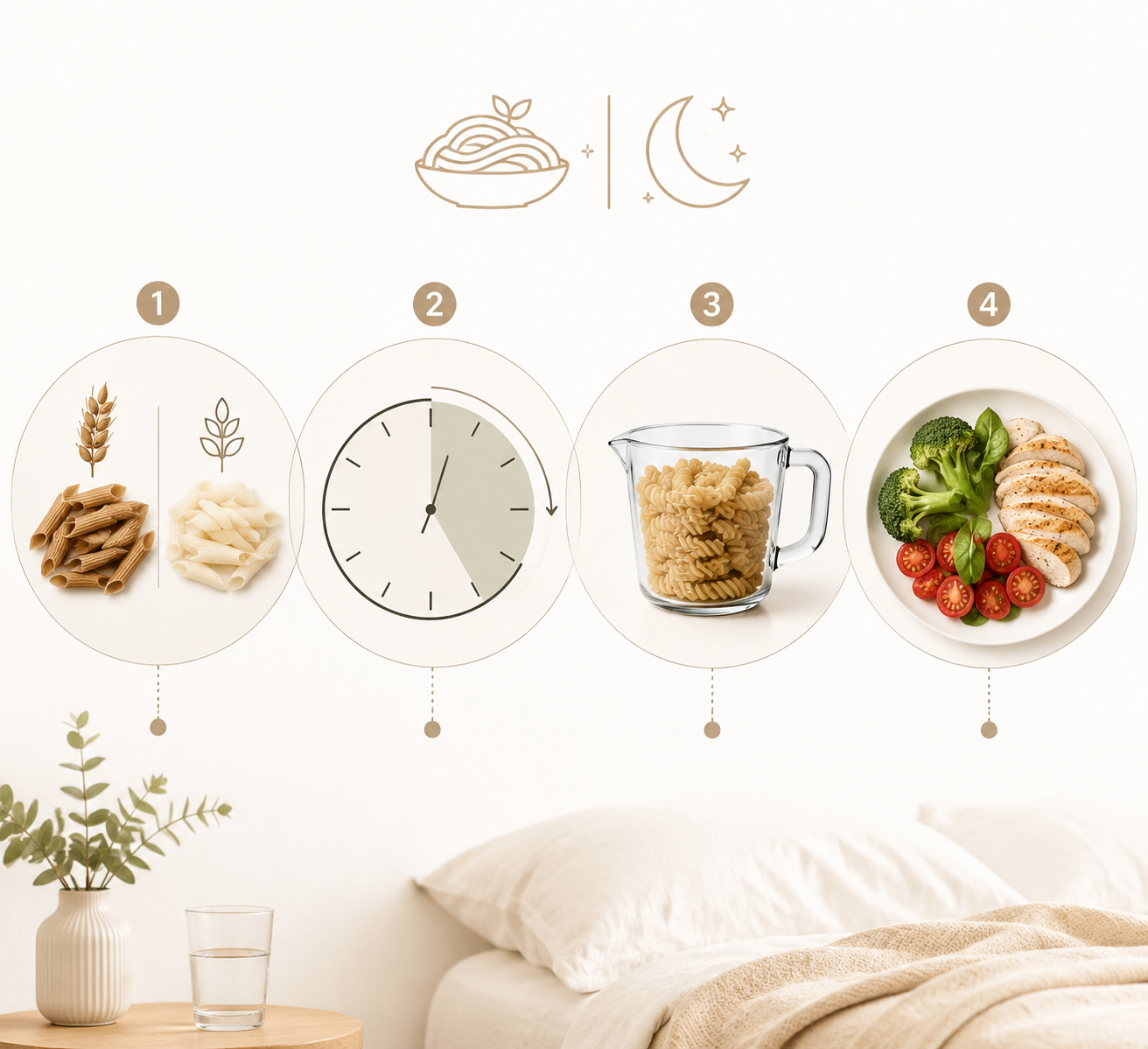
For pasta, the useful window is roughly 2-4 hours before bed. Two hours gives digestion some room. Four hours is still close enough for dinner to belong to the evening rather than becoming an early-bird ritual no one can maintain. If bedtime is 10:30 p.m., a pasta dinner around 6:30-8:30 p.m. is a very different proposition from a large bowl at 9:55 p.m.
A practical way to build a sleep-friendlier pasta dinner
The workable version does not require a special sleep pasta, a supplement-like sauce, or a recipe with twelve functional ingredients. It needs guardrails. The meal should be filling enough that hunger does not wake you up, but not so heavy that digestion becomes the event of the night.
| Dinner variable | Sleep-friendlier choice | Version more likely to backfire |
|---|---|---|
| Pasta type | Whole-wheat, legume-based, or another higher-fiber complex pasta | Large serving of refined pasta with little fiber |
| Timing | About 2-4 hours before bed | Within the last hour or close enough that you lie down full |
| Portion | About 80g dry pasta, or roughly 1 cup cooked | A heaping plate that leaves you overly full |
| Pairings | Lean protein, vegetables, and a modest amount of healthy fat | Heavy cream sauce, lots of cheese, fried sides, or dessert-like add-ons |
The portion benchmark is worth keeping plain: about 80g dry pasta, often around 1 cup cooked, before sauce and add-ins. That is not a punishment portion. It is a way to keep pasta as the carbohydrate base of dinner rather than letting it become the whole meal. A bigger serving may be appropriate for some people, especially with higher energy needs, but sleep hygiene is not helped by going to bed physically uncomfortable.
Pairing also changes the way the meal lands. Lean protein can make dinner more satisfying, vegetables add fiber and volume, and a modest amount of olive oil, nuts, seeds, or avocado can slow the meal down without turning it into a heavy late-night feast. Spinach, kale, broccoli, zucchini, tomatoes, mushrooms, beans, tuna, chicken, tofu, or lentils all make more sense here than a cream-heavy sauce eaten late because dinner was delayed.
There is a small trap here: adding protein is good dinner design, but it weakens the simple tryptophan story. That is fine. Dinner does not need to perform one isolated biochemical trick. It needs to keep blood sugar, fullness, digestion, and bedtime timing in a range your body can tolerate.
When pasta at dinner deserves more caution
Some readers should treat the pasta question less casually. People with diabetes, impaired glucose tolerance, reflux, delayed gastric emptying, or a pattern of waking after blood sugar swings may notice effects that a general sleep article cannot predict. The same is true for people whose insomnia is already persistent or severe. In those cases, pasta timing and type may still matter, but they are part of a larger clinical picture rather than a single habit to optimize.
The other caution is simpler: watch what happens more than what the rule says should happen. If whole-wheat pasta with vegetables at 7 p.m. leaves you comfortable and sleepy by 10:30 p.m., there is no reason to treat that dinner as suspicious. If a refined pasta meal at 9:30 p.m. leaves you hot, thirsty, refluxy, or awake at 2 a.m., the problem is not that pasta has a personality defect. The meal was late, large, and easy to overdo.
So, is pasta bad for sleep?
No, not by itself. The current evidence does not support banning pasta from dinner as a sleep rule. It supports being more specific. Whole-grain or complex pasta, in a moderate portion, paired with vegetables, lean protein, and a little healthy fat, eaten about 2-4 hours before bed, can fit a sleep-friendly routine. The version most likely to backfire is the one people often mean when they say "pasta night" after a long day: refined pasta, oversized serving, heavy sauce, and bedtime too soon afterward.
References
- The impact of the timing of pasta intake on sleep quality and health outcomes: a protocol for a randomized controlled trial, Trials, 2025. https://pmc.ncbi.nlm.nih.gov/articles/PMC12063442/
- Carbohydrate ingestion before bedtime and its effect on sleep: A systematic review, Frontiers in Nutrition, 2022. https://pmc.ncbi.nlm.nih.gov/articles/PMC9532617/
- Glucose Induces Slow-Wave Sleep by Exciting the Sleep-Promoting Neurons in the Ventrolateral Preoptic Nucleus, Journal of Neuroscience, 2015. https://www.jneurosci.org/content/35/27/9900
- Foods That Help You Sleep, Cleveland Clinic. https://health.clevelandclinic.org/foods-that-help-you-sleep
- 5 Good Reasons to Eat Pasta, International Pasta Organisation. https://internationalpasta.org/news/5-good-reasons-to-eat-pasta/
- High glycemic index and glycemic load diets as risk factors for insomnia: analyses from the Women's Health Initiative, American Journal of Clinical Nutrition, 2020. https://academic.oup.com/ajcn/article/111/2/429/5673520
- Does the Proximity of Meals to Bedtime Influence the Sleep of Young Adults? A Cross-Sectional Survey of University Students, International Journal of Environmental Research and Public Health, 2020. https://www.mdpi.com/1660-4601/17/8/2677
- High-glycemic-index carbohydrate meals shorten sleep onset, American Journal of Clinical Nutrition, 2007. https://academic.oup.com/ajcn/article/85/2/426/4649585
Comments
Join the discussion with an anonymous comment.