
A new Nightmare on Elm Street movie is in development at Paramount Primal, announced July 13, 2026, with no confirmed casting, release date, or creative details yet.[1] That is enough news to reopen the old joke and the old worry: if Freddy Krueger lives in dreams, what happens to the people who watch him just before bed?
The clean answer is less supernatural and more inconvenient. A horror movie does not cause nightmares by dropping its images straight into the brain like files into a folder. It can, however, put the body into a threat state at exactly the moment sleep needs the opposite. For some viewers, the result is a delayed bedtime, a lighter first stretch of sleep, or a dream that borrows the film's emotional residue. For others, the same movie is satisfying, intense, and then over.
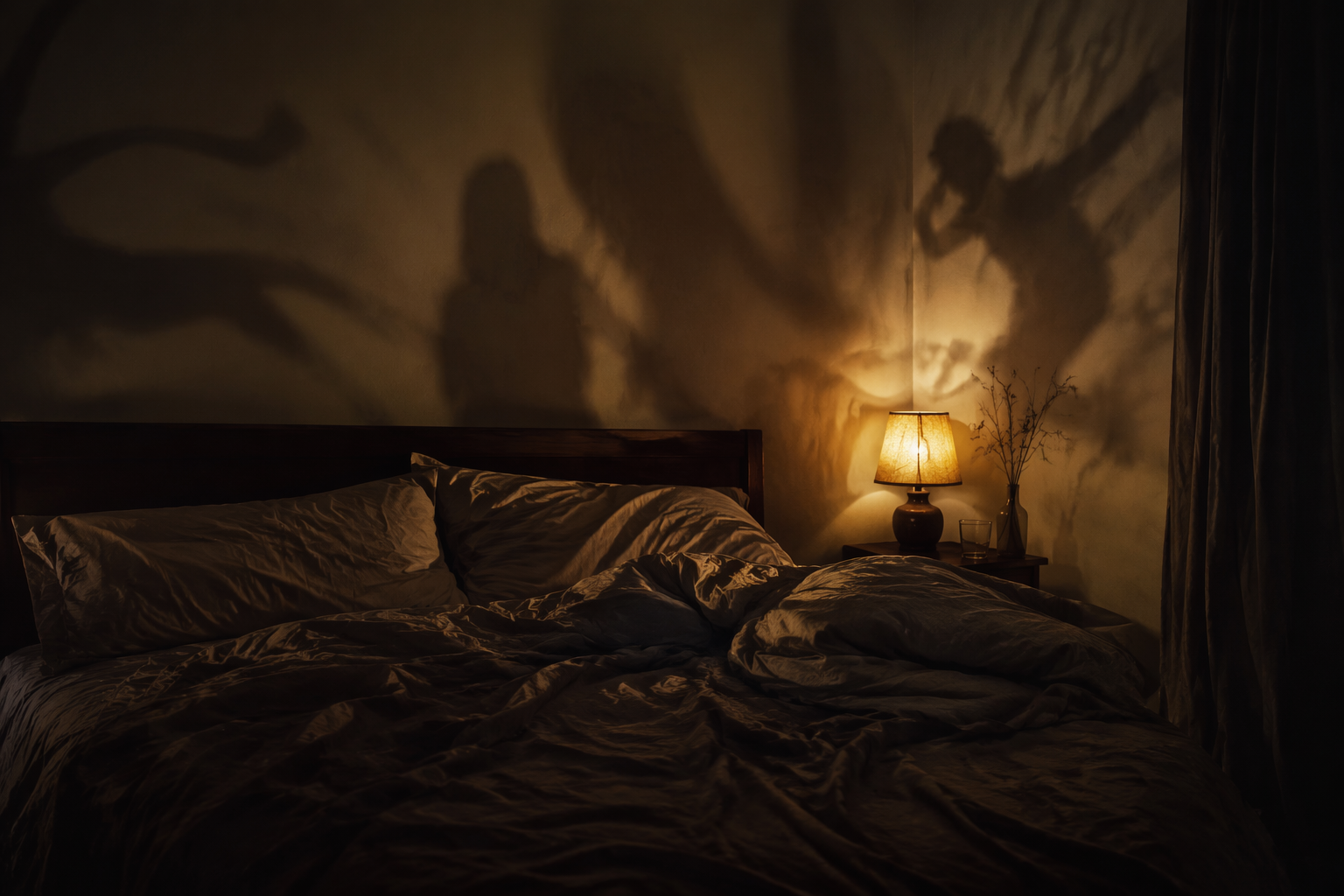
Why a Fictional Threat Can Still Keep the Body Awake
The body is not especially polite about separating a crafted scare from an actual one. A jump cut, a held frame, a low-frequency sound cue, a face appearing where a face should not be: if the scene is convincing enough, the amygdala and sympathetic nervous system can mobilize the same defensive machinery involved in real threat detection. Adrenaline rises, cortisol can rise, heart rate increases, and the body prepares for action rather than surrender.[2]
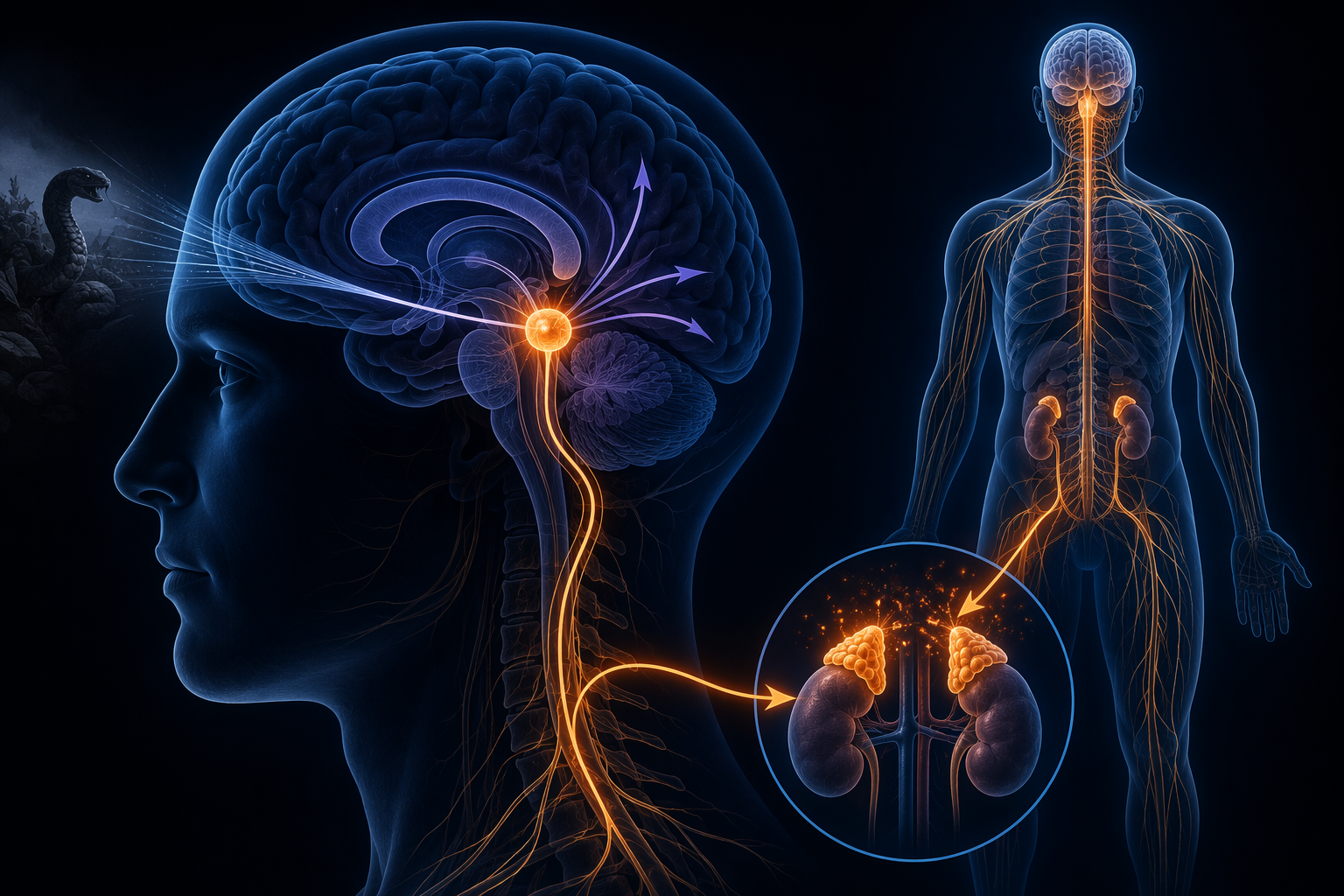
That is the part horror fans often understand in the theater and underestimate in bed. The thrill depends on activation. Sleep initiation depends on deactivation. The transition into sleep asks the body to lower vigilance, reduce responsiveness, and tolerate the small loss of control that comes with drifting off. A well-made horror sequence does the opposite: it trains attention toward hidden movement, ambiguous sound, and the possibility that the next quiet second is not safe.
This is why the Nightmare on Elm Street premise lands so sharply in sleep science. The franchise does not merely show a monster. It contaminates the act of going to bed. In ordinary life, the bedroom is where threat monitoring is supposed to stand down. In the film's logic, sleep itself becomes the threshold of danger. Even when a viewer knows perfectly well that this is fiction, the body may still be running a few minutes or hours behind that knowledge.
That lag matters. A person who watches horror at 7 p.m. may have enough time for the nervous system to return toward baseline. The same person watching at midnight has less buffer between arousal and lights out. The problem is not moral weakness, childishness, or an inability to appreciate the genre. It is timing plus physiology.
Dreams Do Borrow From Screens, But Not on Command
The second piece is dream incorporation: the way recent waking material can appear in dreams. A 2024 scoping review of 29 studies published between 1964 and 2021 found that pre-sleep visual media produced stimulus-related dream incorporation rates ranging from 3% to 43% in REM dream reports and 4% to 30% in NREM reports.[3] The range is wide because the studies differed in stimuli, methods, sleep-stage collection, and how incorporation was defined.
That finding is useful precisely because it is not cartoonishly simple. It does not mean horror reliably invades most people's dreams. It means that visual material before sleep can show up in dreams under some conditions, and emotionally charged or negative material appears more likely to be incorporated than neutral material.[3] The scary image may return as itself, but it may also return as a mood, a chase structure, a distorted room, or the peculiar dream certainty that something is wrong.
A slasher glove appearing in a dream would be the obvious version. More often, the borrowing is less literal. The dream keeps the bodily grammar of the movie: pursuit, helplessness, a locked door, a familiar place made unsafe. The mind does not need to reproduce a scene accurately for the sleep experience to feel contaminated by it.
There is also timing. Studies of the day-residue effect have found that recent experiences are most likely to appear in dreams on the first night after exposure, with incorporation declining over later nights.[3] That maps well onto the common complaint: not a lifelong wound from one movie, but one bad night when the images are still warm.
Why One Viewer Sleeps Fine and Another Is Awake at 1 a.m.
The same horror film can be recreation for one nervous system and unfinished business for another. That difference is where the sloppy version of the topic usually breaks down. The question is not simply whether the movie is scary. It is who is watching, when they watch, and how easily their body returns from threat mode.
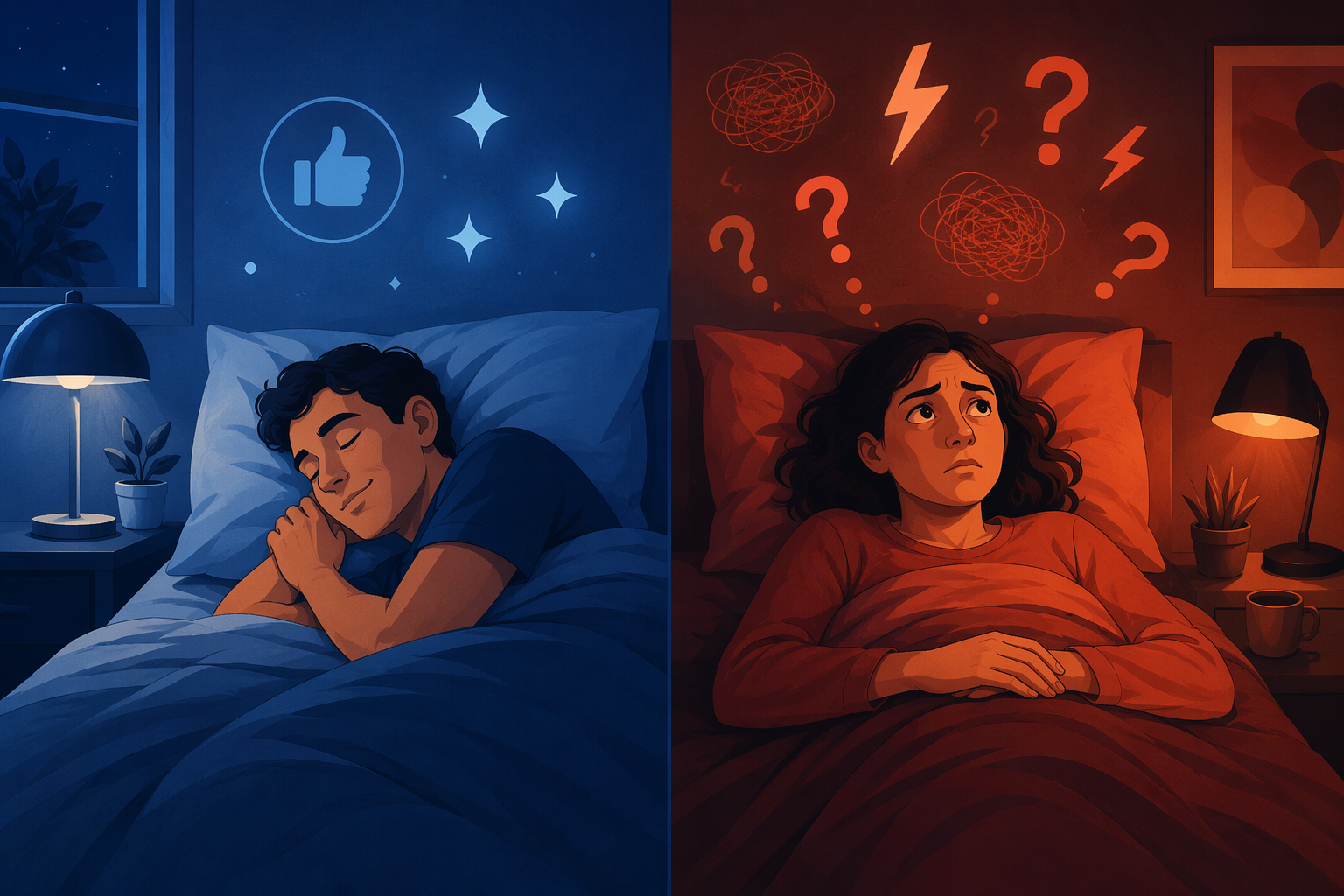
In a review of empirical research on horror responses, lower empathy has been associated with greater enjoyment of frightening media, while higher empathy has been linked to more distress; sensation-seeking tends to correlate with enjoyment, and anxiety sensitivity with disruption.[4] Women have also reported more sleep disruption than men in this research literature.[4] These are patterns, not verdicts. They do not tell any single viewer what they are allowed to like.
The high-sensation-seeking viewer may experience the film as a controlled stressor: an engineered alarm that ends with credits, lights, conversation, and maybe admiration for the sound mix. The high-empathy viewer may track suffering more closely and carry the emotional tone longer. The anxiety-prone viewer may not be afraid of Freddy in a literal sense, but may become afraid of not sleeping, of being alone with the images, or of the body sensations that fear leaves behind.
That last loop is especially unfriendly to sleep. Once a person begins monitoring whether they are calm enough to sleep, they are no longer only recovering from the movie. They are now watching themselves fail to downshift. The racing heart becomes evidence. The dark room becomes a test. A fictional threat has handed the brain a real project.
One frequently cited finding says that about 46% of viewers reported sleep disturbances after frightening films and 75% reported anxiety, based on a retrospective sample of 530 student self-reports.[4] The numbers are worth noticing, but not overpromoting. They do not prove that horror causes clinical sleep disorders, and they do not measure what happens to all adults after all kinds of horror. They do show that post-movie sleep disruption is common enough that embarrassed viewers should stop treating themselves as outliers.
The Bed Is Where the Movie Becomes Personal
Horror works by giving attention a job. Look at the doorway. Listen for the floorboard. Do not trust the mirror. In a living room full of friends, that job can be pleasurable. Alone in bed, it can become surveillance.
This is the elegant cruelty of the Elm Street idea. It does not have to persuade viewers that the monster is real. It only has to make the first minutes of sleep feel less passive. Any sleeper who has tried to relax while checking the hallway shadow understands the mechanism. The conscious mind may be done with the film; the threat system is still asking for one more scan.
There is a useful distinction here between fear and residue. Fear is the immediate reaction: the startle, the bracing, the pulse. Residue is what remains when the film is no longer playing but the body has not fully reclassified the experience as safe. Residue can look like rumination, reluctance to turn off the light, irritation at every apartment noise, or a dream that keeps the film's emotional weather without keeping its plot.
How to Watch Horror Without Donating the Whole Night
The best strategies are not anti-horror. They are pro-recovery. If the problem is a mobilized threat system, the solution is to give the body time and cues to stand down.
- Watch earlier when possible. A late afternoon or early evening viewing leaves more room for heart rate, vigilance, and stress chemistry to settle before bed.
- Add a decompression buffer. Conversation, ordinary lighting, a shower, calm music, or pleasant reading can help separate the movie's threat state from the sleep environment.
- Use cognitive reappraisal if images stick. Behind-the-scenes footage, interviews, bloopers, or effects breakdowns can help the brain reclassify the threat as performance and craft rather than danger.
- Avoid making the bed the first quiet place after the scare. If the nervous system is still scanning, let that happen somewhere other than under the covers.
Sleep clinicians quoted on horror and sleep commonly recommend earlier timing, relaxation, calming music, guided relaxation, and pleasant reading after scary content.[6] Older work on coping with frightening media also supports reappraisal and desensitization approaches, especially for reducing lingering distress.[4] These techniques are not magic erasers. They are ways of changing the last signal the body receives before sleep.
The behind-the-scenes trick deserves special respect because it does not require pretending the movie failed. A beautifully engineered scare can remain beautiful. Seeing the prosthetic, the lighting setup, the actor laughing between takes, or the editor's timing can move the experience from danger back into craft. For some viewers, that shift is enough to loosen the image's grip.
When a Nightmare Is Just a Nightmare
Occasional nightmares are ordinary. Cleveland Clinic reports that about 85% of adults have occasional nightmares, about 1 in 20 have nightmares weekly, and 2% to 8% meet criteria for nightmare disorder.[5] A bad dream after a horror movie, even a vivid one, is not automatically a sign that something is clinically wrong.
The boundary is persistence and impairment. Nightmares deserve more serious attention when they recur, cause significant distress, lead to avoidance of sleep, or interfere with daytime functioning. Nightmare disorder can also be associated with PTSD, sleep apnea, and medication side effects, among other contributors.[5] At that point, the useful question is no longer whether a movie was too scary. It is why sleep has become repeatedly unsafe.
For chronic nightmare disorder, Imagery Rehearsal Therapy is described as a first-line treatment approach: the person rewrites the nightmare while awake and rehearses the new version so the dream script can change over time.[5] That is a different situation from a one-night Elm Street hangover. It belongs in clinical care, not in a guilty argument with yourself about whether you should be tougher.
What the Reboot Really Reveals
The coming Nightmare on Elm Street reboot is not evidence that horror is dangerous, and it is not proof that fans should brace for ruined sleep. For now, it is simply a useful reminder of why this particular franchise has always felt intimate. It points at the one place where everyone eventually has to lower their defenses.
The sleep effect of horror is not located only in the monster. It is in the hour you press play, the body's threat response, the emotional charge of the images, and the viewer's own pattern of empathy, sensation-seeking, and anxiety sensitivity. Some people can admire the scare and sleep cleanly afterward. Some need daylight, a buffer, or a reminder that the claw was built by a prop department.
Enjoying horror and taking your nervous system seriously are not opposing positions. A movie can be fiction and still leave the body activated. A nightmare can be unpleasant and still be transient. The wiser response is not panic or bravado, but calibration: know what kind of viewer you are, leave yourself enough runway to come down, and treat persistent, impairing nightmares as a sleep-health issue rather than a fandom problem.
References
- New 'Nightmare on Elm Street' Movie in the Works From Paramount — Hollywood Reporter, July 13, 2026
- How Watching a Scary Movie Can Affect Your Sleep and Dreams — UNC College of Arts and Sciences
- Impact of Pre-Sleep Visual Media Exposure on Dreams: A Scoping Review — PMC, 2024
- (Why) Do You Like Scary Movies? A Review of the Empirical Research on Psychological Responses to Horror Films — PMC, 2019
- 7 Reasons You're Having Nightmares — Cleveland Clinic
- Why some love horror and others have nightmares — CNN, 2025
Comments
Join the discussion with an anonymous comment.