
Open the nursery door at 2:40 a.m. and the design question becomes very plain: can you see enough to feed, check, and move safely, while keeping the room dark enough that it still behaves like nighttime for the baby? That is where nursery design for better baby sleep should begin—not with a theme, not with a paint chip, and not with a list of adorable objects that later have to be removed from the crib.
The most useful nursery choices are the ones that change the baby’s actual sleep environment: light reaching the eyes, the safety of the sleep surface, where the crib sits, how warm the room gets, how air moves, and how loud the sound machine is from the baby’s ears. A peaceful-looking room is nice. A room that works in the middle of the night matters more.
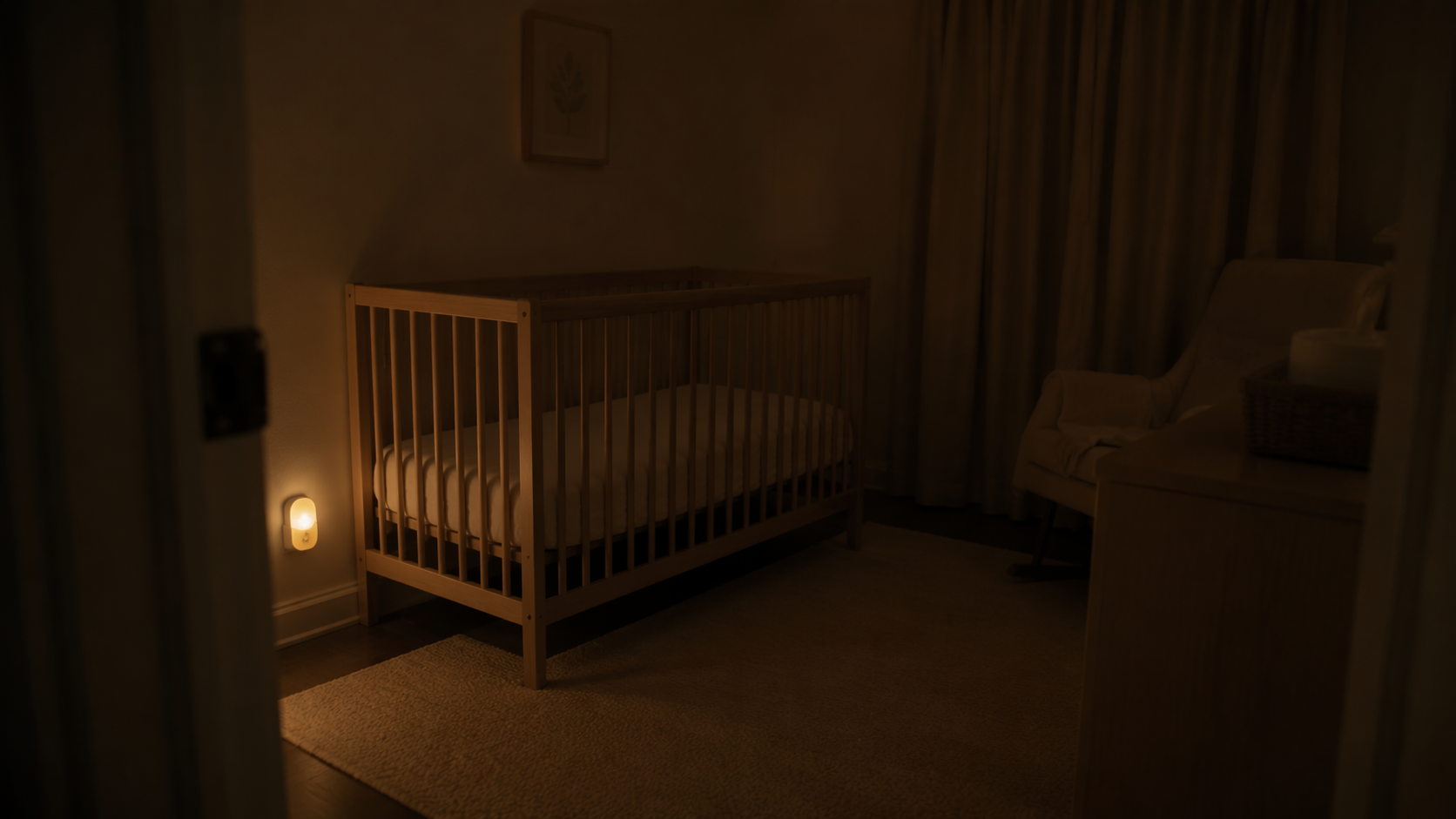
Start with darkness, because it is measurable
A dark sleep location is one of the few nursery design decisions with a quantified infant sleep finding behind it. In the Rise & SHINE cohort, researchers followed 313 infants and found that babies whose sleep location was never or only sometimes dark at 1 month slept 28 minutes less per night at 6 months, measured by actigraphy. Their longest sleep period was also 39 minutes shorter.[1]
That does not mean blackout curtains “solve” infant sleep. The study was observational, and families do not choose room lighting randomly. A baby who wakes often may lead parents to keep a light on for checks, or a parent may use more light because they are worried. Still, the finding is unusually practical: the sleep environment at 1 month was associated with measurable sleep differences months later, and darkness is something many families can change without buying an entirely new nursery.
The same study also found that non-dark sleep environments partially mediated racial and ethnic sleep disparities: 11 minutes of shorter sleep in Black and Hispanic infants was attributable to non-dark sleep environments.[1] That detail is easy to miss, but it matters. “Make the room dark” is not just a decorating preference; it may be one small, modifiable environmental factor sitting inside broader unequal sleep outcomes.
The likely mechanism is circadian. Babies are not born with fully mature day-night rhythms, but light still gives the developing system information. Bright light at night can make the room tell the wrong story. The goal is not to make every caregiving task happen in total darkness. The goal is to keep sleep periods dark, and to use the least disruptive light possible when an adult needs to see.
Use darkness for sleep and low warm light for caregiving
A workable nursery usually needs two lighting modes. The first is sleep mode: curtains or shades that make the crib area genuinely dark for naps and night sleep. The second is caregiver mode: a dim, low-positioned light that lets an adult latch, bottle-feed, change a diaper, or check breathing without flooding the room.
Warm amber or red nightlights are useful because of wavelength, not because red is magically calming. Blue-enriched light suppresses melatonin more strongly than warmer-wavelength light, and guidance on baby nightlights commonly recommends dim red or amber light placed low for nighttime care.[2] If the nightlight is bright enough to cast crisp shadows across the room, it is probably doing more than it needs to do.
- Put the nightlight near the adult’s path, not beside the crib.
- Choose the dimmest setting that still lets you move safely.
- Avoid overhead lights during night feeds when a low lamp or nightlight is enough.
- Use blackout curtains or shades for sleep periods if outside light enters the room.
- Treat wall color claims cautiously; evidence is stronger for light exposure and wavelength than for nursery paint color psychology.
This is also where some beautiful nursery ideas lose their usefulness. A glowing decorative sign, a bright monitor screen facing the crib, or a lamp left on “just in case” may look gentle in photos while making the sleep space less dark in practice. The test is not whether the room looks soothing to an adult at 3 p.m. It is whether the crib area stays dark enough when the baby is supposed to be asleep.
Make the crib layout a safety decision first
Once light is handled, the next design question is where and how the baby sleeps. The American Academy of Pediatrics recommends room sharing without bed sharing for at least the first 6 months, and says this arrangement can reduce the risk of sudden infant death syndrome by up to 50%.[3] In design terms, that means the safest “nursery” for early sleep may be a crib, bassinet, or play yard in the parents’ room rather than a fully separate room used from the first night home.
That can be inconvenient in small bedrooms, but it is not a small detail. If the prettiest nursery is down the hall and the baby’s actual sleep space is a bassinet wedged next to the adult bed, then the bassinet area deserves the design attention: safe clearance, low light, reachable feeding supplies, and no dangling cords or loose textiles.
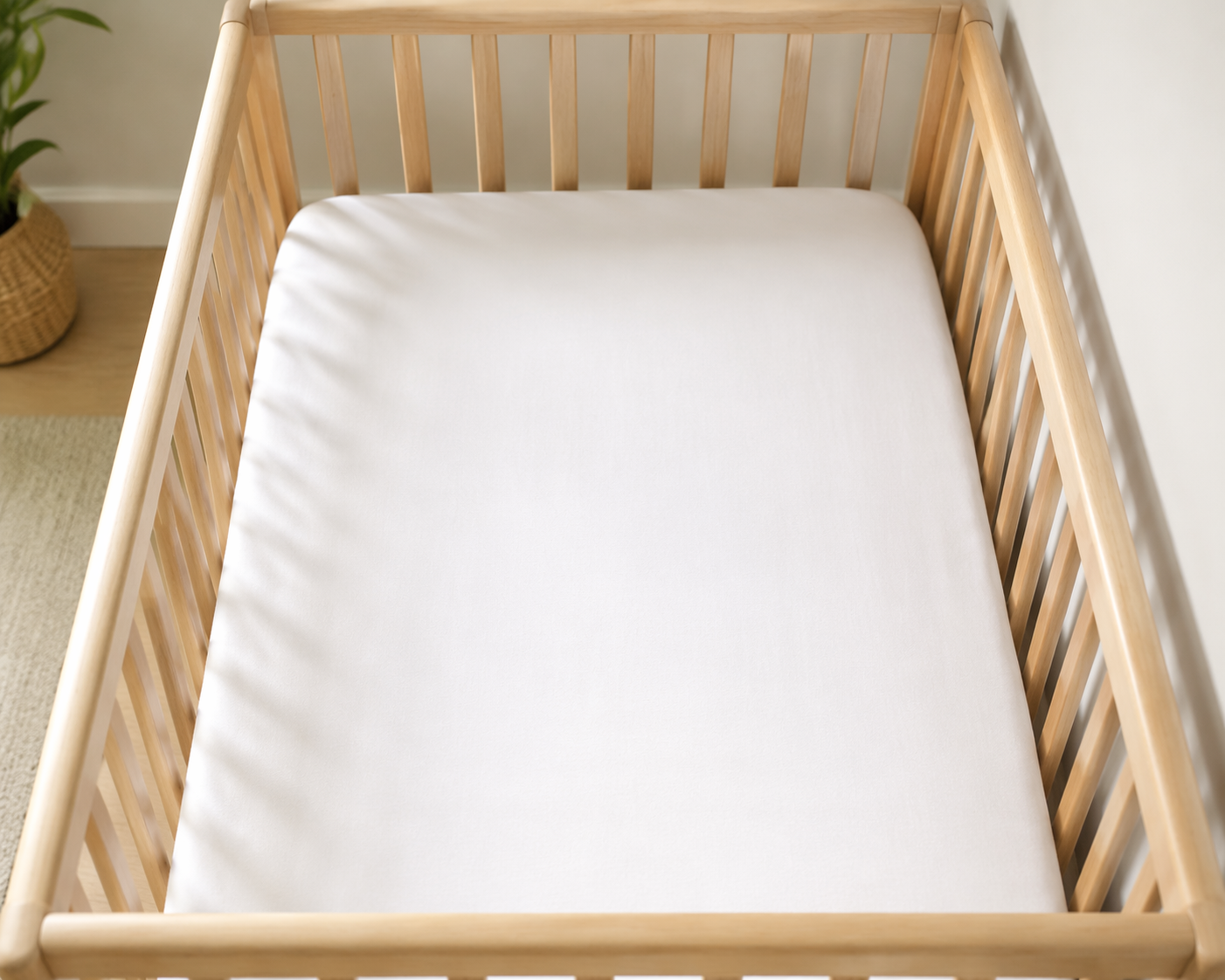
The sleep surface should be boring in exactly the right way: a firm, flat mattress with a tight-fitting fitted sheet, and no pillows, blankets, bumpers, stuffed animals, positioners, or decorative items in the sleep space. Those objects may complete a nursery photo, but they do not belong where an infant sleeps. The AAP safe sleep guidance emphasizes placing babies on their backs for every sleep and keeping soft objects and loose bedding out of the sleep area.[3]
Crib placement is part of the setup, not an afterthought
A crib should be positioned away from window blind cords, curtain ties, monitor cords, wall hangings that could fall, heaters, and direct drafts that make temperature harder to judge. If the crib is near a window because that is the only available wall, the design job is to remove the hazards around that window—not to pretend the hazards become harmless because the room is small.
The same principle applies to mobiles and shelves. A mobile may be fine as a supervised awake-time object when installed according to the product directions and kept out of reach, but the crib should not become a display zone. Heavy art, floating shelves, framed prints, and decorative garlands do not need to hang above a baby’s sleep surface.
| Design choice | Sleep or safety reason |
|---|---|
| Crib or bassinet in parents’ room for early months | Supports AAP room-sharing guidance without bed sharing |
| Firm, flat sleep surface with fitted sheet only | Keeps loose and soft items out of the infant sleep area |
| Crib away from cords, windows, heaters, and unstable decor | Reduces avoidable hazards around the sleep space |
| Low warm caregiver light outside the crib zone | Provides visibility without turning the whole room bright |
Choose a temperature range, then watch the baby
Temperature advice is frustrating because different credible sources give slightly different ranges. The AAP commonly recommends 68–72°F, many sleep consultants suggest 65–70°F, and the NHS in the United Kingdom advises 61–68°F. Those ranges are not identical, but they point in the same direction: avoid overheating, dress the baby appropriately, and do not make the room warm simply because adults worry the baby will be cold.
The safety concern is not only comfort. In a study of 60,364 SIDS cases, a same-day outdoor temperature increase of 5.6°C, or 10°F, was associated with an 8.6% increase in SIDS risk during summer. The increase was higher for Black infants, at 18.5%, and for infants aged 3–11 months, at 16.9%.[4] This study used outdoor ambient temperature as a proxy, not the measured temperature inside a nursery, so it should not be turned into a precise thermostat rule. It does support taking heat seriously.
A practical nursery setup makes temperature visible and adjustable. A simple room thermometer helps, especially in older homes where the thermostat in the hallway does not reflect the baby’s room. Clothing and sleep sacks matter as much as the number on the wall: a baby in a heavy sleep sack in a 70°F room is having a different thermal experience than a baby in a light layer at the same temperature.
- Check the baby’s chest or back of the neck rather than relying on cool hands or feet.
- Look for sweating, flushed skin, damp hair, rapid breathing, or heat rash as signs the baby may be too warm.
- Use layers that can be changed easily instead of heavy bedding, which does not belong in the crib.
- Keep cribs away from direct heat sources and strong sun exposure.
- Use ventilation to reduce stuffiness, but do not aim strong airflow directly at the baby.
The best temperature target is usually a safe range plus observation, not a single magic number. If the room is within a reasonable cool-to-comfortable range and the baby is dressed for that room, the parent’s attention can move from chasing perfection to noticing signs of discomfort.
Use sound carefully, especially near the crib
White noise can be useful in a real house where siblings, dishes, traffic, and floorboards exist. The overlooked design question is not whether a sound machine looks cute on the shelf; it is how loud it is at the baby’s ears. In a Pediatrics study, infant sleep machines placed closer than 30 cm, or about 12 inches, from an infant’s ears could exceed recommended noise limits for hospital nurseries.[5]
That study tested a limited number of devices in 2014, so it should not be treated as a current rating of every model on the market. The design lesson still holds: distance and volume matter. A machine across the room on a low setting is a different exposure than a machine clipped to the crib rail or placed on a nearby dresser at high volume.
- Place the sound machine away from the crib, not inside it or on the rail.
- Start with the lowest useful volume.
- Point speakers away from the baby when possible.
- Avoid using sound to mask a hazard that should be fixed, such as a monitor alarm that is too loud or a room that is repeatedly disturbed by avoidable activity.
Ventilation helps, but it does not replace safe sleep basics
Air movement is another place where the useful point is modest. Fan use during sleep has been associated with reduced SIDS risk, supporting the idea that ventilation may matter in the sleep environment.[6] That association is not a license to relax the basics: back sleeping, a clear crib, room sharing without bed sharing, and avoiding overheating still carry the practical weight.
A ceiling fan or room fan should move air through the room without making the baby cold or blowing strongly into the crib. If a fan requires cords, the cords should be secured well away from the sleep space. If the room has poor airflow, the design fix may be as simple as opening a door, using a fan safely, or adjusting where furniture blocks vents.
Let decor serve the sleep environment
Parents are allowed to want a nursery that feels calm and personal. That is not shallow; many adults spend long, vulnerable hours in that room. But decorative choices should yield when they interfere with darkness, airflow, safe crib clearance, or nighttime caregiving.
Paint color is a good example. Soft greens, warm neutrals, muted blues, or pale pinks may make the room pleasant for adults, but direct evidence that a specific wall color improves infant sleep is limited. If the walls are lavender but the room is bright at midnight, the wall color is not doing the important work. The more relevant light decision is whether sleep periods are dark and night care uses low, warm light.
Rugs can soften adult footsteps, but they should not create a tripping hazard on the route between the door, crib, chair, and changing area. Storage is useful when it keeps diapers, burp cloths, and feeding supplies reachable without piling objects on the crib rail or nearby sleep surface. A glider is helpful if it lets a tired adult feed safely; it should not be so buried in pillows and throws that every night feed begins with clearing a chair.
A parent-checkable setup
Before calling the nursery finished, stand in the doorway at night and test the room the way it will actually be used. The useful questions are concrete.
- Is the crib or bassinet in the recommended room-sharing location for the early months, without bed sharing?
- Is the sleep surface firm, flat, and clear except for a fitted sheet?
- Can the room become truly dark for sleep?
- Is there a dim amber or red light that lets an adult see without turning on overhead lighting?
- Is the crib away from cords, windows, heaters, unstable decor, and strong drafts?
- Is the room temperature in a reasonable range, with clothing adjusted to the room rather than loose bedding added?
- Is any sound machine placed away from the crib and set only as loud as needed?
- Does air move through the room without a fan blowing directly on the baby?
A better sleep nursery is not a flawless showroom. It is a room where darkness, safe crib placement, appropriate temperature, ventilation, and carefully placed sound support longer and safer sleep within the limits of the evidence. Most of that can be done by rearranging what is already there.
References
- Infant Sleep Environments and Sleep Outcomes in the First 6 Months of Life. PMC. 2022.
- What color light helps baby sleep?. Huckleberry.
- A Parent's Guide to Safe Sleep. HealthyChildren.org.
- Ambient Temperature and Sudden Infant Death Syndrome in the United States. PMC. 2017.
- Infant Sleep Machines and Hazardous Sound Pressure Levels. Pediatrics. 2014.
- Use of a Fan During Sleep and the Risk of Sudden Infant Death Syndrome. 2008.



Comments
Join the discussion with an anonymous comment.