
The bill is not due at 2:13 a.m. The bank will not answer. The payroll department will not fix an error before sunrise. Still, the body can treat the arithmetic happening in bed as if something immediate is happening. Heart rate edges up. Attention narrows. Sleep starts to feel less like a natural drift and more like a task being monitored by the same system that is trying to solve the money problem.
That is the useful starting point for understanding how financial stress affects sleep: not as a character flaw, and not as a vague cloud of anxiety, but as a sequence. Perceived economic threat can activate the body’s stress-response machinery, and it can also train a nightly behavioral pattern in which the bed becomes the place where unpaid bills, debt, job insecurity, and future scarcity get rehearsed.
The experience is common enough that it should not need defending. In a 2023 Sleep Foundation survey of 1,000 U.S. adults, 77% said they had lost sleep over money worries, and 41% said this happened all or nearly all of the time.[1] The more important question is what the body is doing during those hours, and why the pattern can harden into insomnia rather than disappearing after one difficult night.
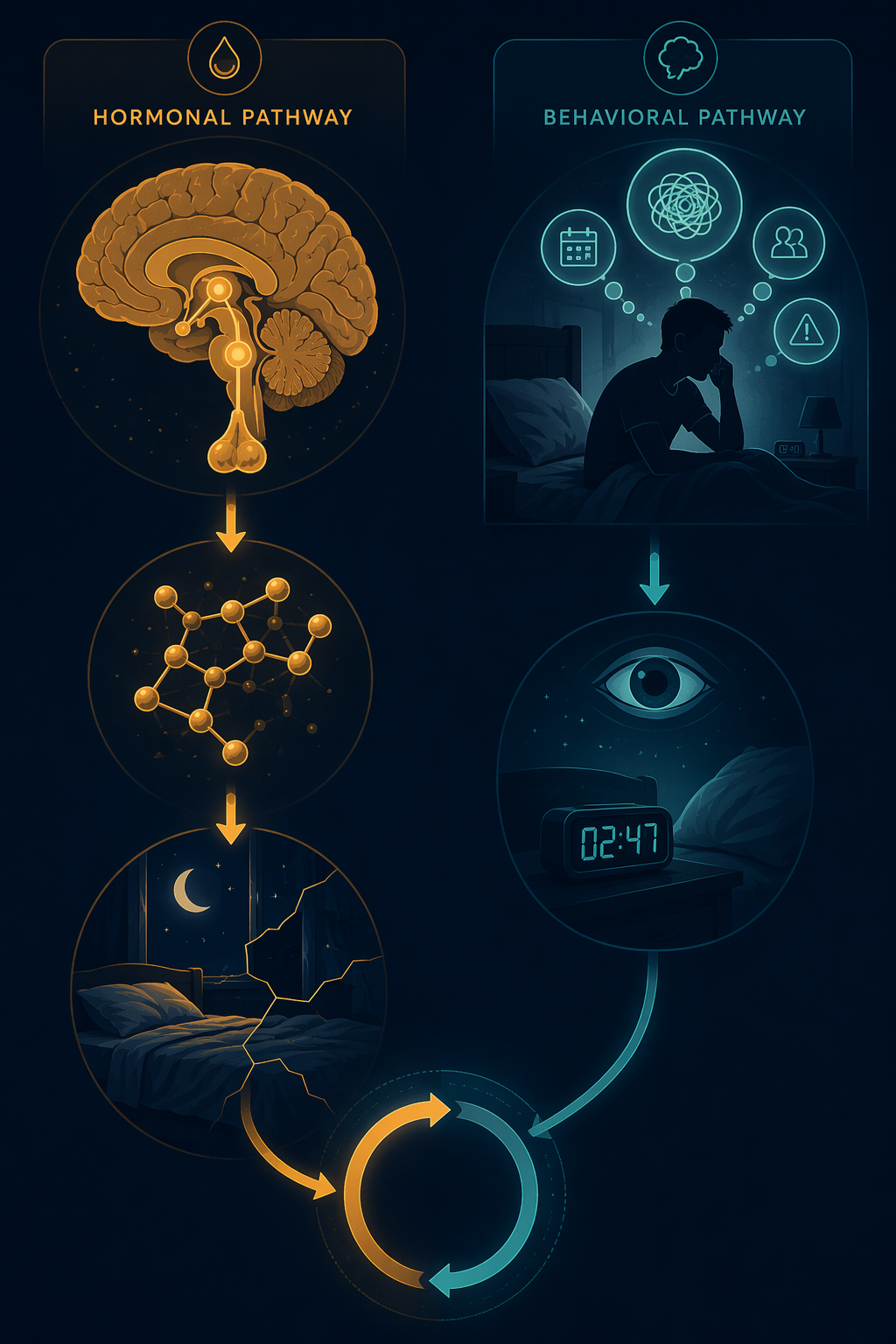
The body does not treat money worry as abstract
Financial stress begins in thought, but it does not stay there. A feared overdraft, a rent increase, or a shrinking paycheck can be processed as threat: a signal that the future contains danger and that resources may not be enough. Once the brain tags a problem that way, the hypothalamic-pituitary-adrenal axis—the HPA axis—can become involved.
The HPA axis is one of the body’s central stress systems. When it is activated, the brain and endocrine system coordinate the release of stress hormones, including cortisol. Cortisol is not “bad” by itself; it helps mobilize energy and attention. The problem for sleep is timing and persistence. Sleep onset asks the body to reduce vigilance. Financial threat asks the body to keep checking.
One of the more useful bridges between lived financial strain and measurable physiology comes from the CARDIA study. In Puterman and colleagues’ analysis of 776 participants, financial strain predicted higher daily cortisol output through a shift in the negative-to-positive affect index; the reported elevation was 4%.[2] That is not a claim that every late bill produces the same hormone change in every person. It is evidence that financial strain can be connected to a measurable stress-biology pathway rather than remaining only in the language of “worry.”
The caveat matters. The high-strain cortisol subsample in that analysis was small, with 35 participants.[2] A result like that should not be inflated into a universal dose-response rule. Its value is narrower and still important: it shows a plausible biological route by which financial strain can alter daily cortisol patterns through emotional load.
Why cortisol makes sleep harder to enter and easier to break
Sleep is not simply the absence of thought. It is an active physiological state that depends on falling arousal, stable rhythms, and reduced threat monitoring. Elevated or poorly timed cortisol pushes in the other direction. It keeps the system oriented toward readiness: more attention to signals, more preparation for action, less permission to disengage.
That helps explain why financial stress so often shows up first as trouble falling asleep. A person may be physically tired and still unable to cross the threshold into sleep because the body is not behaving as if the problem can wait. Mental arithmetic becomes paired with physiological arousal: checking balances, estimating due dates, replaying a conversation with a lender, imagining what happens if the next paycheck is short.
The same stress biology can also make sleep shallower and more interruptible. If the night is spent closer to vigilance, small awakenings become easier to notice and harder to exit. A person may wake at 4 a.m. and immediately find the money problem already loaded, as if the mind had kept the file open in the background.
This is where moral explanations do the most damage. “You need to stop worrying” treats the symptom as a choice. A more accurate model is that the person is trying to sleep while the threat system is still asking for surveillance. The unpaid bill is not physically in the bedroom, but the body may be acting as if the danger is present.
The bedtime handoff: when stress becomes a sleep-disrupting habit
Hormones are only one part of the story. The second pathway is behavioral, and it is the one many people recognize before they have language for it. Financial strain increases the likelihood of stress-before-bed behaviors: lying down and reviewing obligations, rehearsing worst-case scenarios, checking accounts, searching for solutions, or trying to plan the next day while the lights are out.
A 2025 longitudinal study by Brossoit and colleagues, published in the Journal of Business and Psychology, followed Army and Air National Guard members across 9 months and identified stress-before-bed behaviors as a mediating pathway between economic stressors and sleep outcomes.[3] Economic stressors predicted bedtime rumination behaviors at 4 months; those behaviors then predicted insomnia symptoms, lower sleep satisfaction, and daytime impairment at 9 months.[3]
The timeline is the point. The study does not merely say that stressed people sleep worse on the same night. It describes a handoff across months: economic strain gives rise to pre-sleep rumination, and repeated pre-sleep rumination helps carry the strain into later insomnia-related outcomes.
| Point in the pathway | What changes |
|---|---|
| Economic stressor | The person perceives money, debt, work, or resource insecurity as threatening |
| Before bed | Rumination, planning, checking, or problem rehearsal moves into the sleep window |
| Over months | The bed becomes associated with cognitive arousal rather than disengagement |
| Later sleep outcome | Insomnia symptoms, lower sleep satisfaction, and daytime impairment become more likely |
The sample also sets a boundary around the conclusion. Army and Air National Guard members are not a perfect stand-in for all civilian adults. Their job demands, stress exposure, and family rhythms may differ from those of the general population. Still, the mechanism itself is not exotic. Bedtime rumination is familiar well beyond military samples, and the study’s strength is that it follows the sequence rather than freezing it in a single survey moment.
This is also where a one-night sleep problem can begin to look more like insomnia. If the bed repeatedly becomes the place where economic threat is analyzed, the sleep system learns the association. The person may start the night already braced for another round of wakefulness. Readers trying to separate occasional stress-related wakefulness from a more durable insomnia pattern may find a triage framework useful in Sleeping Problem at Night vs. Insomnia.
Rumination is active work, not passive worry
The word “rumination” can sound soft, as if the mind is merely circling. In practice, it is often effortful. The person is calculating, comparing, predicting, and trying to prevent harm. The tragedy is that the work is usually mistimed. At midnight, the brain can generate scenarios, but it cannot renegotiate rent, create income, or make an institution open sooner.
That mismatch keeps the system activated. The mind continues to search because the threat feels unresolved; the body stays alert because the search signals importance. The result is cognitive arousal layered on top of physiological arousal. For many people, that combination is exactly what a “racing mind” feels like. The practical problem is not that the thoughts are irrational. It is that they are occurring in the one part of the day when problem-solving has the least access to action.
That distinction matters for advice. A generic command to relax can feel insulting when the concern is concrete. A better first step is to identify the sleep pattern being produced: trouble falling asleep, waking after a few hours, waking too early, or sleeping long enough but feeling unrefreshed. Those patterns are discussed more directly in Not Being Able to Sleep? Identify Your Insomnia Pattern, while the cognitive-arousal side of the problem is addressed in Why You Can’t Sleep at Night and How to Stop a Racing Mind.
Why the biology matters beyond one bad night
A single night of financial worry is unpleasant. A repeated pattern is biologically more consequential because stress systems, sleep timing, immune signaling, and daytime functioning begin to overlap. The strongest claims here should stay measured: financial stress is associated with worse biological profiles, but that does not mean every association proves a direct causal chain in every person.
In a 2025 analysis from the English Longitudinal Study of Ageing involving 4,940 older adults, financial stress was associated with sleep durations of 5 hours or less and with a 42% higher risk of a high-risk immune-neuroendocrine inflammatory profile.[4] That finding widens the frame. The concern is not only whether someone feels tired after worrying about money. It is whether repeated stress and curtailed sleep are traveling alongside broader physiological strain.
The ELSA finding should not be used to frighten someone who had a few bad nights during an expensive month. It is more useful as a warning against dismissing chronic financial stress as “just stress.” When short sleep, endocrine activation, and inflammatory risk markers cluster together, the body is not making a neat distinction between financial life and health.
The cycle can feed the financial problem back into itself
The loop does not end in the morning. Poor sleep makes the next day harder in exactly the domains financial stress demands: attention, impulse control, working memory, emotional regulation, and planning. A person who slept badly may have to make calls, compare options, resist avoidance, read fine print, decide which bill gets paid first, or explain a problem to someone with authority over the outcome.
That is the cruel feedback structure. Financial stress disrupts sleep through stress biology and bedtime behavior. The resulting sleep loss then weakens some of the executive functions needed to manage the financial stressor. Avoidance becomes more tempting. Decisions become more emotionally loaded. Small errors become more likely. The next night, there may be even more to review.
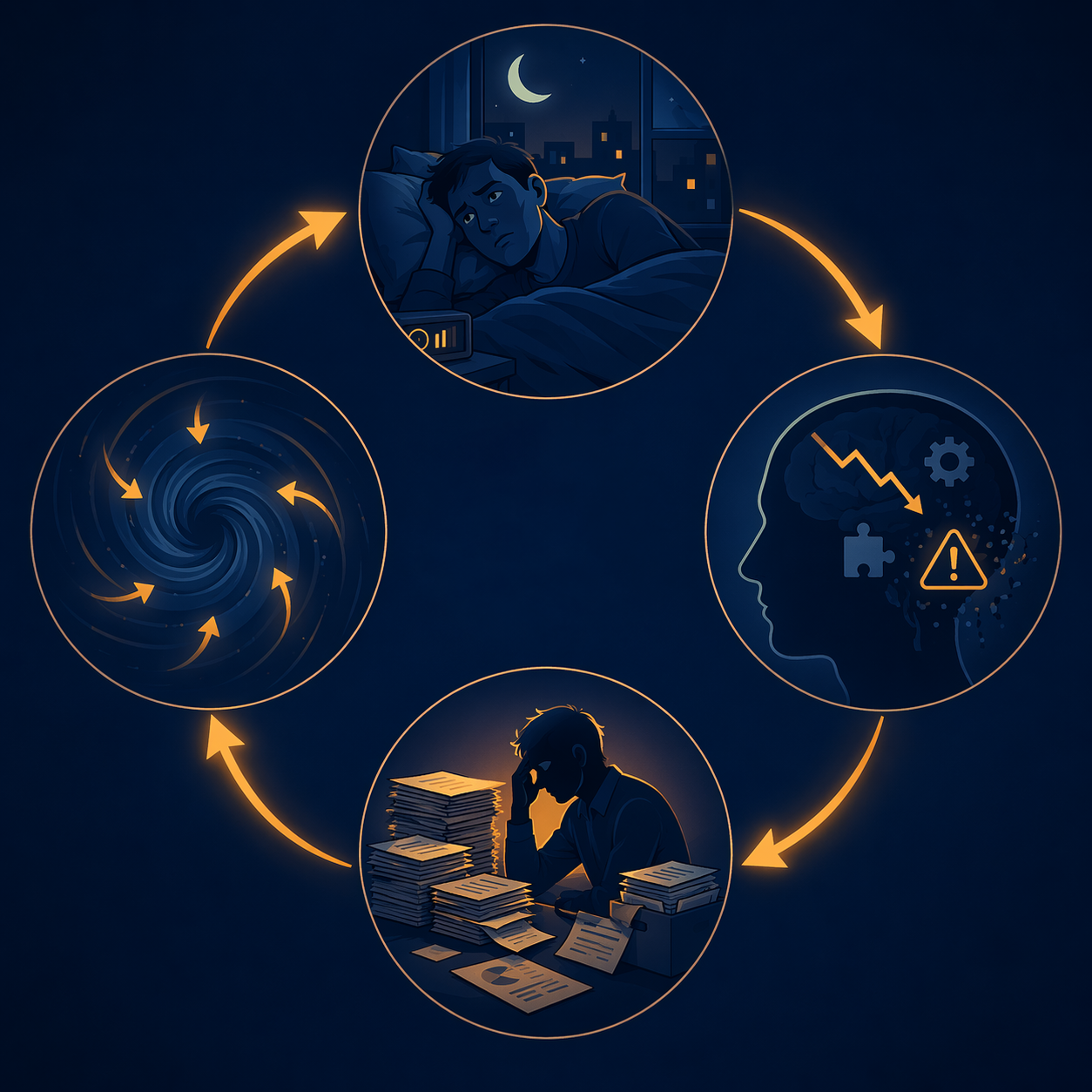
This does not mean the answer is simply to sleep better before dealing with money. Sometimes the financial problem is urgent and material, and no sleep strategy can substitute for income, safety, legal help, debt restructuring, or workplace support. But the sleep biology explains why waiting until midnight to mentally litigate the problem is so costly. It recruits the body’s threat system at the moment when sleep needs that system to stand down.
If the pattern has moved from occasional money-related wakefulness into persistent insomnia symptoms or daytime impairment, it is no longer just a rough week. A self-triage guide such as Can’t Sleep? A Self-Triage Guide for Adults can help clarify when professional support is warranted. When treatment questions arise, it is worth distinguishing short-term sleep aids from CBT-I and other approaches that address insomnia mechanisms more directly; How to Choose the Right Sleep Aid for Your Sleep Problem covers that distinction.
The model to keep
Financial stress affects sleep through two linked routes. One is hormonal: perceived economic threat can activate the HPA axis and shift cortisol output in a direction that favors vigilance over sleep. The other is behavioral: economic strain can move rumination, checking, and problem rehearsal into the pre-sleep window, where repeated practice turns the bed into a cue for arousal.
The danger is not only that money worries steal a few hours. It is that poor sleep can weaken the next day’s financial decision-making, feeding the stressor back into the same system that kept the person awake.
References
- 77 Percent of Americans Lose Sleep Over Financial Worries. Sleep Foundation. 2023.
- Financial Strain and Daily Cortisol Output Through the Negative-to-Positive Affect Index. PMC. 2013.
- Economic Stressors and Sleep: Stress-Before-Bed Behaviors as a Mediating Mechanism. Journal of Business and Psychology. 2025.
- Financial Stress, Sleep Duration, and Immune-Neuroendocrine Inflammatory Profiles in Older Adults. ScienceDirect. 2025.



Comments
Join the discussion with an anonymous comment.