
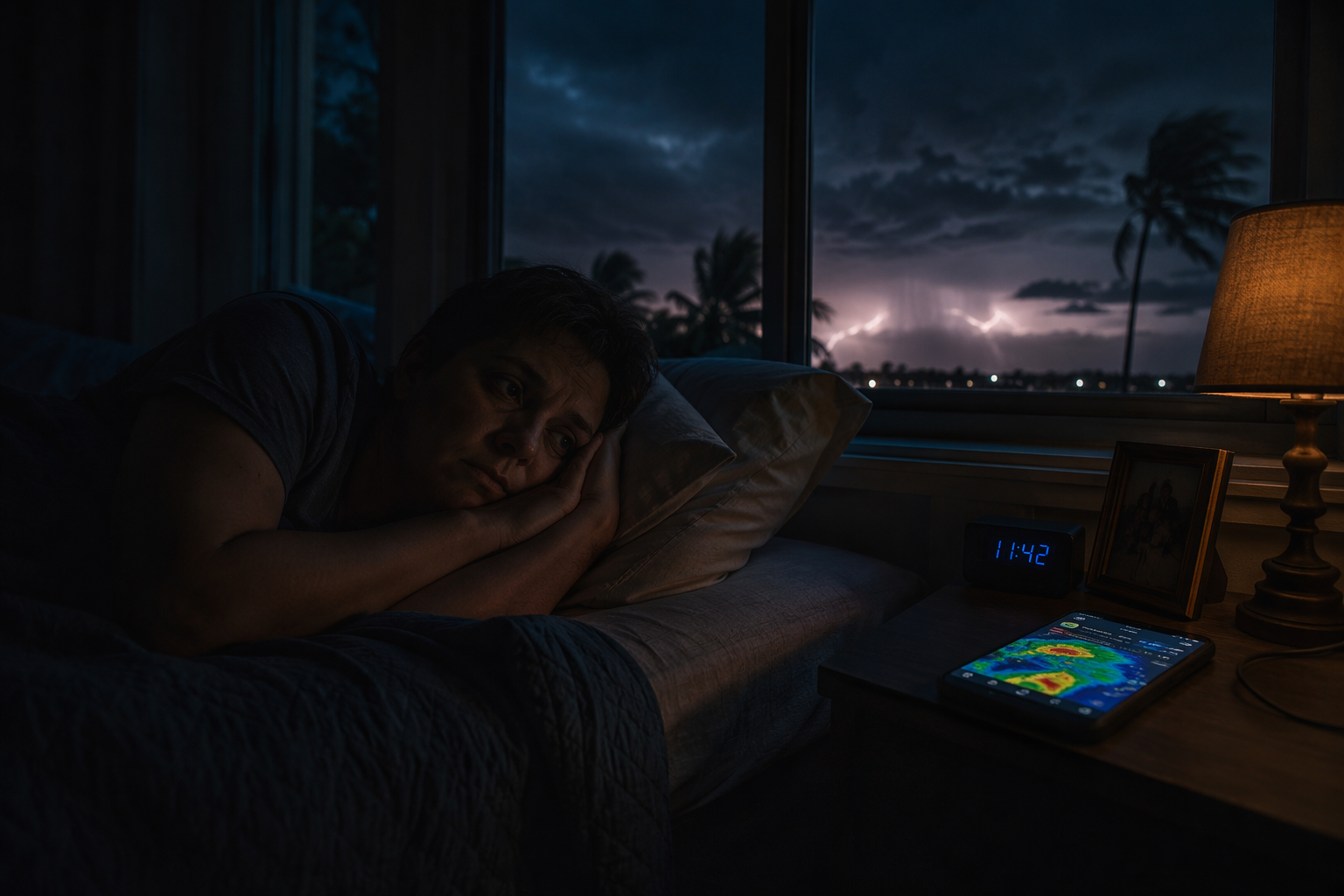
Tropical storm path sleep disruption usually starts before there is anything dramatic to hear. The house is still quiet. The lights are still on. The forecast cone has not made up its mind. Yet sleep already feels thin, oddly timed, and easy to break.
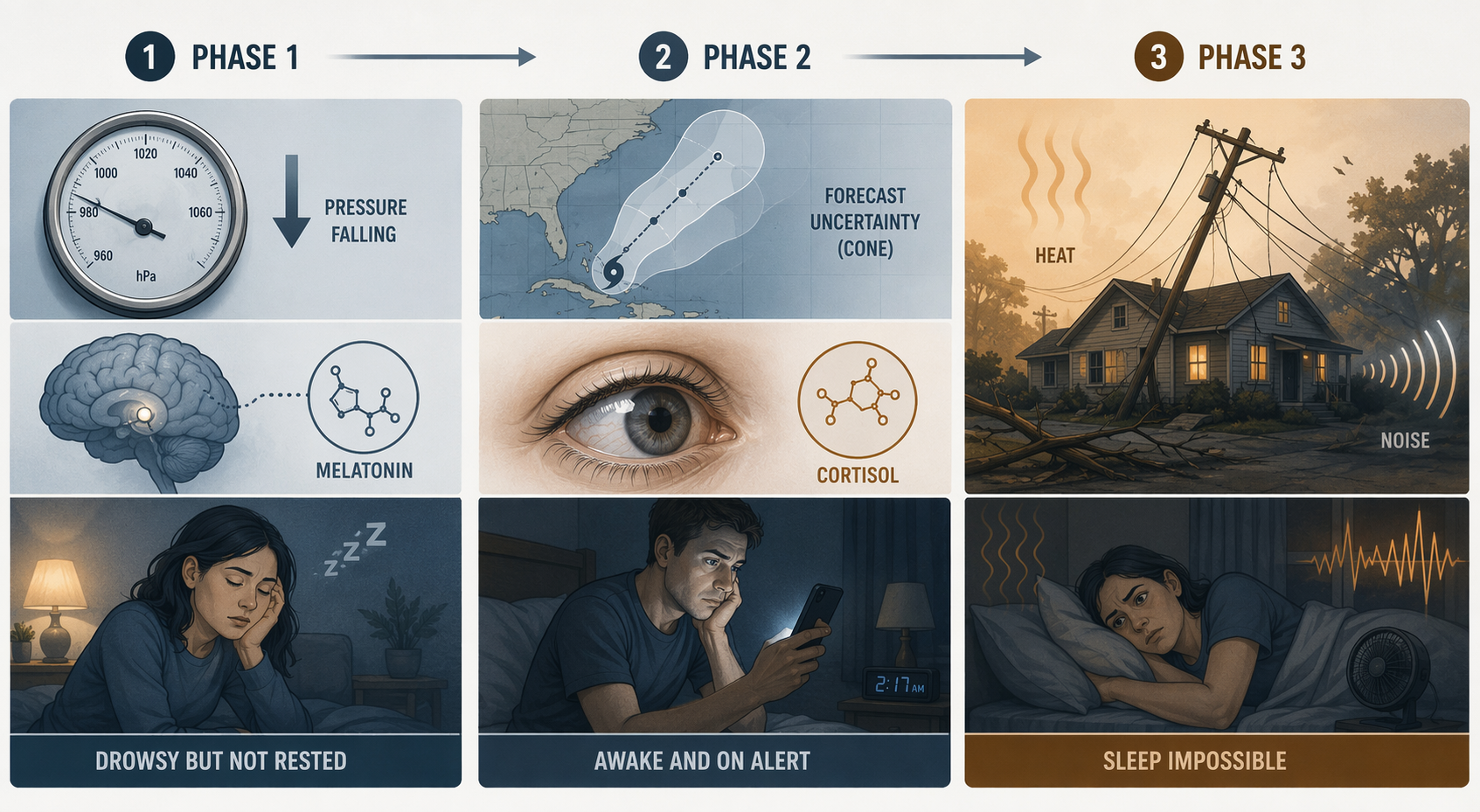
That early failure is not just “being anxious about the weather.” The body is often dealing with three overlapping pressures at once: falling barometric pressure that may change sleepiness without producing real rest, uncertainty about the storm track that keeps attention scanning for updates, and then, if conditions deteriorate, the loss of the basic environment sleep depends on.
The strange drowsiness before the storm
One of the more aggravating parts of pre-storm sleep is that it can feel like fatigue and insomnia at the same time. You may feel heavy, foggy, or unusually ready to lie down, then still spend the night waking up, checking the time, or coming out of shallow sleep with no sense of recovery.
Falling barometric pressure before storms may be one reason. Sleep-health summaries drawing on biomedical sources describe a plausible pathway in which low pressure before storms may influence melatonin release and contribute to tissue swelling, producing a drowsy, weighted feeling that is not the same thing as consolidated sleep [1]. The evidence is not strong enough to say that a specific pressure drop reliably causes a specific amount of insomnia. It is better read as a contributing condition, especially when the timing lines up with the familiar pre-landfall slump.
That distinction matters. Sleepiness is not sleep quality. A storm system can make the body feel slowed down while the night itself remains fragmented. The result is a bad bargain: less alertness in the evening, less restoration overnight, and a harder next morning for the person who still has to decide whether to buy gas, move patio furniture, call family, or keep working.
The forecast cone keeps the brain on duty
Then the track uncertainty takes over. A storm that is still offshore creates a very specific kind of wakefulness because the problem is not simply “a hurricane may happen.” It is that the answer keeps changing. A small shift in the cone can mean a normal rainy day, a night of tropical-storm-force winds, or a household decision that cannot wait until morning.
That uncertainty encourages checking behavior. Weather-anxiety guidance from Baylor College of Medicine and the Anxiety and Depression Association of America describes a pattern of repeated forecast monitoring, hypervigilance, and stress arousal that can begin before landfall rather than after damage occurs [2][3]. In sleep terms, that is a bad setup: the brain is asked to stand down while the environment keeps offering new information that may matter.
The phone is part of the loop, but it is not the whole problem. Blaming the screen misses the harder truth that the person checking radar may be doing legitimate risk management. Someone has to know whether the school closure changed, whether the evacuation zone expanded, whether the storm jogged east, whether the elderly neighbor still has a ride. The same behavior that protects the household can also train the night into repeated alertness.
This is where tropical storm path sleep disruption differs from ordinary poor sleep hygiene. The trigger is not merely bedtime procrastination or vague worry. It is a moving hazard with official updates, model runs, watches, warnings, group texts, local memory, and consequences. The mind keeps asking whether it is safe to stop monitoring. Often, the honest answer is only “probably, for now.”
Why this is more than an inconvenient night
The cost shows up after the storm, but the damage to sleep often starts while people are still supposed to be making good decisions. In a study of low-income women aged 18 to 31 in southeast Texas after Hurricane Ike, 39% were classified as poor sleepers using a Pittsburgh Sleep Quality Index score of 5 or higher [4]. That number should not be generalized to every Gulf Coast household; the cohort was specific by age, gender, income, and region. Still, the pattern is hard to dismiss.
In that Ike cohort, perceived stress declined over 12 months among good sleepers, while poor sleepers showed no decline in perceived stress over the same period [4]. The study does not prove that poor sleep alone caused prolonged stress. Sleep and stress can feed each other in both directions. But it does support a practical judgment people in storm country already understand: sleep quality can become part of resilience, not just a comfort item.
That matters because storm preparation is full of decisions made under time pressure. A poorly slept person is not just crankier. Sleep deprivation can make attention less stable, emotional reactions harder to regulate, and problem-solving more brittle. During a storm threat, those are not abstract wellness concerns. They affect whether someone reads a forecast correctly, remembers medication, times travel safely, or recognizes when they are too depleted to keep pushing.
When the sleep environment collapses
If the storm arrives, the problem becomes less subtle. The room may become hot, humid, loud, bright at the wrong times, crowded with family or pets, or interrupted by alerts. Power loss turns a bedroom from a sleep setting into a survival compromise. The body still needs a temperature drop, relative quiet, darkness, and safety cues to maintain sleep. A storm can remove all of those in one night.
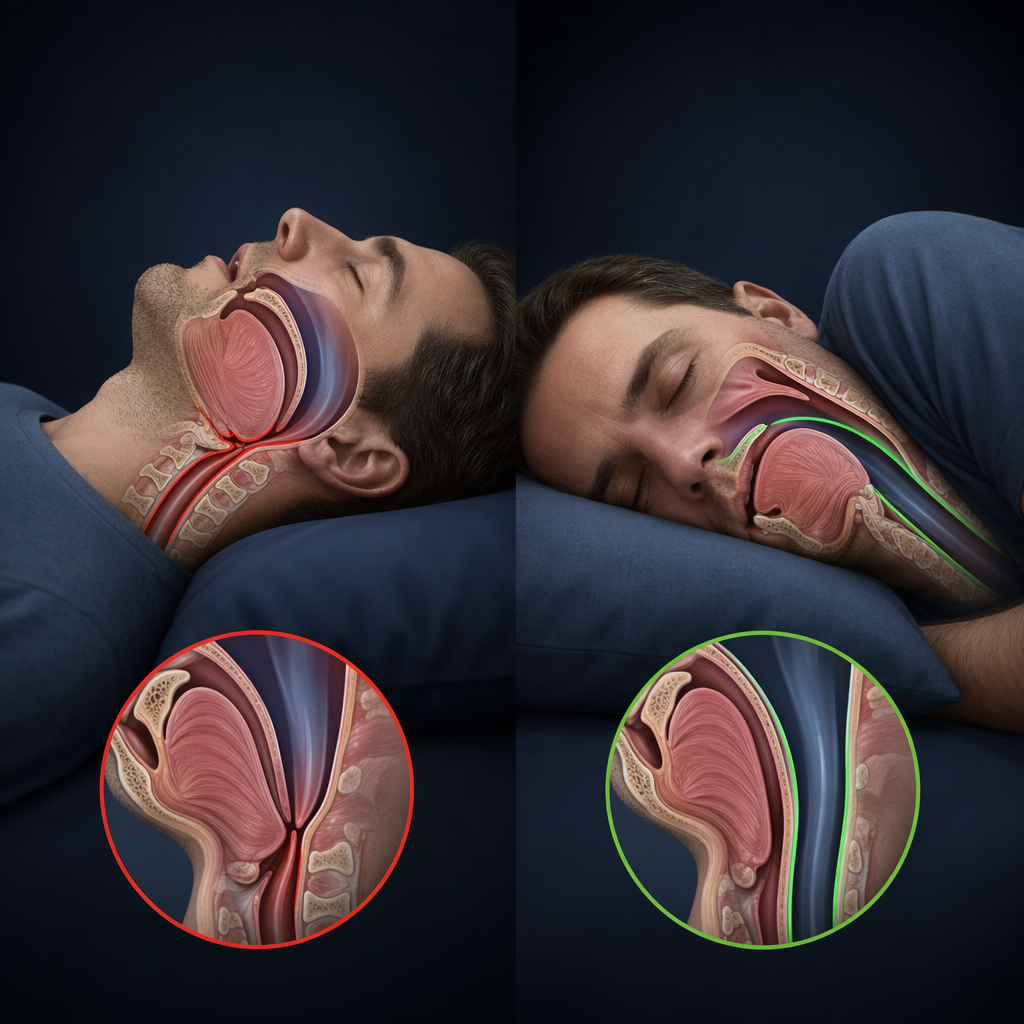
For people who depend on powered medical sleep equipment, the collapse is even more direct. After Hurricane Irma, a University of Miami report found that 80% of sleep apnea patients lost positive airway pressure therapy for an average of 4.3 days; 64% reported snoring and 42% reported daytime sleepiness [5]. That is not a matter of getting annoyed by wind noise. It is a treatment interruption at exactly the moment the household may need steadier breathing, better alertness, and fewer avoidable medical burdens.
Heat deserves its own place in this chain because power outages change the night even after the rain stops. A large U.S. study in Science Advances estimated that a 1°C increase in nighttime temperature was associated with 3 additional nights of insufficient sleep per 100 people per month [6]. The measure was self-reported insufficient sleep, not laboratory polysomnography, so it should not be treated as a direct recording of sleep architecture. It still fits the lived problem after a summer storm: the bedroom can stay hostile long after the radar looks quieter.
Storm sleep can stay disturbed after the cleanup starts
Some storm-related sleep loss clears when the air conditioning comes back, the phone stops buzzing, and the immediate threat passes. Some does not. An American Academy of Sleep Medicine report on catastrophic events noted increased subjective sleep complaints 6 to 12 months after Hurricane Andrew, especially among people with comorbid psychiatric conditions [7]. That finding is broader and less precise than an overnight sleep recording, but it points to the same warning: the body does not always treat landfall as the end of the event.
There is a useful line between a rough storm week and a sleep problem that deserves closer attention. If sleep remains fragmented for weeks after the danger has passed, if the bed itself starts to feel like a monitoring station, or if exhaustion begins shaping mood, work, driving, or medical routines, it may help to look at the specific insomnia pattern rather than writing it off as leftover stress. Readers trying to sort that out can use this guide to identify an insomnia pattern.
The same hypervigilance loop also appears after other disasters and near-disasters, where the sleeping brain keeps listening for the next signal of danger. That overlap is why storm anxiety can resemble other threat-specific sleep disruptions, including earthquake and bridge collapse fears that hijack sleep. The hazard changes; the scanning system is familiar.
Recognize the cascade early
The point is not that every restless night before a storm has a clean biological explanation. It does not. Barometric effects are still best treated cautiously, forecast anxiety cannot always be separated from damage anxiety in the available research, and post-storm sleep complaints vary by exposure, health, income, housing, and recovery support.
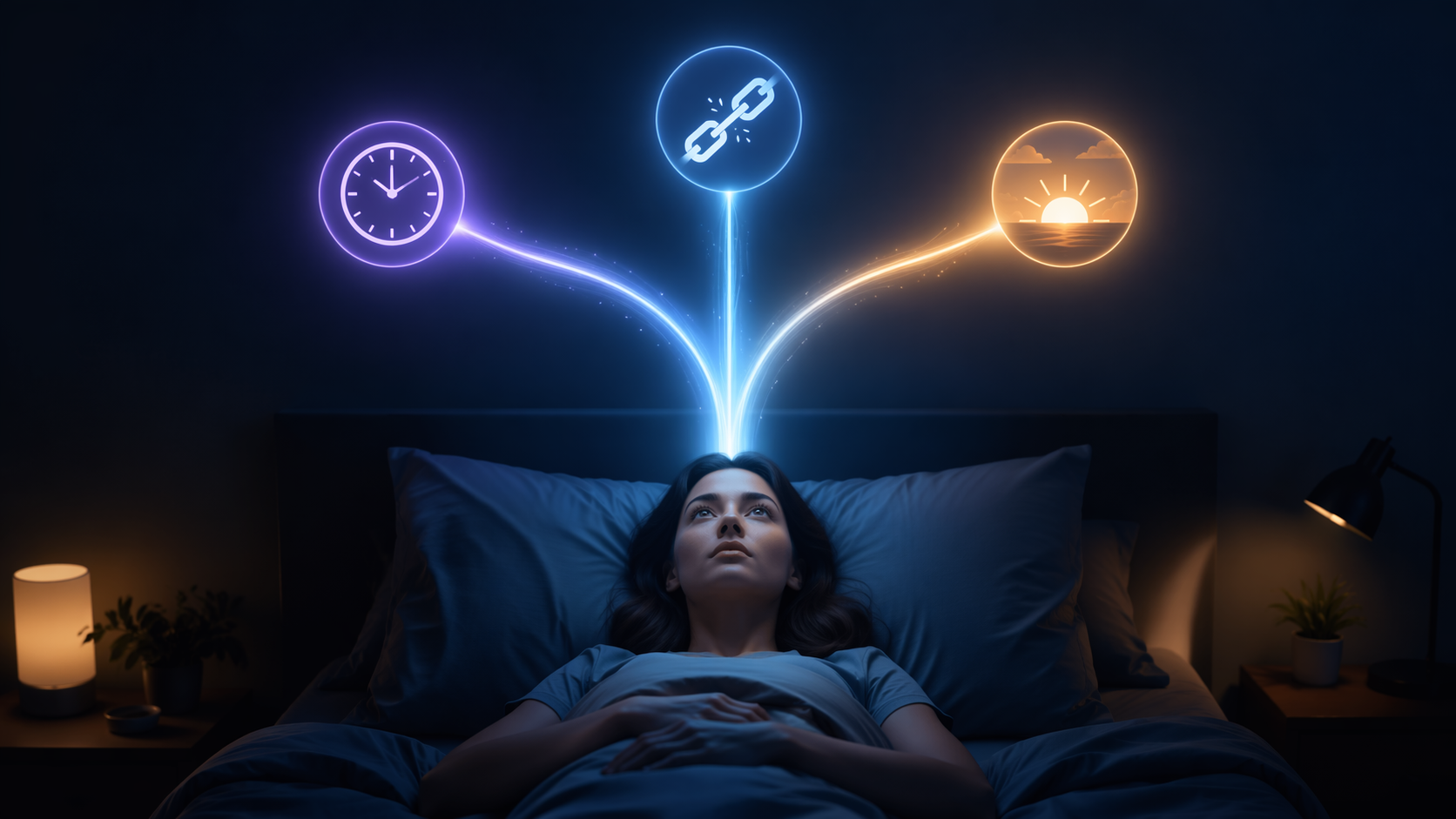
But the pattern is real enough to take seriously: pressure shifts may make the body feel wrong before the weather arrives; path uncertainty keeps attention awake; and the storm can then strip away the temperature, power, quiet, and medical routines sleep needs. That is a disaster-response sleep cascade, not a character flaw. It matters precisely because it begins before landfall, when clear thinking, immune resilience, and judgment are still needed.
References
- Why Do Storms Make You Sleepy?, Amerisleep.
- Weathering the storm: How to cope with hurricane anxiety, Baylor College of Medicine.
- How to Manage Weather Anxiety, Anxiety and Depression Association of America.
- Sleep Quality and Perceived Stress among Low-Income Women after Hurricane Ike, PubMed Central.
- Hurricane Irma disrupted sleep apnea therapy for many patients, University of Miami Miller School of Medicine.
- Nighttime temperature and human sleep loss in a changing climate, Science Advances, 2017.
- Sleep and sleep disorders associated with cataclysmic events, American Academy of Sleep Medicine.
Comments
Join the discussion with an anonymous comment.