
For the 2026 Perseids, the sky is doing its part. The new moon falls on Aug. 12 with 0% illumination, so moonlight will not wash out the shower, and the predicted peak arrives around 14:53 UTC on Aug. 13.[1] That exact peak timing favors Europe and Africa more than North America, but for U.S. viewers the practical answer is still the pre-dawn window on Aug. 13: roughly 2 to 5 AM local time, when the radiant is higher and the sky is dark.[1]
That is where the sleep problem begins. “Best viewing time” is an astronomy phrase; “2 to 5 AM” is a body-clock event. For one adult, that window may be a slightly stretched late night. For another, it lands in the most protected part of sleep. The better question is not only when the Perseid meteor shower is most visible, but where that window falls inside your own night.
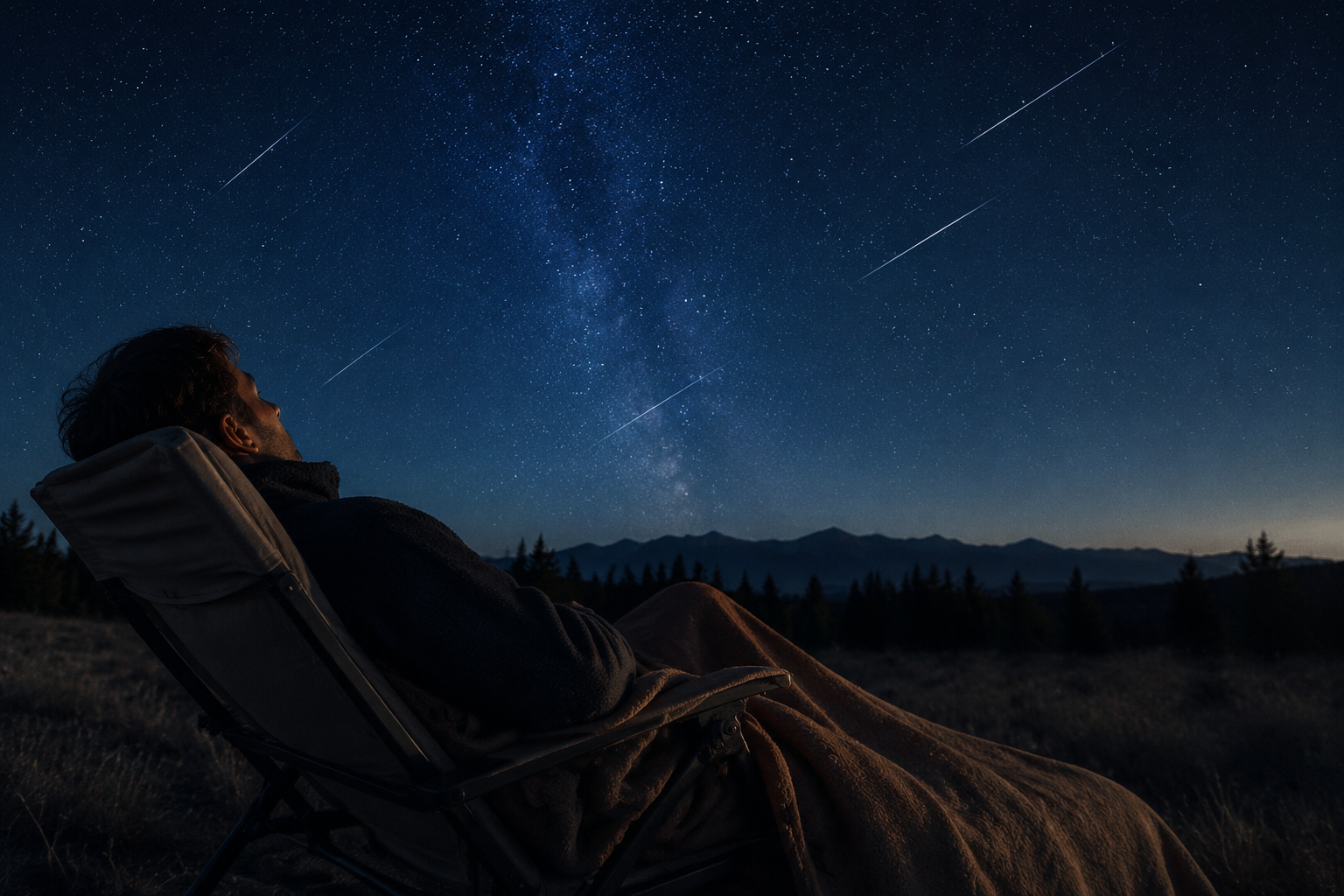
The 2026 Window Is Excellent, But It Is Not Sleep-Neutral
A dark Aug. 12–13 night is a legitimate reason to make an exception. The Perseids are one of the few annual sky events where getting away from lights, lying still, and giving your eyes time can feel worth the inconvenience. If you want a simpler all-purpose plan, the general Perseid sleep guide covers the usual tactics: dark sky, warm layers, a reclining chair, and not expecting instant fireworks.
The question here is narrower. You already want to watch and need to decide whether to stay up, sleep first and wake, shorten the session, or skip the deepest part of the viewing window. There is no published evidence testing “chronotype-specific meteor watching” as a protocol. The recommendations here are a reasoned synthesis: Perseid timing from astronomy, plus circadian timing and chronotype research from sleep science.
| North American viewing choice | Sleep tradeoff |
|---|---|
| Stay up into the 2–5 AM window | Works best if this is close to your natural late-night alert period, and worst if it pushes you far past your usual sleep onset. |
| Sleep first, then set an alarm | Preserves some early-night sleep, but can be costly if the alarm lands near your circadian low. |
| Watch a shorter late-night session | May reduce meteor counts, but also limits schedule damage. |
| Skip the peak window | A reasonable choice if the disruption would create a next-day safety, work, caregiving, or health problem. |
First, Identify the Sleeper You Are This Year
Chronotype means your natural tendency toward earlier or later sleep and wake timing. Popular sleep writing often uses animal labels: bears for middle-of-the-road, sun-aligned sleepers; wolves for evening types; lions for morning types; and dolphins for lighter, more easily disrupted sleepers. Sleep Foundation describes bears as about 55% of the population and wolves as about 15%, with chronotype influenced partly by genetics; Cleveland Clinic also notes that genetics may account for about 40% to 50% of chronotype variation.[2][3]
Use those labels as shortcuts, not diagnoses. They are not DSM or ICD categories, and the research literature more often treats chronotype as a morningness-eveningness spectrum measured by tools such as questionnaires. Still, the labels can help you make a practical decision quickly, as long as you do not turn them into personality tests.
The important move is to judge by your current pattern. Chronotype shifts with age: adolescents tend to move later, while older adults tend to move earlier.[2][3] Your college version, your vacation version, and your aspirational version are less useful than the pattern showing up now, on ordinary weeks. Ask when you naturally feel sleepy, when you wake without an alarm, and which part of the night feels easiest to protect.
If you are already fighting a late sleep schedule, the distinction matters even more. Late timing can interact with work, school, and social demands, which is why sleep timing is not just a preference issue; it can affect how well sleep fits the rest of life. For more on that broader question, see how bedtime timing relates to mental health.
Translate 2–5 AM Into Body-Clock Cost
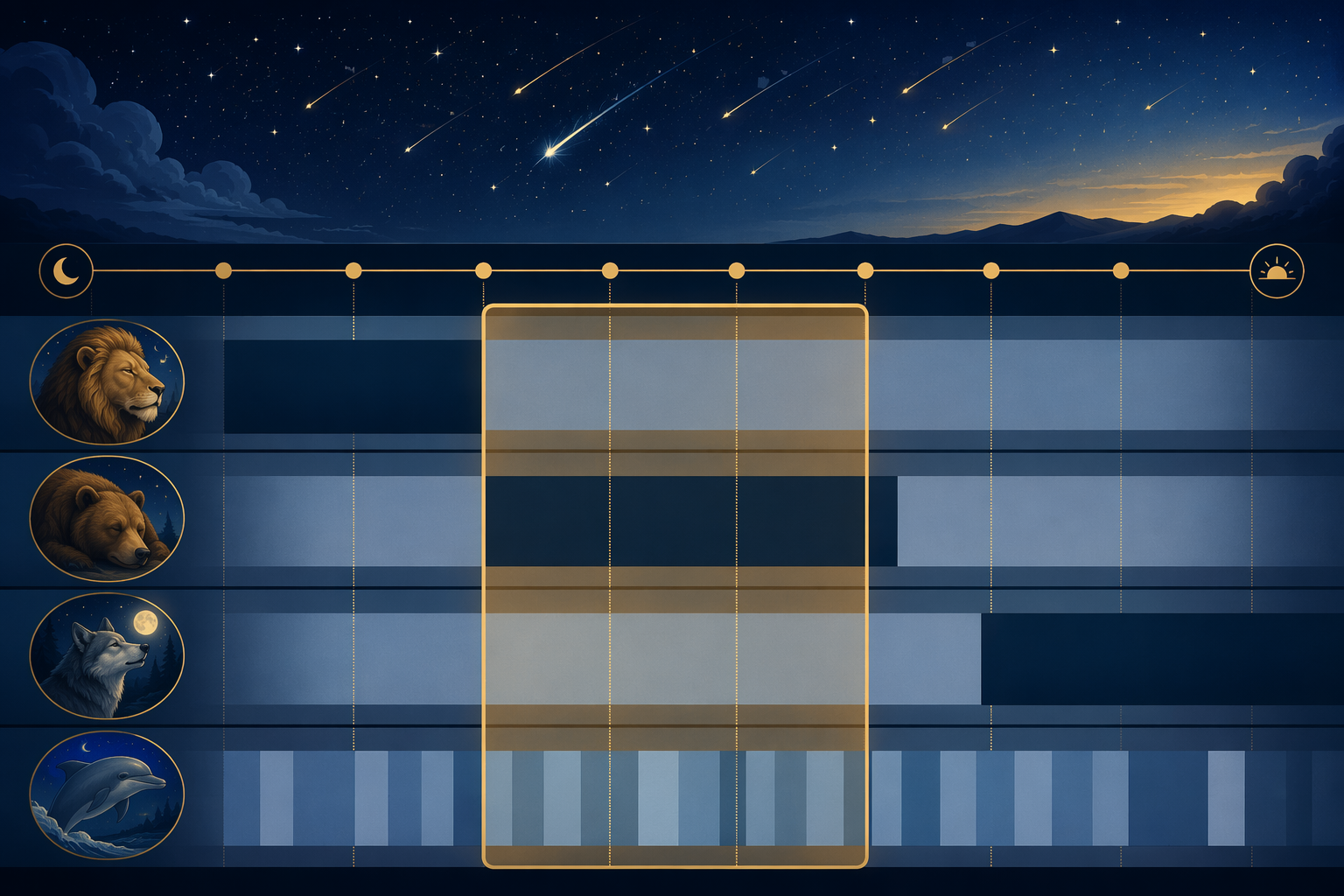
The same clock time does not carry the same biological cost for everyone. In the chronotype framework used here, a bear’s circadian low tends to fall around 2 to 4 AM, a lion’s around midnight to 2 AM, and a wolf’s around 6 to 8 AM. The 2026 Perseid window overlaps those low points differently, which is why the plan should change by sleeper type.
A useful phrase here is social jetlag: the mismatch between your internal clock and the schedule you force yourself to keep. One unusual meteor night is not the same as chronic circadian misalignment. But if your weekday schedule is already tight, a pre-dawn viewing session can act like a small, self-imposed time-zone jump. The cost is not only the hours missed; it is also where those hours sit.
Wolf: Stay Up, But Do Not Use the Perseids as a Permission Slip
If you are a true evening type, the Perseid peak is the least hostile to your rhythm. A 2 AM start may fall near a time when you are still alert, and your deeper circadian low may not arrive until closer to the 6 to 8 AM range. Compared with other chronotypes, staying up is often the cleaner strategy: no alarm shock, no broken sleep cycle, and less time lying awake after being jolted out of bed.
The catch is what happens after. If your normal sleep onset is already drifting later than your obligations allow, a meteor shower can become an elegant excuse for making the drift worse. That is not a Perseid problem; it is a scheduling problem wearing a sky-watching jacket. Extreme eveningness that regularly prevents sleep until very late may overlap with issues discussed in delayed sleep phase in adults.
A wolf plan can be simple: go out already prepared before the best window begins, watch from about 2 to 4 AM or 2 to 5 AM depending on your next day, then protect the recovery sleep afterward. Do not add bright screens, celebratory caffeine, or a long drive home if those will turn one late night into a multi-day delay.
Bear: Choose Between a Short Alarm and a Bounded Late Night
Bears are the group most likely to be misled by generic advice. Because they are relatively sun-aligned and make up the largest popular chronotype group, it is easy to assume they can absorb a pre-dawn outing. But the 2 to 5 AM Perseid window lands right across the bear circadian low, especially the 2 to 4 AM portion. That makes both main options imperfect.
Staying up avoids the violence of an alarm, but it may cut directly through the body’s strongest sleep drive. Sleeping first protects the early part of the night, but a 2:30 or 3 AM alarm may wake you at the groggiest point possible. For many bears, the best compromise is not “watch the whole peak.” It is either a tightly bounded late-night session or a carefully planned short wake-up.
| If you are a bear | Use this plan |
|---|---|
| You can sleep in the next morning | Watch 2–4 AM or 2–5 AM, then allow a real recovery sleep rather than pretending the night was normal. |
| You must work early | Consider a shorter session near 4–5 AM, or skip the peak and protect the day. |
| You fall back asleep easily after waking | Sleep first, set one alarm, watch briefly, and return to bed without adding screens or caffeine. |
| You feel ruined by middle-of-the-night alarms | Do not force the alarm strategy; a shorter late-night watch may be less disruptive. |
If you want nap timing or recovery details around this plan, the companion guide to protecting sleep on Perseid peak night is the better place for those mechanics.
Lion: The Best Meteor Window May Be the Worst Sleep Bargain
Lions get praised for waking early, but that does not mean they have free sleep to spend. If your body wants an early bedtime and early wake time, the Perseid window asks for something awkward: either stay up long past your natural sleep onset, or wake during a part of the night that may be hard to re-enter smoothly.
For lions, the most expensive mistake is often trying to behave like a wolf. Staying up until 3 or 4 AM may mean blowing past the sleep period your body most reliably uses. The sky may be better then, but the bargain can be poor if you have an early shift, caregiving duty, a long drive, or anything safety-sensitive the next day.
A lion plan should be conservative. If you can go to bed early, sleep first, and wake for a short 4 to 5 AM session, that may be the least bad way to catch some meteors while preserving the first stretch of sleep. If you wake naturally before dawn, even better: use that overlap instead of forcing a 2 AM alarm. If you do not wake easily and cannot recover the next day, skipping the peak is not a failure of wonder. It is accurate self-knowledge.
Dolphin: Protect Continuity Before Chasing a Higher Meteor Count
Dolphin is the least tidy label here. It is better handled as a light-sleeper profile than as a precise circadian timing bucket. If your sleep is already fragmented, the main issue may not be whether 2 AM or 4 AM is theoretically optimal. It may be whether interrupting the night creates hours of wakefulness afterward.
For light sleepers, a middle-of-the-night alarm can be a trap: you see a few meteors, come back inside cold and alert, and then spend the rest of the night negotiating with your own nervous system. The more conservative plan is usually better. Watch earlier for a shorter period if conditions are good, or choose a pre-dawn session only if you know from experience that you can return to sleep.
- Use one alarm, not a series of alarms that repeatedly fragment the night.
- Keep the setup friction low: warm layers ready, chair ready, route to the viewing spot simple.
- Avoid checking meteor forecasts, messages, or photos in bed before or after the session.
- Set a clear stop time before you go outside, because fatigue is a poor negotiator at 4 AM.
If Your Schedule Is Already Misaligned
Some adults do not fit neatly into recreational chronotype advice because their work hours, caregiving duties, or sleep disorder symptoms already push sleep out of alignment. In that case, the Perseids are not a harmless isolated exception by default. They are one more timing stressor layered onto an existing one.
Shift workers, for example, may find that the 2 to 5 AM window is either conveniently awake time or exactly the wrong disturbance, depending on the rotation. The same clock hour can mean post-shift wind-down, pre-shift sleep, or a rare protected rest period. The logic is similar to other circadian timing problems discussed in shift work sleep disorder treatment: timing choices matter because they can either reduce or deepen misalignment.
A Practical Pick for Aug. 12–13
If you want the simplest chronotype-based decision, start here:
- Wolf: stay up for the 2–5 AM window if the next day allows it, but protect the recovery morning.
- Bear: choose either a bounded 2–4 AM session with recovery sleep, or a short alarm-based watch if you fall back asleep easily.
- Lion: favor sleep first, then a short 4–5 AM look if you can wake cleanly; skip the deepest window if the next day matters.
- Dolphin: keep the plan short and low-stimulation, and do not trade a fragile night for a slightly better meteor count.
The best Perseid meteor shower viewing time for sleep is not just the hour when the sky is most active. It is the hour when the sky’s timing does the least damage to the sleeper you actually are.
References
- Perseid meteor shower 2026: All you need to know, EarthSky
- Chronotypes: Definition, Types, & Effect on Sleep, Sleep Foundation
- Sleep Chronotypes: What They Are and How To Figure Yours Out, Cleveland Clinic


Comments
Join the discussion with an anonymous comment.