
The sleep impact of viewing the Perseid meteor shower in 2026 is not imaginary, and it is not catastrophic. The best viewing is expected overnight August 12 into the morning of August 13, with the prime window roughly from 2 AM until dawn; the new moon on August 12 means the sky should be unusually dark, and ideal conditions can produce a zenithal hourly rate around 100 meteors per hour [1][2]. That is exactly the problem: the year with the most sleep-inconvenient timing is also one of the years most worth planning for.
This is not a case where better discipline moves the event to 10 PM. Meteor showers tend to improve after midnight because the part of Earth you are standing on has rotated into the planet’s forward-facing direction of travel, so it runs more directly into the stream of debris left by Comet Swift-Tuttle [1][3]. You can go out earlier, and you may see some meteors. But the strongest bet for 2026 is still the part of the night when a sleep-conscious adult would normally be protecting the second half of sleep.
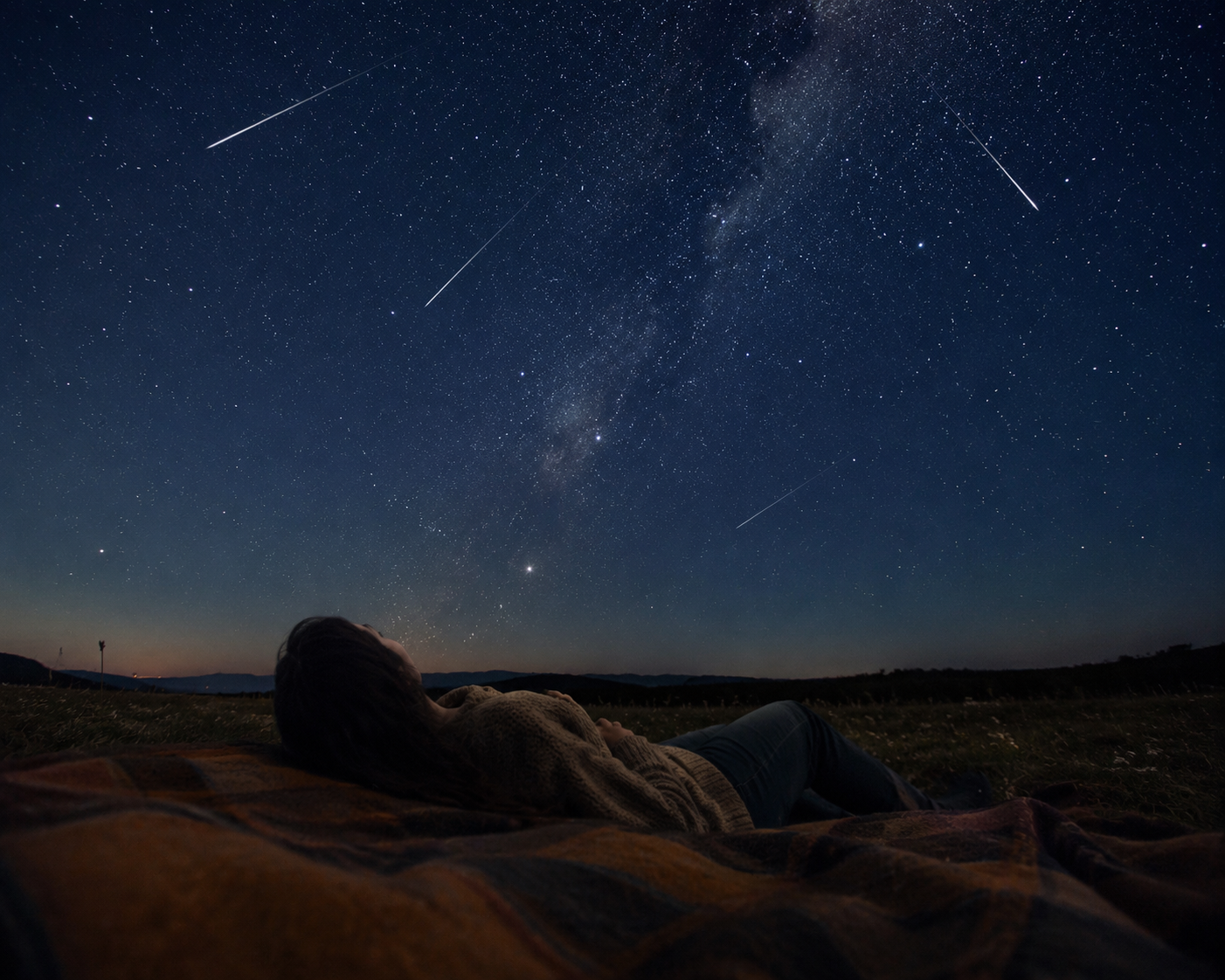
The cleanest way to think about the trade-off is this: staying up for the Perseids mostly costs late-night sleep opportunity, especially REM-heavy sleep, and it places you awake during the body’s lowest-alertness window. It is not mainly a case of the night sky blasting your melatonin system. A dark field and a glowing phone are not the same exposure.
What You Lose If You Stay Out Until Dawn
A normal night’s sleep is not evenly mixed from beginning to end. Slow-wave sleep is concentrated more heavily in the first third of the night, while REM periods generally lengthen across the second half. That matters because a Perseid plan that starts with several hours of sleep before you go outside is physiologically different from simply staying awake from dinner until sunrise [4].
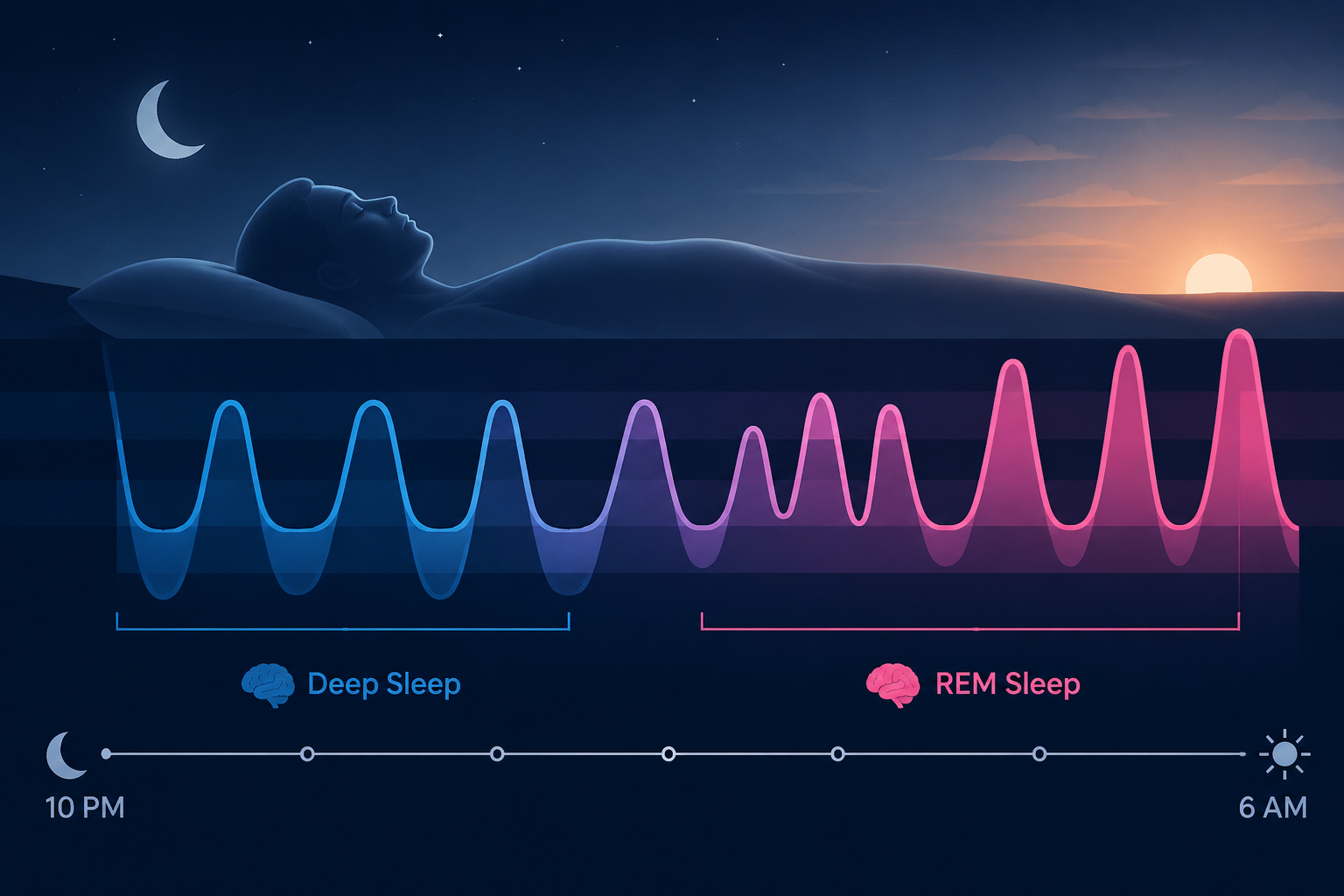
If you sleep from roughly 9:30 or 10 PM until 1:30 AM, you are not getting a complete night, but you are protecting a meaningful portion of the early-night deep sleep that tends to come first. The cost then shifts toward the late cycles you cut away: more REM opportunity, more dream-rich sleep, and more of the sleep that would normally occur as morning approaches.
The timing adds another layer. The 4–6 AM circadian nadir, the part of the biological day when alertness is typically lowest, overlaps with the tail end of the recommended Perseid viewing window [4]. That is why the next morning can feel disproportionate to the number of hours you technically missed. You are not only short on sleep; you were also awake and possibly driving, packing up, or making decisions when your body was least interested in performing.
| Phase | Main Sleep Cost | Better Choice |
|---|---|---|
| Before viewing | Skipping early sleep removes the part of the night most likely to contain more slow-wave sleep | Sleep first, then go out |
| 2 AM to dawn | Lost late-night sleep cuts into REM-heavy cycles and overlaps the circadian low | Keep the outing simple and low-light |
| After returning | Phone use and bright indoor light can turn a short disruption into a stronger circadian signal | Go straight back to bed or keep lights dim |
| Next night | Recovery is delayed if the following night is treated as optional | Plan August 13–14 as part of the event |
The Sky Is Not the Light Problem
It is tempting to collapse every nighttime exposure into the same warning: light at night is bad. That is too crude for meteor watching. Natural night-sky light is extremely dim, around 0.0001–0.001 lux, far below the rough melanopsin-relevant range of about 1–10 lux near 480 nm needed to meaningfully suppress melatonin. Indoor room light is a different category; evening room light around 100–300 lux has been shown to suppress melatonin onset and delay it by about 90 minutes [5].
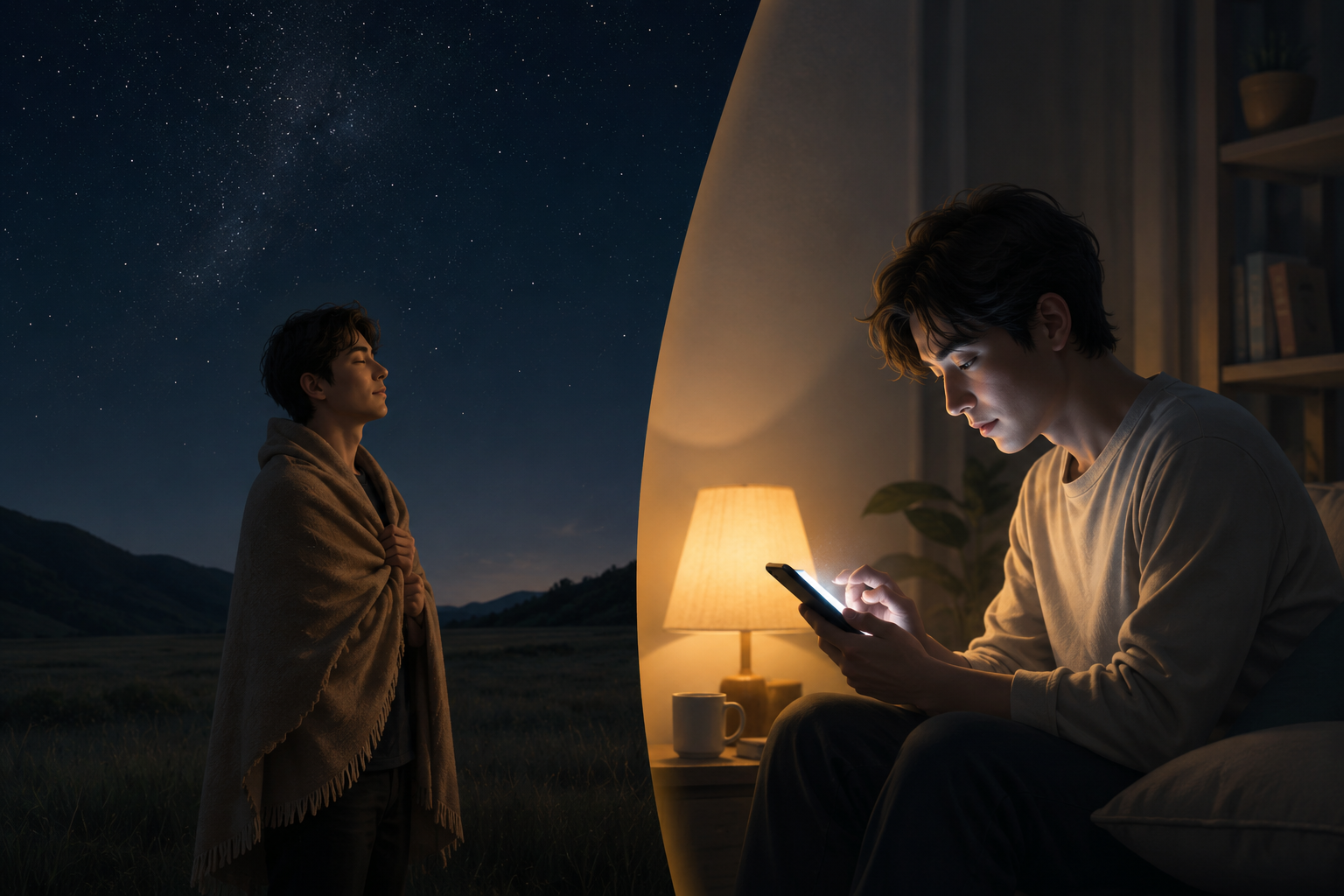
That distinction is not a loophole for an all-night scrolling session in a folding chair. It is a reason to aim your caution correctly. The dark field is closer to natural darkness than to a lit bedroom. In camping studies, exposure to natural light-dark cycles shifted circadian timing closer to the solar day, including under natural nighttime darkness rather than modern indoor lighting patterns [6][7].
The practical consequence is simple enough to be annoying: the meteor shower is not the melatonin problem; your logistics can become the melatonin problem. Car dome lights, bathroom lights, bright headlamps, and “just checking the forecast” on a phone after you come inside are the exposures most likely to turn a planned short night into something more biologically disruptive.
A Sleep Plan for the 2026 Perseids
The goal is not to make a late-night meteor watch cost-free. It is to keep the cost from spreading. For a healthy adult with a normal daytime schedule, the best plan starts well before sunset.
- Take a 90-minute nap before 3 PM on August 12 if your schedule allows. A full-cycle nap can reduce sleep pressure without pushing too hard into the evening sleep window.
- Go to bed early that night instead of waiting awake for the shower. Even a first sleep block gives you a better starting point than treating the whole night as disposable.
- Set one alarm for the viewing window. Avoid repeated alarms that fragment the early sleep you are trying to protect.
- Pack before bedtime: blanket, warm layer, water, keys, and any viewing spot directions. Fewer decisions at 1:30 AM means fewer reasons to turn on lights.
- Use red light only when you need light outside. Keep it dim and pointed down.
- After coming back inside, do not scroll. If you need to record what you saw, write one line on paper or leave yourself a voice memo without staring at the screen.
The red-light advice is not magic; intensity and duration still matter. A bright red lamp held close to your face for a long time is still more stimulation than sitting under the sky. But for finding a thermos, checking a path, or avoiding a trip hazard, dim red light is usually the better compromise than a white flashlight or phone beam.
If You Have to Work the Next Morning
The riskiest part of the plan is not feeling a little foggy at breakfast. It is pretending that fogginess will not affect anything that requires sustained attention. If you must drive home near dawn, keep the viewing site close, go with another adult if possible, and leave before you are fighting to stay awake. If your Thursday morning includes safety-sensitive work, long driving, clinical decisions, machinery, or high-stakes meetings, the better version of “watching” may be a shorter session rather than the full 2 AM-to-dawn window.
Parents of young children, shift workers, older adults, and people with insomnia or another sleep disorder also have a different budget. The one-night plan can still help, but the recovery assumption is less tidy when baseline sleep is already restricted or irregular. In that case, the more honest plan may be to watch earlier, stay closer to home, or choose the best hour instead of trying to claim the whole peak.
Recovery Starts the Night After, Not Eventually
The recovery night is not a nice add-on. It is part of the viewing plan. In laboratory sleep-restriction research, recovery sleep produced disproportionate gains: the first recovery opportunity delivered the largest cognitive rebound, and even 4–5 hours of recovery sleep was better than remaining awake entirely [8]. That does not mean everyone feels perfect after one night, but it does support the practical idea that the first protected recovery sleep matters a lot.
For most healthy adults, a single planned late night is usually recoverable within one to two recovery nights, especially if the next day does not become a caffeine-fueled extension of the same disruption [8]. The useful move is to protect August 13–14 before the meteor shower happens: no late dinner plans, no unnecessary evening work, no revenge scrolling because the day felt slow. Let the rebound occur.
Caffeine deserves a small warning here. Morning caffeine may be reasonable if you normally use it, but late-day caffeine after a short night can steal from the very recovery sleep you need. A nap the afternoon before the shower is strategic; a stimulant bridge into the next evening is borrowing against the repayment period.
A Bounded Trade-Off
The 2026 Perseids are a reasonable exception for many healthy adults because the disruption is specific and plannable. You are trading away some late-night REM-rich sleep and waking through the circadian low. You are not, if you keep the night dark and the phone away, bathing your brain in the kind of artificial light that delays melatonin.
Sleep first, go out prepared, keep the light red and minimal, come back without screens, and treat August 13–14 as the second half of the plan. That is enough structure to enjoy a rare dark-sky Perseid peak without pretending the next morning is free.
References
- Everything you need to know: Perseid meteor shower, EarthSky, https://earthsky.org/astronomy-essentials/everything-you-need-to-know-perseid-meteor-shower/
- Perseid meteor shower 2026 guide: Where and when to see it, Space.com, https://www.space.com/perseid-meteor-shower-2026-guide
- Perseids, NASA Science, https://science.nasa.gov/solar-system/meteors-meteorites/perseids/
- Best Meteor Shower Sleep, Mattress Miracle, https://mattressmiracle.ca/blogs/mattress-miracle-blog/best-meteor-shower-sleep
- Exposure to Room Light before Bedtime Suppresses Melatonin Onset and Shortens Melatonin Duration in Humans, Journal of Clinical Endocrinology & Metabolism, 2011, https://pmc.ncbi.nlm.nih.gov/articles/PMC3047226/
- Entrainment of the Human Circadian Clock to the Natural Light-Dark Cycle, Current Biology, 2013, https://pmc.ncbi.nlm.nih.gov/articles/PMC4020279/
- Circadian Entrainment to the Natural Light-Dark Cycle across Seasons and the Weekend, Current Biology, 2017, https://pmc.ncbi.nlm.nih.gov/articles/PMC5335920/
- Neurobehavioral Dynamics Following Chronic Sleep Restriction: Dose-Response Effects of One Night for Recovery, Sleep, 2010, https://pmc.ncbi.nlm.nih.gov/articles/PMC2910531/
Comments
Join the discussion with an anonymous comment.