The 2026 Perseids make the sleep trade-off unusually tempting. The peak night is August 12–13, with a new moon at 0% illumination, so moonlight should not wash out the sky; the best rates arrive after midnight and build toward dawn, exactly when most people are supposed to be in their most protected sleep window.[1][2] That is the real trade-off: the sky is at its best when your next day is most at risk.
The reward is not imaginary. The American Meteor Society lists a zenithal hourly rate of about 100 for the Perseids, the Planetary Society gives a more practical 50–75 meteors per hour at dark sites, and Royal Museums Greenwich notes that up to 150 per hour can be possible under ideal conditions.[1][3][4] Those figures should not be blended into a promise. They describe different assumptions: perfect sky geometry, dark-site viewing, and real-world limits are not the same thing.
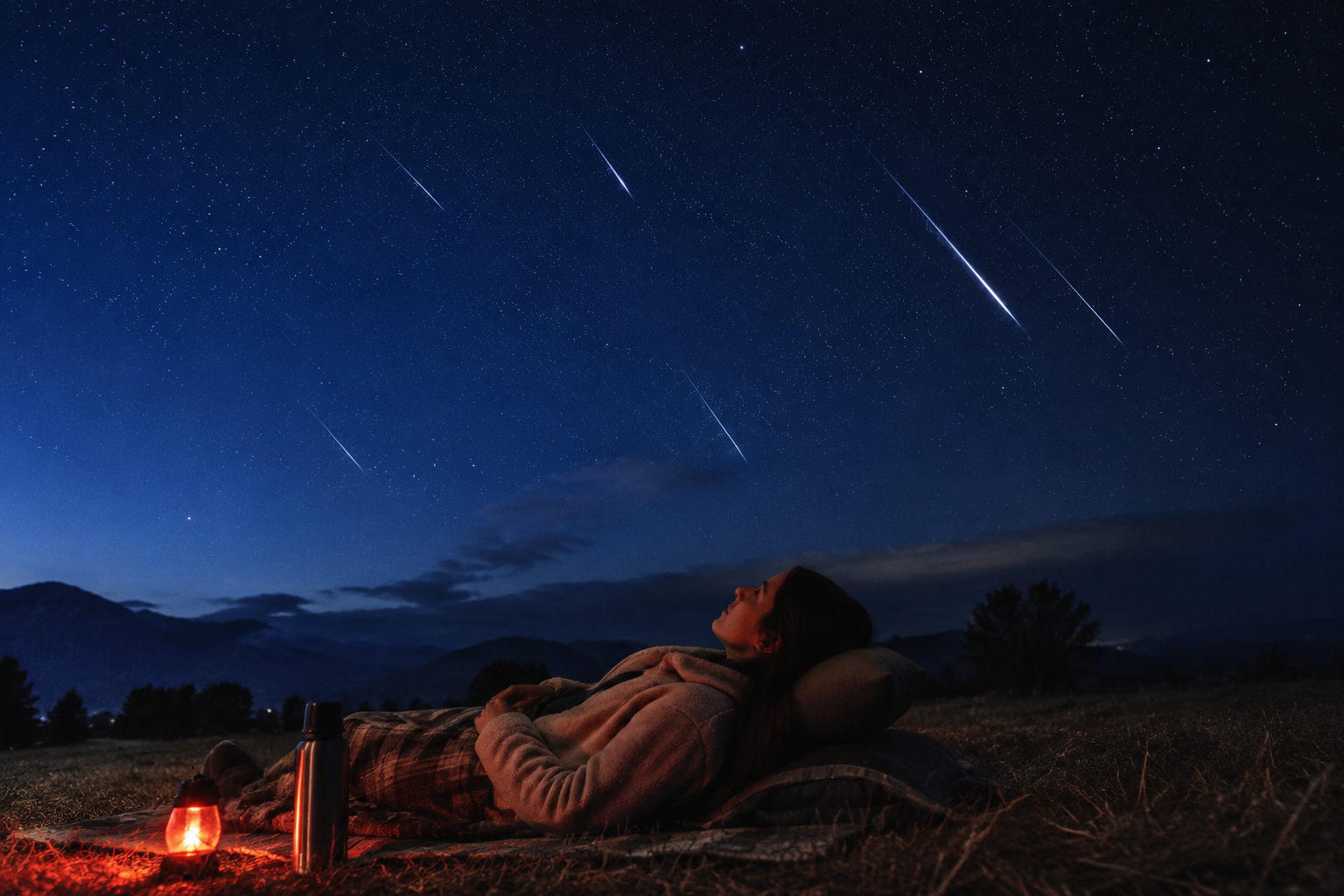
For most healthy sleepers, a single planned late night is a reasonable exception. The mistake is treating it like a harmless movie night that can be repaired by “sleeping in.” The better approach is to decide in advance how late you will be awake, how you will avoid the worst light and wake-up mistakes, and what the next morning is allowed to demand from you.
The Viewing Window Worth Losing Sleep For
If you can only watch for one night, choose August 12 into the early morning of August 13. Activity rises from around August 11, peaks on August 12–13, and falls off sharply after August 13, while the new moon removes the usual lunar penalty.[1][2] In a year with a bright moon, the sleep cost would be harder to justify. In 2026, the timing and the sky are both cooperating.
The hard part is that the Perseids improve after local midnight. After midnight, your side of Earth is turned more directly into the stream of debris, so the planet’s leading face sweeps up more particles head-on; meteor rates can be roughly double what they are in the evening.[2] This is why a 10:30 p.m. blanket session can be pleasant but underwhelming, while a 2 a.m. watch can feel like the event finally arrived.
| Choice | Best for | Sleep cost | Viewing expectation |
|---|---|---|---|
| Evening watch, before midnight | Work nights, parents on early duty, fragile sleepers | Lowest | Fewer meteors, but still a chance to see Perseids under a dark sky |
| Post-midnight watch, about 1–4 a.m. | Healthy sleepers who can protect the next day | Moderate to high for one night | Best practical balance between rates and recovery |
| Stay until dawn | Astronomy-first viewers with no next-day demands | Highest | Highest rates, but the hardest sleep recovery |
The middle option is the one most sleep-conscious viewers should plan around: stay up continuously into the post-midnight window, watch while the rates are meaningfully better, then leave before dawn unless you have a truly empty recovery day. It is not the purist’s maximum. It is the version most likely to leave the experience intact instead of turning the next day into collateral damage.
Do Not Set a 1:30 A.M. Alarm
The most tempting plan is also one of the worst: go to bed at your normal time, set an alarm for the peak, drive out half-awake, then try to sleep again afterward. That sounds efficient, but it risks waking you from deep sleep. Sleep inertia—the grogginess and impaired performance that follows waking, especially from slow-wave sleep—can last 30–60 minutes.[5] That is a bad state for driving, navigating a dark field, or deciding whether you are too tired to continue.
For a one-night meteor plan, continuous wakefulness is usually cleaner than a mid-sleep interruption. Go into the night knowing you are delaying sleep, not cutting a hole in the middle of it. You will still pay a sleep-pressure cost, but you avoid the disoriented wake-up, the forced transition into bright light, and the second sleep-onset struggle after returning home.
There is one exception: if you know from experience that you can take an early-evening sleep block, wake easily, and function safely, that may work for you. But for the average routine-builder, especially anyone driving, the alarm-from-deep-sleep strategy is too brittle.
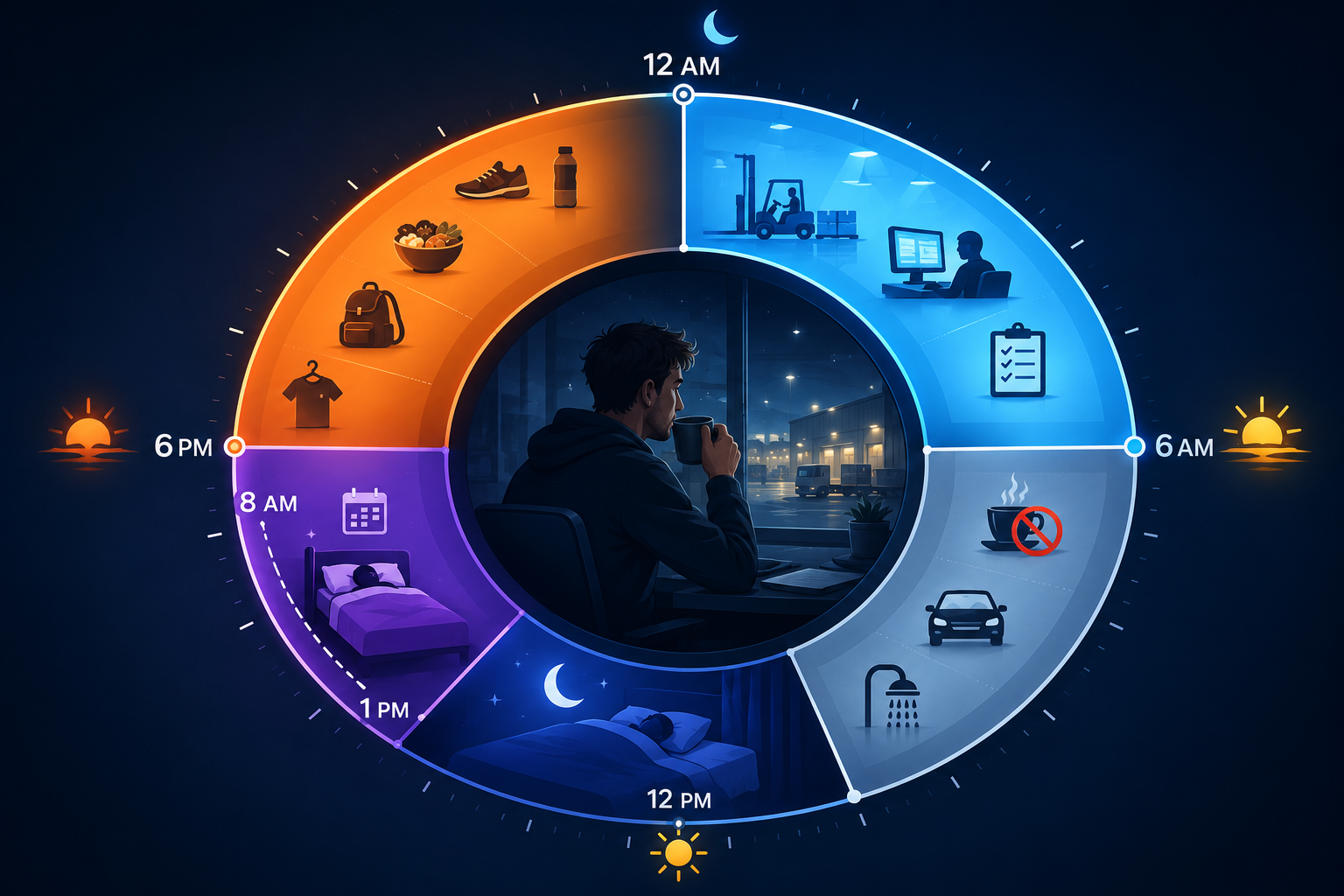
The One-Night Sleep Plan
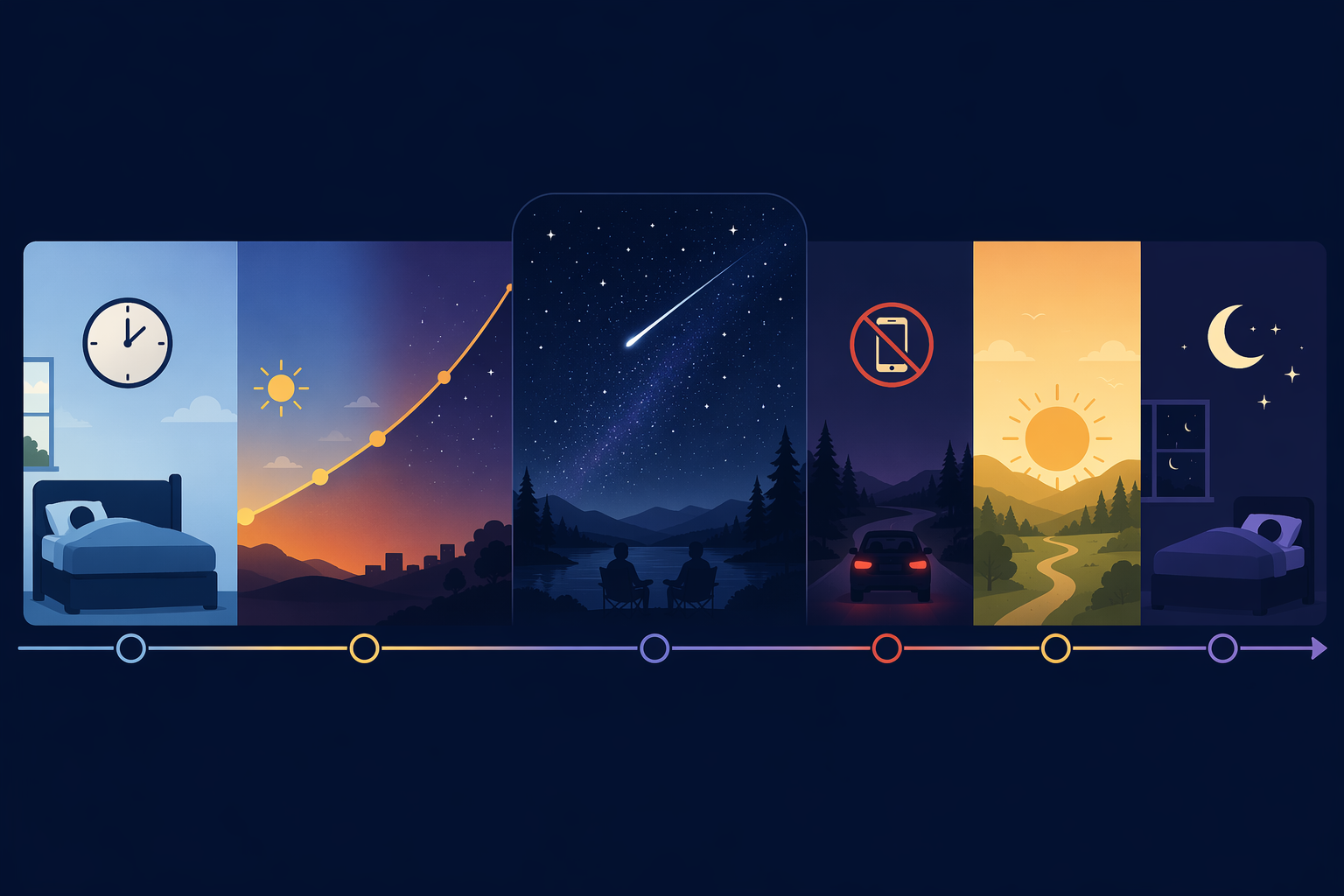
The plan is simple, but the timing matters. You are not trying to erase the late night; you are trying to make it bounded.
- Take a 90-minute nap in the early afternoon, finishing before 3 p.m.
- Stay awake through the evening instead of sleeping first and using a middle-of-the-night alarm.
- Drive to a dark site before you are dangerously tired, and set up with a blanket, chair, warm layer, water, and a red light.
- Watch during the post-midnight window, ideally around 1–4 a.m. if your schedule allows.
- Keep the return trip dark and boring: no phone scrolling, no bright convenience-store stop, no “just one episode” decompression.
- Protect the next day and allow one to two recovery nights before judging how you feel.
Why the 90-minute nap belongs before 3 p.m.
A full 90-minute nap gives you a better chance of completing a sleep cycle instead of waking from the deepest part of one. Placing it early in the afternoon reduces homeostatic sleep pressure before the late night without pushing too hard against your normal bedtime. If you are prone to insomnia, this advice changes; our guide to napping with insomnia explains why naps can backfire when sleep confidence is already fragile.
If 90 minutes is impossible, a short nap is still better than dragging yourself into the peak already depleted. What you do not want is a long nap ending at dinner or later. That can leave you oddly alert at the exact moment you need your body to cooperate after the outing.
Dark sky is not the circadian problem
Standing in a dark field is not the same biological event as lying in bed with a phone. Starlight is roughly 0.0001–0.001 lux, far below light levels used to activate the human circadian system through melanopsin-sensitive pathways.[6][7] The field itself is not what usually wrecks the night. The hazards are the phone check, the dashboard glare, the gas-station lighting, the kitchen lights when you get home, and the wired half hour you accidentally build around them.
Use red light only when you need it. Turn phone brightness down before you leave home, enable a red or extra-warm display mode if your device allows it, and put the phone away once your eyes are dark-adapted. If you need a map, have the route ready in advance. If you want photos, decide before the trip whether photography is worth the screen exposure and fiddling. For many people, the cleanest sleep plan is to leave the phone in a pocket and let the meteors be undocumented.
The same rule applies after you get home. Keep lights low, skip email, skip social media, and do the dull version of your bedtime routine. If technology is your weak point, the mechanisms are covered more fully in How Technology Affects Sleep; for this night, the takeaway is narrower: do not let a dark-sky outing become a bright-screen return.
Plan the morning like it matters
The recovery day is not a bonus. It is part of the viewing plan. Avoid scheduling an early meeting, a long drive, a hard workout, or a high-stakes decision the morning after. If you have children, decide in advance who is on morning duty. If you cannot move the morning, choose the earlier viewing window and accept the lower meteor yield.
One late night is not the same as chronic restriction. Experimental sleep-loss research suggests that recovery sleep can restore important cognitive and REM-related function, and even a 4-hour recovery opportunity produces much larger cognitive gains than no recovery opportunity.[8] That does not mean you are untouched the next morning. It means a single planned disruption has a different risk profile from repeatedly shaving sleep night after night.
A practical recovery target is one protected sleep opportunity the next night, with a second normal night if you still feel off. For more on recovery timelines, see How Many Nights to Recover Sleep Debt? The important part is not to chase the late night with caffeine all afternoon, a late nap, and another delayed bedtime. That is how a one-night exception becomes a two-day problem.
What To Bring, And What To Leave Alone
Comfort is sleep protection. If you get cold, thirsty, bug-bitten, or cramped, you will compensate with movement, light, snacks, and phone use. Pack like someone who plans to return home calmly.
- A reclining chair, camping pad, or thick blanket so your neck is not working all night.
- A pillow or rolled layer, because staring upward is less charming after 20 minutes of neck strain.
- A warm layer, even in August, plus region-appropriate heat planning if you live somewhere very hot.
- Water and a simple snack, not a heavy meal at 2 a.m.
- A red-light headlamp or lantern, tested before you leave.
- A firm departure time, especially if you are driving.
Leave alcohol out of the plan. It may make the waiting feel festive, but it fragments sleep and complicates the drive home. Be careful with caffeine after the early afternoon, too. A small amount may help if you must drive back, but using caffeine to force a dawn finish changes the recovery equation.
The Eclipse Is A Bonus, Not The Plan
August 12, 2026 also brings a total solar eclipse, but totality is limited to places including Iceland, Greenland, Spain, and parts of the Atlantic.[2][9] For most readers in the contiguous United States, Canada, and the United Kingdom, the eclipse should not be treated as part of the same itinerary. The Perseid plan stands on its own: new moon, peak night, post-midnight rates.
There is also a softer reason people make room for nights like this. Awe is not a sleep treatment, and it should not be sold as one. Still, one study found that awe and other positive emotions were associated with lower levels of the inflammatory marker IL-6.[10] That is not a license to ignore sleep biology. It is just a reminder that the outing has value beyond counting streaks per hour.
Who Should Choose The Earlier Window
This plan assumes a healthy baseline sleeper making one planned exception. It is not the right default for everyone. If you have chronic insomnia, delayed sleep phase, shift-work strain, bipolar disorder, a history of severe sleep disruption, or a next day that cannot safely absorb reduced alertness, the smarter choice may be an evening watch, a shorter outing, or skipping the peak.
The same applies if sleep anxiety is currently high. A late-night plan that makes you monitor every sensation—Am I tired enough? Did I ruin tomorrow? Will I recover?—may cost more than the meteors are worth. In that case, protect the routine and watch earlier. You may see fewer meteors, but you also avoid turning a sky event into a sleep test.
No study directly tests “Perseid viewing sleep recovery.” The best advice here is an application of broader sleep-restriction, circadian-light, nap-timing, and sleep-inertia research. That is enough to make a sensible plan, but not enough to pretend every reader will respond the same way.
A Bounded Recommendation
For most healthy sleepers, the 2026 Perseids are worth a carefully bounded late night: nap early, stay awake continuously into the post-midnight window, keep the outing dark, come home without screens or bright lights, and protect the next day. If that recovery space is not available, the lower-yield evening watch is not failure. It is the version that respects the morning you actually have.
References
- Meteor Shower Calendar, American Meteor Society
- Perseid meteor shower 2026: All you need to know, EarthSky
- Meteor shower guide, The Planetary Society
- Meteor shower guide: where and when to see meteor showers, Royal Museums Greenwich
- Sleep Inertia: Current Insights, Nature and Science of Sleep, 2017
- Action spectrum for melatonin regulation in humans: evidence for a novel circadian photoreceptor, The Journal of Neuroscience, 2001
- Measuring and using light in the melanopsin age, Trends in Neurosciences, 2014
- The effects of sleep deprivation on cognitive performance, Neuropsychiatric Disease and Treatment, 2007
- Total solar eclipse 2026: Everything you need to know, Space.com
- Positive affect and markers of inflammation: discrete positive emotions predict lower levels of inflammatory cytokines, Emotion, 2015
Comments
Join the discussion with an anonymous comment.