You want the 2026 Perseid peak night, but you also want to be useful the next day. That is the right problem to solve. The best practical window is overnight from Aug. 12 into Aug. 13, especially from midnight until about 5:30 AM local time, with the strongest viewing usually in the pre-dawn hours. The timing is unusually tempting because the new moon falls on Aug. 12, leaving dark skies with 0% moon illumination, and EarthSky lists the predicted peak at 14:53 UTC on Aug. 13; check a current sky guide again in early August because meteor shower peak estimates can shift slightly. [1]
For most healthy adults, one planned late night is not the same thing as drifting into weeks of short sleep. It can be managed. The bargain is that you do not treat the Perseids as an ordinary bedtime with a little stargazing attached. You treat the day as a planned sleep exception with a before, a during, and an after.
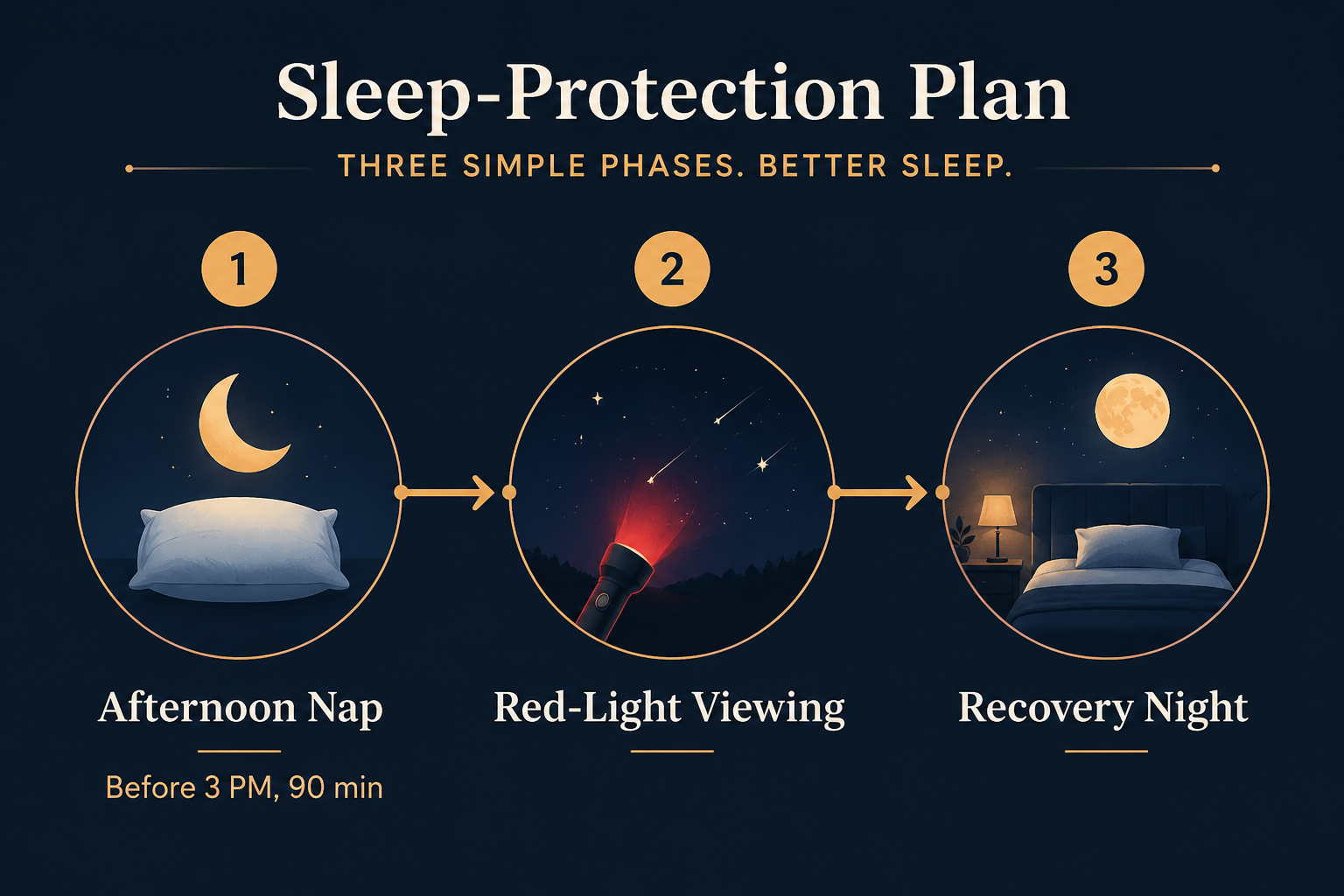
The peak-night plan at a glance
| When | What to do | Why it matters |
|---|---|---|
| Before 3 PM on Aug. 12 | Take a 90-minute nap if you can. | It reduces sleep pressure before the long wake period without pushing too hard into evening sleep timing. |
| Evening of Aug. 12 | Pack before you are tired: blanket, layers, thermos, red light, chair, route home. | Fatigue turns small decisions into sloppy ones. |
| Midnight to about 5:30 AM | Stay dark-adapted; use only dim red light when necessary. | Bright phone checks and white flashlights are the avoidable circadian mistake. |
| If watching through dawn | Do not plan a 2 AM alarm after a short first sleep unless you have a specific reason. | Waking from the middle of sleep can add sleep inertia on top of sleep loss. |
| After returning home | Keep the landing boring: low light, no work triage, no doom-scrolling. | The goal is to end the event, not start a second night. |
| Night of Aug. 13 | Protect one full recovery night. | Recovery works best when it is scheduled, not improvised. |
The Perseids are worth planning around in 2026 because the sky is doing its part. The American Meteor Society lists the Perseids with a zenithal hourly rate of 100, which is a best-case dark-sky measure rather than a promise that every backyard will see that many meteors. [2] Space.com also places the 2026 viewing emphasis on the late-night and pre-dawn window. [3] That is enough astronomy to make the sleep problem real: the good part of the show happens when your body would normally be deep into its night.
Nap before the night gets expensive
The most useful sleep move happens hours before the first meteor. Aim for a 90-minute nap that ends before 3 PM. If your schedule allows only less, take the shorter version, but do not let the nap slide into early evening and then act surprised when bedtime becomes strange.
A 90-minute nap is long enough to give many people a fuller sleep cycle instead of dropping them into deep sleep and yanking them out after 25 minutes. Ending before 3 PM keeps the nap from crowding the part of the evening when your body should be preparing for night. This matters because you are not trying to bank unlimited sleep. You are lowering the pressure enough to make the midnight-to-dawn stretch less punishing.
If naps usually make you groggy, set two boundaries: lie down in a real sleep setting, and put a hard stop on the wake-up time. If you have chronic insomnia, this is not the moment to casually experiment with daytime sleep; use a more conservative plan and consider the site’s guide on whether you should nap when you have insomnia. The same nap that helps a well-rested adult may complicate the night for someone whose sleep system is already unstable.
- Best option: 90 minutes, ending before 3 PM.
- Acceptable backup: a shorter early-afternoon nap if 90 minutes is unrealistic.
- Avoid: a late-day “just in case” nap that runs close to dinner.
- Skip or individualize: daytime napping if you have chronic insomnia or a circadian rhythm disorder.
Pack while your judgment is still awake
The gear list is short because this is not a camping article. Pack the things that prevent tired decisions: a blanket or reclining chair, warm layers, water or a thermos, a snack if you need one, a red flashlight or red-filtered headlamp, and a return-home plan. If you are driving, decide before you leave what “too tired to drive” means and what you will do instead.
Do the boring logistics before sunset. Download the map. Tell someone where you are going. Put the red light where your hand can find it. The sleep-protective part of this is not heroic; it is removing small choices from the coldest, sleepiest hour of the night.
If you plan to watch until dawn, think twice before splitting sleep
A lot of sensible people assume the best plan is to sleep from 10 PM to 2 AM, wake up for the meteors, then sleep again after sunrise. Sometimes that works, especially for people who fall asleep easily and have no next-morning obligations. But if your goal is to watch through the pre-dawn window and function the next day, the split can backfire.
The problem is not that “some sleep” is bad. The problem is the 2 AM wake-up. Waking from the middle of a sleep episode can leave you with sleep inertia: the heavy, confused period when the body is awake on paper but not fully online. If you then add cold air, driving, bright phone use, and the pressure to enjoy yourself, you have made the night more complex than it needed to be. The same sleep inertia issue is why emergency-alert sleep plans need more than a loud alarm; waking is not always the same as being ready to act.
For a through-dawn Perseid plan, many adults will do better with a strategic afternoon nap, a normal quiet evening, and continuous wakefulness during the viewing window, followed by a protected recovery night. That is a practical judgment, not a universal rule. If you know from experience that you can wake at 2 AM cleanly, stay off bright light, observe for a limited window, and fall back asleep, your personal plan may differ.
The red-light rule is not decorative
The best meteor watching and the best sleep protection point in the same direction: keep it dark. Your eyes need time to adapt to the sky, and your circadian system does not need a blast of blue-white light at 1:30 AM. The avoidable mistake is not lying under stars. It is repeatedly checking a bright phone, sweeping the field with a white flashlight, or using a headlamp like you are reorganizing a garage.
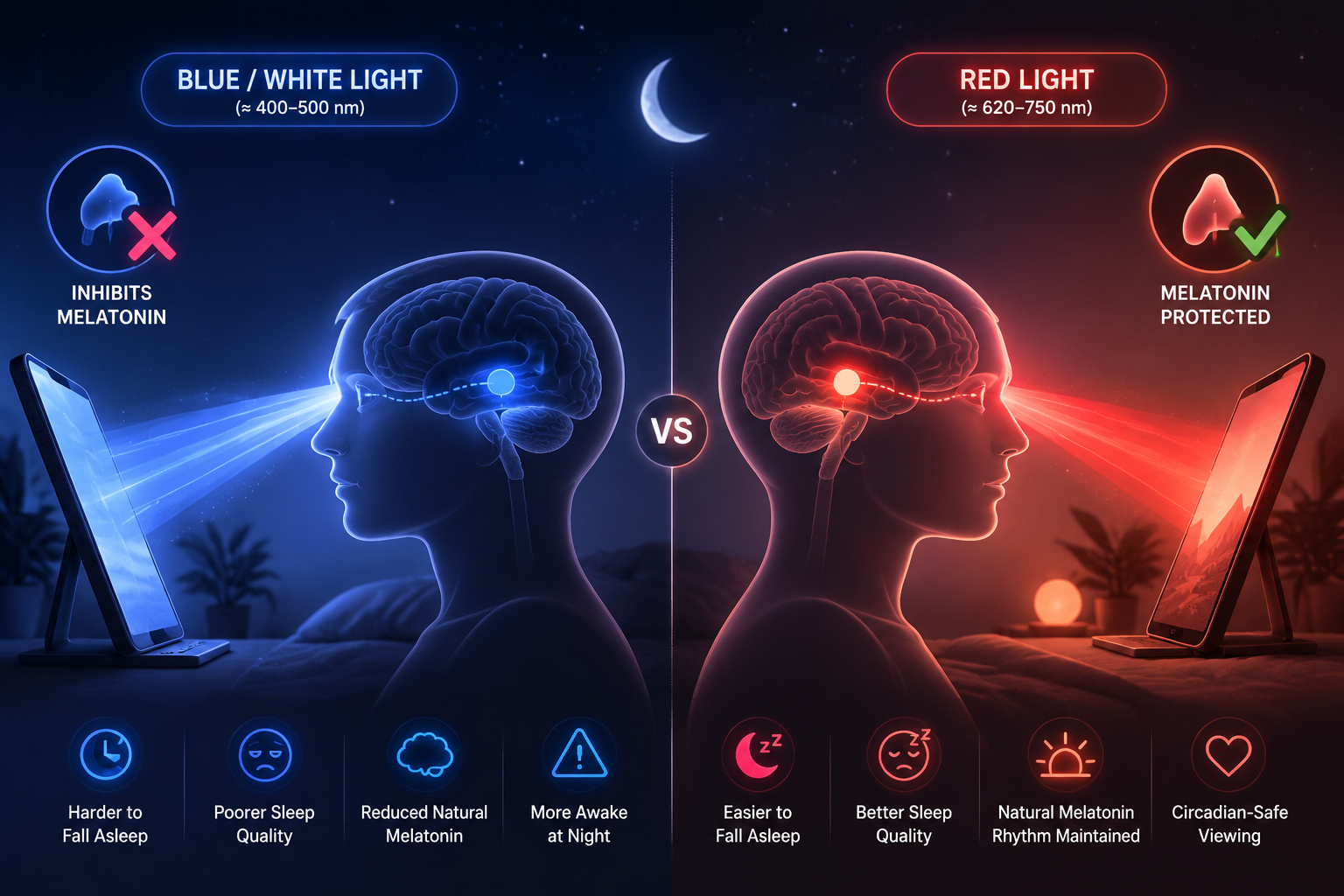
Your circadian system is especially sensitive to bright, short-wavelength light at night. Deep red light is less disruptive and is also friendlier to dark adaptation, which is why astronomers use it. Keep the light dim, aim it downward, and use it only when you need to move, read a label, or avoid stepping on something. A red light left blazing in your face is still a light.
Treat the phone as the main hazard. If you need it for safety, set it up before you leave: lowest brightness, night mode, red display filter if available, and essential notifications only. Better yet, decide on two or three planned phone checks rather than grazing every time the sky goes quiet. Meteors arrive unevenly; boredom is not a medical indication for a glowing rectangle.
- Use a red flashlight or red-filtered headlamp, not a white beam.
- Keep any light low, brief, and pointed away from faces.
- Pre-set your phone so emergency use does not become casual scrolling.
- Avoid bright convenience stops on the way home if you can safely do so.
Keep the return home small
The viewing window ends; the night should end with it. This is where people accidentally add a second disruption. They get home cold and wired, open email “just to see,” answer a message, start uploading photos, or stand under bright kitchen lights making an elaborate breakfast. None of that helps the body understand that the exception is over.
If you can sleep after returning, make the landing quiet: dim warm light, simple food if needed, no work decisions, no bright screens in bed. If you cannot sleep because the day has begun, at least avoid turning the morning into a stimulant-and-screen sprint. Get outdoor daylight after your intended wake time, use caffeine deliberately rather than continuously, and keep the day’s highest-risk tasks in mind. Driving while sleepy deserves the same respect as any other safety issue.
Do not confuse one late night with chronic sleep debt
Sleep-debt advice can sound alarming because it often describes repeated restriction, not one planned exception. The Sleep Foundation notes that accumulated sleep debt can take multiple days to recover from, depending on the amount and pattern of sleep loss. [4] That is not the same as one Perseid night in an otherwise stable schedule.
After acute sleep loss, recovery sleep often includes REM rebound, meaning the body may spend extra time in REM sleep as it restores balance. [5] That does not give you permission to make the next night chaotic. It gives you a reason to protect it. One full, boring, ordinary night after the meteor shower is part of the plan, not a nice bonus.
For the night of Aug. 13, make fewer promises. Do not schedule an intense late workout, a long dinner, or a “quick” work catch-up that starts at 9:45 PM. Keep caffeine earlier. Let bedtime be plain. If you nap randomly late the next day because you are panicking about lost sleep, you may make the recovery night harder. If you need a nap for safety, take one; just do not turn recovery into a series of unplanned sleep fragments.
Who should be more cautious
This plan is for most healthy adults with reasonably stable sleep. It is not casual advice for everyone. If you have chronic insomnia, a circadian rhythm disorder, a safety-sensitive job early the next morning, or meaningful existing sleep debt, the cost of one late night can be larger and longer than it looks on paper.
Existing sleep debt is the quiet disqualifier. If you are already short-sleeping through the week, the Perseid plan is not starting from neutral. In that case, the best sleep tip may be to choose a shorter viewing window, watch on the easier of the two pre-dawn mornings, or skip the peak and keep your recovery intact.
Let the night be worth something, but do not ask it to erase biology
There is a reason people make inconvenient plans for meteor showers. A dark field before dawn can do something that another efficient evening cannot. Research on awe has linked awe experiences with lower levels of interleukin-6, a pro-inflammatory cytokine, although that single line of evidence should not be stretched into a claim that wonder cancels sleep loss. [6] It is simply fair to admit that the psychological side of the night matters too.
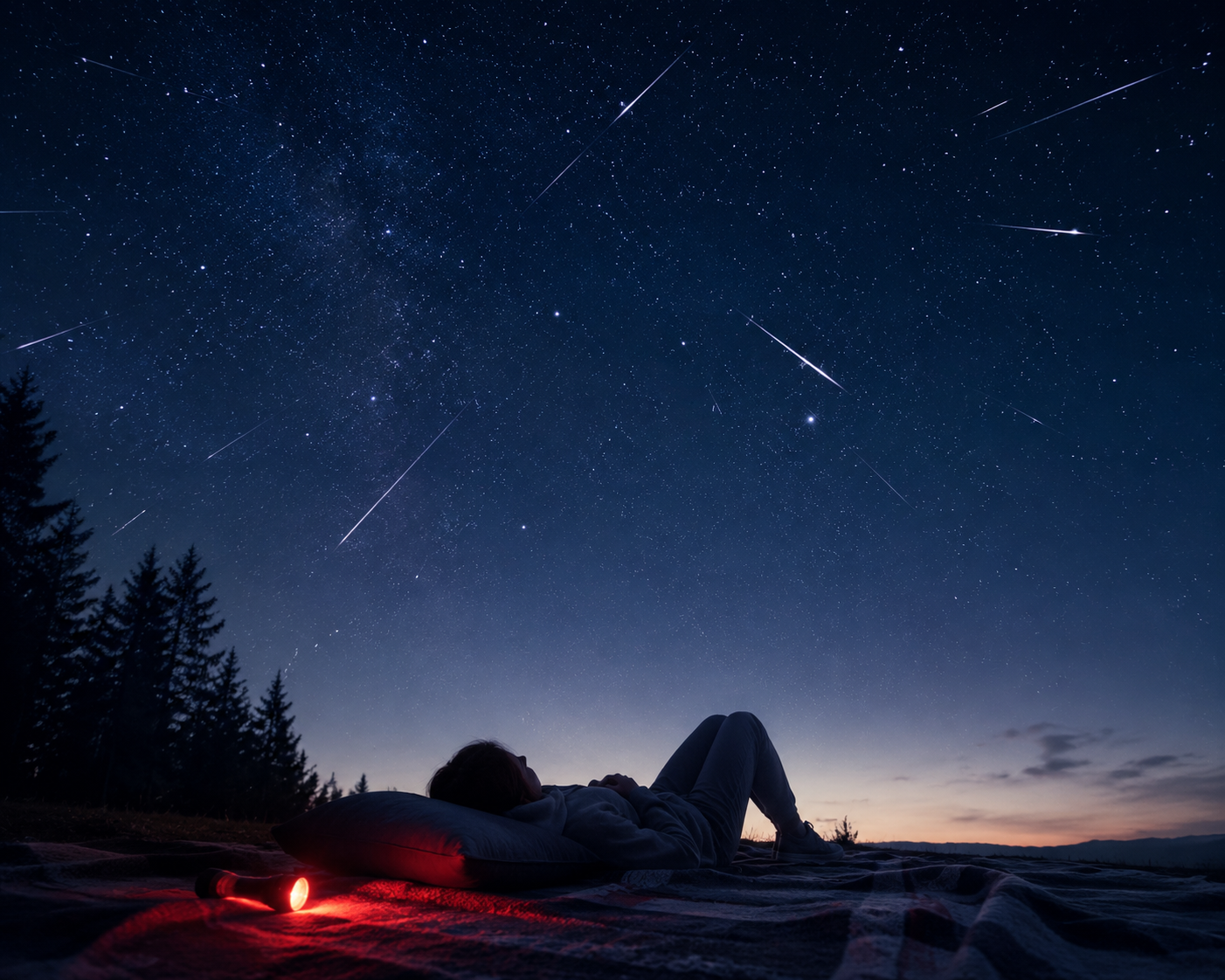
The clean version is this: nap before 3 PM, pack before you are tired, stay dark and red-lit outside, avoid a messy 2 AM sleep split if you are watching through dawn, and protect the next night. For most healthy adults, that makes a single Perseid peak night compatible with decent next-day function. For people with insomnia, circadian disorders, safety-critical morning duties, or real sleep debt, the plan needs more caution than enthusiasm.
References
- Perseid meteor shower 2026: All you need to know, EarthSky
- Meteor Shower Calendar 2026–2027, American Meteor Society
- Perseid meteor shower 2026 guide, Space.com
- Sleep Debt and Catch-Up Sleep, Sleep Foundation
- REM Rebound, Sleep Foundation
- Positive Affect and Markers of Inflammation: Discrete Positive Emotions Predict Lower Levels of Inflammatory Cytokines, Emotion, 2015
Comments
Join the discussion with an anonymous comment.