
The practical problem with the 2026 Perseids is not finding the peak. It is deciding whether the best sky is worth a Thursday morning. This year, the answer can be yes, but only if the night has edges: nap before the damage starts, choose one viewing window, come back inside without reopening the day on your phone, and protect the next recovery night.
The astronomical timing is unusually clean. The Perseid meteor shower is predicted to peak at 14:53 UTC on August 13, 2026, while the new moon occurs at 17:37 UTC on August 12, leaving the main local pre-dawn viewing windows on August 12 and August 13 without moonlight washing out the sky.[1][2] Under ideal dark-sky conditions, the shower is often described around a zenithal hourly rate of up to 100 meteors per hour, but that number is not a backyard guarantee; it assumes a dark site, a high radiant, patient watching, and cooperative weather.[1]
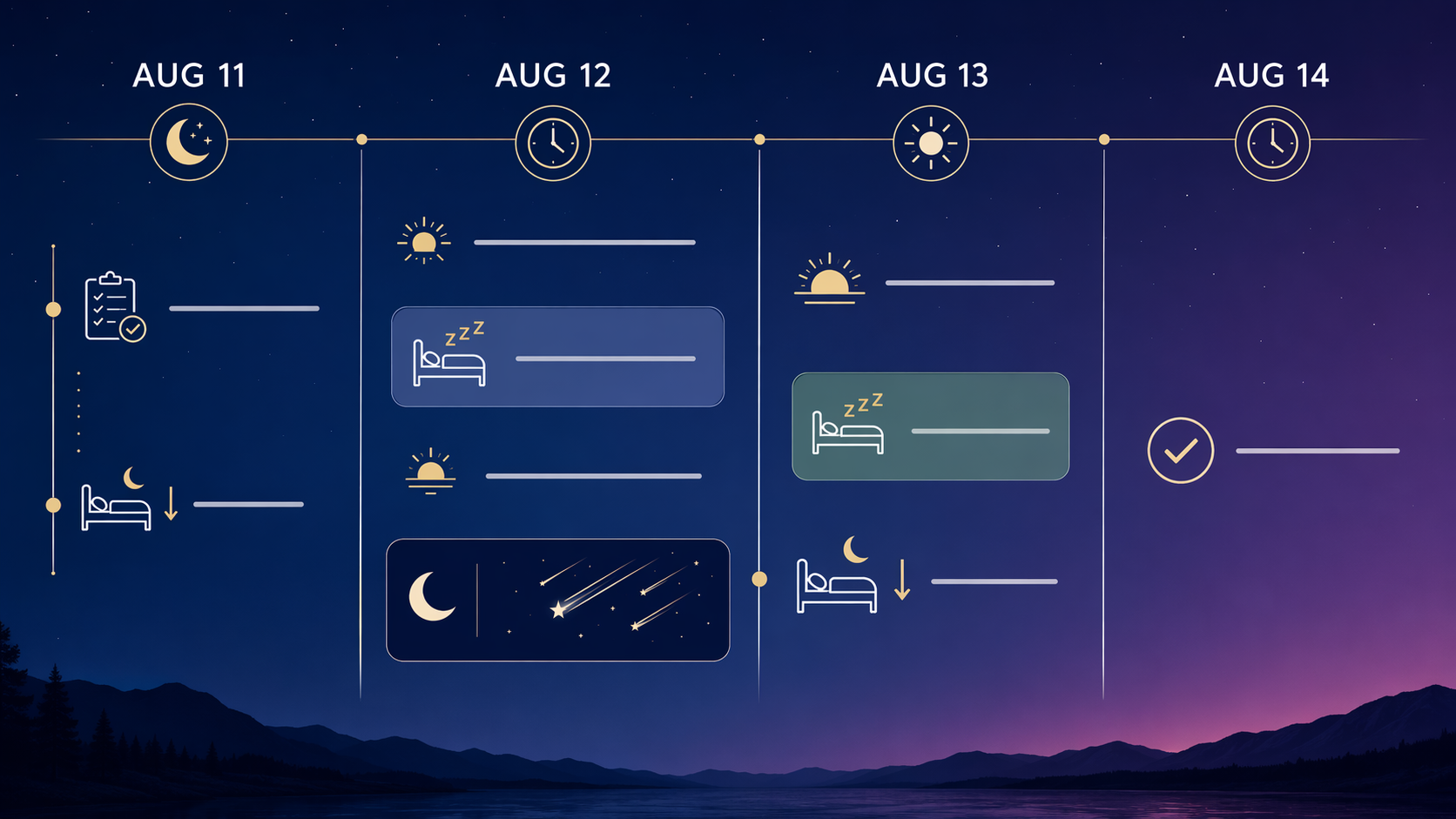
The Short Version: One Planned Disruption
| When | What to do | Why it matters |
|---|---|---|
| Tuesday, Aug. 11 evening | Optional: shift bedtime and wake time 15–30 minutes earlier if your week allows. | A small shift can make the peak night feel less abrupt without turning the whole week into a sleep project. |
| Wednesday, Aug. 12, 1:30–3:00 PM | Best nap option: take a 90-minute nap and finish before 3 PM. | A full-cycle nap can reduce sleep pressure while leaving enough time to fall asleep later. |
| Wednesday, Aug. 12, 4:00–4:30 PM | Backup nap option: take a 20-minute power nap, especially if you cannot block 90 minutes. | Short naps are less restorative but carry less risk of waking groggy. |
| Wednesday, Aug. 12, 9:00–11:00 PM | Optional early look only. | Perseids may be visible, but the radiant is still lower, so rates are usually less rewarding. |
| Wednesday night into Thursday, Aug. 12–13, 11:00 PM–1:00 AM | Truncated plan for people with a 6:00 AM obligation. | A real compromise: some increasing activity, less sleep damage than staying out until dawn. |
| Thursday, Aug. 13, 1:00–4:00 AM | Best balanced viewing block. | The radiant is higher, rates improve, and the window ends early enough to salvage a return-to-bed block. |
| Thursday, Aug. 13, 4:00–5:30 AM | Final opportunity if you are still awake and do not need an early workday. | The sky can be excellent near dawn, but this is where the sleep cost rises fastest. |
| Thursday, Aug. 13 morning | Get outdoor light soon after waking; keep caffeine ordinary, not heroic. | Morning light helps reset timing after a late night. |
| Thursday, Aug. 13 afternoon | Nap only if needed; keep it short unless your schedule allows more recovery. | The goal is to function, not to erase all sleep pressure before bedtime. |
| Thursday night into Friday, Aug. 13–14 | Go to bed early enough for a full night. | Most healthy adults should treat this as the main recovery night. |
Why August 12–13 Gets the Plan
For most U.S. readers, the calendar points to the overnight stretch from Wednesday, August 12, into Thursday, August 13. The actual predicted peak lands during daylight for North America, so the useful question becomes which dark hours sit closest to that maximum. The mornings of August 12 and August 13 both matter, with the strongest practical emphasis on the pre-dawn hours because the Perseid radiant in Perseus rises late in the evening and stands higher toward dawn.[1]
That radiant detail is not trivia. When the radiant is low, some meteors can still appear, and a few may be dramatic earthgrazers. But as the radiant climbs, more meteors have geometry on their side. That is why a 9 PM blanket in the yard is a pleasant compromise, while a 1–4 AM watch is the serious sleep trade.
If your schedule is unusually flexible, you can also watch before dawn on August 12 as a lower-stress rehearsal or alternate weather window. If you only get one costly night, save the more deliberate plan for August 12–13.
August 11: Make the Peak Night Less Abrupt
Tuesday night is not for staying up late in anticipation. If anything, it is the night to make Wednesday easier. Move bedtime and wake time 15–30 minutes earlier only if that does not create domestic chaos. A parent with daycare pickup, a nurse coming off shifts, and a commuter who has to drive at 7 AM may not have the same useful lever here.
The main preparation is boring and therefore useful: choose the viewing site, check the route, decide the cutoff time, and put the warm layers somewhere you will not have to rummage for them at midnight. If you are comparing this plan with a more chronotype-specific approach, use a guide to Perseid viewing by sleep type before you commit to the default schedule.
August 12 Daytime: Choose the Nap That Matches Your Real Life
The cleanest version is a 90-minute nap from 1:30 to 3:00 PM. The point is not magic; it is timing. A longer nap gives you a better chance of completing a sleep cycle, and finishing before 3 PM reduces the chance that the nap steals too much pressure from bedtime.[3]
If 90 minutes is impossible, use the smaller tool: a 20-minute nap around 4:00 PM, ending no later than 4:30 PM. A short nap will not carry the night the way a full-cycle nap might, but it is less likely to leave you heavy-headed. NASA-related nap research cited by the Sleep Foundation found that a 26-minute nap improved alertness by 54%, which is a useful reminder that short sleep can still change how safe and functional a person feels afterward.[4]
A caffeine nap can help if you tolerate caffeine well: drink a modest amount of coffee or tea immediately before a 20-minute nap so the alerting effect arrives as you wake. Do not use this if caffeine after lunch usually harms your sleep, and do not use it as a license to drive sleepy after the viewing window. The nap is there to narrow the damage, not to make sleep loss disappear.
| Nap choice | Use it if | Avoid it if |
|---|---|---|
| 90 minutes, 1:30–3:00 PM | You can protect the block and want the best chance of staying steady from midnight to 4 AM. | You tend to wake disoriented from long naps or cannot finish before midafternoon. |
| 20 minutes, 4:00–4:30 PM | You have work, childcare, or errands and need the lowest-friction option. | Even short late-day naps routinely make your bedtime slide. |
| No nap | You plan to use only the 11 PM–1 AM truncated window. | You already feel sleepy in the afternoon or must drive after viewing. |
August 12 Evening: Protect Sleep Pressure Until You Actually Need It
After dinner, the job is to stay quietly functional. Keep lights lower than usual, avoid a second evening of errands, and do not let the meteor plan become three hours of scrolling sky maps. If you want a more formal pre-sleep routine before leaving the house, borrow from an evening wind-down routine, then simplify it for a night when you will be going back outside.
- Pack a red-light headlamp or flashlight, and test it before you leave.
- Bring a reclining chair or thick blanket so you can look up without standing tense in the cold.
- Wear warmer layers than the daytime forecast suggests; still bodies get cold quickly.
- Bring water and a simple snack if hunger is likely to wake you later.
- Set the phone to Do Not Disturb, download any needed map, and keep the screen face-down.
- Decide your exit time before the first meteor appears.
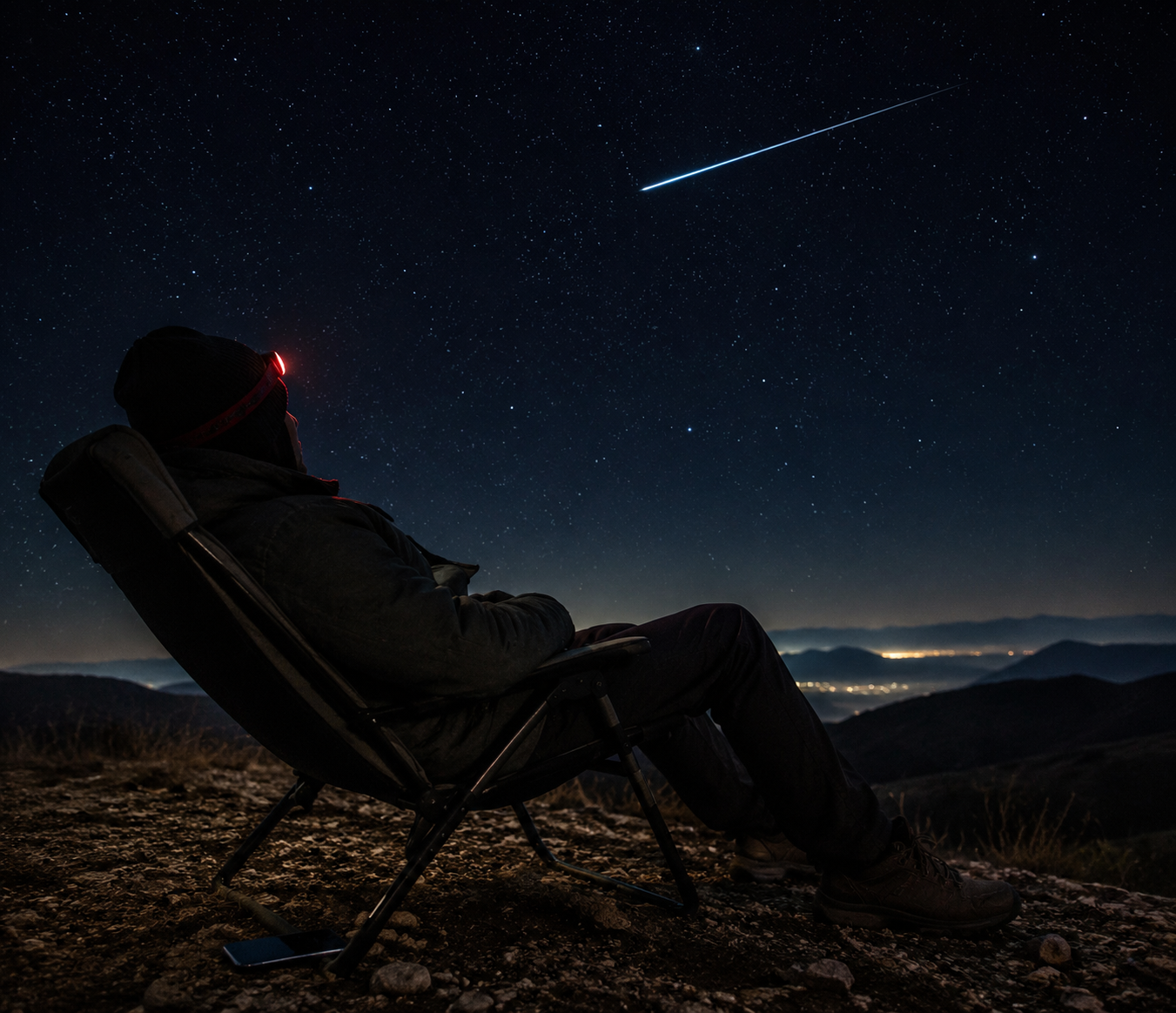
9–11 PM: The Low-Cost, Lower-Yield Look
This window is for families with children, people who cannot safely function after midnight, or anyone who wants the mood of the Perseids more than the maximum count. You may see meteors, and under a dark sky the experience can still be worth the lawn chair. It is simply not the premium timing because the radiant is lower earlier in the night.[1]
If you choose this version, make it clean: outside by 9:00, eyes dark-adapted by about 9:20, stop by 10:45, in bed by 11:15. Do not “just check” the later forecast from bed. That is how a sensible compromise turns into a normal late night without the benefit of the best sky.
11 PM–1 AM: The Truncated Plan for a 6 AM Obligation
If you have a 6:00 AM wake time and cannot change it, this is the more honest adult compromise. It catches a later, improving part of the shower without asking your brain to handle the workday after a near all-nighter. The schedule is tight: nap if possible, leave screens alone after dinner, observe from 11:00 PM to 12:45 AM, and be physically in bed by 1:15 AM.
You will probably miss some of the best geometry of the night. That is the trade. What you gain is a block of sleep before the alarm rather than a heroic drive home at dawn. For commuters, parents doing morning care, and anyone whose job punishes foggy attention, that trade may be the correct one.
1–4 AM: The Best Balance of Sky and Sleep Cost
The 1–4 AM block is the center of the plan. It is late enough for the radiant to be useful and close enough to the predicted peak to justify the disruption, but it still leaves a possible return-to-bed window before morning obligations. If you took the 90-minute nap, this is where it pays rent.
| Time | Action |
|---|---|
| 12:15 AM | Wake or get dressed in dim light. Do not open social apps, email, or bright weather loops. |
| 12:30 AM | Leave for the viewing spot if needed. Keep the car and phone lighting as low as safety allows. |
| 1:00 AM | Start the watch. Give your eyes time to adapt before judging the sky. |
| 1:00–2:00 AM | Settle in. Look broadly across the darkest part of the sky rather than staring only at Perseus. |
| 2:00–3:30 AM | Treat this as the main watch. Stay warm, stay seated, and avoid checking counts minute by minute. |
| 3:30 AM | Make the cutoff decision while you still have judgment. |
| 4:00 AM | End the planned session unless you have no morning obligation and already planned to continue. |
The hidden sleep risk in this window is not only the hour. It is stimulation. Cold air, driving, bright screens, excited conversation, and repeated “one more minute” decisions all push the body away from sleep. Use red light when possible, keep conversation low on the way in, and make the last 20 minutes intentionally dull.
A useful rule: if you drove to a dark site, your cutoff has to include the drive home. A 4:00 AM stop at a field 35 minutes away is not a 4:00 AM bedtime. If you are already sleepy at 3:15, leave then. Meteors are not worth a drowsy-driving risk.
4–5:30 AM: Only If the Morning Can Absorb It
The final pre-dawn stretch can be beautiful because the radiant is high and darkness remains useful before dawn.[1] It is also the part most likely to turn one planned disruption into a second bad day. Choose it only if Thursday morning is flexible, you are not driving sleepy, and you can protect Thursday night as a full recovery night.
If you stay until 5:30, do not pretend you are preserving a normal day. You are borrowing from it. The responsible version is to lower expectations for complex work, avoid unnecessary driving, and keep the rest of the day quiet where you can.
The Return-to-Bed Protocol
The post-viewing hour decides whether the plan worked. The body can often fall back asleep after an odd waking, but it needs a boring runway. That means no photo sorting, no meteor-count arguments, no group chat recap, and no bright phone in bed.
- Use dim red light or the lowest safe household lighting to get inside.
- Put gear down without unpacking everything.
- Keep the bedroom cool and already prepared if possible.
- If hungry, eat something small and familiar rather than making a full meal.
- Go to bed even if you feel temporarily alert.
This is also where bright-screen light is different from dark-sky wakefulness in practical terms. Looking at meteors keeps you awake because you are awake; a phone adds light, novelty, and decisions at exactly the wrong moment. The difference matters most after you come inside.
August 13: Recovery Without Overcorrecting
If you can wake naturally on Thursday, do. If an alarm is nonnegotiable, get up with the least drama possible and seek outdoor light early. Morning sunlight is one of the cleaner tools for helping the circadian system re-anchor after a late night.[5]
Keep caffeine normal. A little more coffee than usual may be understandable; turning the day into a stimulant rescue mission often pushes the problem into Thursday night. Eat breakfast, move lightly, and put the most error-sensitive work at the time of day when you are usually sharpest, if your schedule gives you any control.
Nap only if you need it. If you are dragging but still need to sleep Thursday night, use a short early-afternoon nap. If you have an unusually flexible day and are truly sleep-deprived, a longer recovery nap can be reasonable, but keep an eye on whether it will make bedtime drift. For the physiology behind why recovery sleep may feel deeper or dream-heavy after a short night, a sleep architecture and recovery guide is the better place to go deep.
A Careful Note on Awe and Health
There is a small, interesting line of research connecting awe experiences with biological markers. One study reported that greater awe was associated with lower levels of interleukin-6, an inflammatory cytokine, but that is a correlational finding, not proof that stargazing lowers inflammation or cancels out sleep loss.[6]
The better reason to go outside is simpler: a rare, moonless Perseid peak is worth planning around if the plan is honest. Let the sky be meaningful without asking it to become medicine.
August 13–14: Let the Recovery Night Do Its Work
After a single late night, many healthy adults can recover cognitive function within one to two nights of adequate sleep, but that estimate should be treated as general, not universal.[7] People with insomnia, circadian rhythm disorders, untreated sleep apnea, mood instability, chronic pain, or unusually fragile sleep may need longer and may not be good candidates for the 1–4 AM version.
Thursday night is therefore part of the meteor plan, not an afterthought. Aim for an early, ordinary bedtime. Keep the room cool. Do not nap so long on Thursday that you are wide awake at midnight. If you want another short Perseid look on Thursday night, make sure you are choosing it knowingly rather than drifting into a second sleep-debt night because the first one was beautiful.
For 2026, the new moon makes the Perseid peak unusually worth a controlled disruption. The win is not staying up all night. It is seeing the sky, honoring the cutoff, getting morning light, napping only if needed, and letting August 13–14 be the night that gives your brain the rest of the story.
References
- Perseid meteor shower 2026, EarthSky, https://earthsky.org/astronomy-essentials/everything-you-need-to-know-perseid-meteor-shower/
- Perseid Meteor Shower To Peak Under A New Moon In 2026, The Weather Channel, July 16, 2026, https://weather.com/
- How to Watch the Perseid Meteor Shower Without Losing Sleep, Mattress Miracle, https://mattressmiracle.com/
- NASA Nap Study, Sleep Foundation, https://www.sleepfoundation.org/how-sleep-works/how-long-should-i-nap
- Entrainment of the Human Circadian Clock to the Natural Light-Dark Cycle, Current Biology, PMC4020279
- Positive Affect and Markers of Inflammation: Discrete Positive Emotions Predict Lower Levels of Inflammatory Cytokines, Emotion, 2015, PubMed 25603133
- Neurobehavioral Dynamics Following Chronic Sleep Restriction: Dose-Response Effects of One Night for Recovery, Sleep, PMC2910531

Comments
Join the discussion with an anonymous comment.