
Psychiatric hospital sleep disorder treatment sits inside an uncomfortable paradox. Admission may be considered when insomnia or severe sleep disruption is tangled with psychiatric symptoms, unsafe impulses, extreme distress, medication problems, or repeated outpatient failure. But the first night on a psychiatric unit is often not quiet, dark, or uninterrupted. The same ward that may keep someone alive can also wake them over and over.
That matters because sleep disturbance is not a side issue in psychiatric care. Sleep problems affect up to 80% of people with psychosis and up to 90% of people with bipolar disorder, and one controlled inpatient study found poor sleep quality in 95% of psychiatric inpatients, with significant sleep fragmentation in 90% of those measured by actigraphy.[1] Another clinical overview notes that 40% of insomnia patients have an underlying mental illness.[2] Those numbers do not mean every person with insomnia belongs in a hospital. They do mean that when sleep falls apart, psychiatric symptoms and safety can become part of the same clinical picture.
The question is not simply whether a hospital “treats sleep.” The sharper question is what kind of sleep treatment is actually offered there, and what the ward environment will take away while treatment is being delivered.
The Ward May Stabilize You Before It Helps You Sleep
A psychiatric admission is usually built around stabilization: safety assessment, observation, medication review, crisis containment, group programming, individual meetings when available, discharge planning, and routines that reduce chaos. Sleep may be discussed every day. Staff may ask how many hours you slept, whether nightmares woke you, whether racing thoughts kept you up, whether medication helped or left you groggy.
But a general psychiatric unit is not the same thing as a dedicated insomnia program. On many wards, sleep care may mean medication adjustments, basic sleep hygiene reminders, encouragement to attend daytime groups, limiting naps if the unit can enforce it, and watching whether poor sleep signals mania, psychosis, withdrawal, severe anxiety, or suicidality. Those are legitimate clinical tasks. They are not the same as structured cognitive behavioral therapy for insomnia.
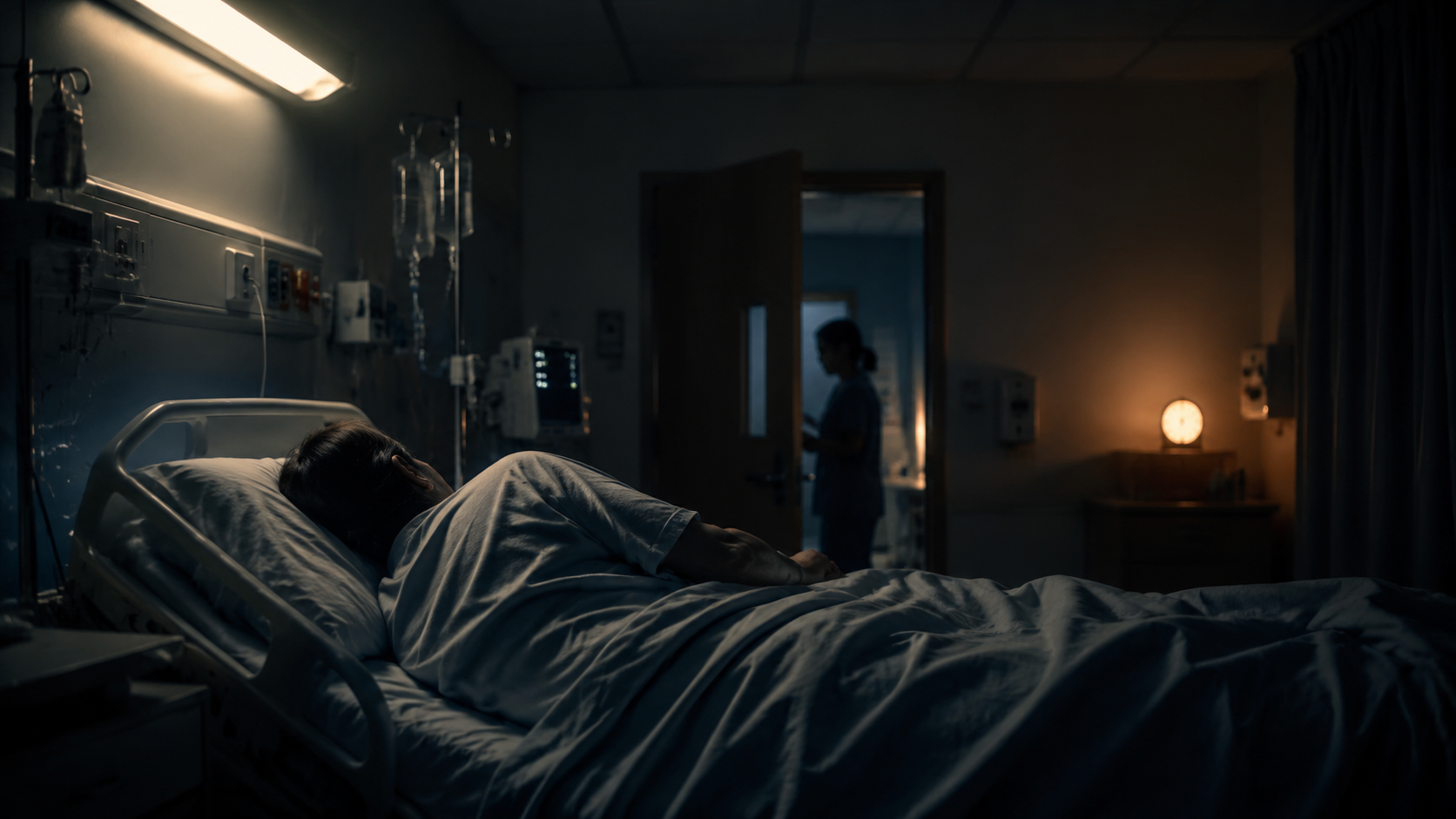
The physical setting can work against sleep from the first night. In a UK inpatient psychiatric ward study, overnight noise levels stayed around 40–70 dB, with spikes up to 90 dB, above the World Health Organization hospital recommendation of 30 dB.[1] Those spikes are not abstract. They are doors, alarms, staff voices, distressed patients, checks, cleaning, admissions, emergencies, and the particular sharpness of sound in a corridor at 3 a.m.
Light can be just as awkward. The same study found that daytime light levels across psychiatric wards rarely exceeded 200 lux, which is not enough to give the circadian system a strong daytime signal.[1] A patient may spend the day under dim indoor light, then spend the night under safety lighting, hallway spill, door openings, and brief observation interruptions. That is a poor bargain for a body clock: too little brightness when wakefulness needs anchoring, too much disturbance when sleep needs protection.
This is why practical coping strategies for hospital sleep can still matter even when the admission is psychiatric. Earplugs may or may not be allowed. Eye masks may or may not pass safety rules. A room change may be impossible. Still, asking staff what is permitted, requesting quieter placement when clinically appropriate, and planning for daylight exposure are not trivial requests. For more general hospital strategies, sleeping during hospital recovery is a useful companion issue; psychiatric units add extra safety rules, but the basic environmental problem is familiar.
Safety Checks Are Not a Small Detail
Observation rounds are one of the hardest parts to explain honestly. Psychiatric units use them because people can become unsafe quickly, sometimes quietly. Staff are expected to verify that patients are alive, present, and not in immediate danger. No serious discussion of inpatient sleep should pretend those checks are careless or malicious.
The sleep cost is also real. A UK analysis of observation practice noted that only 16% of inpatient suicides occurred overnight between 23:00 and 07:00, yet all patients on intermittent observation were checked hourly through the night.[3] The point is not that nighttime risk disappears. It does not. The point is that a blanket safety procedure can fragment sleep for many people, including patients whose main problem is already severe sleep disruption.
Hourly checks do not always wake a person fully. Sometimes the door opens softly, the flashlight stays low, and the patient drifts back. Other times the latch clicks, hallway light cuts across the bed, the patient startles, and the next 40 minutes are gone. For someone with insomnia, hypervigilance, trauma symptoms, mania, or psychosis, being repeatedly observed can become part of the night’s arousal pattern.
This is also a staff burden. The nurse doing the check may know perfectly well that the patient has barely slept. The policy still has to be followed, documented, and defended if something goes wrong. A good unit can reduce unnecessary disruption, but it cannot usually promise uninterrupted sleep.
Poor sleep on admission may also be a marker for a harder hospitalization. A 2024 systematic scoping review reported that shorter sleep duration at psychiatric admission was negatively correlated with subsequent length of hospital stay, meaning shorter sleep predicted longer admission.[4] That does not prove that improving sleep alone shortens every stay. It does suggest that sleep is clinically meaningful, not just a comfort measure.
What Counts as Treatment Depends on the Program
Inside a psychiatric hospital, sleep disorder treatment can mean several different things. They are often bundled together in conversation, but they are not equivalent.
| What the hospital may provide | What it can do | What it may not do |
|---|---|---|
| Safety containment and observation | Reduce immediate danger during severe psychiatric distress | Create a quiet or uninterrupted sleep environment |
| Medication review or hypnotic medication | Temporarily reduce arousal, treat psychiatric symptoms, or support sleep onset | Teach durable insomnia skills by itself |
| General sleep hygiene | Address obvious disruptors such as caffeine timing, irregular routines, or daytime sleeping | Resolve conditioned insomnia when delivered as brief advice |
| Structured CBT-I | Target insomnia mechanisms with sleep restriction, stimulus control, cognitive work, and relapse planning | Eliminate all ward noise, light, or observation interruptions |
Medication is often the most visible intervention because it can be ordered quickly and administered on the unit. That does not make it simple. Sedating medications may help some patients sleep during crisis stabilization, and medication changes may be essential when insomnia is being driven by mania, psychosis, depression, withdrawal, akathisia, or medication side effects. But hypnotics do not answer the whole insomnia problem, especially when someone has learned to fear the bed, monitor every minute awake, nap from exhaustion, or spend long nights trying harder and harder to force sleep.
This is where CBT-I changes the picture. Cognitive behavioral therapy for insomnia is not generic advice to avoid screens and drink less coffee. A real program usually includes a sleep diary, stimulus control, sleep scheduling or sleep restriction, cognitive work around sleep-related fear, and relapse planning. It asks the patient and clinician to make specific decisions about time in bed, wake time, naps, and what to do during long awakenings.
Access is one reason inpatient CBT-I attracts attention. Many people cannot find a trained outpatient CBT-I clinician, cannot afford one, or cannot wait months while their sleep and mental health deteriorate. That access problem is real; it is also why a more intensive setting can start to look appealing. The broader shortage is discussed in why CBT-I is so hard to get.

The Strongest Evidence Is for Structured Inpatient CBT-I, Not Admission Alone
The most encouraging inpatient evidence comes from a one-week inpatient CBT-I program, not from ordinary psychiatric hospitalization as a sleep cure. In a 2024 retrospective study, median Insomnia Severity Index scores fell from 18.0, in the moderate-to-severe range, to 7.0, in the subthreshold range, with a large effect size of Cohen’s d = 1.34.[5]
The improvement did not vanish immediately after discharge. At three-month follow-up, 67.4% of patients had a clinically meaningful improvement, defined as an ISI reduction of at least 8 points, and 59.3% reached remission, defined as an ISI score below 8.[5] For an intensive one-week format, that is worth taking seriously.
The medication finding is also important. Hypnotic use dropped from 78.7% at baseline to 34.0% at follow-up, and 62.2% of baseline hypnotic users discontinued entirely.[5] That does not prove every patient can or should stop sleep medication after CBT-I. It does show that a structured behavioral program can reduce reliance on hypnotics for many participants in that study, rather than simply adding therapy on top of sedation.
Acceptability looked promising as well: the dropout rate was 5.3%.[5] Intensive insomnia treatment can be demanding. Sleep restriction, consistent wake times, and changing bed habits are not soft interventions when a person is exhausted. Low dropout suggests the format was tolerable for the people included.
The boundary matters. This study excluded patients with severe mental disorders, including schizophrenia, bipolar disorder, and major depressive disorder, so it should not be treated as proof that the same one-week program works the same way for the broader psychiatric inpatient population.[5] The study also reported a potential program-related conflict of interest because one author was a former director of the inpatient program studied.[5] Those caveats do not erase the results. They keep them in the right container: promising evidence for a defined inpatient CBT-I model, not a blanket endorsement of psychiatric admission for insomnia.
Who Might Reasonably Consider Inpatient Care
The clearest reason to consider psychiatric hospitalization is not insomnia alone. It is insomnia plus risk: suicidal thoughts, inability to stay safe, psychosis, mania, severe depression, dangerous impulsivity, substance withdrawal concerns, or a level of exhaustion and agitation that cannot be managed safely at home. In those situations, the sleep environment is not the deciding issue. Safety is.
Hospital care may also be reasonable when sleep disruption is worsening a psychiatric disorder that needs rapid stabilization. Someone sleeping very little during emerging mania, for example, may need medication adjustment, containment, and monitoring more urgently than they need a perfect circadian environment. A person with severe depression and insomnia may need protection while treatment begins to work. A person whose medication regimen has become tangled and unsafe may need supervised changes.
For non-crisis insomnia, the case is narrower. Inpatient treatment becomes more plausible when the program can name its sleep-specific intervention, explain who delivers CBT-I, describe the daily schedule, track sleep with diaries or other measures, and show how discharge planning continues the work. “We can help you rest” is not the same as “we provide a structured CBT-I program.”
A patient or family member can ask direct questions before admission when there is time:
- Is this a general psychiatric admission, a residential program, or a dedicated inpatient CBT-I program?
- Who provides insomnia treatment, and are they trained in CBT-I?
- Will I keep a sleep diary, follow a prescribed sleep window, and receive stimulus control guidance?
- How often are nighttime safety checks done, and can they be adjusted based on risk level?
- How does the unit manage noise, hallway light, room placement, daytime light exposure, and naps?
- What happens after discharge so the sleep plan does not collapse the first week home?
Who Should Be Cautious
People whose main problem is chronic insomnia without acute psychiatric risk should be cautious about assuming hospitalization will be restorative. A noisy ward with observation checks can make sleep feel more fragile, especially for someone already conditioned to monitor every sound and every awakening. If the hospital cannot describe a sleep-specific treatment beyond medication and sleep hygiene, the tradeoff may be poor.
People with trauma histories may also want to ask about observation procedures, room entry, staff gender when relevant, and how the unit handles nighttime distress. A safety check that seems minor on a policy sheet can feel very different to a half-awake patient who startles easily or fears being watched.
Patients with bipolar disorder, schizophrenia, major depression, or other severe psychiatric disorders should not assume that the one-week CBT-I results apply directly to them, because those groups were excluded from that study.[5] That does not mean CBT-I is useless for them. It means the evidence cited here does not prove the same effect in those inpatient populations.
US readers should also be careful when applying the UK ward-environment and safety-check evidence. The noise, light, and observation problems are recognizable across many hospital settings, but local regulations, staffing, ligature-risk policies, room design, insurance rules, and observation levels can differ. The right question is not “Will my unit be exactly like this study?” It is “How does this specific unit protect sleep while meeting safety requirements?”
Cost Is Hard to Generalize
Published private-pay figures from treatment-center sources place inpatient care around $500–$2,000 per day and residential treatment around $6,000–$30,000 per month.[6][7] Those figures should be handled carefully. They come from private or residential treatment sources, not a clean national estimate for general psychiatric hospital wards, and insurance coverage can change the patient’s actual cost dramatically.
Cost questions should be specific: whether the setting is hospital inpatient, residential, partial hospitalization, or intensive outpatient; whether CBT-I is included or billed separately; whether the program is in network; what prior authorization is required; and what happens if the insurer approves crisis stabilization but not a longer sleep-focused stay.
A Practical Way to Weigh the Decision
If there are emergency symptoms or safety concerns, seek emergency help. Suicidal intent, inability to stay safe, psychosis, mania, severe withdrawal risk, or dangerous deterioration overrides worries about hallway noise and hourly checks. A disruptive hospital night can still be the right night if the alternative is unsafe.
If the decision is not an emergency and the main goal is sleep treatment, slow the conversation down. Ask what sleep-specific care is offered. Ask whether CBT-I is structured, who provides it, and how outcomes are tracked. Ask how nighttime checks work. Ask what the unit does about noise, light, daytime activity, naps, and discharge planning. Ask whether medication is the main intervention or one part of a broader plan.
Psychiatric hospitalization can be necessary for acute mental health stabilization, and structured inpatient CBT-I can help some people substantially. It is also true that hospitalization is not automatically a sleep-restoring environment. Both facts belong in the decision before the first night begins.
References
- An evaluation of sleep disturbance on in-patient psychiatric units in the UK
- Sleep disorders and mental illness go hand in hand, UT Southwestern
- Safety versus sleep, ACNR, 2019
- Sleep interventions for adults admitted to psychiatric inpatient settings, 2024
- One-week inpatient cognitive behavioral therapy for insomnia: a retrospective study, Frontiers in Psychiatry, 2024
- AMFM Treatment
- Apex Recovery

Comments
Join the discussion with an anonymous comment.