
A knee injury can make the day feel highly managed: protect the joint, do the prescribed exercises, watch the swelling, avoid the wrong load. Then night arrives, and the plan often becomes strangely vague. Find a tolerable position. Hope the knee does not throb. Try not to wake up every time the brace shifts.
But the injured knee is not biologically idle overnight. The strongest healing argument for sleep is not simply that the leg is unloaded. It is that sleep has architecture. During slow-wave sleep, the body releases its largest pulse of growth hormone, and that endocrine signal is tied to fibroblast activity, collagen synthesis, and the repair biology that ligaments and tendons depend on.[1]
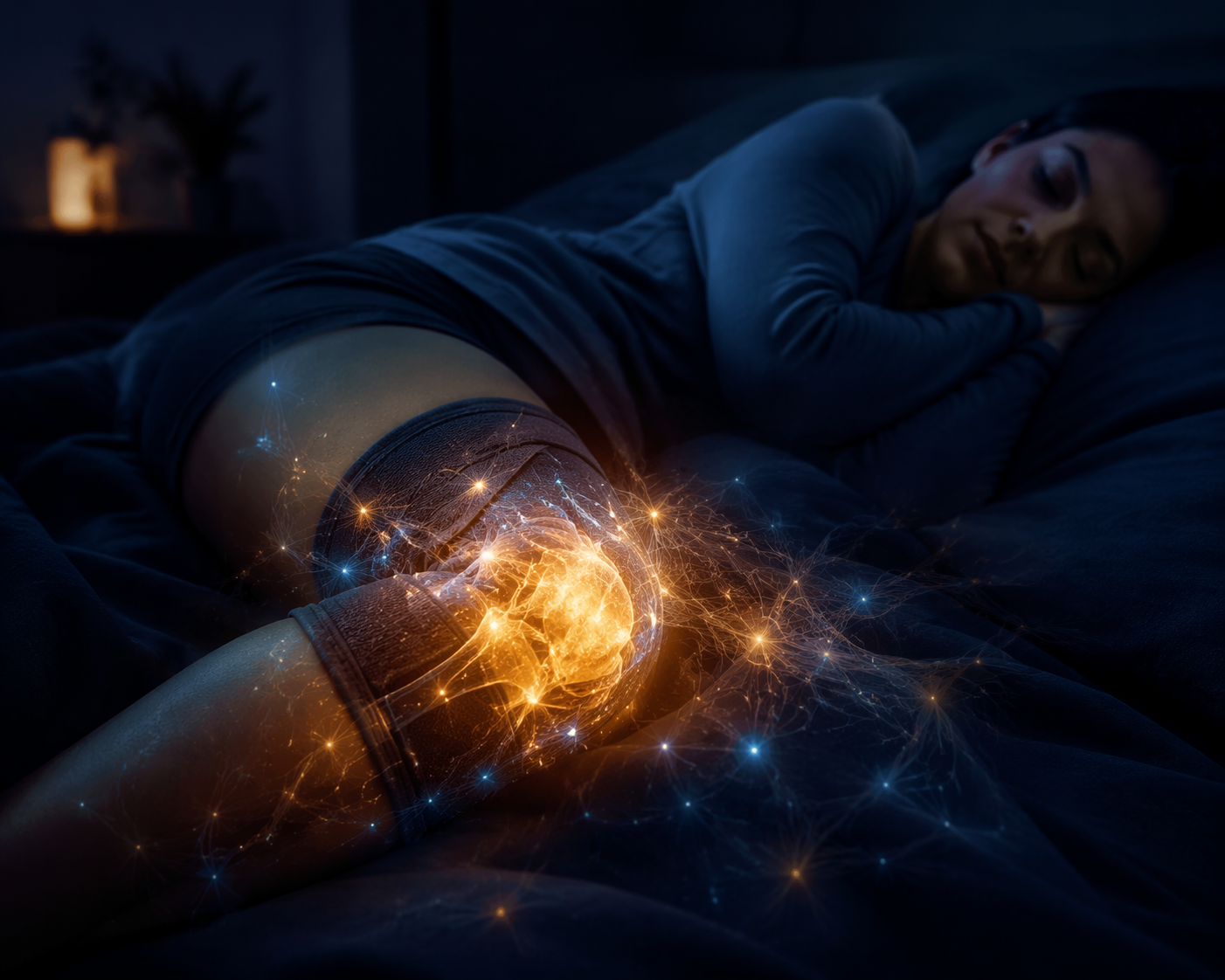
That is the more useful way to think about sleep during knee injury recovery: not as a softer version of rehab, and not as a promise that sleep alone heals an ACL tear, meniscus injury, patellar tendon problem, or post-surgical knee. Sleep matters because it changes the internal conditions in which rehab is trying to work.
Quality sleep means enough architecture, not just enough stillness
When people say “get good sleep,” the phrase can sound like a mood recommendation. Biologically, it means getting enough continuous sleep to move through repeated cycles, including the slow-wave sleep that tends to be richest earlier in the night. The commonly cited 7–9 hour adult sleep window is useful here because it usually allows roughly 4–5 complete sleep cycles, giving the body repeated opportunities to enter the stages where repair-related endocrine activity is strongest.[1]
That does not make 7–9 hours a magic orthopedic dose. People differ, injuries differ, medications and pain can change sleep, and a knee that needs surgery or guided loading will not be persuaded by an excellent bedtime. The point is narrower and more defensible: fragmented or shortened sleep can reduce exposure to the very sleep stages that support tissue repair.
The most important stage for this discussion is slow-wave sleep, often called deep sleep. Charest and Grandner’s review of sleep and athletic performance describes growth hormone secretion as occurring primarily during slow-wave sleep, with growth hormone stimulating fibroblast activity involved in ligament and tendon repair.[1]

The slow-wave sleep repair chain
The chain is worth spelling out because this is where “sleep helps healing” becomes less fuzzy. Slow-wave sleep is associated with the major nocturnal growth hormone pulse. Growth hormone stimulates fibroblasts. Fibroblasts produce collagen. Collagen is a central structural material in ligaments and tendons, including the tissues people worry about after ACL, MCL, PCL, and patellar tendon injuries.[1]
This does not prove that adding one hour of sleep will make a specific torn ligament knit back together on a predictable timetable. Much of the human evidence is mechanistic and comes through broader athletic-performance and tissue-repair literature rather than direct randomized trials in every knee diagnosis. Still, the biological sequence is not decorative. It points to a real recovery window: if deep sleep is repeatedly interrupted, the knee may be unloaded, but the endocrine environment supporting collagen work may be less favorable.
That distinction matters after surgery as well. A reconstructed ligament, a repaired meniscus, or an irritated tendon is not simply waiting for the calendar to pass. Cells are responding to chemical signals, mechanical load, oxygen availability, inflammation, and pain. Sleep does not control all of those variables, but it touches enough of them that treating it as optional background noise is a mistake.
Inflammation has to move on
Inflammation is not the villain at the start of a knee injury. The early inflammatory phase helps initiate cleanup and signaling. The problem is getting stuck there. Ligament, tendon, cartilage, and meniscus recovery all need a local environment that can shift toward repair and remodeling rather than remain dominated by swelling, sensitivity, and inflammatory noise.
Sleep loss pushes in the wrong direction. Charest and Grandner summarize evidence that sleep deprivation elevates pro-inflammatory markers including interleukin-6, or IL-6, and C-reactive protein, or CRP.[1] Those markers are not knee-specific scorecards, and a blood marker cannot tell you whether a meniscus is healing well. But they do show that insufficient sleep can make the whole-body inflammatory climate less friendly to the transition from injury response to tissue remodeling.
Cortisol belongs in the same conversation. Sleep disruption can raise stress-system activity, and elevated cortisol is not what most recovering tissues need when the goal is collagen formation, inflammation resolution, and a steady return to loading.[1] For the person doing rehab, this may show up less as a lab value and more as a familiar pattern: the knee feels more reactive, exercises feel sharper, and the next day’s plan becomes easier to skip or shorten.
Blood flow turns the night into a delivery window
Sleep also changes circulation. OrthoCarolina describes deep sleep as a period when muscle blood flow can increase by 2–3 times, delivering oxygen and nutrients that injured tissues need.[2] That is a useful correction to the image of sleep as mere immobility. The leg is still, but the supply system is not asleep.
The knee itself is complicated: ligaments, tendons, cartilage, meniscus, synovium, bone, and muscle do not all receive blood in the same way. Cartilage and parts of the meniscus are famously limited in direct blood supply. So it would be too neat to say deeper sleep simply “floods the knee” and repairs every structure. The better claim is that sleep supports the broader perfusion and metabolic environment around recovery, including the muscles that stabilize the joint and the tissues that depend on diffusion, local signaling, and a less inflamed neighborhood.
Bad sleep makes rehab harder before the knee even starts moving
The morning after poor sleep is not just psychologically harder. Pain sensitivity can change. Hinge Health, discussing research by Sivertsen and colleagues, reports that each hour of lost sleep is associated with increased next-day pain intensity.[3] For knee rehab, that matters because pain is not merely an unpleasant signal in the background. It affects how confidently someone bends the knee, loads the quadriceps, climbs stairs, performs prescribed exercises, and tolerates necessary but uncomfortable progressions.
This is one reason night pain can become a recovery trap. A swollen knee interrupts sleep. Short sleep increases pain sensitivity the next day. Higher pain makes rehab feel more threatening. Less movement can increase stiffness and reduce confidence. None of that means the pain is imaginary, and none of it means a patient should push through warning signs. It means sleep loss can amplify the sensory volume on a real injury.
Muscle energy is another overlooked piece. In the athletic-performance review, sleep deprivation is linked to reduced muscle glycogen resynthesis by about 32%.[1] That finding is not a direct knee-ligament healing trial, but it is relevant because the quadriceps are central to knee control. A recovering knee often depends on the quadriceps to protect the joint, absorb load, and restore normal gait. If poor sleep leaves the supporting musculature under-recovered, the knee may pay for it during the next session.
What to protect at night
Most practical sleep advice after a knee injury is useful only if it serves one goal: protect sleep continuity long enough to reach and maintain deeper sleep. Pillows, elevation, room temperature, medication timing, and brace positioning are not moral virtues. They are tools for reducing awakenings.
| Night problem | Why it matters biologically | Practical aim |
|---|---|---|
| The knee throbs when lying flat | Pain-related awakenings can fragment sleep cycles | Use clinician-approved elevation or positioning that reduces swelling pressure |
| The brace, pillow, or bedding keeps shifting | Repeated awakenings can reduce slow-wave sleep continuity | Stabilize the sleep setup before bedtime rather than improvising at 2 a.m. |
| The room or routine keeps you alert | Delayed sleep shortens the architecture window available for 4–5 cycles | Lower stimulation and protect a consistent sleep opportunity |
| Evening pain makes rehab anxiety spike | Stress and pain can reinforce lighter, more broken sleep | Use the pain plan your clinician gave you, and ask for one if nights are unmanageable |
Screen avoidance, a dark room, and a regular bedtime can help, but they are not the center of the story. The center is whether the injured person gets enough uninterrupted sleep opportunity for deep sleep, growth hormone signaling, inflammation regulation, pain modulation, blood flow changes, and muscle energy restoration to occur in the same night.
There is also a re-injury angle, though it should not be stretched too far. Charest and Grandner cite work by Milewski and colleagues finding that adolescent athletes sleeping less than 8 hours per night were 1.7 times more likely to sustain an injury.[1] That is adolescent athlete data, not a direct prediction for every adult recovering from a knee injury. Still, it fits the broader pattern: sleep loss can affect reaction time, fatigue, pain, and muscular recovery, all of which matter when a recovering knee is reintroduced to load.
The calibrated version of the advice
Sleep will not replace diagnosis, surgery when it is needed, physical therapy, progressive loading, bracing decisions, or medical management. A torn ligament does not heal because someone bought a better pillow. A post-operative knee still follows the surgeon’s restrictions. A painful swelling pattern that changes suddenly belongs with a clinician, not a bedtime checklist.
But insufficient sleep can biologically work against the rest of the plan. It can reduce exposure to slow-wave sleep and the growth hormone pulse tied to fibroblast activity. It can keep inflammatory markers elevated. It can increase next-day pain sensitivity. It can interfere with glycogen restoration in the muscles that help stabilize the knee. It can turn rehab from difficult-but-doable into something the nervous system treats as a bigger threat.
So the practical target is not heroic sleep perfection. It is giving the body enough continuous sleep opportunity, usually in the 7–9 hour range for adults, to complete repeated cycles and spend real time in slow-wave sleep.[1] For someone taking knee rehab seriously, that belongs in the recovery plan for the same reason exercise dosage and swelling control do: it changes the conditions under which healing happens.
References
- Sleep and Athletic Performance. Charest and Grandner. 2020. https://pmc.ncbi.nlm.nih.gov/articles/PMC9960533/
- Sleep: The Secret Ingredient of Injury Recovery. OrthoCarolina. https://www.orthocarolina.com/blog/sleep-the-secret-ingredient-of-injury-recovery
- Knee Pain at Night. Hinge Health. https://www.hingehealth.com/resources/articles/knee-pain-at-night/


Comments
Join the discussion with an anonymous comment.