
If you are awake because you are afraid your insomnia means rabies is starting, the first distinction matters: isolated insomnia is not a rabies symptom. Rabies can involve sleep disturbance late in the illness, but the CDC describes that as part of encephalitis, alongside severe neurological and systemic symptoms such as fever, confusion, agitation, delirium, hallucinations, hypersalivation, and difficulty swallowing.[1] A person who is simply unable to sleep because they are frightened, scanning their body, replaying an animal encounter, or reading symptom lists is dealing with a different problem.
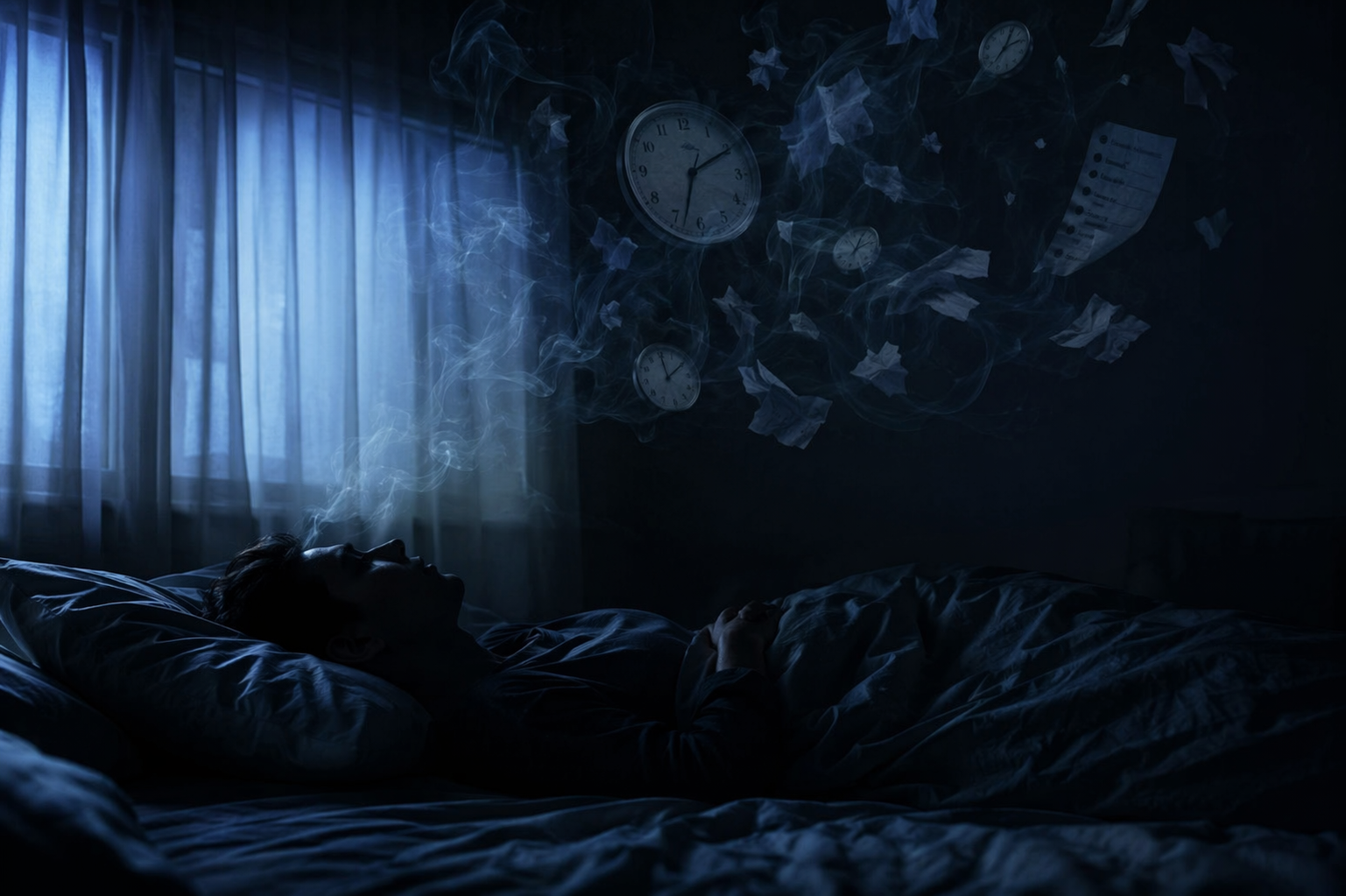
That difference is not a small reassurance detail. It changes the task for the night. The question is not “Can anxiety feel urgent?” Of course it can. The question is whether sleeplessness by itself is evidence of rabies. It is not. When fear of rabies keeps someone awake, the more common explanation is an anxiety-insomnia loop: the nervous system has learned to treat bedtime as the hour for threat review.
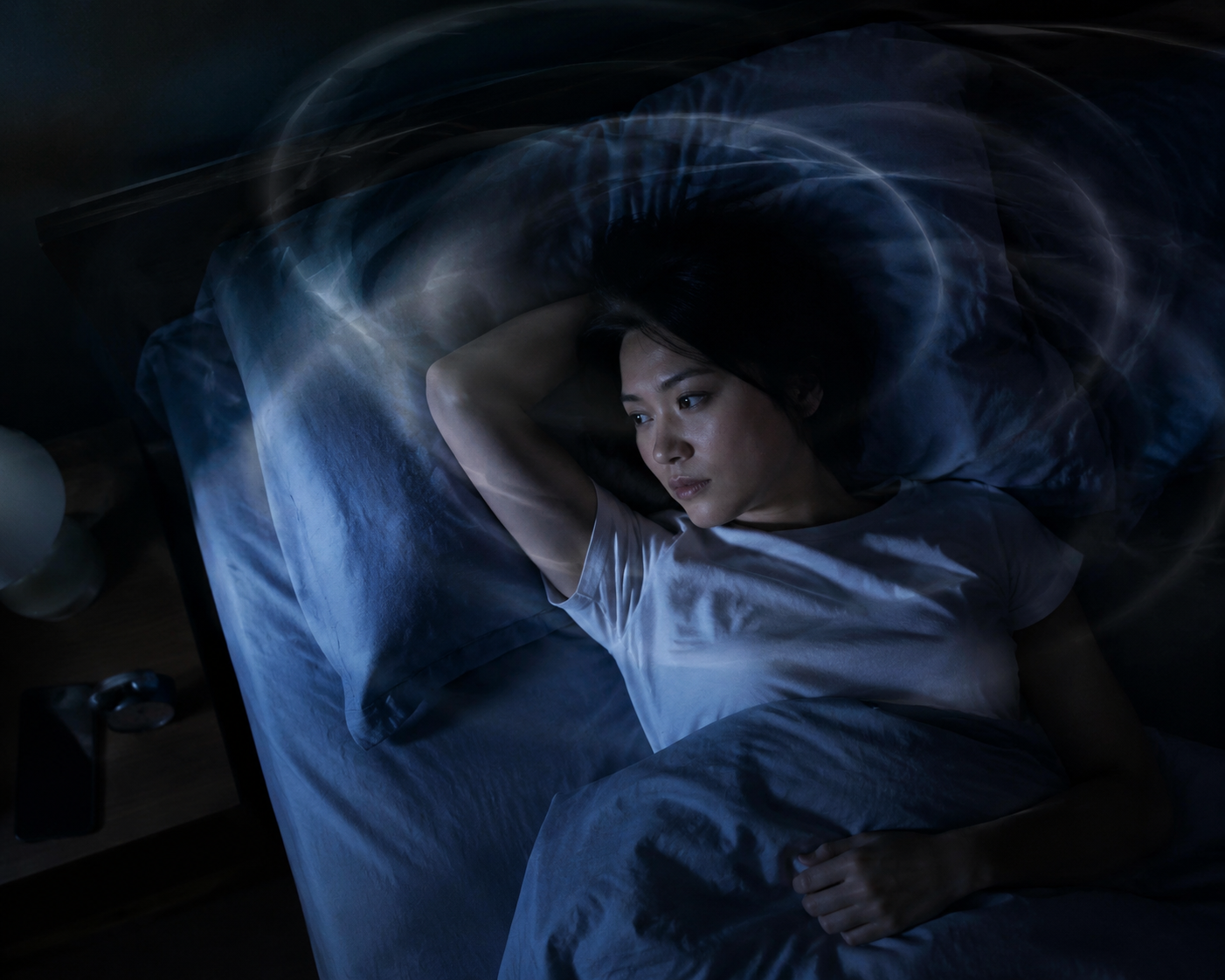
Why rabies fear becomes a sleep problem
Rabies fear often begins with a small uncertainty that refuses to stay small. A bat was in the room, but you are not sure whether it touched you. A dog bite happened weeks ago, and now you are remembering it differently. You read that rabies can be fatal, then later noticed your throat felt tight. Someone told you “you’d know if you were bitten,” but your mind immediately found the exception.
At night, there is less competing input. The room is quiet, the body becomes more noticeable, and the usual daytime distractions fall away. A normal sensation — dry mouth, a muscle twitch, warmth, a skipped heartbeat, a strange dreamlike feeling after hours awake — can be pulled into the rabies story. The more frightened you become, the more your body produces sensations that seem to need interpretation.
This is why checking the facts can help briefly and then fail. You read a medical page, feel relief, close your phone, and lie still. Then a new question arrives: what if saliva was on the animal’s fur? What if I slept through a bat bite? What if insomnia is the first sign before the other symptoms? The next search is not really education anymore. It is an attempt to get certainty from a situation the anxious brain has already decided is dangerous.
The medical boundary: exposure risk is different from fear
A credible rabies concern deserves prompt medical guidance. Rabies is transmitted when saliva or neural tissue from an infected animal enters broken skin or mucous membranes, usually through a bite, and much less commonly through scratches or direct contamination of wounds.[2] Cleveland Clinic also notes that rabies is not spread through casual contact such as touching someone, being near someone, or contact with blood, urine, or feces.[3]
That boundary is especially important with bats. A bat in a room can require careful public health judgment because bat bites can be small and may not wake a sleeping person. But “I saw something outside,” “I walked near a bat,” “a dog licked intact skin,” or “I touched an object that might have been near an animal” is not the same category as saliva entering a bite wound or mucous membrane. The practical step is not to spend the night multiplying possibilities. If there was direct contact with a potentially rabid animal, an unexplained bat encounter while sleeping, or a bite or scratch that has not been medically assessed, call a clinician, urgent care, or local health department.
Post-exposure prophylaxis, or PEP, is the reason this distinction exists. Cleveland Clinic describes rabies PEP as highly effective when given before symptoms begin.[3] Once true rabies illness begins, survival is extraordinarily rare, which is why medical evaluation belongs before symptom-watching when a credible exposure has occurred. Documented survivor reports, including a CDC MMWR case from California and a later India case series, are notable precisely because they are exceptions, not a reason to monitor yourself at home after a real exposure.[4][5]
For many readers, however, the problem has already moved past medical triage. They have checked the exposure facts. They have called a doctor or health department, or the event was never a plausible exposure in the first place. The remaining distress is still intense, but its fuel is no longer the virus. It is checking, body scanning, avoidance, and the repeated attempt to feel perfectly certain before allowing sleep.
How reassurance starts feeding the insomnia
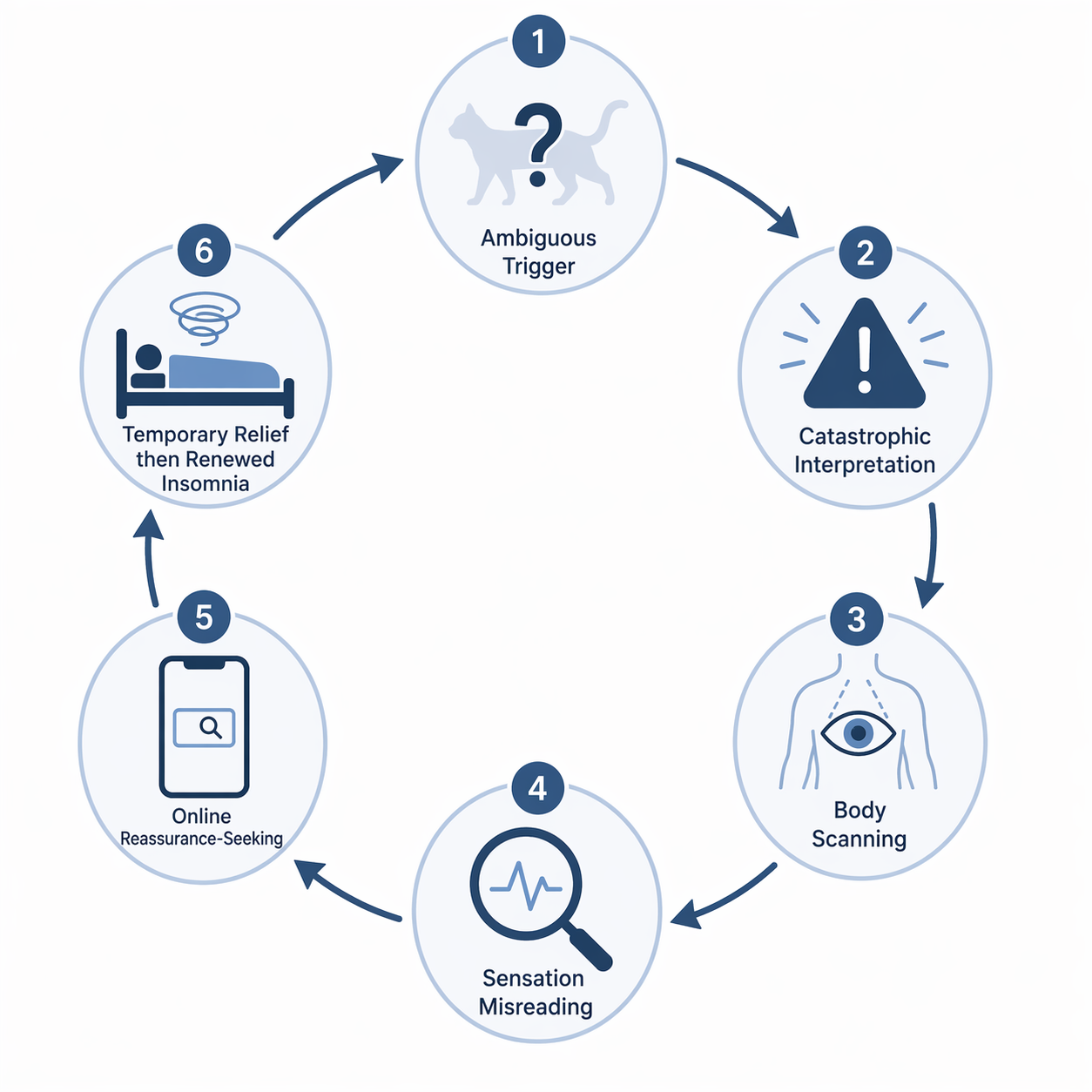
The loop usually has a recognizable shape:
- An ambiguous trigger appears: an animal encounter, a memory, a headline, a symptom list, or a late-night image of rabies.
- The mind makes a catastrophic interpretation: “This could be rabies, and if I miss it, I die.”
- The body is checked: skin, throat, saliva, temperature, swallowing, mood, sleepiness, dreams.
- Normal sensations are treated as clues: dry throat becomes trouble swallowing; anxiety becomes agitation; insomnia becomes a neurological sign.
- Reassurance is sought: CDC pages, forums, friends, photos of skin marks, repeated calls, repeated searches.
- Relief arrives briefly, then disappears, and the bed becomes associated with another round of checking.
Clinical descriptions of rabies phobia and rabies-focused OCD patterns emphasize this same territory: intrusive fear, avoidance of animals or places associated with animals, repeated reassurance-seeking, compulsive checking, and difficulty accepting ordinary uncertainty.[6][7] Those sources are useful as clinical framing, not as proof that every person afraid of rabies has OCD or a specific phobia. The diagnosis depends on the pattern, duration, impairment, and whether compulsions or avoidance are maintaining the fear.
The sleep damage comes from the behavior of the loop. A person lies down and immediately tests whether they can swallow. They search one more phrase before turning off the light. They keep the phone nearby in case panic rises. They inspect old photos of a bite. They ask a partner to confirm there is no fever. Each act makes sense in the moment. Each one also teaches the brain that bed is not a sleep cue; it is the place where rabies danger must be solved.
What the statistics can and cannot do for you
Rabies is medically serious, but in the United States it is rare in humans. CDC summaries commonly place U.S. human rabies deaths in the low single digits per year, while global deaths remain concentrated in places where dog-mediated rabies and access to prompt PEP are much larger public health problems.[4] Domestic dog vaccination has changed the risk landscape in the U.S.; a dog bite in a highly vaccinated setting is not the same risk category as an unvaccinated dog exposure in a region where canine rabies is common.
Numbers can create a floor under panic, but they rarely cure the loop by themselves. A frightened brain often answers probability with possibility: “Rare does not mean impossible.” That sentence is technically true and clinically unhelpful when repeated at 2:13 a.m. The purpose of statistics here is calibration, not an invitation to debate every edge case until morning.
Once a credible exposure has been assessed, continuing to chase certainty usually stops being medical prudence and starts becoming a safety behavior. Safety behaviors are actions that reduce anxiety briefly while keeping the feared prediction alive. In rabies fear, the safety behavior may look like research, but the effect is often the same as a compulsion: temporary relief, then a stronger need to check again.
CBT-I treats the bed as part of the problem
There does not appear to be a peer-reviewed trial specifically on rabies phobia causing insomnia. That should be said plainly. The treatment logic comes from better-established work on insomnia, health anxiety, specific phobia, OCD patterns, and exposure-based therapy. For sleep itself, the most relevant treatment is cognitive behavioral therapy for insomnia, or CBT-I, because it targets conditioned arousal rather than arguing with the fear all night.
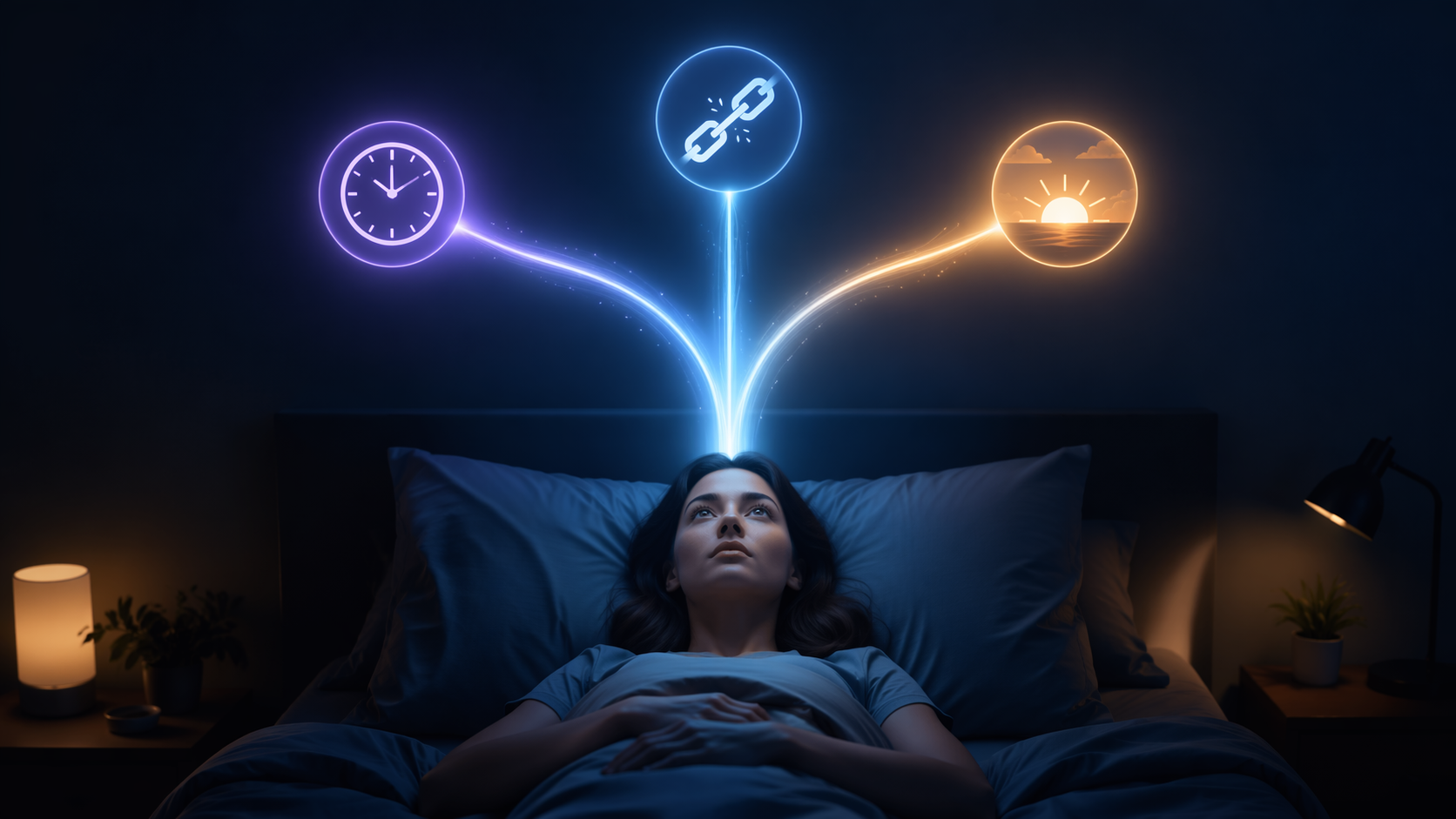
In ordinary insomnia, people often start associating the bed with wakefulness, frustration, clock-checking, and effort. In rabies fear, the association can become sharper: bed equals symptom monitoring. The person may feel relatively functional during the day, then become flooded once the lights go out. CBT-I works by changing what happens in and around the bed so the brain relearns that lying down is not the start of an investigation.
Stimulus control is often the most important piece. If you are awake for a sustained period, you leave the bed and do something quiet and low-stimulation until sleepiness returns. That is not punishment, and it is not a test of discipline. It prevents the bed from absorbing another hour of fear rehearsal. A fuller explanation of this mechanism appears in the site’s guide to CBT-I for sleep anxiety, which is the closest match for readers whose insomnia spikes as bedtime approaches.
Another CBT-I move is reducing the amount of time spent awake in bed. Someone with rabies fear may spend nine hours in bed but sleep five, with the remaining time used for checking, praying for certainty, searching, or mentally reconstructing an animal encounter. A clinician using CBT-I may temporarily narrow the sleep window so sleep pressure becomes stronger and the bed has fewer chances to become a fear arena. This should be done carefully, especially if there are medical, psychiatric, bipolar-spectrum, seizure, or safety concerns, but the principle is straightforward: less wakeful threat review in bed gives sleep a chance to become automatic again.
CBT-I also removes behaviors that look comforting but keep the nervous system alert. For rabies-related insomnia, that may mean no symptom searching in bed, no checking bite marks under the blanket, no taking repeated temperatures unless medically instructed, no asking for the same reassurance after lights-out, and no reading rabies survivor stories as a “final check.” The goal is not to force calm. It is to stop training the brain that sleep requires a completed safety audit.
Readers who are not sure whether this has become clinical insomnia can use the site’s broader sleeping problem at night versus insomnia triage framework. If the sleep disruption has lasted long enough, occurs multiple nights a week, or is changing daytime function, it is no longer just a bad night after a scare.
The fear side needs exposure, not endless certainty
CBT-I can reduce the insomnia, but rabies fear may also need direct anxiety treatment. Exposure-based CBT and OCD-focused therapy work on the prediction that uncertainty is intolerable or that not checking is dangerous. The work is not to convince yourself that rabies is “nothing.” Rabies is serious. The work is to stop treating every sensation, memory gap, animal image, or bedtime thought as an emergency requiring ritualized response.
For one person, exposure might involve looking at a neutral picture of a dog without searching symptoms afterward. For another, it might mean walking past a park without inspecting the ground for saliva. For someone with a bat-related fear, it might mean writing a clear, clinician-informed rule for what counts as contact, then practicing not reopening the question each night. These examples are hypothetical; the exact plan should be matched to the person’s symptoms and safety needs.
The response-prevention part matters. If you do the exposure and then spend forty minutes proving you are safe, the brain learns that the ritual saved you. In rabies OCD patterns, reassurance-seeking, checking skin, avoiding animals, avoiding outdoor spaces, and repeatedly reviewing exposure scenarios can become the compulsive behaviors that keep the fear alive.[7] Treatment usually asks the person to reduce those behaviors gradually enough to practice, but firmly enough that the old loop does not keep running under a new name.
This is where reassurance reaches its limit. A single, accurate medical boundary can be helpful. Ten more rounds often are not. The feeling of urgency does not prove that the question is medically unresolved; it may prove that the nervous system has become dependent on reassurance to come down.
A practical night plan after medical triage
If there may have been a real exposure and you have not been assessed, the night plan is medical: contact urgent care, a clinician, or your local health department for PEP guidance. Do not use a sleep article as a substitute for that decision.
If the exposure has already been assessed as not needing PEP, or there was no credible exposure, the night plan changes. It should be behavioral, short, and repeatable:
- Write the medical decision once: for example, “No direct saliva-to-wound or mucous-membrane exposure was identified,” or “A clinician advised no PEP.”
- Set a no-searching rule for the bed: no symptom lists, forums, image searches, survivor stories, or repeated exposure reconstruction.
- Move body checking out of the sleep window: if there is a genuine wound-care issue, handle it before bed; do not inspect skin repeatedly under fear.
- Use stimulus control: if you are awake and escalating, leave the bed for a quiet activity, then return when sleepy.
- Expect anxiety to protest: the first nights without reassurance may feel worse before the brain learns that nothing needs to be solved at 2 a.m.
This plan is not meant to make fear vanish on command. It changes what fear is allowed to make you do. That is the part that restores sleep over time.
When to get more help
Professional help is appropriate when rabies fear is costing sleep, work, relationships, or ordinary movement through the world. It is especially important if you are avoiding animals or outdoor spaces, repeatedly seeking reassurance, checking your body many times a day, asking others to participate in rituals, or losing multiple nights of sleep despite medical reassurance.
A sleep clinician trained in CBT-I can work on the insomnia pattern. A therapist trained in exposure-based CBT, exposure and response prevention, or health-anxiety treatment can work on the rabies fear pattern. Some people need both. If panic, depression, suicidal thoughts, substance use, or severe sleep deprivation is present, the care plan should involve a licensed professional promptly.
The important sorting question remains simple. If there was a credible exposure, get prompt medical guidance. If the remaining problem is repeated checking, body scanning, reassurance-seeking, and sleeplessness after appropriate reassurance, the target is the anxiety-insomnia loop. That loop is treatable, but it is not treated by giving it one more night of research.
References
- Clinical Features of Rabies, CDC, cdc.gov/rabies/hcp/clinical-signs/index.html
- Rabies, MSD Manual Consumer Version, msdmanuals.com/home/brain-spinal-cord-and-nerve-disorders/brain-infections/rabies
- Rabies, Cleveland Clinic, my.clevelandclinic.org/health/diseases/13848-rabies
- Recovery of a Patient from Clinical Rabies — California, 2011, CDC MMWR, cdc.gov/mmwr/preview/mmwrhtml/mm6104a1.htm
- Rabies survivors in India: a case series, pmc.ncbi.nlm.nih.gov/articles/PMC6335910/
- Rabies Phobia, NeuroLaunch, neurolaunch.com/rabies-phobia
- Rabies OCD: Signs, Symptoms, and Treatment, KOR Results, korresults.com/rabies-ocd-signs-symptoms-and-treatment

Comments
Join the discussion with an anonymous comment.