
Yes, insomnia can appear on rabies symptom lists. The CDC lists insomnia among common signs and symptoms during the neurologic dysfunction phase, next to anxiety, confusion, agitation, and delirium. Mayo Clinic lists insomnia as a later sign or symptom. MSD Manual says people with rabies may hallucinate and have insomnia. [1][2][3]
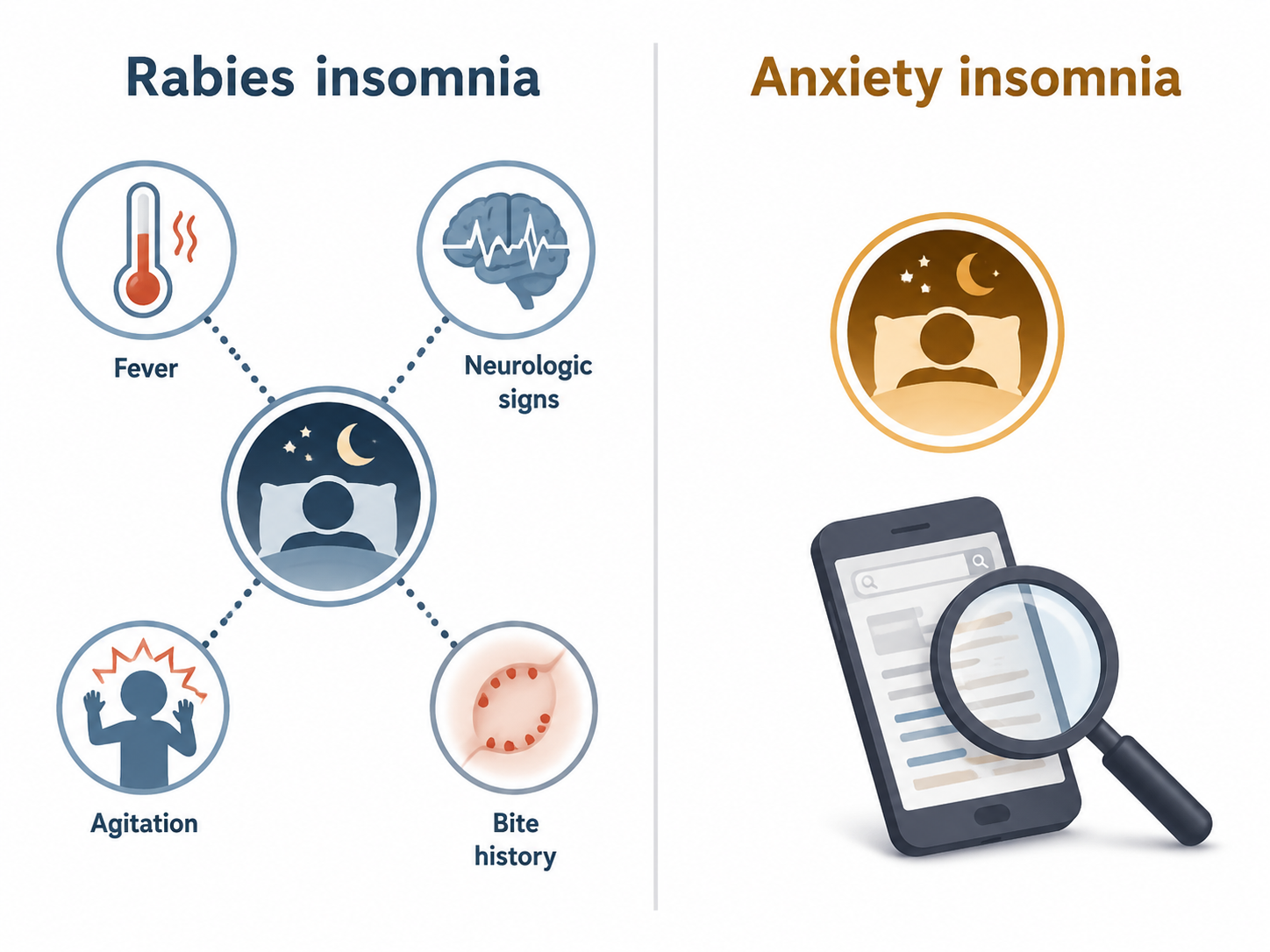
That is the frightening, accurate sentence. It is also incomplete if it is read alone at 2 AM. In clinical rabies, insomnia is not a lone clue floating apart from the rest of the illness. It appears in the setting of a dangerous neurologic disease: fever or flu-like illness may come first, then agitation, confusion, delirium, hallucinations, hydrophobia, aerophobia, weakness, paralysis, seizures, coma, or other progressive neurologic signs depending on the form of the disease. [1][2][3]
So the useful question is not “Is insomnia ever listed under rabies?” It is “What else is happening, and was there a meaningful exposure?” Isolated sleeplessness after reading about rabies points in a very different direction than sleeplessness occurring during a worsening neurologic illness after a bite or plausible exposure.
What “rabies symptoms insomnia” actually means clinically
Rabies is a medical emergency because once clinical symptoms appear, the disease is almost always fatal. That severity is part of why this fear sticks. It is not a silly thing to notice that the disease is catastrophic. The mistake is treating one nonspecific symptom as if it carries the meaning of the whole syndrome.
Verywell Health describes insomnia as appearing in both the prodromal phase and the acute neurologic phase, while also noting that prodromal symptoms are nonspecific and can be mistaken for flu or anxiety. Its time windows for both the prodromal and acute neurologic phases are each described as 2 to 10 days. [4]
That nonspecific early period is exactly where anxious readers get trapped. Fever, body aches, sore throat, and insomnia are not unique to rabies. A Qatar case report also notes that initial rabies symptoms can be nonspecific, including fever, body aches, sore throat, and insomnia, and may mimic panic attack or anxiety disorder. [5]
But a case report is not a frequency estimate, and nonspecific does not mean “any one of these symptoms equals rabies.” It means clinicians cannot diagnose rabies from an isolated symptom word. They look for the larger pattern: exposure history, progression, neurologic findings, and the cluster of signs around the insomnia.
| Pattern | What it suggests |
|---|---|
| Insomnia plus recent searching, panic, body scanning, and repeated reassurance-seeking, with no known exposure | More consistent with health anxiety or OCD-driven insomnia than rabies |
| Insomnia with fever, confusion, agitation, delirium, hallucinations, hydrophobia, aerophobia, weakness, paralysis, or rapidly worsening neurologic symptoms | Needs urgent medical evaluation, especially if there was a bite or plausible exposure |
| A known bite or direct contact with a possibly rabid animal, even before symptoms | Needs prompt medical advice about post-exposure care; do not wait for insomnia or other symptoms |
Exposure matters more than symptom-matching
Rabies risk begins with exposure, not with a search result. A person who was bitten by a potentially rabid animal, had saliva from a suspect animal enter broken skin or mucous membranes, or woke to find a bat in a situation where contact cannot be ruled out is in a different category from someone who read a symptom list and then could not sleep.
Cleveland Clinic notes that bat bites can be so small—about the size of the tip of a pencil—that many people do not know they have been bitten. [6] That fact matters because it is one reason clinicians take certain bat encounters seriously. It should not become an invitation to spend the night inspecting normal skin marks under a phone flashlight.
In the United States, rabies deaths are very rare: fewer than 5 U.S. deaths per year, while lightning kills 20 to 50 people and bee stings kill more. Globally, the risk picture is different, with dog-mediated transmission concentrated overwhelmingly in Asia and Africa. Those distinctions do not make rabies harmless. They keep probability attached to geography and exposure instead of to fear intensity.
How the anxiety-insomnia loop forms
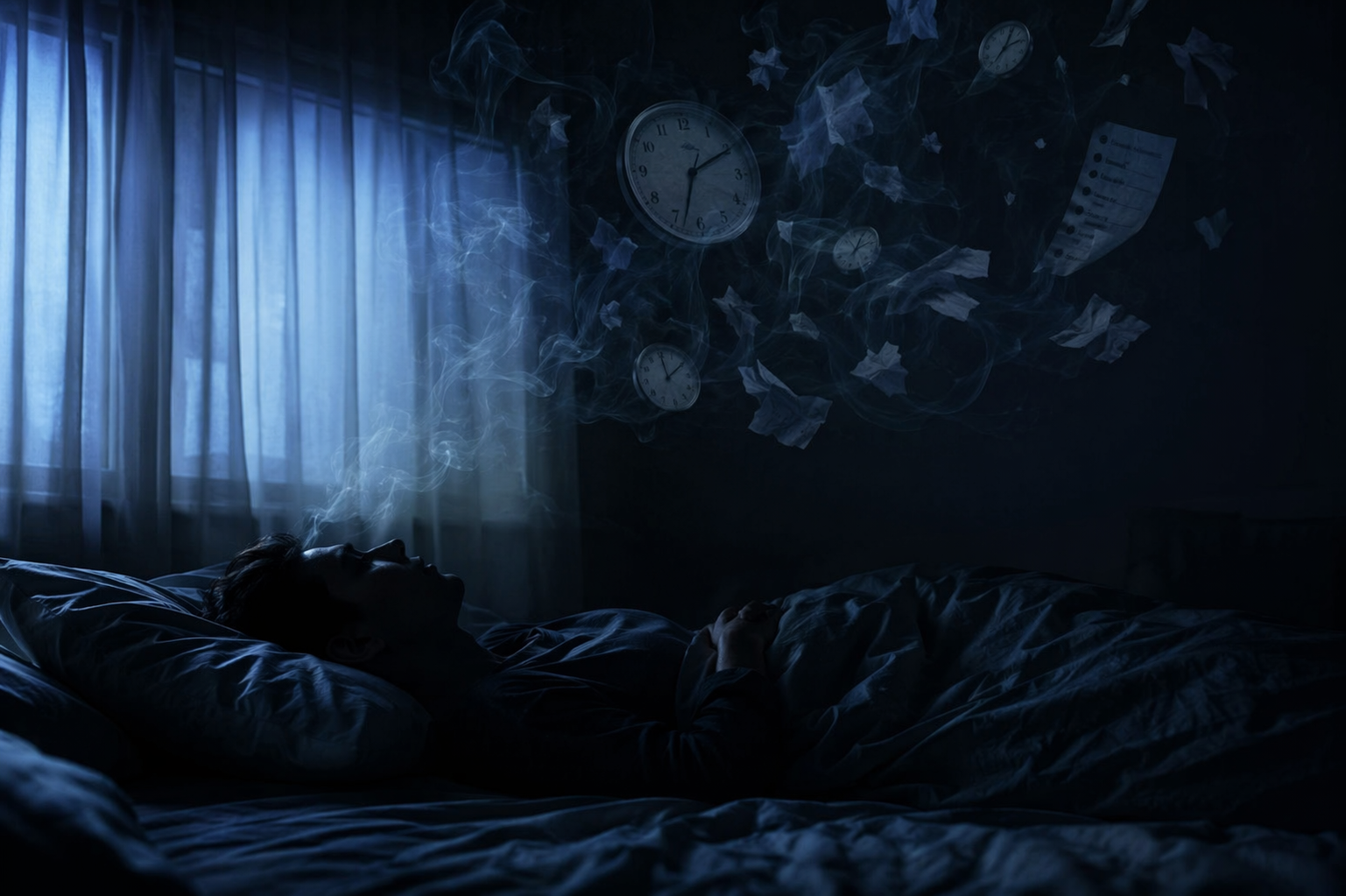
The loop usually starts with an exposure doubt, not a confirmed illness: a mark on the ankle, a memory of walking near a bat, a pet encounter, a “what if” thought that refuses to resolve. The person searches. A legitimate source lists insomnia. The body reacts as if the word itself were evidence. Heart rate rises. The bed stops feeling like a place to sleep and starts feeling like a place to monitor.
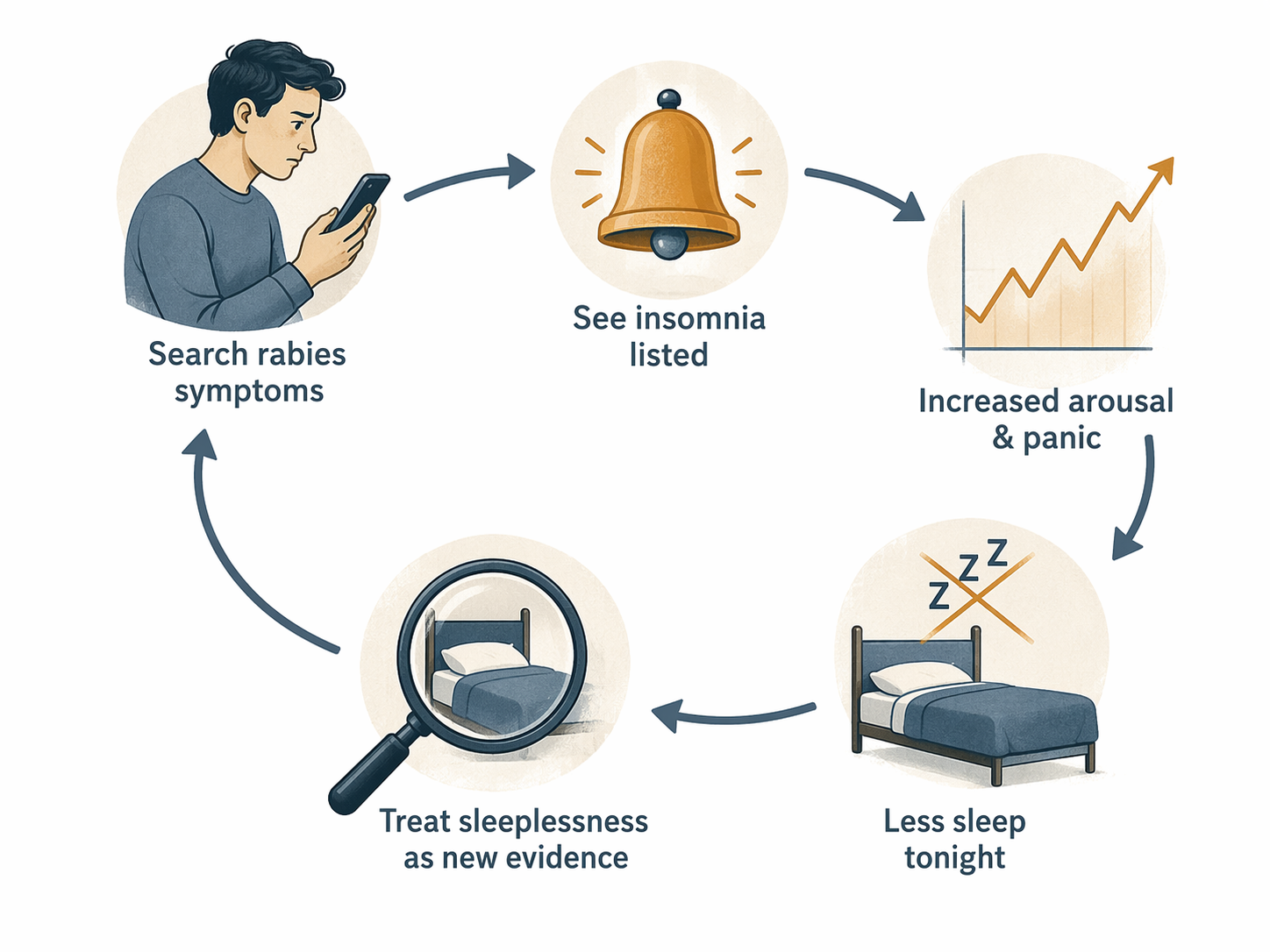
Then the cruel part: the person sleeps less because they are frightened, and the sleeplessness is treated as new evidence that the feared disease may be starting. The next search feels necessary. It may even calm them briefly. But the relief does not settle the question; it trains the brain to ask again.
NeuroLaunch describes “Googling rabies symptoms at 2am” as part of a compulsive fear-of-rabies pattern and notes that reassurance-seeking gives only temporary relief while strengthening the obsessive loop. [7] KOR Results similarly identifies rabies OCD symptoms that include compulsive checking for bites, compulsively researching rabies, and repeatedly seeking medical advice. [8]
This is why ordinary sleep hygiene advice often feels almost insulting to someone in the middle of a rabies spiral. The problem is not only caffeine, screens, or an irregular bedtime. The compulsion is doing work. It promises safety, then keeps the threat active. Nighttime obsessions and checking rituals are one of the ways OCD can disrupt sleep, a pattern discussed in OCD Disrupts Sleep Through Three Distinct Pathways.
Klarity Health calls rabies OCD “surprisingly common in OCD communities” and describes the near-100% fatality rate as a cognitive trap: accurate medical knowledge can intensify fear rather than resolve it. [9] That is the paradox here. The person may know more about rabies than most people around them, yet feel less safe because every fact has become material for checking.
Health anxiety after rabies exposure is real, but it is not the same as rabies
A 2026 Frontiers in Psychology study of 226 rabies-exposed patients found that 47.8% had moderate-to-severe health anxiety, with four distinct anxiety profiles. Health literacy was the strongest protective factor for the high-level maintenance profile, with an odds ratio of 0.26 and p<0.001. The study also found that perceived social support was associated with more severe anxiety, with an odds ratio of 1.20, which the authors interpreted as suggesting that excessive reassurance from family may backfire. [10]
That study matters because it refuses a lazy conclusion: people can be genuinely exposed and genuinely anxious at the same time. Anxiety in this context is not imaginary. It can be severe, patterned, and clinically important.
The limitation also matters. The study was conducted in a Chinese hospital population, where exposure patterns differ from the United States and dog-mediated rabies is a more central concern. It should not be used to claim that U.S. readers with no known exposure are at high rabies risk. It is better evidence for a narrower point: after rabies-related exposure, health anxiety can become a major problem in its own right, and repeated reassurance may not fix it.
Why isolated insomnia after searching points away from rabies
If your insomnia began after you read about rabies, worsens when you search symptoms, and temporarily improves after reassurance, the timing itself is information. Rabies does not wait for you to Google it before causing insomnia. Anxiety often does.
An anxious nervous system can keep the body awake through hyperarousal: threat monitoring, muscle tension, racing thoughts, and conditioned fear of the bed or the night itself. The same bidirectional anxiety-insomnia pattern that affects generalized anxiety can attach itself to one feared disease. For a deeper explanation of that mechanism, see Sleep Anxiety and Insomnia: The Bidirectional Link, Causes, and Evidence-Based Treatment.
This does not mean “you are fine” in the dismissive way that makes people search harder. It means the evidence has to be sorted by category. A symptom word has low value by itself. Exposure history and symptom clustering have higher value. Reassurance rituals have their own cost.
- A new inability to sleep after reading rabies symptom lists is more consistent with fear-driven arousal than with rabies insomnia.
- Repeated checking for bites can make ordinary skin marks feel suspicious, especially at night.
- Asking for reassurance may help for minutes, then reset the demand for more certainty.
- The absence of known exposure and the absence of progressive neurologic symptoms are clinically important, not emotional conveniences.
What to do with the fear tonight
If you have had a known or plausible rabies exposure, do not use insomnia to decide whether to act. Contact urgent medical care, an emergency department, or local public health guidance promptly about post-exposure treatment. Rabies prevention is time-sensitive before symptoms appear; waiting to see whether insomnia “means something” is the wrong test.
If you have fever, confusion, agitation, delirium, hallucinations, hydrophobia, aerophobia, weakness, paralysis, seizures, or other rapidly worsening neurologic symptoms—especially with a possible exposure—seek emergency care. That situation is no longer a sleep question.
If there is no known exposure, no plausible bat or animal contact, and the main pattern is searching, checking, asking, sleeping less, and searching again, the next useful step is not another rabies article. It is support for health anxiety or OCD-pattern fear. Sources discussing rabies OCD describe approaches such as cognitive behavioral therapy, exposure and response prevention, and, when appropriate, medication under professional care. [7][8][9]
A practical boundary for tonight can be simple: if you have a real exposure question, move it out of the search bar and into medical or public health channels. If you are trying to prove, for the tenth time, that a sleepless night is not rabies, treat the checking itself as the problem to interrupt.
Insomnia is real in rabies. But insomnia by itself, especially insomnia that begins after frightening symptom searching and grows through compulsive checking, is far more consistent with an anxiety loop than with rabies.
References
- Clinical Features of Rabies, CDC, 2026.
- Rabies - Symptoms and causes, Mayo Clinic, 2025.
- Rabies, MSD Manual Consumer Version, reviewed 2024.
- Rabies Symptoms, Verywell Health, 2026.
- A Case of Fatal Rabies Encephalitis in Qatar, PMC, 2017.
- Rabies, Cleveland Clinic, 2026.
- Fear of Rabies: Understanding and Overcoming Cynophobia's Dark Side, NeuroLaunch, 2024/2026.
- Rabies OCD: Signs, Symptoms, and Treatment, KOR Results, 2024.
- When OCD Becomes Health Anxiety: Understanding Intrusive Thoughts and Finding Relief, Klarity Health, 2025.
- Health anxiety trajectories and associated factors among rabies-exposed patients: a latent profile analysis, Frontiers in Psychology, April 2026.

Comments
Join the discussion with an anonymous comment.