

If you lie down exhausted and your mind starts running the second the room goes dark, that experience is common: about 1 in 3 adults report insomnia symptoms, and 10–12% meet the pattern of chronic insomnia [1][2].

Why your mind gets louder at night
The first mistake is to treat this as a character problem. What often develops instead is conditioned hyperarousal: the brain has learned that bed is a place to stay alert, review the day, and rehearse tomorrow [3][4].
At night, the supports that usually keep thoughts organized start to thin out. Daytime distractions fall away, cognitive control dips, and whatever was held together by meetings, errands, or noise becomes easier to hear. That is why the same worries that felt manageable at 4 p.m. can turn repetitive at 1 a.m. [3][4].
Screens, late stimulation, caffeine, and a stressful evening can all make the loop easier to trigger, but they are usually not the root of the problem. The more important shift is that the bed itself starts to predict wakefulness. After enough nights of trying to force sleep while thinking hard, the brain begins to treat getting into bed as the cue to get busy [3].
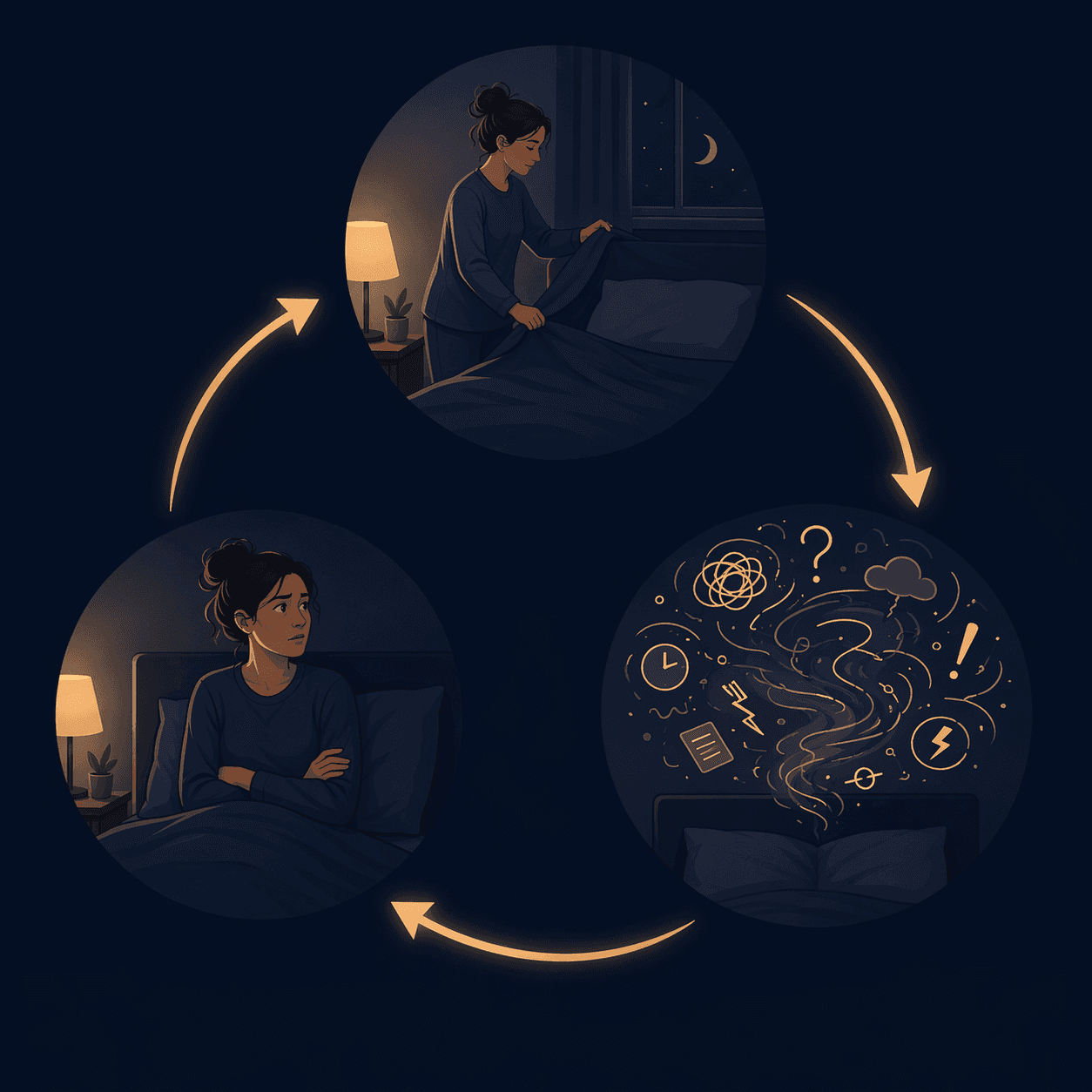
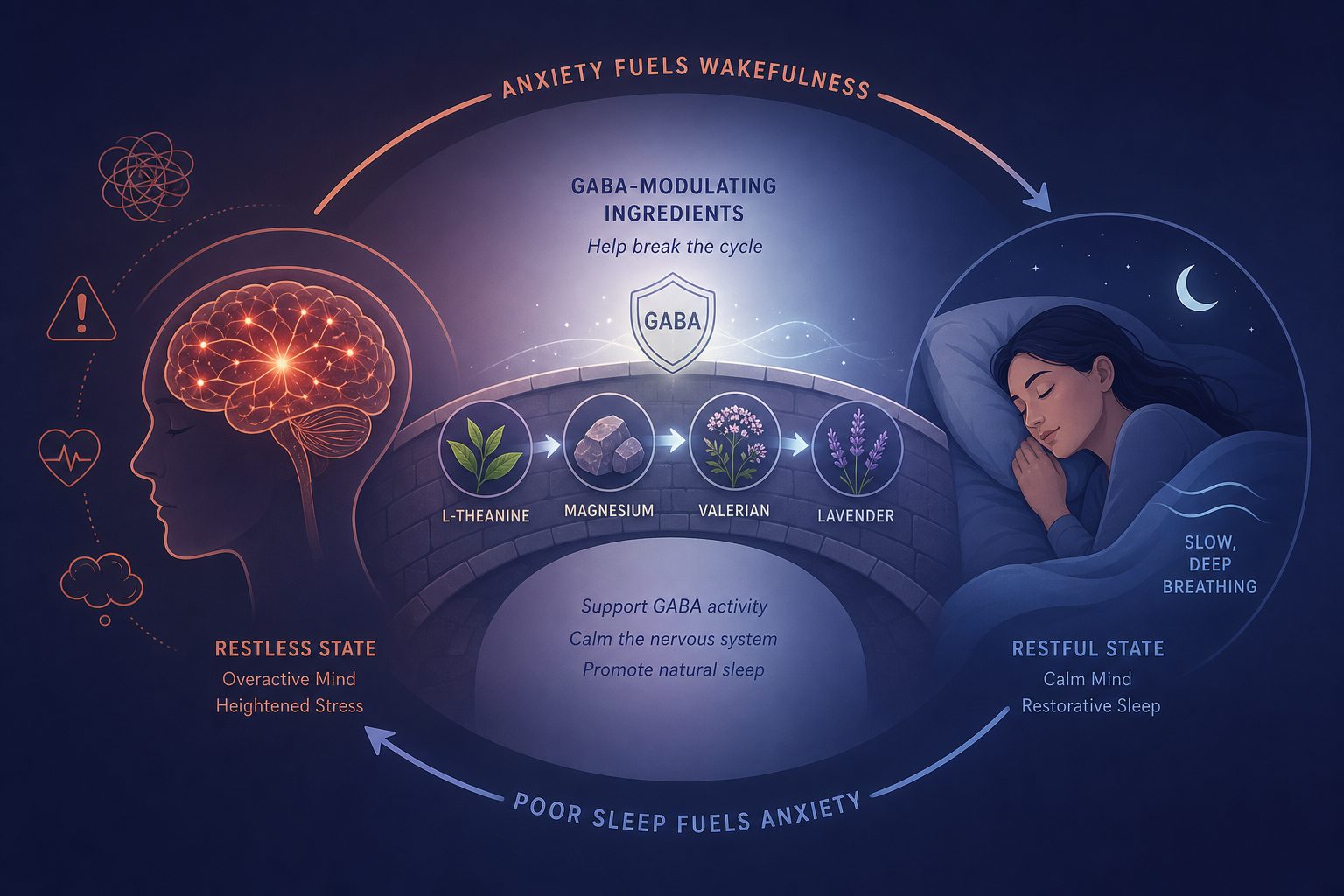
Cognitive hyperarousal is the useful term here. It is not just having anxious thoughts. It is a broader state of scanning, checking, solving, and self-monitoring that keeps the mind pointed toward threat or unfinished business when sleep depends on letting that posture go [4].
What actually interrupts it tonight
The goal is not to talk yourself into sleep. It is to stop using the bed as the place where worry gets repeated.
- Set a short worry window earlier in the evening. Spend about 15 minutes writing down the thoughts your brain keeps reopening, plus the next concrete step for anything actually actionable. The point is containment: worry gets a container before bed, not permission to occupy the bed itself [3].
- If you stay awake in bed for roughly 15–20 minutes, get up. Keep the lights low, do something quiet and non-engaging, and return only when you feel sleepy again. This is not giving up on sleep; it is weakening the association between bed and alertness that keeps the loop alive [3].
- Use a body-based downshift, not a sleep test. Slow breathing such as 4-7-8, progressive muscle relaxation, or a body scan can lower arousal enough to make sleep possible. They are helpful because they change the state of the body, not because they force the mind to go blank on command.
These tools are not equal in evidence. CBT-I is the more established treatment because it addresses both the behavior around sleep and the thinking patterns that keep arousal going [5][6]. In clinical trials, multicomponent CBT-I helps many people, often by roughly 70–80%, but those results depend on adherence and on whether insomnia is happening alone or alongside anxiety, depression, pain, or other conditions [5][6].
When racing thoughts are more than an occasional bad night
If this shows up only after a demanding day, the best plan is usually simple: contain the worry earlier, leave the bed if the loop starts, return only when sleepy, and use one body-based technique without turning it into a performance test. If the pattern is persistent, or if racing thoughts come with daytime worry, avoidance, panic, or clear impairment, it is time to think about professional care rather than another self-help routine.
That distinction matters. A person whose sleep is mostly thrown off by timing or sleep drive mismatch needs a different explanation than someone whose bed has become a trigger for monitoring and rumination. For the second group, the work is not to win an argument with thoughts in the dark. It is to retrain the conditions that taught the brain to argue there in the first place.
References
- [AASM survey shows 12% of Americans have been diagnosed with chronic insomnia](https://aasm.org/survey-shows-12-of-americans-have-been-diagnosed-with-chronic-insomnia/) — American Academy of Sleep Medicine
- [Insomnia: Symptoms, causes and treatment](https://www.mayoclinic.org/diseases-conditions/insomnia/symptoms-causes/syc-20355167) — Mayo Clinic
- [How To Stop Your Mind from Racing and Get To Sleep](https://health.clevelandclinic.org/when-youre-trying-to-sleep-but-your-mind-is-racing-give-these-tactics-a-try) — Cleveland Clinic
- [Insomnia: What It Is, Causes, Symptoms & Treatment](https://my.clevelandclinic.org/health/diseases/12119-insomnia) — Cleveland Clinic
- [Cognitive Behavioral Therapy for Insomnia (CBT-I): What It Is](https://my.clevelandclinic.org/health/treatments/cognitive-behavioral-therapy-insomnia) — Cleveland Clinic
- [What is CBT-i?](https://www.health.harvard.edu/sleep/what-is-cbt-i) — Harvard Health


Comments
Join the discussion with an anonymous comment.