
Waking up at 3 a.m. does not mean the night has failed. Brief awakenings happen. The part that turns a normal wake-up into middle of the night insomnia is usually what happens next: lying very still, trying to be calm, checking whether sleep is coming, and slowly teaching the bed to feel like a place where you perform wakefulness.
So the job is not to win an argument with your brain at 3 a.m. The job is to follow a sequence simple enough to use while tired: give sleep a short chance to return, leave bed if it does not, keep the light low and the activity boring, use relaxation as support rather than a test, then protect tomorrow morning.
If your main problem is waking during the night rather than falling asleep at bedtime, you are in the territory often called sleep maintenance insomnia. If you are not sure which pattern fits you, insomnia pattern matters because the right behavioral move depends on where the night is breaking.
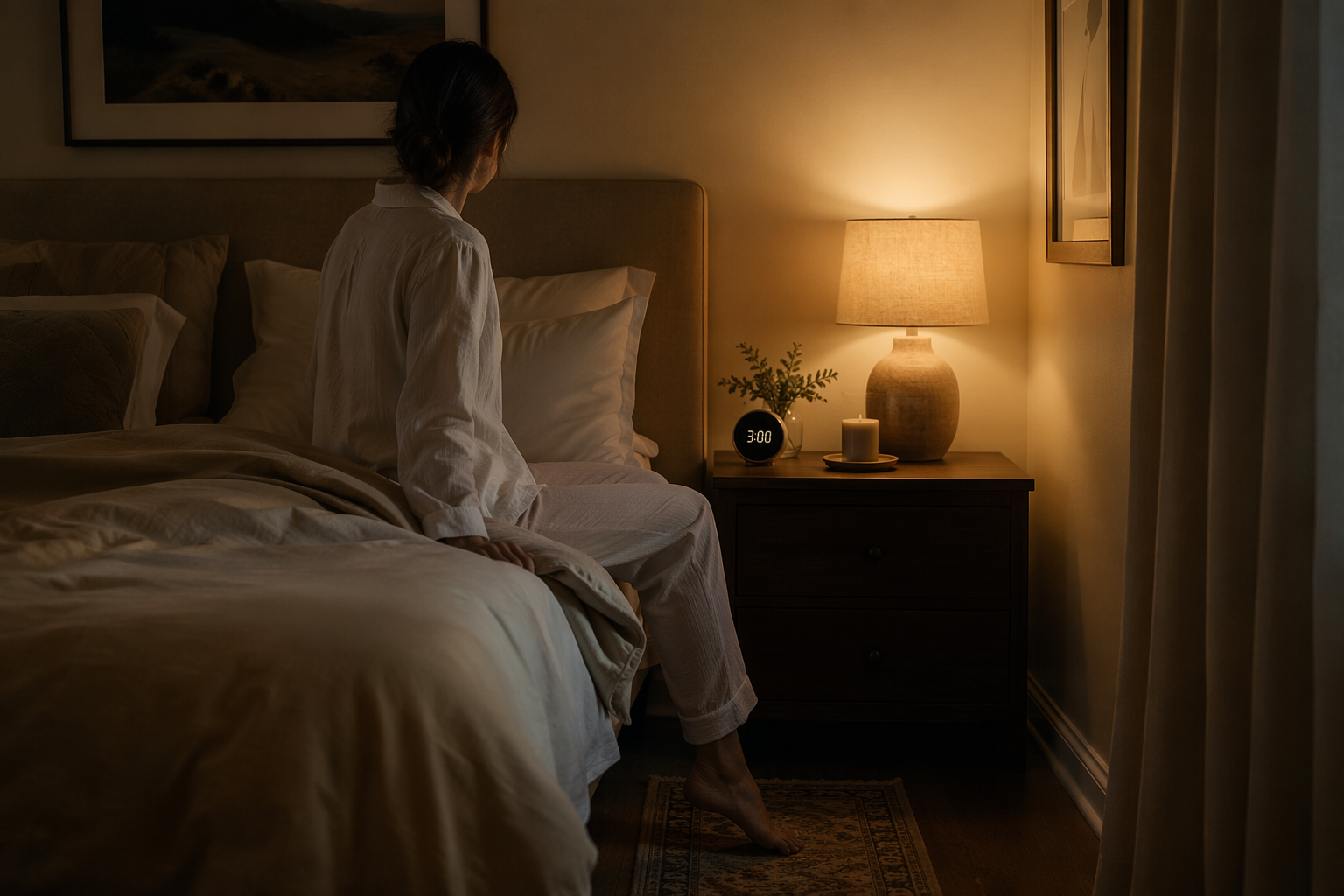
First, do less than you want to do
When you first notice you are awake, do not check the time. Do not pick up your phone to confirm that it is 3:07. Do not start calculating how much sleep is left. If you already saw the time, let that be the last clock information you collect tonight.
Mayo Clinic, Johns Hopkins, Harvard Health, and Sleep Foundation converge on the same practical boundary: if you are not back asleep after roughly 20 minutes, get out of bed rather than staying there awake [1][2][3][4]. The word roughly is doing real work. This is not an invitation to time yourself.
Use a loose estimate. If you wake, roll over, settle, and feel sleep returning, let that happen. If you are still awake after what feels like a short stretch, or if you catch yourself wondering whether it has been 20 minutes yet, that is already enough information. Leave the bed.
Clock-checking is not harmless bookkeeping. Johns Hopkins and Harvard both warn that watching the time can feed anxiety about being awake, which makes returning to sleep harder [2][3]. In the dark, arithmetic becomes stimulation. The more carefully you monitor sleep, the less sleep behaves like something that can arrive on its own.
Leave the bed before the bed becomes the problem
Getting out of bed at 3 a.m. can feel like admitting defeat. It is usually the opposite. In CBT-I, this is stimulus control: the bed should keep meaning sleep, not waiting, bargaining, worrying, or trying harder.
Make the move quiet and boring. Sit in a chair, on a couch, or somewhere close enough that returning to bed will be easy. Keep the room dim. If you need light, use the lowest warm light that lets you move safely. This is not the time to tidy the kitchen, answer messages, research symptoms, or solve tomorrow.
- Do not stay in bed rehearsing how badly you need sleep.
- Do not use your phone as a flashlight, clock, reader, or comfort object.
- Do not turn on bright overhead lights unless safety requires it.
- Do not start a task that has a goal, deadline, or emotional charge.
The phone is especially good at pretending to be useful. A “boring” article is still a lit screen, a search box, and a small machine for making choices. Johns Hopkins notes that blue and green wavelengths from phones, tablets, and computer monitors can suppress melatonin and promote alertness, which is why a physical book under dim warm light is a better default [2].
Choose an activity that does not reward being awake
The activity should be calm enough that you could stop it mid-sentence. That is the test. If it pulls you toward finishing, fixing, scrolling, learning, comparing, or deciding, it is too interesting for this job.
| Better at 3 a.m. | Usually too activating |
|---|---|
| A familiar physical book | A phone, tablet, laptop, or TV |
| Quiet audio already queued before bed | Searching for the perfect sleep meditation |
| Simple guided imagery | Planning tomorrow’s schedule |
| A repetitive, low-stakes craft in dim light | Cleaning, work email, finances, or health research |
Reading works best when the book is not suspenseful and not important. Re-reading something familiar is fine. The point is not to become entertained; it is to stop pairing the bed with wakeful effort while giving sleepiness room to build again.
Add relaxation, but do not turn it into another performance
Relaxation techniques can help, but they are not magic passwords. If you use one, use it as something to do gently while awake, not as a way to check every few seconds whether you are calm enough yet.
Progressive muscle relaxation has the strongest support among the options here. Sleep Foundation describes a sequence in which you tense muscle groups at about 75% strength for 5 seconds, then release, moving through the body systematically [4]. The release is the important part. You are giving the body a clearer contrast between holding and letting go.
A simple progressive muscle relaxation sequence
- Start with your feet. Curl or tense them at moderate strength for about 5 seconds, then release.
- Move to your calves and thighs. Tense, notice the effort, then let the muscles drop.
- Tense your hands and forearms, then release them into your lap.
- Gently tense your shoulders, then let them fall away from your ears.
- Soften your jaw, forehead, and eyes rather than squeezing your face hard.
- If you lose track, restart wherever you are. Losing track is not a problem.
Breathing techniques are reasonable alternatives if muscle tensing is uncomfortable. With 4-7-8 breathing, you inhale for 4 counts, hold for 7, and exhale for 8. With box breathing, you keep the parts even: inhale, hold, exhale, hold. Harvard also discusses body scan meditation as an option for returning attention to the body rather than the clock [3].
Pick one technique for the night. Do not sample five methods in a row and grade each one. That turns relaxation into troubleshooting, and troubleshooting is daytime work.
Return to bed only when sleepy
Sleepy is not the same as tired, annoyed, bored, or aware that you have work tomorrow. Sleepy means your eyelids are heavy, your attention is drifting, and returning to bed feels like the natural next move rather than the responsible one.
When that happens, go back to bed. Keep the lights low. Do not check the time on the way. If you get back in bed and wakefulness takes over again, repeat the same sequence. Not a new plan. Not a better plan. The same plan.
This repetition can feel irritating, especially when you are already short on sleep. But the consistency is the treatment logic: bed gets fewer minutes of awake struggle, and wakeful time gets moved somewhere less emotionally loaded.
Tomorrow morning is part of tonight’s protocol
The hardest instruction comes after the bad night: wake up at your usual time. Do not sleep in to compensate if you can avoid it. Do not take a long recovery nap. Do not go to bed dramatically early the next night. Johns Hopkins, Mayo Clinic, and Harvard all emphasize keeping a consistent wake time after a poor night because it protects circadian timing and helps preserve sleep drive for the following night [2][1][3].
This can sound almost unfair. You had the bad night; now you are being asked not to collect the sleep you missed. But sleeping late shifts the morning anchor your body uses to time the next night. Long naps reduce the pressure that helps sleep consolidate. Going to bed very early can put you in bed before your body is ready, which creates another opportunity to lie there awake.
This is the same logic that makes sleep restriction therapy useful in CBT-I. The aim is not to punish you with less sleep. It is to consolidate sleep by keeping the wake-up anchor steady and allowing enough sleep pressure to build before the next bedtime.
If you are dangerously sleepy, safety comes first. Do not drive drowsy just to prove discipline. But for ordinary fatigue after a rough night, the cleaner behavioral move is boring and consistent: get up at the usual time, get daylight when you can, keep caffeine sensible, and save sleep for the next night.
Naps are the place many people accidentally undo the night’s work. If you need more detail on when a nap is a reasonable exception and when it is likely to keep the cycle going, see napping with insomnia.
What this can and cannot fix
This protocol is a behavioral response to being awake in the middle of the night. It is not a promise that one good 3 a.m. routine will cure chronic insomnia. Harvard reports that in online CBT-I programs, about 80% of completers report at least mild improvement and about 35% report that sleep is “much improved” [3]. That is useful expectation-setting: CBT-I can help many people, but it is a structured treatment, not a single trick.
If awakenings happen at least 3 nights a week for 3 months or more, it is worth looking for full CBT-I rather than trying to assemble treatment from scattered advice. The in-the-night sequence still matters, but chronic patterns usually need daytime pieces too: sleep scheduling, stimulus control, cognitive work, and adjustment over time.
Also look beyond behavior if the awakenings come with loud snoring, choking or gasping, restless legs, reflux, frequent urination, pain, hot flashes during perimenopause, medication changes, or panic-like symptoms. If early-morning waking is paired with persistent low mood or loss of interest, the depression-insomnia cycle deserves attention. A behavioral protocol may reduce the bed-awake association, but it will not treat sleep apnea, GERD, nocturia, restless legs, hot flashes, depression, or another driver by itself.
Sleep aids are a separate question. If you have tried the behavioral sequence consistently and still want to understand over-the-counter options and safety limits, start with adult sleep aid guidance rather than making a new 3 a.m. experiment out of the medicine cabinet.
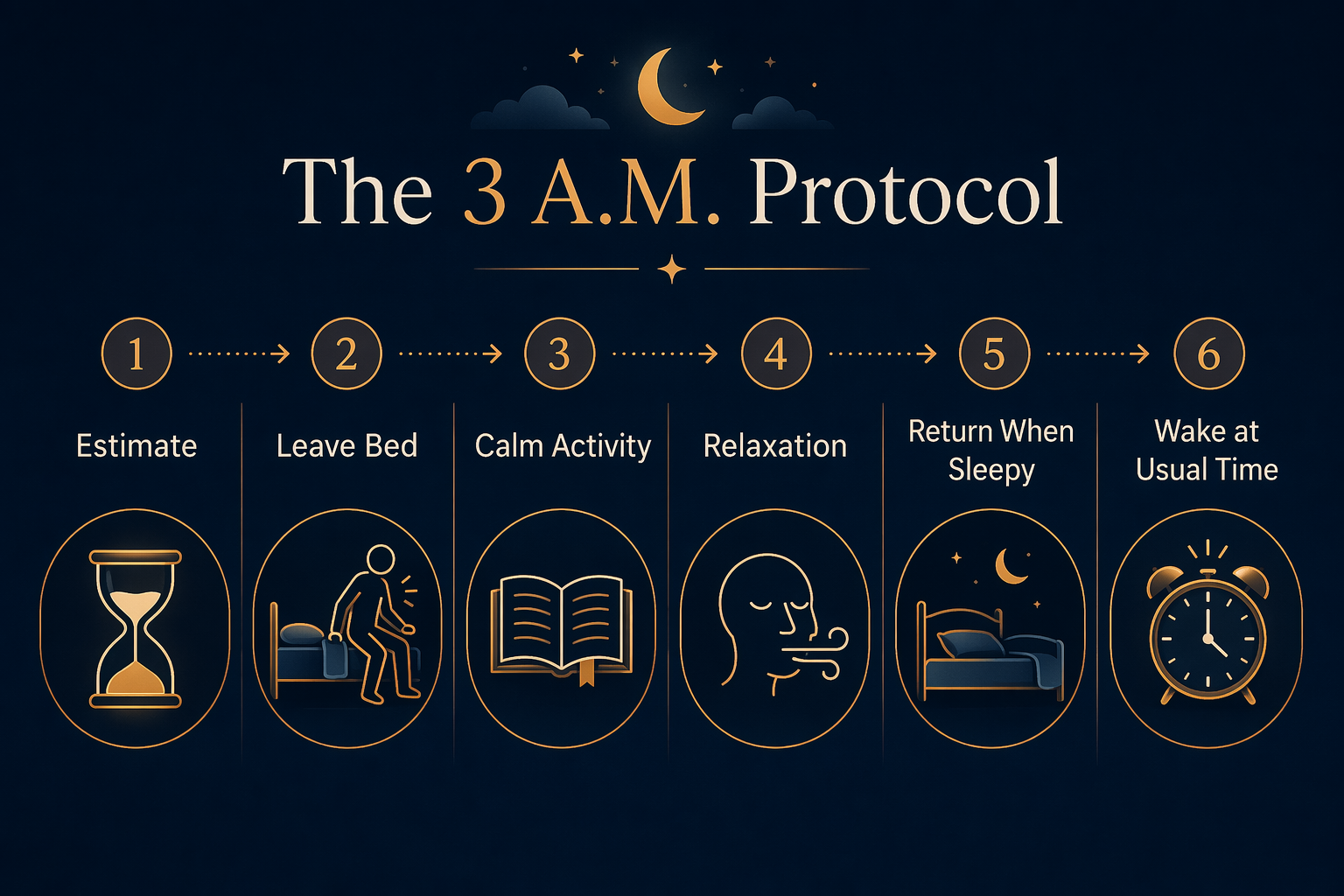
The 3 a.m. protocol
| Moment | What to do |
|---|---|
| You notice you are awake | Do not check the clock. Settle briefly and give sleep a loose chance to return. |
| You are still awake after a short window | Get out of bed. If you are wondering whether it has been long enough, it has. |
| You are out of bed | Use dim warm light and choose a calm activity: a physical book, quiet audio, or simple imagery. |
| Your body feels keyed up | Use one relaxation technique, such as progressive muscle relaxation, 4-7-8 breathing, box breathing, or a body scan. |
| Sleepiness returns | Go back to bed without checking the time. |
| Morning arrives | Wake at your usual time. Avoid sleeping in, long naps, and a very early bedtime. |
References
- Insomnia: How do I stay asleep?, Mayo Clinic
- Up in the Middle of the Night? How to Get Back to Sleep, Johns Hopkins Medicine
- Awake at 3 am? Strategies to help you to get back to sleep, Harvard Health Publishing
- How to Fall Back Asleep, Sleep Foundation


Comments
Join the discussion with an anonymous comment.