
Sciatica has a particularly unfair habit: the day finally gets quiet, you lie down expecting your back and leg to settle, and the pain sharpens. It may run from the low back into the buttock, down the back or side of the leg, or into the calf or foot. You shift to your side. Then your back. Then you put a pillow somewhere because every article about sciatic nerve pain sleeping positions seems to start there. At 2 AM, that advice can feel less like help and more like a shrug.
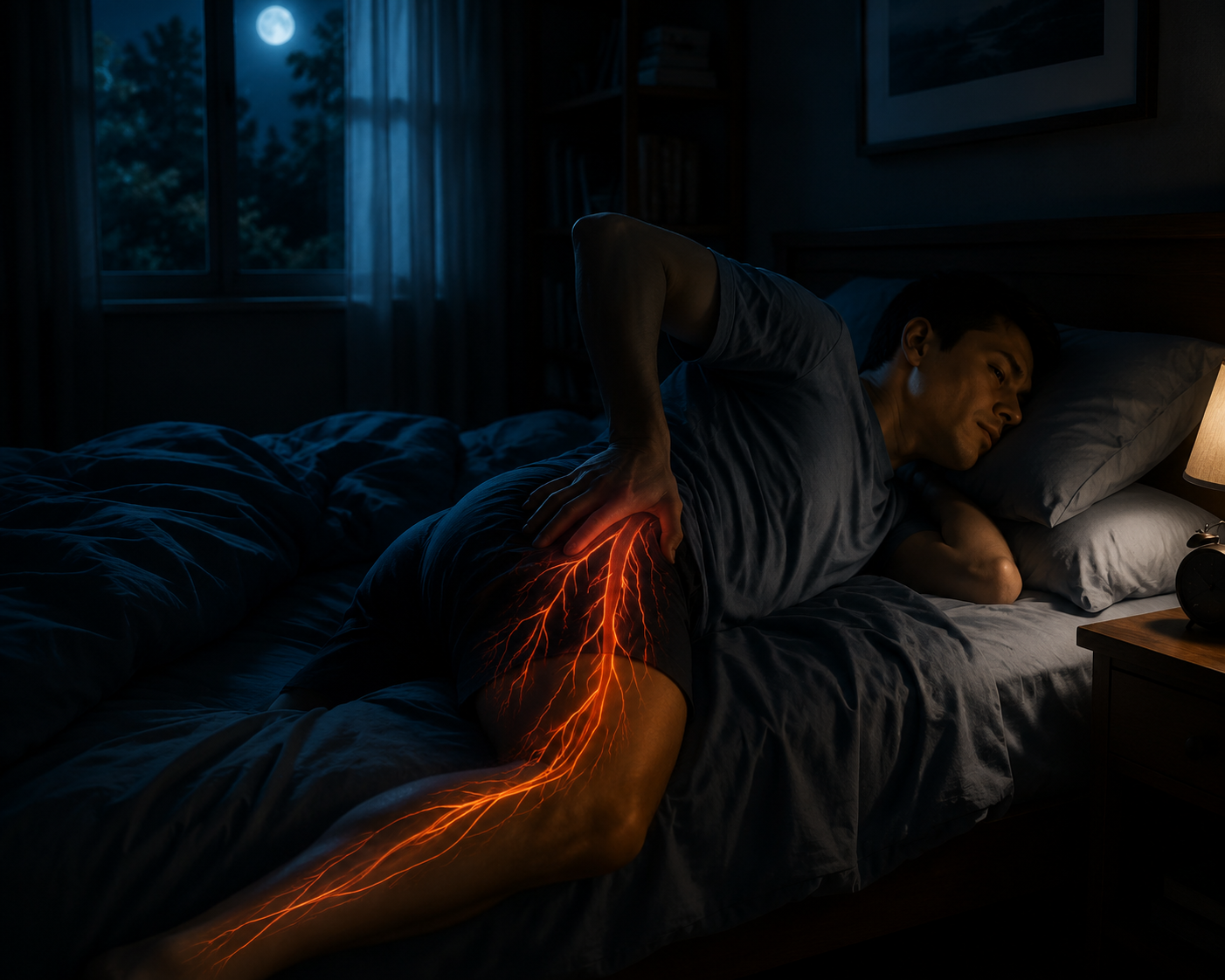
The frustrating part is that lying down is supposed to unload the spine. Sometimes it does. But nighttime also changes the pain environment. Cortisol, one of the body’s built-in anti-inflammatory signals, drops overnight and reaches its lowest levels between midnight and 4 AM; lying down allows spinal discs to rehydrate and expand; and tissues that stay still for hours can become tighter, cooler, and more chemically irritated around an already sensitized nerve pathway.[1][2]
So no, worsening pain at night does not mean your body is inventing symptoms. Sleep disruption is common in people with sciatica: Doctronic reports that about 55% to 65% of chronic sciatica patients experience significant sleep disturbance, and HSSH Health cites one study of 466 patients in which 77% reported disturbed sleep.[1][3] Those numbers should not be stretched into a universal rule, but they are enough to validate the pattern many people recognize immediately.
Why the Pain Can Get Louder After You Lie Still
Sciatica is not a single injury. It is a symptom pattern caused by irritation or compression somewhere along the sciatic nerve pathway, often involving nerve roots in the lower spine. That distinction matters because a sleep position that helps one person can annoy another person’s exact source of compression.
Still, nighttime flare-ups often make more sense when you look at three overlapping mechanisms. They do not diagnose the cause of your sciatica by themselves, but they do explain why a position list without a reason behind it is usually too thin.
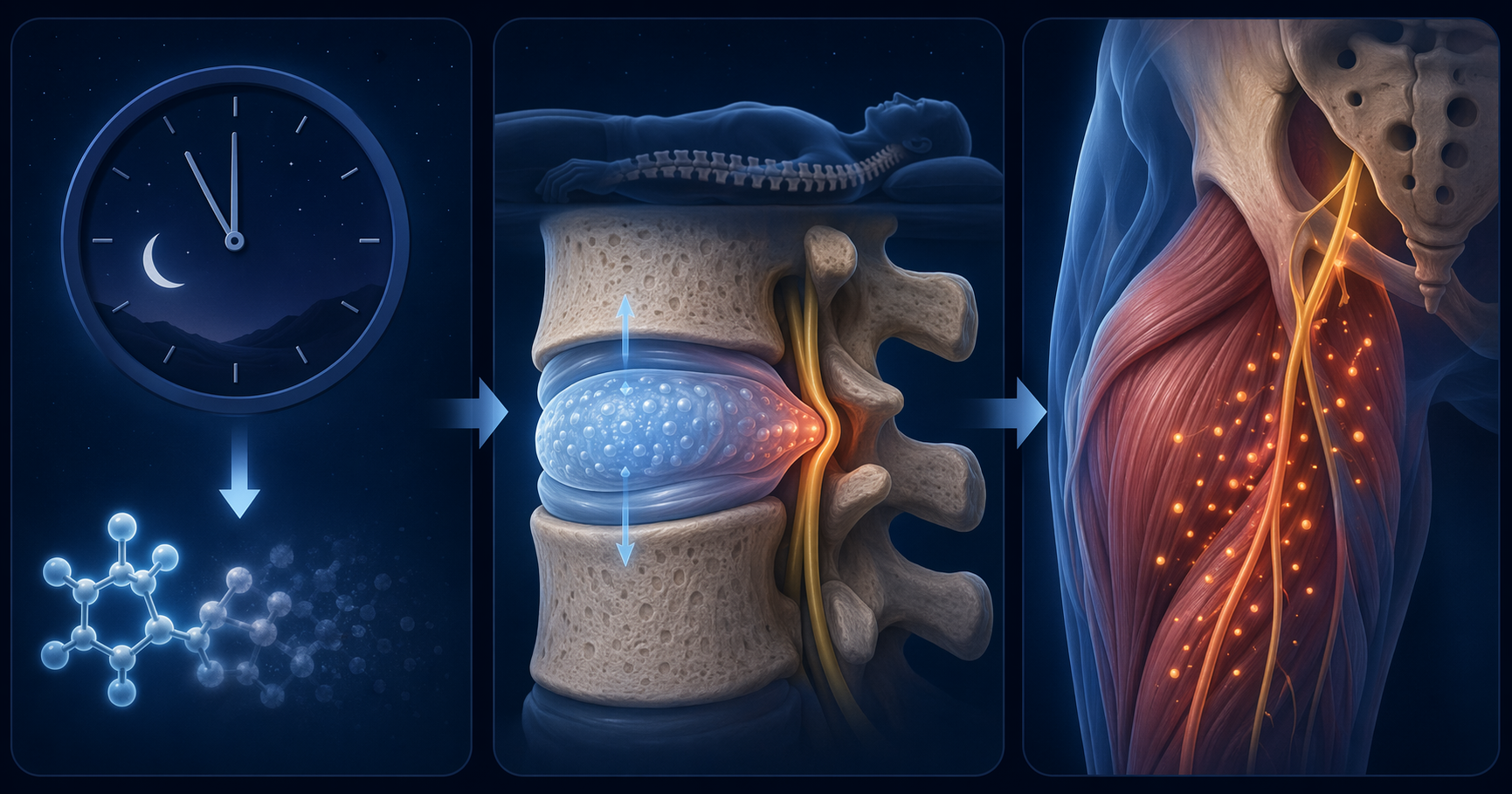
1. Cortisol Drops, So Inflammation Has Less Resistance
Cortisol is often discussed as a “stress hormone,” but it also helps regulate inflammation. Overnight, cortisol normally declines, with the lowest point between midnight and 4 AM.[1] If a nerve root or nearby tissue is already irritated, that drop can remove some of the body’s usual anti-inflammatory buffering right when you are trying to sleep.
This does not mean cortisol is the only reason sciatica wakes you. It means timing matters. If your pain consistently intensifies in the middle of the night after you initially fall asleep, an inflammation-sensitive pattern may be part of the story.
The sleep strategy that follows is not to hunt for the one magic posture. It is to reduce irritation before the low-cortisol window arrives. That can mean a calmer pre-bed routine, avoiding the position or activity that reliably provokes symptoms late in the evening, using clinician-approved anti-inflammatory measures when appropriate, and applying warmth before bed if tight buttock or hip muscles seem to be part of the flare.
2. Discs Rehydrate When You Are Horizontal
Intervertebral discs lose fluid under daytime loading and rehydrate when you are lying down. StatPearls describes this recumbent rehydration and expansion as an increase in intradiscal volume.[2] For a healthy, roomy spinal segment, that is ordinary physiology. For an already crowded nerve root near a bulging or herniated disc, a small volume change can matter.
This is where sleeping position becomes useful, but only if it is tied to the likely mechanical problem. If your symptoms feel worse when your low back arches, a slightly flexed position may reduce irritation. If curling tightly increases symptoms, too much spinal flexion may be the wrong direction. The point is not that side sleeping is always superior; it is that the position should reduce nerve-root crowding rather than simply look comfortable in a diagram.
| Night Pattern You Notice | Possible Mechanism | Position Experiment to Try |
|---|---|---|
| Pain worsens after lying flat with the low back arched | Extension may be increasing irritation around the nerve root | Try back sleeping with knees elevated or side sleeping with knees slightly bent |
| Pain worsens when curled tightly on the side | Too much spinal flexion may be aggravating symptoms | Try a less curled side position or a supported back position |
| Pain is worse on one side when the top leg drops forward | Pelvic rotation may be adding tension through the low back or hip | Try a pillow between the knees to keep the pelvis more level |
| Pain eases when the hips and knees are gently supported | Reduced nerve-root or hip tension may be helping | Keep that support consistent for several nights before changing again |
A pillow between the knees, a pillow under both knees while lying on the back, or a modest adjustment away from the painful side can all be reasonable tests. They are not treatments for every kind of sciatica. They are ways to change spinal and pelvic loading long enough to see whether your nerve calms down.
3. Still Tissues Can Cool, Tighten, and Accumulate Irritants
During the day, even small movements help circulate fluid, change pressure, and interrupt local irritation. At night, the same tissues may stay in one position for hours. Doctronic describes how prolonged stillness can allow inflammatory mediators to accumulate locally, while cooling muscles may tighten structures such as the hip flexors and piriformis.[1]
That matters because the sciatic nerve pathway passes through a neighborhood of muscles and connective tissues, not through empty space. If the buttock and hip area becomes tighter overnight, an already irritated nerve may have less tolerance for compression or stretch.
Heat is a practical tool here. Cleveland Clinic recommends using heat on the lower back or buttocks for about 20 minutes before bed to relax tight structures and prepare for sleep.[4] This is not the same as falling asleep on a heating pad, which can carry burn risk. It is a pre-bed intervention: warm the area, move gently, then settle into the position that least provokes symptoms.
How to Choose a Sleep Strategy Without Guessing Blindly
The useful question is not “What is the best sleeping position for sciatica?” It is “Which nighttime mechanism does my body seem to respond to?” You do not need to diagnose a disc herniation, piriformis involvement, or inflammatory driver from bed. You are looking for a repeatable response pattern.
- If pain reliably peaks between midnight and early morning, treat inflammation timing seriously: reduce late-evening provocation, use warmth before bed if it helps, and keep the wind-down routine boring and consistent.
- If pain changes quickly with spinal angle, prioritize mechanical positioning: experiment with knee elevation, side sleeping with pelvic support, or avoiding the exact bend or arch that lights up the leg.
- If pain builds after staying still, add a brief reset before sleep: gentle walking around the room, easy hip motion, or a short heat session before getting into bed.
- If pain is mainly noticeable once the room is quiet, acknowledge the nervous system effect without dismissing the pain: fewer distractions can make real nerve signals feel more prominent at night.[1]
That last point is easy to mishandle. Pain becoming more noticeable in quiet does not mean it is imaginary. It means attention, threat level, inflammation, and tissue mechanics are all arriving in the same dark room.
A Practical Several-Night Test
Changing five things at once makes it almost impossible to know what helped. For several nights, pick one main hypothesis and test it cleanly.
- Write down your usual pattern: time pain starts, position you were in, where the pain travels, and what movement or position changes it.
- Choose one mechanism to target first: inflammation timing, disc-pressure positioning, or stillness and muscle tightness.
- Make one sleep change at a time: heat before bed, knee support, side-position support, or a short gentle movement reset before lying down.
- Track whether the change affects sleep onset, middle-of-the-night waking, leg pain intensity, or morning symptoms.
- Keep what clearly helps, stop what clearly worsens symptoms, and avoid forcing a position because it is supposed to be “best.”
For example, if back sleeping with knees elevated reduces leg pain within minutes, that suggests your nerve may prefer less extension or less tension in that position. If heat plus gentle movement before bed helps you stay asleep longer but pillows do very little, stillness and muscle tightening may be a bigger contributor than spinal angle. These are observations, not formal diagnoses.
When Nighttime Sciatica Should Not Be Self-Managed
Most nighttime sciatica does not require emergency care, but some symptoms change the situation. Seek urgent medical evaluation if you have new bowel or bladder changes, numbness in the saddle area, weakness in both legs, or rapidly worsening neurologic symptoms. Those signs can point to serious nerve compression and should not be handled with pillows, heat, or position experiments.
For non-emergency symptoms, the better goal is not to find a universal perfect position. It is to understand why your pain gets worse at night, then choose the smallest experiment that fits the likely mechanism. Sciatica has different causes, and individual responses vary. But once the night pattern makes mechanical and physiological sense, the advice becomes less vague: calm irritation before the low-cortisol window, reduce nerve-root crowding where position can change it, and keep still, cooling tissues from becoming another source of pressure.
References
- Why Sciatica Is Worse at Night, Doctronic
- Intervertebral Disc, StatPearls, NIH/NCBI
- 8 Useful Tips to Help You Sleep Better With Sciatica, HSSH Health
- How To Get Better Sleep With Sciatica Pain, Cleveland Clinic

Comments
Join the discussion with an anonymous comment.