
If you cannot sleep after an earthquake, your body may be doing exactly what it was built to do: staying alert for danger. That does not make the night easier. It does mean the goal for tonight is smaller and kinder than “sleep normally.” The goal is to lower the alarm enough that your body can rest.
Sleep disruption after earthquakes is common enough that it should not be treated as a private failure. In a small SLEEP 2019 conference abstract of 165 Haiti earthquake survivors, 94% reported insomnia symptoms; because it was a conference abstract and a limited sample, that number should not be stretched into a universal estimate, but it is still a useful reminder that this reaction is not rare.[1] A later Türkiye earthquake study of 428 participants reported a mean Pittsburgh Sleep Quality Index score of 11.10, a level consistent with poor sleep quality, though the study was cross-sectional and did not have a pre-earthquake sleep baseline.[2]
For a deeper look at why earthquake anxiety can keep the brain scanning for danger, see Earthquake Anxiety Keeping You Awake? How to Finally Sleep. Here, stay with the next few hours: make the room feel safer, stop feeding the threat system, downshift the body, and know what to do if the bed starts feeling like a place where you wait for the next shock.
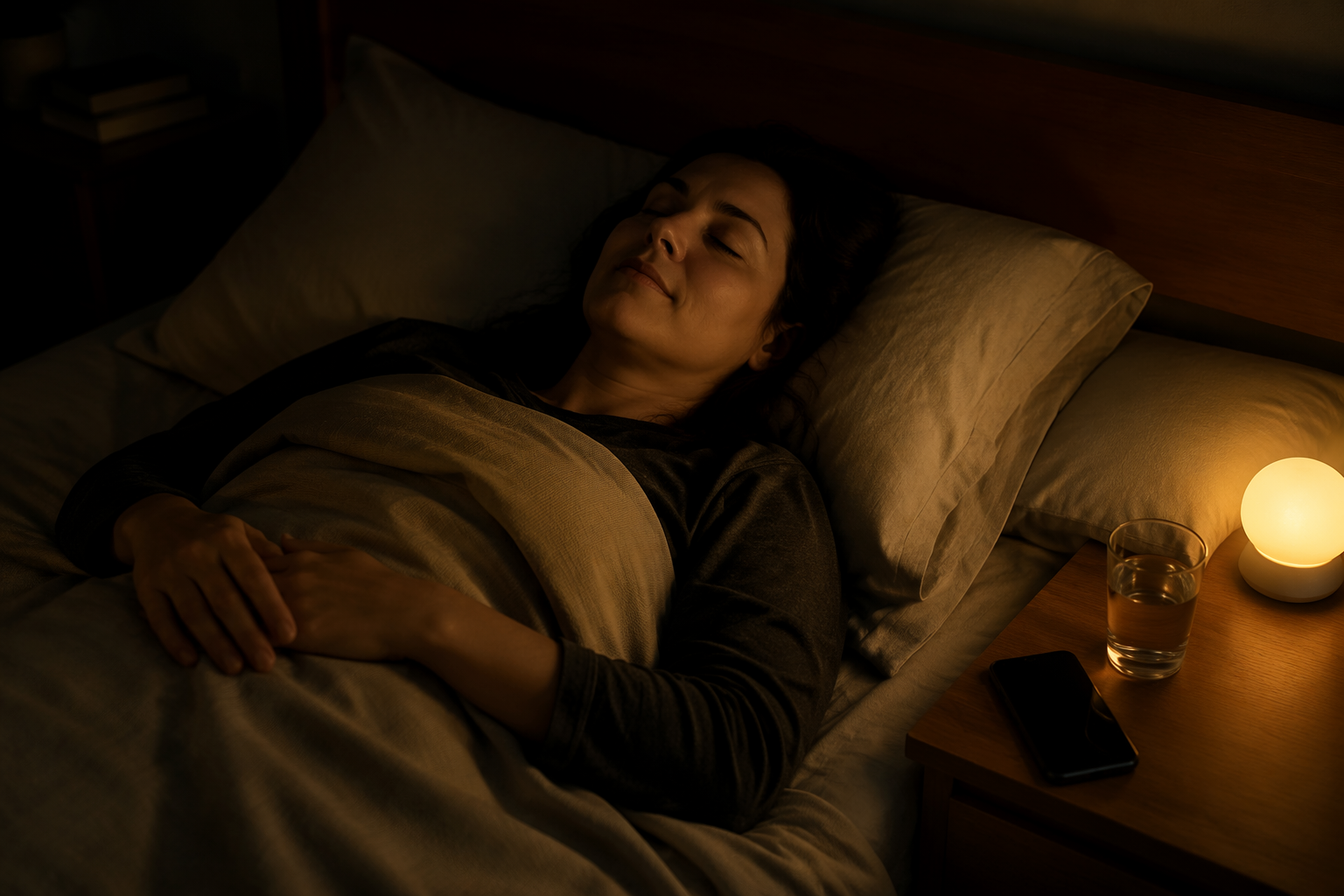
First, Make the Room Tell Your Body “Safer”
After an earthquake, darkness, silence, distance from other people, or the feeling of being trapped under heavy covers can become threat cues. You do not have to win an argument with those cues tonight. Change them.
- Use a nightlight, hallway light, or low lamp if total darkness makes you listen harder.
- Keep your phone, shoes, glasses, medications, and water within easy reach so your body is not rehearsing an escape plan.
- Sleep near a family member, roommate, or pet if proximity helps you feel oriented.
- Choose bedding that feels grounding but not trapping; if a heavy blanket feels restrictive tonight, use something lighter.
- If safe to do so, leave the bedroom door partly open or choose a room where you feel less boxed in.
These are not childish habits. Trauma and sleep resources describe safety, fear, and sleep as closely linked; when the body does not feel safe, sleep can stay shallow or broken.[3] Trauma-informed bedtime recommendations often use sensory cues—light, scent, texture, sound, and proximity—to help the nervous system register that the immediate danger has passed.[4]
Stop Adding New Alarm Signals
Your brain may ask for updates because updates feel like control. At bedtime, they usually become fuel. If you are in an official aftershock or emergency zone, check the necessary safety information once from a reliable source, make the practical adjustment you need, and then stop refreshing.
For the next 30 to 60 minutes, give the threat system fewer inputs: dim the lights, put news and social media away, lower the volume in the room, and move through the same few quiet actions in the same order. A warm bath or shower, a familiar lotion or lavender scent, soft clothing, white noise, or a brief tidy of the nightstand can be enough structure; trauma-therapist sleep routines often recommend these sensory wind-down cues, including lavender, weighted blankets, and white noise, as calming supports rather than cures.[4][5]
Do not make the ritual elaborate. A shaken person does not need a perfect routine. You need a repeatable signal: the emergency-checking part of the night is over for now.
Use the 5-In, 7-Out Breath
Paced breathing is useful after an earthquake because it gives the body a job that is incompatible with sprinting, bracing, and scanning. Dr. Gail Saltz recommended a simple version for earthquake anxiety: inhale for 5 counts and exhale for 7 counts, using the longer exhale to help activate the parasympathetic nervous system.[6]

Try it this way:
- Put one hand on your chest or belly, not to judge the breath, just to give your attention somewhere to land.
- Inhale through your nose, or through your mouth if that is easier, for a slow count of 5.
- Exhale for a slow count of 7, letting the last two counts be soft rather than forced.
- Repeat for 10 rounds. If counting makes you tense, count only the exhale.
- If you feel lightheaded, return to normal breathing and simply lengthen the next few exhales without counting.
The important part is not taking the biggest possible breath. Big breaths can make some anxious bodies feel more activated. Aim for quiet, low-effort breaths with a slightly longer way out than in.
Then Release the Muscles That Are Still Bracing
After a quake, the body can keep preparing for impact long after the shaking stops: jaw tight, shoulders up, hands clenched, legs ready to move. Progressive muscle relaxation gives that bracing a beginning and an end. CNN’s earthquake-anxiety guidance also points to progressive muscle relaxation as a way to move the body out of heightened arousal.[6]
Use a gentle version tonight. Do not tense any injured area, and do not turn it into a strength exercise.
- Feet: curl your toes lightly for 5 seconds, then release for 10 seconds.
- Legs: press your calves or thighs into the mattress for 5 seconds, then release.
- Hands: make loose fists for 5 seconds, then let the fingers open.
- Shoulders: lift them slightly toward your ears, then let them drop.
- Face: squeeze your eyes and jaw gently, then unclench the jaw and let the tongue rest.
- Whole body: take one 5-in, 7-out breath and notice any place that wants a second release.
If your mind keeps returning to aftershocks, do not argue with it. Say something plain—“I am noticing the fear again”—and go back to the next muscle group or the next exhale. The point is not to prove that nothing else can happen. The point is to give your nervous system repeated evidence that, in this moment, you are lying down and not running.
If Bed Becomes the Place Where You Monitor for Danger
There is a difficult moment in post-earthquake insomnia when staying in bed starts to train the bed as a danger station. You are under the covers, but your brain is working: listening, calculating, replaying, checking the phone, waiting. Stimulus control is meant to interrupt that pairing.
AASM’s Sleep Education guidance for sleeping after trauma recommends getting out of bed if you cannot sleep after about 20 minutes and returning when sleepy, so the bed remains associated with sleep rather than wakeful distress.[7] PTSD.va.gov gives similar guidance for sleep problems in PTSD: if you cannot sleep, get out of bed, do something quiet and relaxing, and return when sleepy.[8]
That advice can sound harsh after an earthquake, especially if the hallway feels unsafe. Adapt it without abandoning the reason behind it.
| If this is happening | Do this instead of forcing sleep |
|---|---|
| You have been awake roughly 20 minutes and feel more alert, not sleepier | Sit up in bed or move to a nearby chair with low light; keep the activity boring and quiet |
| Leaving the room feels unsafe | Stay in the same room but change posture, uncover slightly, or sit against the wall so bed no longer means “lie still and panic” |
| You keep checking for news | Put the phone face down after one safety check; use it only for emergency alerts or a calming audio track |
| Your body starts to feel drowsy again | Lie back down and return to the 5-in, 7-out breath rather than restarting the news loop |
The quiet activity should not be interesting enough to reward wakefulness. Fold a blanket, read a familiar page, listen to a calm audio track, or hold a warm mug of non-caffeinated tea. Keep the light low. Do not stand in the kitchen scrolling footage of damage and call that stimulus control; that is just changing locations for the alarm.
Avoid the Shortcuts That Can Make the Night More Broken
Alcohol, marijuana, and over-the-counter sleep aids can look like obvious exits when the body is exhausted and scared. They are not harmless switches. PTSD.va.gov warns that alcohol may help people fall asleep at first but can lead to worse sleep later in the night, and it cautions that using alcohol or drugs to sleep can create longer-term problems.[8]
The same source notes that sleep medications may be used in some cases but should be discussed with a provider, especially because some medications can have side effects or lose effectiveness over time.[8] Tonight is not the time to mix substances, increase doses, or improvise a medical plan because fear is loud.
If you already have prescribed medication, follow the directions you were given. If you are considering something new because of the earthquake, choose the lower-risk tools first: safety cues, reduced input, paced breathing, progressive muscle relaxation, and stimulus control.
When Tonight’s Tools Are Not Enough
Acute sleep disruption after trauma can improve as the body gets more evidence of safety, and AASM’s Sleep Education guidance notes that sleep problems after trauma are common and often improve with time.[7] But “common” should not become “ignore it.” If insomnia, nightmares, panic, avoidance, or daytime impairment continue, it is reasonable to seek professional support.
PTSD.va.gov identifies cognitive behavioral therapy for insomnia, or CBT-I, as an effective treatment for sleep problems, including in people with PTSD.[8] Trauma-focused care may also be appropriate if the earthquake keeps replaying in your body and your days, not only your nights.
For now, keep the plan small enough to use: one safety adjustment, one last necessary information check, 10 rounds of 5-in and 7-out breathing, one gentle muscle-release pass, and a protective version of getting out of bed if the bed turns into a watch post. That is enough work for one frightened night.
References
- Disturbed sleep linked to mental health problems in natural disaster survivors, AASM, 2019
- Sleep and Trauma Effects of the Earthquake, PMC, 2025
- The Role of Trauma in Sleep Problems, Sleep Foundation
- Soothing Bedtime Rituals for Trauma Recovery, Philadelphia EMDR Therapy
- 6 Tips for Better Sleep Routines to Reduce Trauma and Improve Mood, Vancouver EMDR Therapy
- What to do if you have earthquake anxiety, according to an expert, CNN, 2024
- Sleeping after a trauma, AASM / Sleep Education
- Sleep Problems and PTSD, PTSD.va.gov
Comments
Join the discussion with an anonymous comment.