
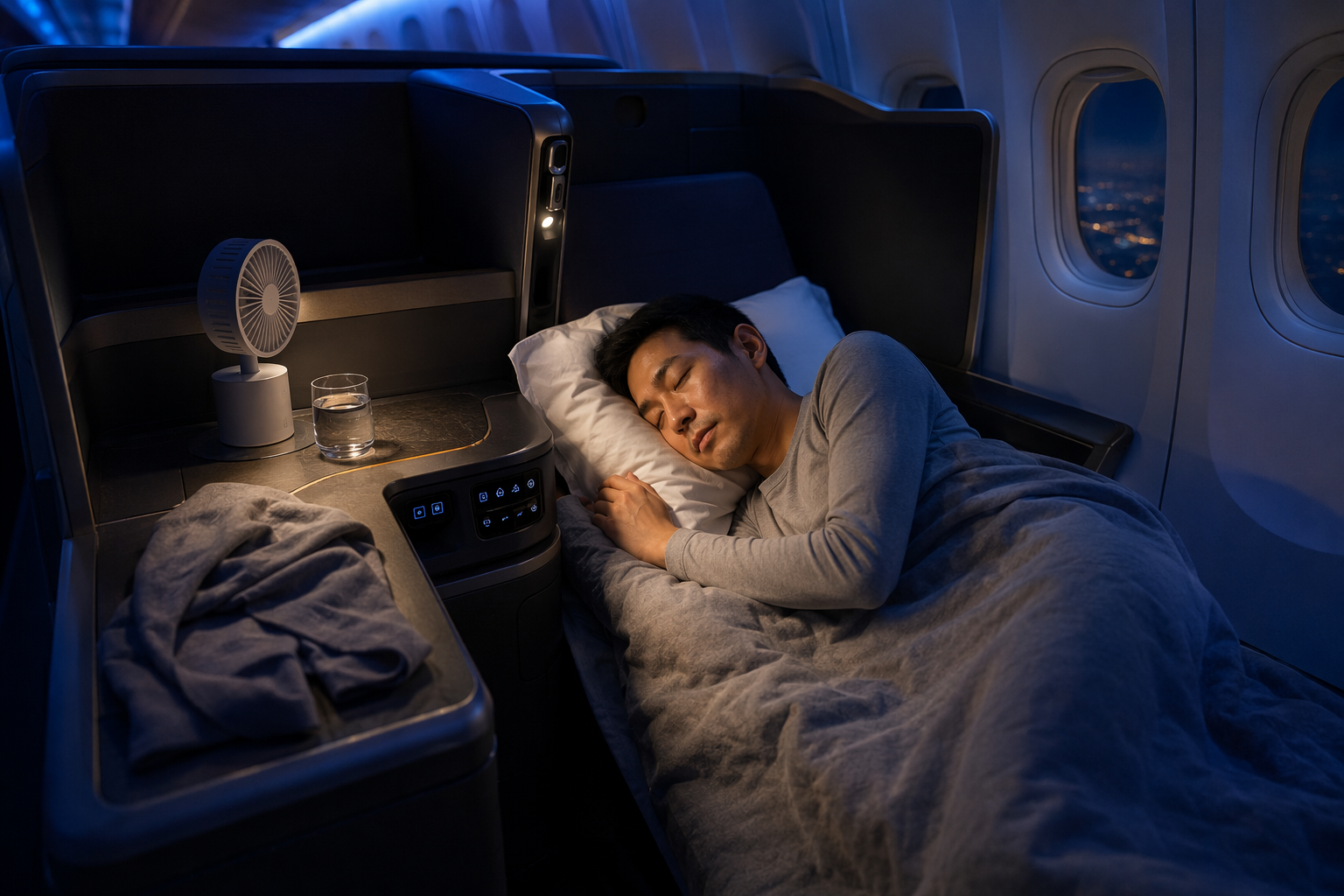
Turkish Airlines business class can be a very good place to sleep, but it is not a cabin where the seat does all the work for you. The lie-flat bed helps. The newer bedding helps. The real question is whether you manage the three things that most often disturb sleep on TK long-haul flights: a cabin that may run warm, a meal service that follows the airline’s schedule rather than yours, and aircraft differences that change both bed space and airflow.
The practical answer is simple enough to act on before boarding: ask early for the mattress pad and turndown if they are available, decide before takeoff whether dinner is worth cutting into your sleep window, dress for a warm cabin with one removable layer, bring your own small cooling tools if you run hot, and use Istanbul Airport’s lounge bedrooms, showers, day rooms, or stopover hotel options when the itinerary makes onboard sleep too short to matter.
Start With The Aircraft, Not The Menu
On Turkish Airlines, the aircraft type matters because it changes the shape of the bed and, just as importantly, whether you can control airflow at your seat. The nicest-looking cabin is not always the easiest one for a warm sleeper or a side-sleeper.
| Aircraft family | What changes for sleep | Best expectation to set |
|---|---|---|
| 777 business class | Older 2-3-2 layout; reported bed length about 78 inches and width about 21-22 inches | More sleeping surface, less privacy, and some seats without direct aisle access |
| 787 / A350 business class | Newer 1-2-1 Stelia Symphony product; Prince of Travel measured the bed at about 76 inches long and 20.1 inches wide | More privacy and direct aisle access, but a narrower bed and footwell that can feel restrictive for side-sleepers |
| A330 business class | Older and more variable product; mixed lie-flat availability is reported across the fleet | Check the specific route and aircraft carefully before assuming the sleep setup |
The 777 is the odd bargain for sleep: less private, less modern, and awkward if you are in a window seat and need to step over someone, but the surface can feel more forgiving once you are flat. The 787 and A350 look more current and give every passenger aisle access, yet multiple reviews describe a narrower bed or footwell, which matters most when your knees naturally bend to the side at night. Published seat-width figures also vary by source, so the conservative expectation is the safer one: assume the 787/A350 bed feels tighter than the cabin photos suggest.[1][2][3]
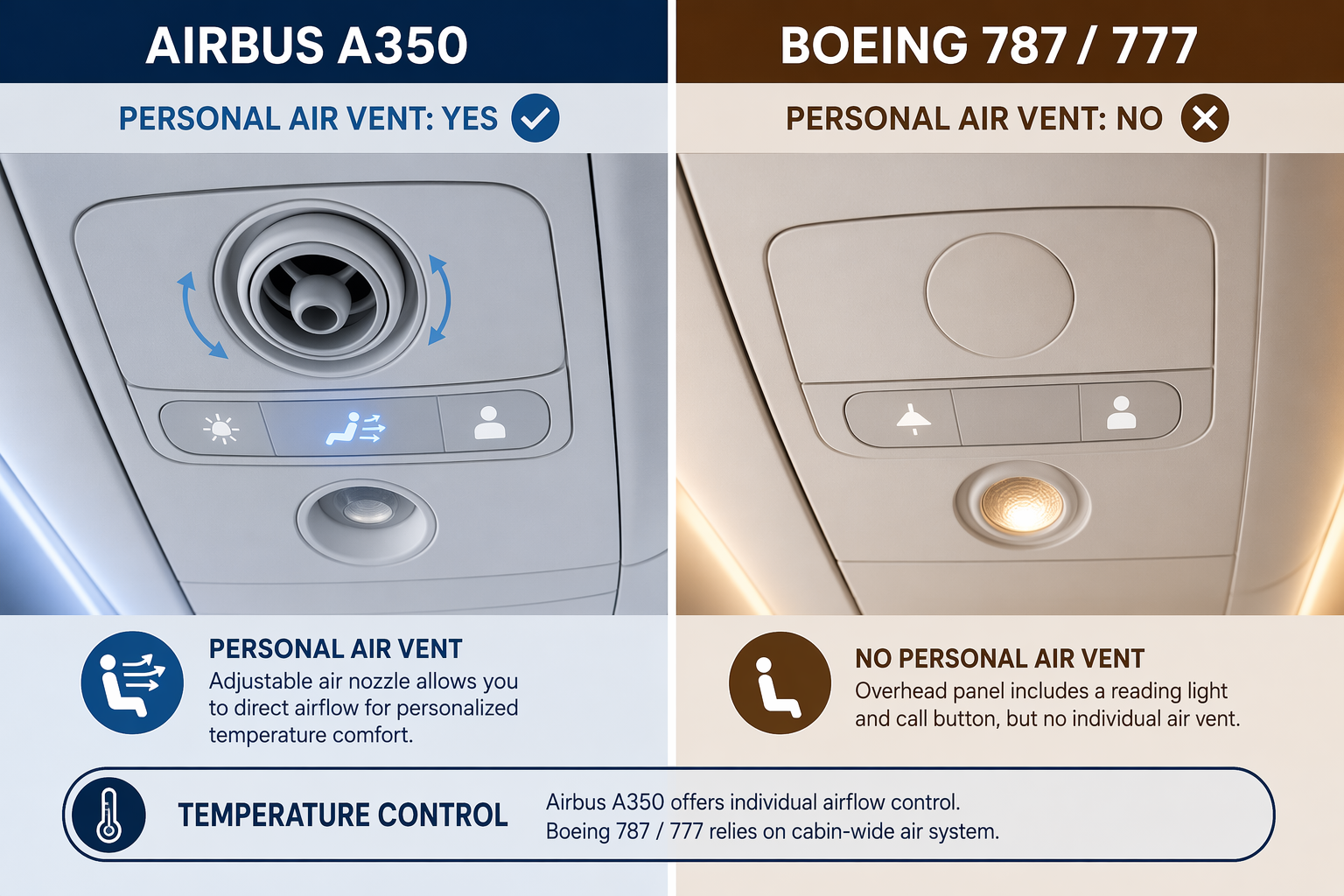
For temperature-sensitive travelers, the A350 has the cleanest advantage: personal air vents at business-class seats. The 787 and 777 generally do not offer the same passenger-controlled airflow, which makes the A350 meaningfully different on a warm overnight sector.[2][4]
Ask For The Bed Before You Need The Bed
Turkish Airlines has improved its long-haul sleeping set with an ergonomic mattress pad, a high-loft pillow, and a velvety blanket. The important detail is not that the bedding exists. It is that the turndown service is request-based, and timing can vary by crew and route.[5][6][7]
Ask soon after boarding or soon after the first service begins: “When you have a moment, could I please have the mattress pad and turndown for sleeping?” That sentence does two useful things. It signals that you intend to sleep, and it gives the crew time to find the bedding before the cabin is dark, trays are out, and everyone else has realized they want the same thing.
If the crew says the mattress pad is not loaded, not offered on the route, or not available yet, do not build the rest of the night around waiting for it. Use the pillow to support the shoulder or hip, put the blanket under you rather than over you if the cabin is warm, and keep your own light layer separate. TK’s bedding can be an asset, but it should not become another delayed service item between you and sleep.
Treat The Warm Cabin As A Planning Problem
The warm-cabin reputation around Turkish Airlines should be handled carefully. Forum reports are not cabin logs, and passengers on the same airline can disagree sharply about whether a flight felt hot, comfortable, or cool. Still, multiple FlyerTalk and Reddit discussions describe TK long-haul cabins around 24°C, or about 75-76°F, with some travelers saying this feels roughly 2°C warmer than what they experience on many other airlines.[4][8]
That temperature range is not a minor preference if you sleep hot. Sleep quality can decline above 75°F, which is why the TK cabin pattern is worth planning around rather than discovering under a heavy blanket at 2 a.m. For a broader explanation of heat and sleep disruption, see our guide to sleeping when it is hot or cold.[9]
The onboard strategy starts with clothing. Wear lightweight sleepwear or a breathable base layer, then add one removable layer for boarding, meal service, and early descent. A sweater that traps heat under the blanket is the wrong tool here. A thin cardigan, zip layer, or scarf that can come off without standing up is better.
A small USB-powered fan is not ridiculous overpacking on Turkish Airlines if you run warm. It gives you local airflow when the cabin has no individual vent, and it can be more useful than another amenity-kit item you will never touch. The same goes for a backup eye mask, earplugs or noise-cancelling headphones, and a light layer you can add if the cabin cools closer to arrival.[8]
- On the A350: open the personal air vent early, before you are settled under bedding.
- On the 787 or 777: assume you may not have a direct vent and pack for self-managed cooling.
- If the cabin feels hot before sleep: ask the crew politely whether the temperature can be lowered.
- If nothing changes: remove insulating layers first, then use the blanket only where you need pressure or comfort.
- If you wake up sweating: do not wait and hope it passes; reset the bed, drink water, and reduce bedding immediately.
Crew can sometimes adjust cabin temperature, and it is worth asking before you improvise. The request is more likely to land well if it is specific and calm: “The cabin feels quite warm for sleeping; is it possible to make it a little cooler?” What you should not assume is full personal control. On aircraft without vents, you may be sharing one temperature decision with an entire cabin, a working galley, and crew procedures you cannot see.
The Dinner Decision Is Really A Sleep Decision
Turkish Airlines is generous with food, and that is part of the pleasure of flying it. The problem is that TK business class generally does not work as a true dine-on-demand product. Meal service follows a fixed schedule, so passengers who want real sleep have to decide whether the full dinner is worth the lost first sleep cycle.[6][7][10]
This matters most on overnight flights leaving in the evening. If you board already tired and then spend the first part of the flight eating multiple courses, waiting for clearing, changing clothes, arranging bedding, and cooling yourself down, the lie-flat bed may only become useful after your body has moved past its easiest sleep window.
There are four workable approaches. None is morally superior. The right one depends on flight length, departure time, how hungry you are, and whether you can sleep after a large meal.
| Meal choice | Best for | Sleep tradeoff |
|---|---|---|
| Full service | Long flights where the meal is part of the trip and you still have a large sleep window | You may lose the earliest and easiest part of the night |
| Expedited service | Travelers who want a real meal but need the cabin time back | You must ask early and accept a less leisurely pace |
| Skip courses | Passengers who want something light before sleeping | You avoid the longest part of service but still need tray clearing |
| Decline dinner and sleep | Shorter red-eyes, late departures, or anyone who ate in the lounge | You miss TK’s strongest soft-product feature, but protect the sleep window |
If sleeping is the priority, tell the crew before the service rhythm is set. “I’d like to sleep as soon as possible. Could I have a quicker meal service?” is more useful than silently hoping the courses arrive quickly. If you plan to skip dinner, say that clearly and ask whether breakfast or a pre-arrival meal can still be offered later.
The worst option is indecision. Nibbling through the full service while telling yourself you will sleep soon often creates the least satisfying result: not enough dinner to feel like an experience, not enough darkness to sleep deeply, and a bed that is finally ready when the cabin is already preparing for the next service.
Make The Seat Work For Your Sleeping Position
Back-sleepers usually have the easiest time in TK business class because the seat’s length matters more than the footwell shape. Side-sleepers need to be more deliberate, especially on the 787 and A350, where the bed may feel narrow around the hips, knees, or feet. The fix is not elegant, but it is effective: use the pillow and blanket to create support rather than treating them only as hotel-style bedding.
- For side-sleeping: place the pillow partly under the upper shoulder or between the knees if the footwell permits.
- For hip pressure: use the blanket as a thin pad beneath you if the cabin is too warm to use it on top.
- For footwell tightness: test your sleeping position before committing to the full setup, while the lights are still on.
- For aisle disturbance: choose privacy and direct aisle access on the 787/A350, or choose width on the 777 if that matters more.
Do the awkward testing early. Put the seat flat, check where your knees go, check whether your feet can turn, and decide whether the pillow belongs under your head or somewhere more useful. This is the point at which many travelers discover that “lie-flat” describes the mechanism, not the quality of the sleep surface.
Use Istanbul As A Backup Sleep Plan
Istanbul Airport can rescue an itinerary when the onboard sleep window is too short, too warm, or too interrupted. Turkish Airlines’ business lounge at IST has private bedroom suites that are available through the concierge desk on a first-come, first-served basis for eligible passengers with layovers in the 4-9 hour range. The same lounge also offers showers and quieter rest areas.[11][12]
The bedrooms are not something to count on as if they were a confirmed hotel booking. They cannot be treated as guaranteed recovery. But if you land in Istanbul with a long enough connection, go to the concierge desk early rather than wandering the lounge, eating again, and checking later when the rooms are gone.
For longer connections, paid day rooms may be available, and Turkish Airlines’ stopover program can provide up to 2 free hotel nights for eligible business-class passengers on certain international itineraries.[12][13]
This is not a luxury add-on if your next sector matters. A shower, a dark room, and ninety quiet minutes can be more valuable than another plated meal after a warm overnight flight. If the itinerary gives you a real ground-sleep option, use it deliberately.
A Realistic TK Sleep Plan
Before the flight, check the aircraft type and decide what problem you are solving. On the A350, use the vent. On the 787 or 777, assume less personal airflow. On the 777, decide whether the wider bed is worth the open cabin and possible aisle-access compromise. On the A330, verify the specific aircraft as much as your booking tools allow.
At boarding, separate your sleep items before the overhead bins close: light sleep layer, eye mask, earplugs or headphones, water, charging cable, and fan if you brought one. Ask early for the mattress pad and turndown if you intend to sleep soon. If you wait until the cabin is dark, you have made the crew’s timing problem your sleep problem.
During meal service, choose one path and make it clear. Eat fully because the flight is long enough. Ask for expedited service because you want both dinner and rest. Skip courses because a light meal is enough. Or decline dinner because sleep is the reason you booked business class. The fixed schedule is manageable only when you stop pretending it is flexible.
When you go flat, build the bed around temperature first. In a warm cabin, the blanket may belong under your body more than over it. In an A350, open the vent. In a 787 or 777, aim the fan before you are half-asleep. Ask the crew about the cabin temperature while there is still time for a useful adjustment.
If you want broader long-haul habits beyond Turkish Airlines, see our general long-haul flight sleep guide and our evidence-ranked guide to sleep strategies that hold up best. For the underlying idea behind this kind of planning, our explanation of what sleep hygiene actually means is the better place to go next.
Turkish Airlines business class can be a strong sleep product, especially when the bedding is loaded, the crew is responsive, and the schedule leaves enough uninterrupted time. It is just not a passive one. The passengers who sleep best are usually the ones who decide early what they are protecting: temperature, time, or space.
References
- Turkish Airlines 777 Business Class Review, Prince of Travel
- Turkish Airlines 787 and A350 Business Class Comparison Review, PaxEx Aero
- Turkish Airlines Business Class Guide and U.S. Route Fleet Guide, Upgraded Points
- HOT TK Cabins, FlyerTalk
- Turkish Airlines Introduces New Sleeping Set on Long-Haul Flights, Turkish Airlines
- Turkish Airlines Business Class Review, Flight Odyssey
- Turkish Airlines Business Class Review, BusinessClass.com
- r/awardtravel Turkish Airlines Cabin Temperature and Sleep Discussions, Reddit
- How to Sleep During a Power Outage, Whether It's Hot or Cold, Sleep site article
- Turkish Airlines Business Class Review, Going
- Turkish Airlines Business Lounge Istanbul Review, Wander Upfront
- Turkish Airlines Lounge and Istanbul Connection Review, Going
- Stopover Program, Turkish Airlines





Comments
Join the discussion with an anonymous comment.