
A daytime flood plan quietly assumes you are already awake. You can see water pooling, read a warning clearly, find your shoes, collect a pet, decide which road is still open, and leave before the lowest exit is cut off. An emergency preparedness plan for sleep during flash flooding has to start from a less flattering picture: your phone may be silenced, your glasses may be across the room, your go-bag may be by the front door you can no longer reach, and the first useful sound may be an alert tone, not water.
That difference matters because flash flooding does not have to begin with rain falling on your roof. The National Weather Service warns that flooding can develop from heavy rain many miles upstream and specifically says to be especially cautious at night because flood dangers are harder to recognize then.[1] At 2:13 a.m., “pay attention” is not a plan. The plan has to be arranged before sleep takes away most of your attention.
Build the Bedside System Before Flood Season
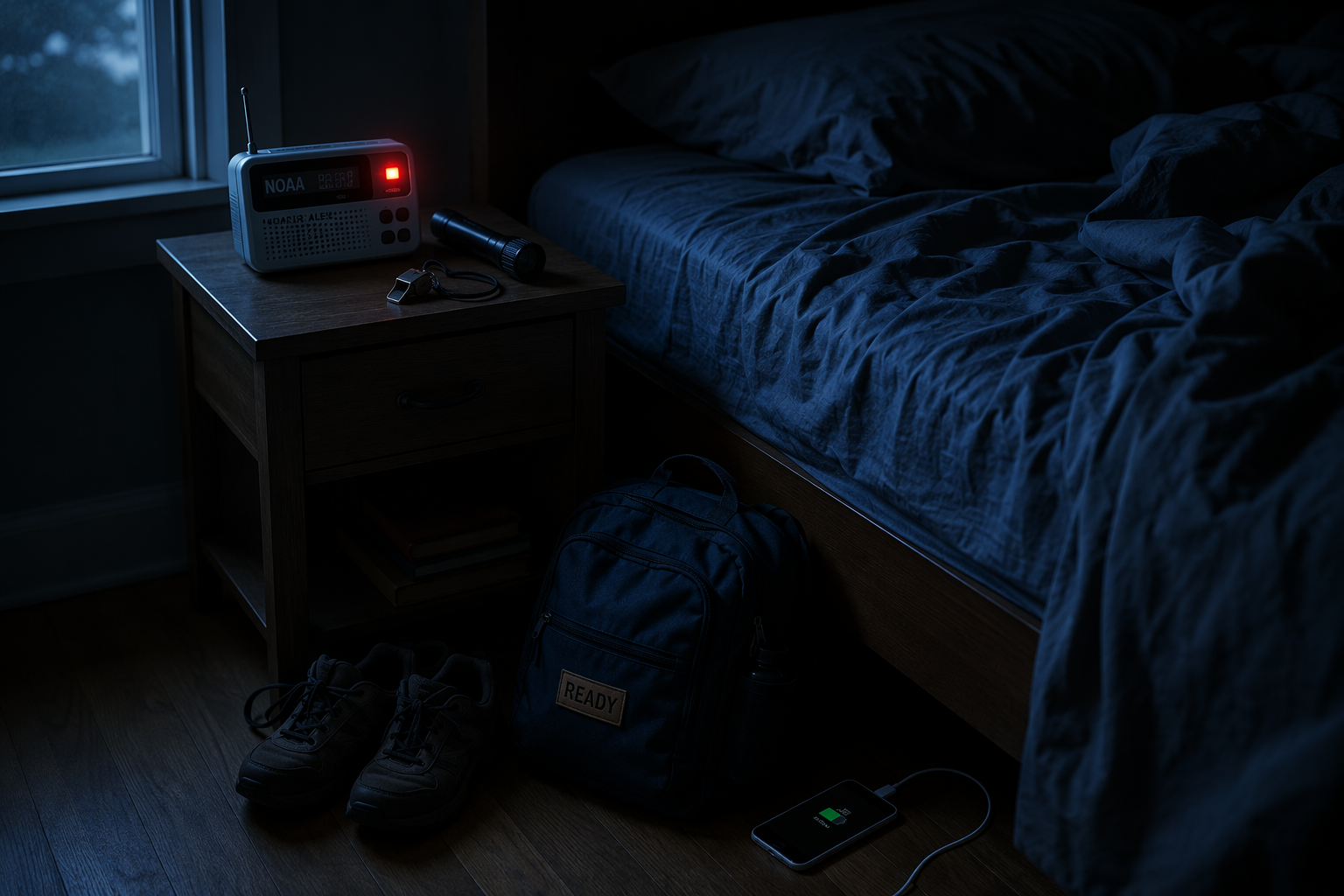
The safest place for your nighttime flood kit is not wherever emergency supplies look neat during the day. It is within reach from the bed, in the dark, while you are half-awake. FEMA specifically recommends keeping a go-bag in the bedroom with items such as a flashlight, whistle, shoes, and phone charger.[2] The Centers for Disease Control and Prevention also includes a battery-operated radio, flashlight, extra batteries, first-aid supplies, medications, important documents, and other essentials in flood preparedness guidance, and recommends a NOAA Weather Radio for emergency information.[3]
Treat these as one bedside system, not scattered supplies:
- NOAA Weather Radio with tone alert, powered and tested, close enough to wake you.
- Phone on the charger, with Wireless Emergency Alerts enabled and emergency bypass settings considered for local alert contacts if your device supports them.
- Flashlight where your hand naturally goes, not in a kitchen drawer.
- Whistle for signaling if you are trapped or if shouting will not carry.
- Sturdy shoes or boots beside the bed, because flood debris, broken glass, and wet stairs are not barefoot problems.
- Small bedroom go-bag with medications, copies of key documents in a waterproof container, spare glasses if available, power bank, pet leash or carrier supplies, and any must-have medical device accessories.
The radio and phone are the waking system. The shoes, light, whistle, and bag are the movement system. Both have to live near the bed because the hallway, front closet, or garage may be exactly where you should not spend your first minute searching.
Use Alert Tones, Not the Sound of Water
Do not make hearing rising water part of the plan. That is a daytime instinct smuggled into a nighttime emergency. If you are asleep, a closed door, air conditioner, fan, rain noise, medication, hearing loss, exhaustion, or ordinary deep sleep can erase the signal you are counting on. The National Weather Service’s warning about nighttime flood danger is blunt enough: the hazard is harder to recognize at night.[1]
Redundancy is the point. A Wireless Emergency Alert on a phone is useful, but phones run out of battery, get placed face-down, receive software changes, or sit in Do Not Disturb modes that people do not fully understand. A NOAA Weather Radio with tone alert gives you a separate path into the room. The CDC’s flood guidance includes monitoring local radio, television, or NOAA Weather Radio for emergency information, which is especially relevant when the person who needs the information is asleep.[3]
Before flood season, test the volume. Put the radio where it can wake the deepest sleeper, not where it looks tidy. If more than one adult lives in the home, do not assume the light sleeper will wake everyone else every time. Assign it: one person wakes children, one assists an older adult, one handles pets, one grabs the medical device bag. In a one-person household, write the sequence on a card and tape it near the radio.
The First Minute After Waking
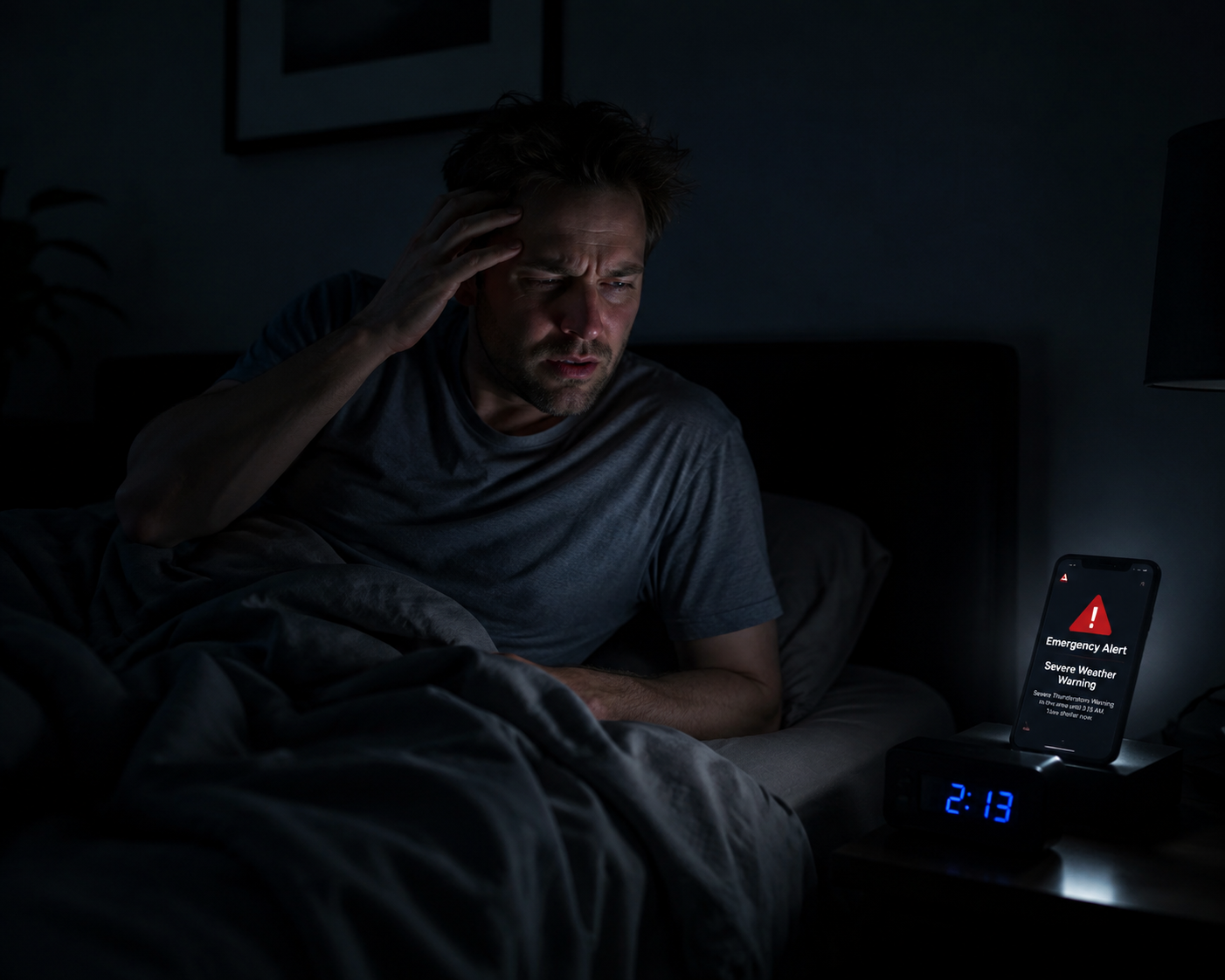
The first minute should not require creativity. Sleep inertia can impair cognitive and motor performance after waking, and that impairment can last up to 30 minutes. That does not mean everyone is useless for half an hour. It means the plan should not depend on a groggy person inventing good judgment in the dark.
Keep the first 60 seconds scripted:
| Time | Action | Decision |
|---|---|---|
| 0-10 seconds | Wake, sit up, turn on flashlight, put on glasses if needed. | Do not walk barefoot into a dark room. |
| 10-25 seconds | Read or listen to the alert: flash flood warning, location, urgency. | Assume water may already be moving nearby. |
| 25-40 seconds | Put on shoes, grab bedside go-bag, wake assigned people or secure pet. | Do not search the house for nonessential items. |
| 40-60 seconds | Check the prechosen exit or route to higher ground. | Leave if the route is safe; move upward if evacuation is already cut off. |
The questions are just as important as the objects. Tape them to the wall if that is what it takes:
- Where am I sleeping tonight: upper floor, ground floor, basement, hotel, campsite, or someone else’s house?
- Is water entering the room, hallway, stairwell, garage, or street?
- Is my planned route to higher ground still clear without wading through moving water?
- Who needs help moving right now?
- If I cannot leave safely, what is the highest safe floor or elevated place with an exit?
This is where the pre-sleep setup earns its place. If shoes are already touching the bed frame, the flashlight is already in hand, and the bag already contains medications and document copies, the first minute can stay focused on movement instead of rummaging.
Choose the Survival Move Before You Need It
For a sleeping household, the route is part of the sleep environment. You should know before bed which door leads away from low ground, which stairwell avoids the garage, which neighbor or public location sits higher, and which road dips under water first. A vague plan to “evacuate if needed” is too slow when the warning arrives after midnight.
If the alert arrives and your route to predetermined higher ground is still clear, leave early. Take the bag, shoes, phone, people, pets, and necessary medical equipment. Do not wait to see whether water reaches the bedroom. Flash flooding can be caused by rain upstream, so local quiet does not prove local safety.[1]
If evacuation is cut off, move to the highest safe floor or elevated interior area that still gives rescuers a way to reach you. Do not enter an attic unless it has a roof exit. An attic can become a trap if water continues rising and there is no way out.
Do not make wading or driving through moving water your backup plan. Ready.gov says six inches of moving water can knock a person down, and one foot of moving water can sweep away a vehicle.[4] Those numbers are not trivia; they are the line between a route and a trap.
Basement Bedrooms Need a Stricter Rule
A basement bedroom changes the calculation. The danger is not only that water may enter the room. It is that stairs, exterior doors, window wells, and narrow exits can become unusable before the rest of the building feels threatened. If you sleep below grade in a flash-flood-prone area, the threshold for leaving must be lower than it is for someone on an upper floor.
During a flash flood watch, heavy rain forecast, or local conditions that make flooding plausible, consider sleeping on a higher floor if one is available. If that is not possible, keep shoes, flashlight, radio, phone, and go-bag within arm’s reach and make the first move upward, not toward storage areas, laundry rooms, or exterior drains. Shelby County emergency guidance also warns never to camp on low ground next to streams, a reminder that sleeping low and near fast-changing water removes too much margin.[5]
Assign Help Before Everyone Is Groggy
The person who needs help moving should not be the person responsible for explaining the plan during the warning. If an older adult, disabled household member, child, or guest needs assistance, assign the helper and the exact task before bed. “I’ll help Mom” is weaker than “I wake Mom, put her walker by the bed, carry the medication pouch, and take the east stairwell.”
Pets need the same lack of sentimentality. The carrier, leash, harness, food pouch, and medication should be near the sleeping area or on the route out, not in a closet behind the flood path. A frightened animal under a bed can consume the entire minute you needed for a safe exit, so practice the pickup or containment routine the same way you practice the route.
CPAP users and anyone relying on powered medical equipment need a power plan that works at night. That can include a charged backup battery, extension arrangement that does not create a trip hazard, and a bag containing the parts needed to relocate quickly. The plan should answer one blunt question: if power fails and a flood warning wakes you, what do you grab without thinking?
The Bedtime Check During Flood Risk
On ordinary nights, the bedside system can sit ready. On nights with forecast heavy rain, a flood watch, saturated ground, or local alerts, the check should be more deliberate and short enough that people will actually do it.
- Radio on, audible, and placed near the bed.
- Phone charging, alerts enabled, volume settings checked.
- Shoes open and facing the right direction.
- Flashlight tested and reachable without standing.
- Go-bag closed, light enough to carry, and not blocking the path.
- Route to higher ground named out loud: door, stairs, street, destination.
If you live with others, the last step is not a motivational speech. It is a role call: who wakes whom, who takes the pet, who carries medical equipment, who checks the exit, and where everyone reunites if separated. Red Cross flood guidance emphasizes listening to emergency officials and being ready to evacuate when told to do so; at night, readiness depends on removing the tiny delays that pile up between bed and the door.[6]
What This Plan Does Not Solve
A bedroom flood plan cannot guarantee that every alert arrives, every road remains open, or every household member wakes quickly. It also does not replace local evacuation orders, building-specific planning, flood insurance decisions, or cleanup safety after the water recedes. Its job is narrower and more urgent: to make the first warning, first light source, first pair of shoes, first bag, and first decision available while the sleeper is still disoriented.
Floods can also disturb sleep long after the immediate danger passes. Post-disaster sleep and mental health research is important, but it does not prove a special nighttime evacuation method. The survival protocol comes first because the first problem is not insomnia. It is getting a sleeping person out of a vulnerable place before water removes the options.
The safest nighttime flash flood plan is not to become more alert in your sleep. It is to move the warning system, gear, route, and decisions as close to the bed as possible before the warning ever arrives.
References
- Severe Weather Preparedness: Floods - National Weather Service - https://www.weather.gov/mob/severe_flood
- 7 Flood Safety Tips - FEMA - https://www.fema.gov/blog/7-flood-safety-tips
- Flood Safety - Centers for Disease Control and Prevention - https://www.cdc.gov/floods/safety/index.html
- Floods - Ready.gov - https://www.ready.gov/floods
- Flash Flood Safety Tips - Shelby County - https://www.shelbyal.com/393/Flash-Flood-Safety-Tips
- Flood Safety - American Red Cross - https://www.redcross.org/get-help/how-to-prepare-for-emergencies/types-of-emergencies/flood.html




Comments
Join the discussion with an anonymous comment.