
Two extra minutes can sound like mercy. In a World Cup final, with players having already run through the most pressurized first half of their season, a longer break is easy to describe as more rest. That is the wrong question. The useful question is what kind of rest those minutes create: active or passive, warm or cooling, scheduled for the body or scheduled for the show.
FIFA has confirmed that the 2026 World Cup final half-time will not exceed 17 minutes, after earlier reporting said the organization had been targeting a 20-minute interval for a major entertainment production.[1][2] That lands awkwardly beside IFAB Law 7, which sets half-time at no more than 15 minutes. The tension is not just bureaucratic. In 2021, IFAB rejected a proposed 25-minute half-time on the grounds that it could have a “potential negative impact on player welfare and safety.”[3]
The rule change looks procedural, but the physiology is not procedural. A player who sits through a longer passive interval does not simply store more energy for later. Warm muscle cools. The first few minutes of the second half then ask that cooler tissue to sprint, brake, jump, and change direction before it has fully returned to match temperature.
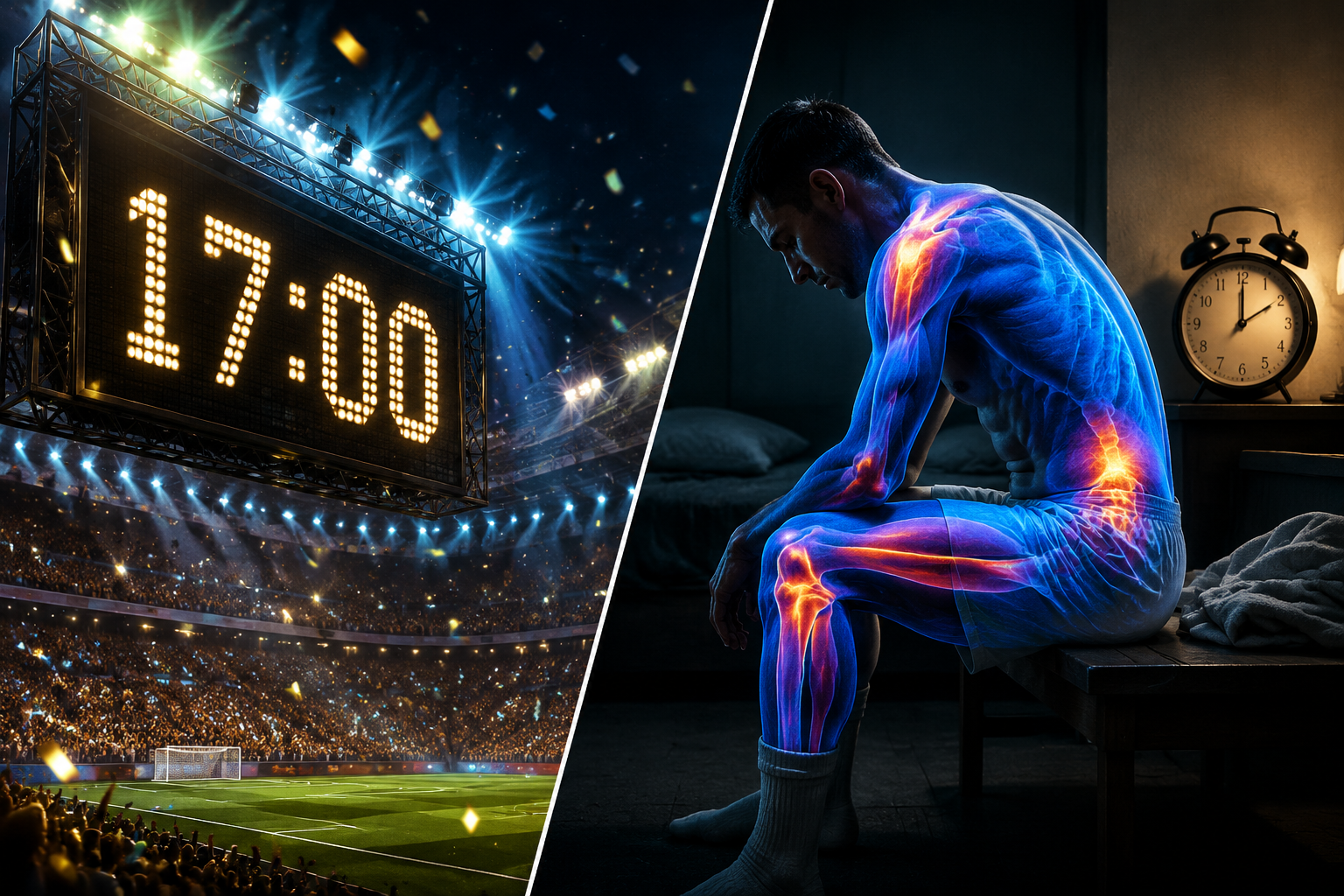
The Problem Is Not the Show. It Is the Passive Interval.
Entertainment is now part of elite sport. Players already perform inside broadcast windows, ceremony blocks, cooling breaks, substitution delays, video reviews, and sponsor obligations. The problem with the 17-minute half-time is narrower and more testable: it extends the one interval in the match when players are most likely to stop moving while still needing to restart at near-maximal intensity.
If the break were simply a longer period for medical treatment, tactical instruction, refueling, and a properly planned re-warm-up, the discussion would be different. But half-time is not blank recovery time. It is a sequence. Players leave the pitch, walk to the dressing room, receive instructions, change kit or equipment, take fluids and carbohydrates, manage minor knocks, and wait for the restart cue. Adding minutes to that sequence does not guarantee that the extra minutes are used for useful recovery work. In practice, they can become more sitting.
That distinction matters because a rest interval has two jobs that can work against each other. It should reduce acute fatigue, but it must also preserve readiness. The longer the athlete remains passive, the more the readiness side begins to leak away.
What Happens to Muscle Temperature During Half-Time
The most useful evidence here is not a broad complaint about commercialization. It is a small temperature measurement inside footballers’ thighs.
In a study of competitive Danish players, Mohr and colleagues measured quadriceps muscle temperature before and after a standard 15-minute half-time. Muscle temperature fell from about 39.4°C to about 37.4°C during the break, a decline of roughly 2°C. At the start of the second half, sprint performance was reduced by about 2.4%.[4]
Those numbers are not a direct test of a 17-minute World Cup final half-time. The players, setting, and competitive environment were different. The study does, however, show the direction of the problem with unusual clarity. A normal 15-minute half-time was already long enough for meaningful cooling in the working muscle group. Extending the passive portion of that interval pushes on a variable that was already moving the wrong way.
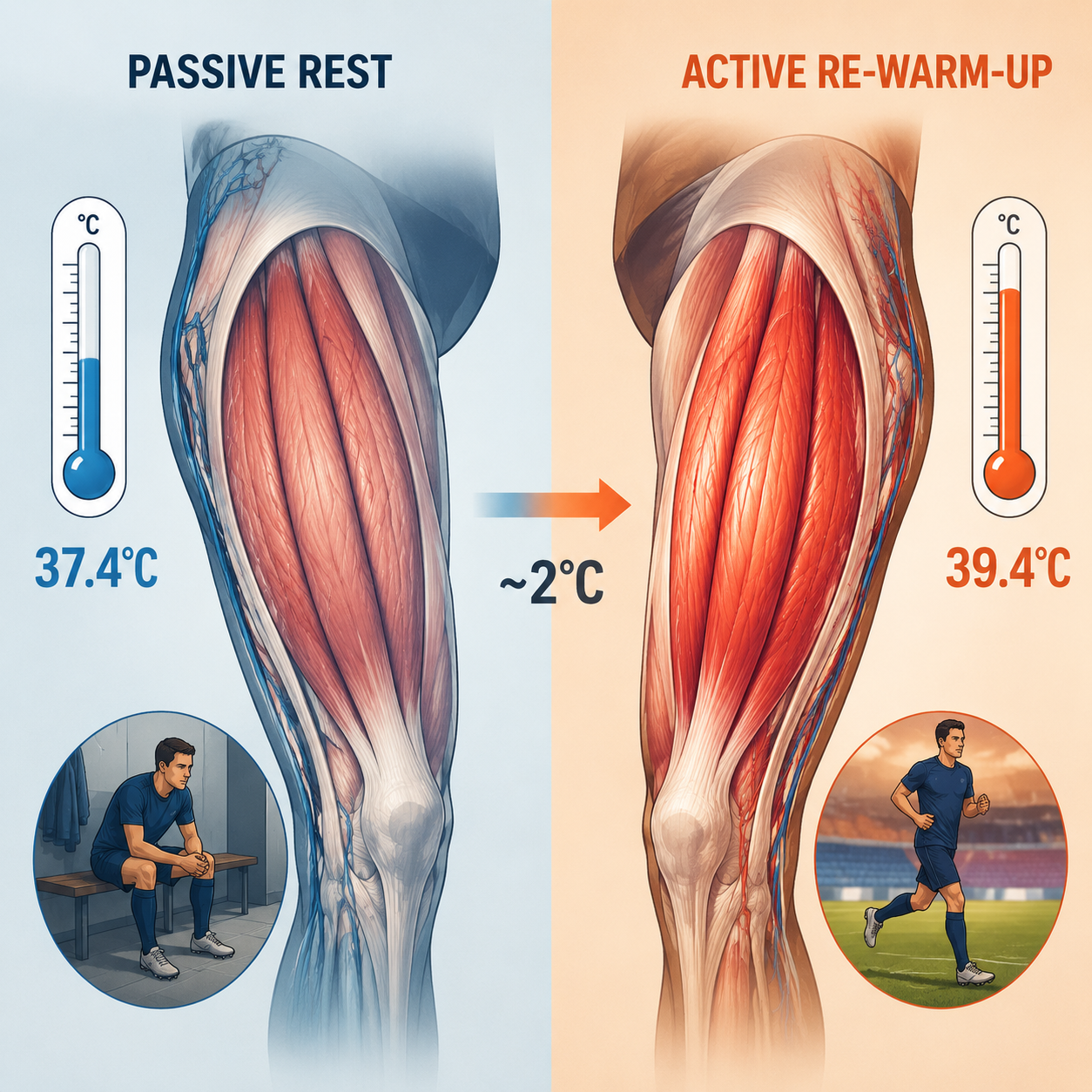
Warm muscle is not just more comfortable muscle. Higher muscle temperature supports faster cross-bridge cycling, quicker nerve conduction, lower internal resistance, and better explosive force production. In football terms, that shows up where matches often turn: the first acceleration after a loose ball, the recovery sprint after a turnover, the first jump on a corner, or the deceleration before a tackle.
The same Mohr study also gives the practical counterpoint. Players who performed a low-intensity re-warm-up during half-time maintained muscle temperature about 0.9°C to 2.1°C higher and preserved sprint capacity better than players who stayed passive.[4] That does not mean players need a second full warm-up. It means the body treats “rest” differently depending on whether the athlete is sitting still or keeping enough movement in the system to hold temperature.
This is where the casual reading of a longer half-time breaks down. More minutes can help if they allow treatment, fueling, and carefully timed movement. More minutes can hurt if they lengthen the coldest, stillest part of the interval. The clock does not tell us which one happened.
Why the First Minutes After the Restart Are Vulnerable
A football restart is not a gentle return to work. The second half can begin with immediate pressing, a long ball, a defensive scramble, or a sprint into space. Players are asked to go from the controlled environment of the dressing room back into maximal, reactive movement with very little gradual loading.
That is why muscle temperature evidence matters more than whether a halftime show is popular. A cooler quadriceps does not announce itself as a dramatic failure. It changes margins. A player may still sprint, but not quite as sharply. A defender may still close down, but arrive a fraction later. A winger may still explode into space, but with slightly less first-step quality. At this level, small losses are not small to the people managing the consequences.
The evidence should not be stretched into a claim that a 17-minute interval will injure players or decide a final. It supports a more careful conclusion: a longer passive half-time moves a known readiness variable in the wrong direction unless the extra time is actively managed. That is enough to make the rule change worth scrutiny.
The Other Cost Arrives After the Final Whistle
Half-time also shifts the back end of the night. A 17-minute interval does not only alter the second-half restart; it pushes the final whistle later than it otherwise would be. In a final, that delay lands before added time, possible extra time and penalties, medal ceremonies, anti-doping selection, medical review, broadcast interviews, media duties, nutrition, transport, and the slow physiological downshift from competition.
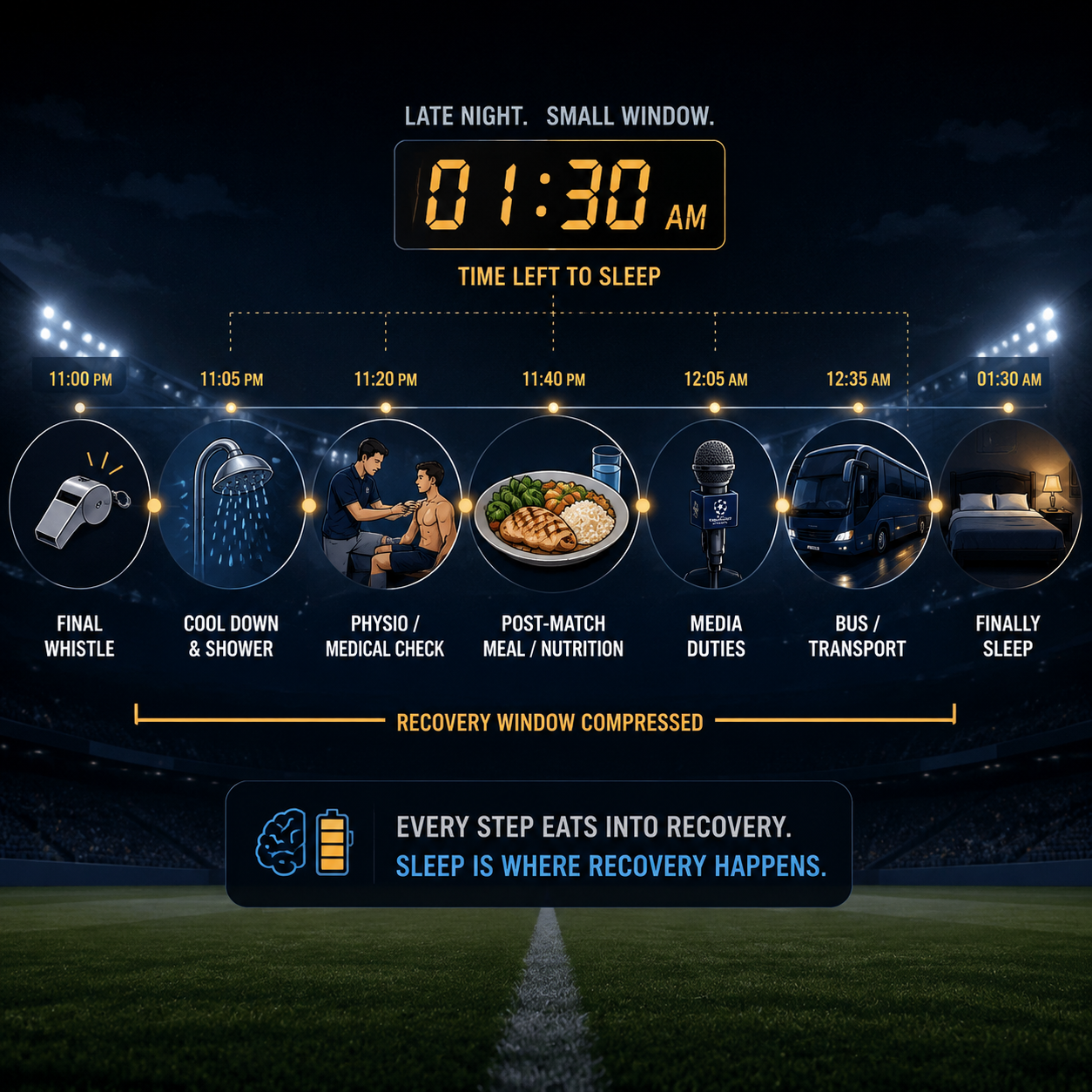
This is where a sleep-science lens changes the story. Sleep does not begin when the match clock stops. A player has to come down from high sympathetic arousal, complete basic recovery behaviors, eat enough to support repair, manage pain or soreness, and get out of the stadium environment. If the match runs later, those steps do not disappear. They are compressed or displaced.
Research on elite soccer has found that players can lose 2 to 4 hours of sleep after evening matches.[5][6] The 2026 final is scheduled for about 3 PM ET, so that exact magnitude should not be pasted onto this match. An afternoon kickoff gives more clock time before biological night than a late evening fixture. Still, the cascade is the same in shape: later match completion means later recovery tasks, later downregulation, and less protected sleep opportunity than the schedule would otherwise allow.
The practical issue is not that two minutes alone ruin sleep. It is that elite post-match recovery is already crowded. A final adds ceremony and media load on top of the normal medical and nutritional sequence. A small broadcast-driven delay is small only if nothing else is waiting behind it.
Poor Sleep Is Not Just Tiredness
For players, reduced sleep opportunity is not mainly about feeling groggy the next morning. Sleep is part of tissue repair, immune function, pain modulation, learning, and emotional regulation after high-intensity work. A final may be the last match of the tournament, but the bodies involved still have club seasons, travel, rehabilitation needs, and accumulated tournament load ahead of them.
A systematic review by Clemente and colleagues found consistent associations between poor sleep and increased injury risk or injury severity in soccer players.[7] Silva and colleagues also reported that sleep efficiency explained 44% to 47% of the variance in injury metrics in their player data.[8] These findings do not prove that a 17-minute World Cup half-time will cause injuries. They do explain why compressing sleep opportunity is not a trivial scheduling detail.
For a fuller look at that relationship, see how poor sleep increases your risk of sports injury. The short version is that recovery is not one behavior. It is a chain. When the early links run late, the sleep link often pays.
What This Means Outside a World Cup Final
Most adults do not need to manage a halftime show, but they do make the same mistake in smaller settings. A runner finishes hard intervals and sits too long before the next rep. A recreational player waits through a long substitution cycle and then returns cold. Someone doing evening strength work adds a long passive break, finishes later, eats later, showers later, and then wonders why sleep feels delayed.
The lesson is not to remove rest. It is to design the rest interval for the next demand. If the next demand is explosive, complete stillness may need to be brief, with light movement reintroduced before the restart. If the next demand is sleep, the recovery routine should protect the path toward it: cool down, refuel, lower light and stimulation, handle soreness, and avoid letting low-value waiting occupy the part of the evening needed for downshifting.
That same principle applies when training sessions are close together. The point is not to celebrate the longest possible break, but to ask what the break is preserving. For more on the repair side of the equation, see how sleep quality drives muscle repair and recovery. For athletes stacking sessions into the same day, how to sleep and recover when you train twice a day is the more practical extension.
A longer half-time can be made safer by using the added time intelligently. It can also be made worse by letting athletes cool while everyone else waits for the broadcast clock. The body does not care whether the pause was marketed as recovery. It responds to temperature, movement, arousal, fuel, timing, and sleep opportunity.
References
- FIFA confirms World Cup final half-time show won’t exceed 17 minutes, Hindustan Times, July 2026.
- FIFA targeting 20-minute half-time for 2026 World Cup final, The Athletic, July 2026.
- IFAB rejects 25-minute half-time proposal citing player welfare and safety concerns, Inside World Football, 2021.
- Muscle temperature and sprint performance during soccer matches — beneficial effect of re-warm-up at half-time, Scandinavian Journal of Medicine & Science in Sports, 2004.
- Sleep and athletic performance: the effects of sleep loss on exercise performance, and physiological and cognitive responses to exercise, Journal of Sports Sciences, 2016.
- Effects of long-haul transmeridian travel on player preparedness: case study of a national team at the 2014 FIFA World Cup, 2015.
- The association between sleep and injury in athletes: a systematic review, 2021.
- Sleep and injury in soccer players, 2020.
Comments
Join the discussion with an anonymous comment.