
If you are searching for how to sleep when sick with a stomach bug, the useful answer starts before you try to sleep. For the next 30 to 60 minutes, the goal is not a perfect bedtime routine. It is to keep nausea from escalating the moment you lie down, avoid a large vomit-triggering drink, and make the room safe enough that you do not have to sprint half-awake.
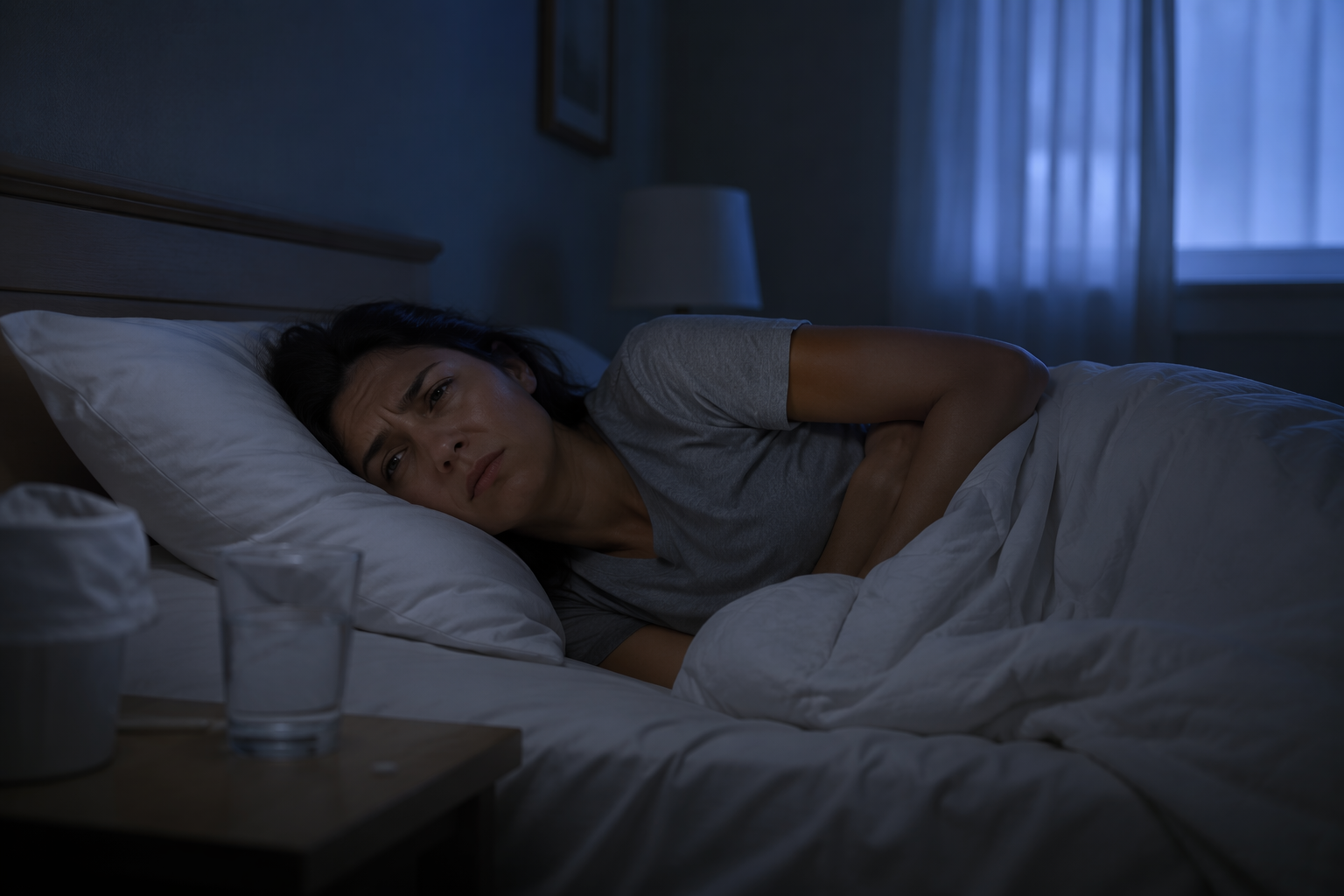
The tonight protocol
Use this first, then read the explanation only if you have the bandwidth.
- Set the room: put a trash can or bowl within arm's reach, clear the path to the bathroom, keep water or electrolyte fluid at the bedside, and place a towel where it can be grabbed quickly.
- Start tiny fluids: take 1 to 2 tablespoons of electrolyte fluid every 5 minutes instead of drinking a full glass. Larger volumes can stretch an irritated stomach and trigger another vomiting episode; small repeated sips are the safer bet during active vomiting or diarrhea.[1][2]
- If ginger usually agrees with you, take ginger tea or a capsule 30 to 60 minutes before trying to sleep. Skip it if the smell, spice, reflux, or past experience makes nausea worse.
- Lie on your left side with your head and upper chest elevated about 15 to 30 degrees. Do not lie flat on your back if reflux, burping, or a sour taste is part of the night.
- When a nausea wave rises, do one or two rounds of 4-7-8 breathing: inhale for 4 seconds, hold for 7 seconds, exhale slowly for 8 seconds. Stop if breath-holding feels uncomfortable.
- Stop treating this as a sleep problem if vomiting lasts more than 2 days, fever rises above 102°F, you have not urinated for 8 or more hours, you feel dizzy when standing, or your mouth is very dry. Those are medical-risk signals, not sleep-hygiene details.[1][2]
That list is intentionally plain. At 2 a.m., the difference between a tolerable night and a ruined one is often a few inches of elevation, a sip small enough to stay down, and not having to decide where to vomit while half asleep.
Why stomach bugs feel worse when you lie down
Viral gastroenteritis can bring nausea, vomiting, diarrhea, cramps, fever, and body aches; norovirus is one common cause, and the CDC says norovirus illness usually improves within 1 to 3 days.[1][3] That short timeline does not make the acute night feel short. A stomach that was barely manageable upright can become much harder to ignore when you get horizontal.
Several things stack up at night. Lying flat makes it easier for stomach contents and acid to move toward the esophagus. Vomiting and diarrhea pull down fluid and electrolytes, and dehydration can feed more nausea. The body can also move into a jittery sympathetic state: sweating, racing thoughts, shallow breathing, and the awful sense that another wave is coming. Anxiety does not invent the illness, but it can amplify the signal.
Sleep still matters, but not in a vague wellness way. Sleep and immune function influence each other, and a protected block of sleep may help you get through a short acute infection with less physiologic stress.[4] The practical target tonight is smaller: reduce enough nausea triggers to let one real stretch of sleep happen.
Before lying down: keep the stomach quiet
Do not chug water because you are worried about dehydration. That is a very understandable mistake. During a stomach bug, the stomach may reject volume before the body gets any benefit from it. Mayo Clinic and NIDDK both emphasize fluids and oral rehydration, but the nighttime move is controlled dosing: 1 to 2 tablespoons every 5 minutes, then slowly increasing only after the stomach has proved it can hold that down.[2][5]
| What is happening | What to do tonight |
|---|---|
| You just vomited | Wait a few minutes, rinse your mouth, then restart with 1 to 2 tablespoons of electrolyte fluid every 5 minutes. |
| You feel thirsty but still nauseated | Use repeated small sips, ice chips, or a spoon. Avoid the big bedside glass. |
| You have diarrhea too | Favor oral rehydration solution or electrolyte fluid rather than plain water alone. |
| You kept fluids down for a while | Increase gradually. Do not use improvement as a reason to overload the stomach. |
Food is secondary in the worst hours. NIDDK recommends eating when appetite returns and focusing first on replacing fluids and electrolytes.[6] If you can tolerate bland foods, that is fine. If toast sounds revolting, forcing it is not a sleep strategy.
The old BRAT diet can still describe foods some people tolerate, but it should not become a strict rule. Cleveland Clinic cautions against following a strict BRAT diet because it is too limited nutritionally, especially beyond a brief period.[7] For this particular night, the better question is narrower: will this bite or sip make lying down easier, or will it restart the clock?
Where ginger fits
Ginger is one of the few home nausea measures worth considering when it is tolerated. A sleep-nausea synthesis from Superpower, a commercial health company rather than a clinical guideline publisher, summarizes peer-reviewed evidence that ginger can affect 5-HT3 serotonin signaling involved in nausea and that meta-analytic evidence supports benefit across some nausea settings.[8] That does not mean ginger is equivalent to ondansetron, and it does not prove ginger will stop vomiting from viral gastroenteritis.
The timing is the useful part: if ginger has helped you before, take ginger tea or a capsule 30 to 60 minutes before bed rather than waiting until you are already curled over the trash can.[8] Keep it modest. A strong, spicy mug can be too much for a stomach that is already threatening mutiny.
How to lie down without making nausea worse
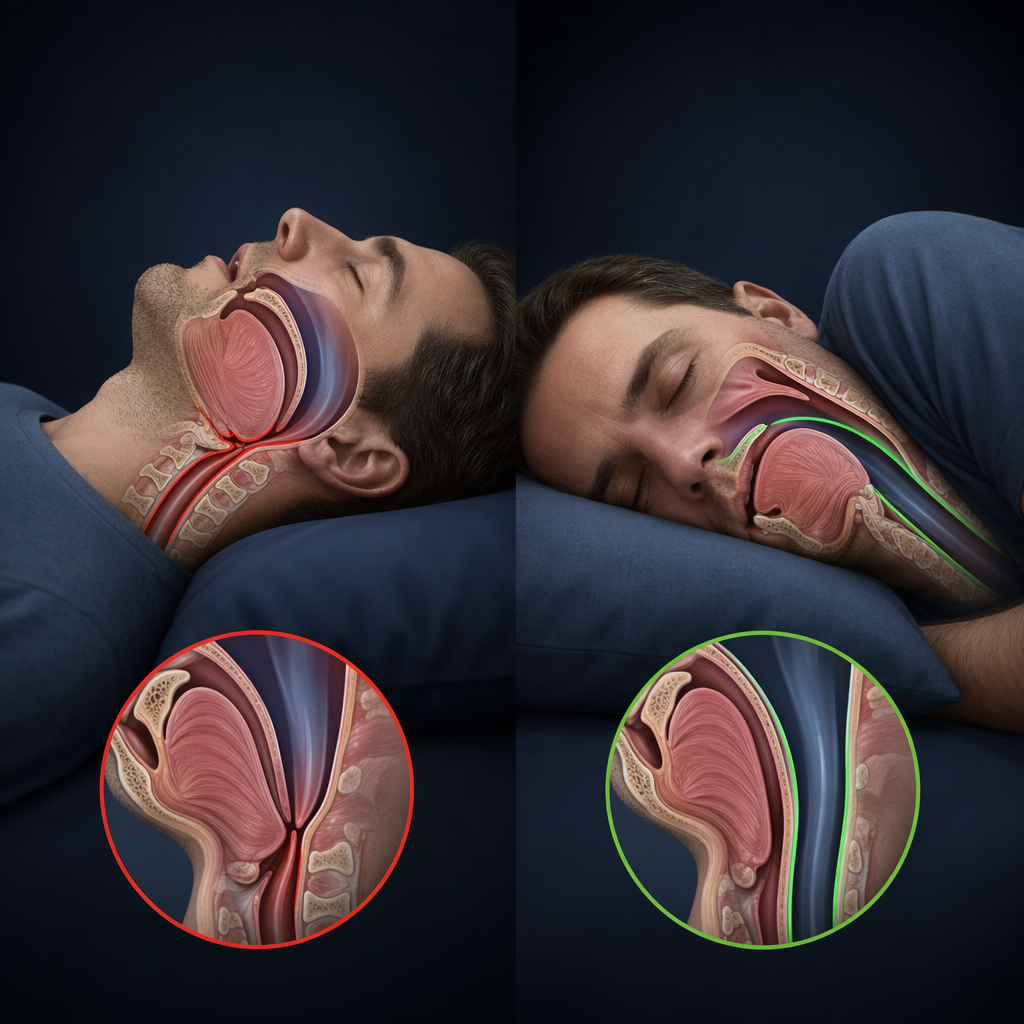
For a stomach bug night, left side plus elevation is the main sleep-specific adjustment. The reason is mechanical: when your head and upper chest are raised, gravity is less likely to send stomach contents toward the throat. Left-side positioning can also reduce reflux exposure compared with positions that make backflow easier, and elevation reduces the chance that regurgitated material reaches the airway during sleep.[8]

Aim for a 15 to 30 degree incline.[8] If you have a wedge pillow, use it. If not, stack pillows so the upper chest rises with the head; bending only the neck can create a kinked posture and may not help reflux much. A pillow between the knees can keep you from rolling onto your back.
This is one of those nights when general sleep-position advice changes. Back sleeping can be useful in some contexts, but reflux, active nausea, and vomit risk shift the calculus. If you want the broader tradeoffs for ordinary nights, see Sleep on Your Back: A Decision Framework. During an acute stomach bug, the safer practical setup is usually not flat, not supine, and not far from the bathroom.
When nausea wakes you up
The first job is to avoid turning one nausea wave into a full-room emergency. Sit partly upright or stay on your left side, keep the trash can close, and do not immediately drink a large amount because your mouth feels awful. Rinse, spit, and restart the small-sip pattern only after the wave settles.
This is where 4-7-8 breathing can be useful. The long exhale may help shift the body away from sympathetic overdrive and toward vagal regulation. The nausea evidence cited for this breathing approach comes from a postoperative context, not specifically viral gastroenteritis, so it should be treated as a low-risk supportive tool rather than a proven stomach-bug treatment.[8] For a deeper explanation of the technique, use How to Fall Asleep Faster: 5 Evidence-Based Techniques Ranked by Research Support when you are not actively trying not to vomit.
A simple version is enough: inhale through the nose for 4 seconds, hold for 7 seconds if comfortable, then exhale slowly for 8 seconds. If holding your breath makes the nausea sharper, skip the hold and just lengthen the exhale. The point is not to perform the method perfectly. The point is to stop the panic-breathing loop from adding fuel.
P6 acupressure can be a quiet add-on
P6, also called Nei Guan, is the inner-forearm acupressure point often targeted for nausea. The evidence is moderate, with better support in some nausea settings than others; it is not a first-line treatment for dehydration, fever, or repeated vomiting.[8] Its advantage at night is effort. A wristband can keep pressure there while you sleep, or you can press the point briefly during a wave.
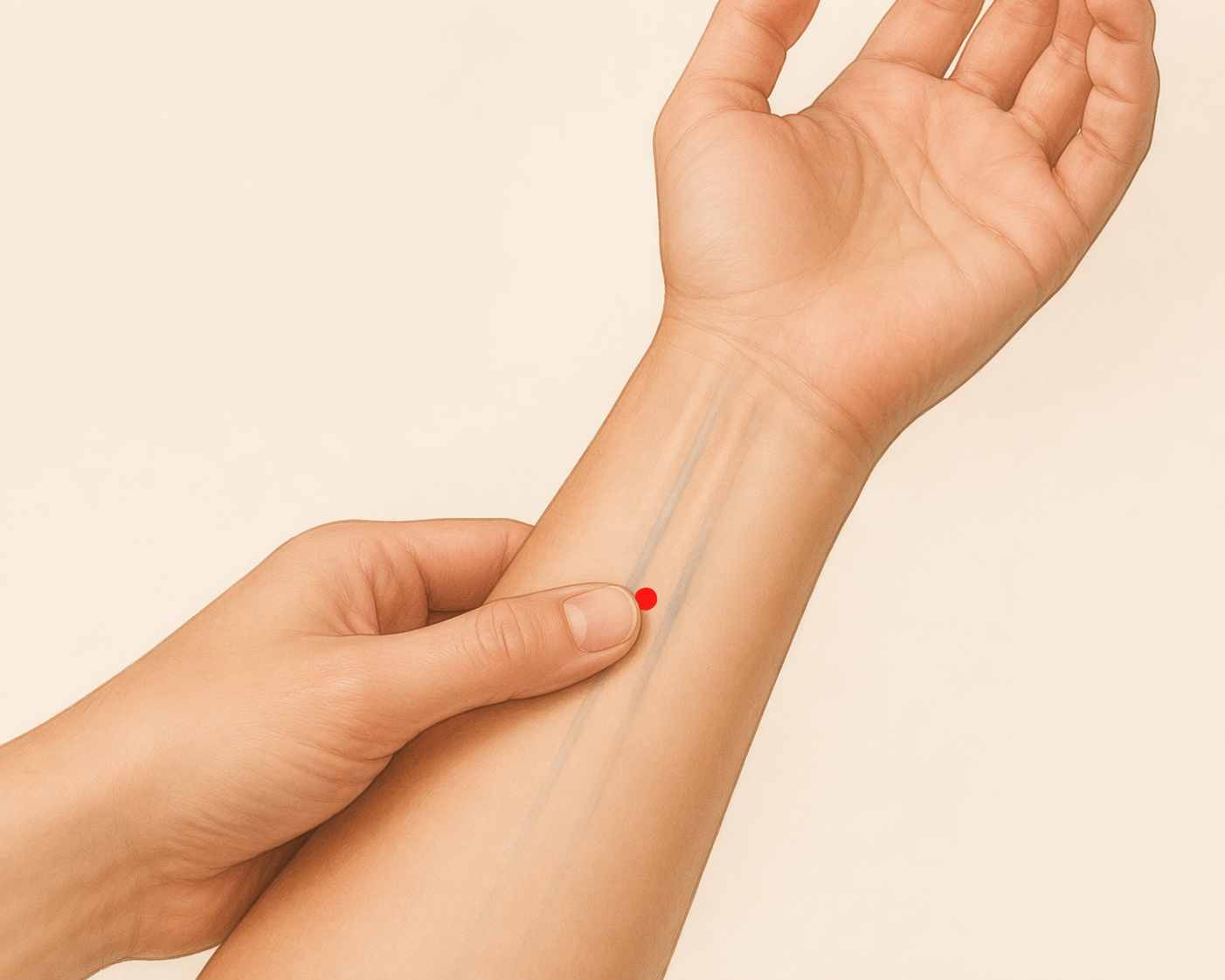
To find it, place three fingers below the wrist crease on the inner forearm, between the tendons, and apply steady gentle pressure. If it distracts you from nausea, good. If it does nothing, move on. Do not spend the night trying to force a modest tool to act like medication.
What not to spend energy on tonight
This is not the night to rebuild your entire sleep routine. A dark, cool, quiet room still helps, but a full wind-down ritual can wait. If you want the broader framework later, see Sleep Hygiene Fundamentals and an Evidence-Based Bedtime Routine. Tonight's version is narrower: dim the room, lower stimulation, keep supplies close, and choose the position least likely to provoke reflux or panic.
Also be careful with remedies that sound soothing but expand the stomach, irritate reflux, or add decision-making. A large mug of tea, a heavy bowl of soup, or a complicated supplement stack may be more burden than help. Natural does not automatically mean gentle when your stomach is already rejecting fluids. For broader evidence grading on nonprescription sleep aids, save Natural Sleep Remedies Graded by Scientific Evidence for a normal day.
A note on 2026 norovirus anxiety
Norovirus has been prominent enough in 2026 that University of Rochester Medicine published a current-season explainer on myths, symptoms, and prevention.[9] That can make a miserable night feel ominous. The useful framing is still the same: many cases are short, contagious, and brutally inconvenient; the danger line is less about the label and more about dehydration, persistent vomiting, or high fever.
If symptoms remain within a typical acute gastroenteritis pattern, the overnight plan is simple: protect the bed, sip slowly, use left-side elevation, time ginger only if tolerated, breathe through nausea spikes, and let P6 acupressure be optional support. If vomiting lasts more than 2 days, fever exceeds 102°F, or severe dehydration signs appear, home sleep strategies are no longer the main issue.[1][2]
References
- Stomach Flu: Symptoms, Causes & Treatment — Cleveland Clinic
- Gastroenteritis: First Aid — Mayo Clinic
- About Norovirus — CDC
- Sleep & Immunity: Can a Lack of Sleep Make You Sick? — Sleep Foundation
- Treatment of Viral Gastroenteritis — NIDDK
- Eating, Diet, & Nutrition for Viral Gastroenteritis — NIDDK
- Why You Shouldn't Follow a Strict BRAT Diet When You're Sick — Cleveland Clinic
- How to Sleep When Nauseous — Superpower
- Norovirus 2026: Stomach Bug Myths, Symptoms, and Prevention — University of Rochester Medicine



Comments
Join the discussion with an anonymous comment.