
The injured athlete on the sideline usually has a plan for everything except sleep. There is a warm-up routine, a strength program, a practice calendar, maybe a brace, maybe a physical therapy appointment, and often a careful argument about playing time. Then the same athlete goes home wired from practice, starts homework late, scrolls in bed, wakes before sunrise, and repeats the cycle until the next ache becomes the next missed week.
So the direct answer is yes, with an important limit: sleep cannot prevent every sports injury in young athletes, but chronic sleep deprivation is a meaningful, modifiable risk factor. The evidence is strong enough that sleep hygiene belongs in the injury-prevention plan, not as a vague lecture about being healthier, but as recovery infrastructure that parents, coaches, and athletes can actually track.
That matters because the usual sleep tips for young athletes are often handed over like one more impossible assignment. A teenager already juggling school, practice, travel games, friends, family, and screens does not need a scolding. They need adults to stop treating exhaustion as proof of commitment and start treating sleep debt as a load the body has to carry.
The Injury Finding Parents Can Actually Remember
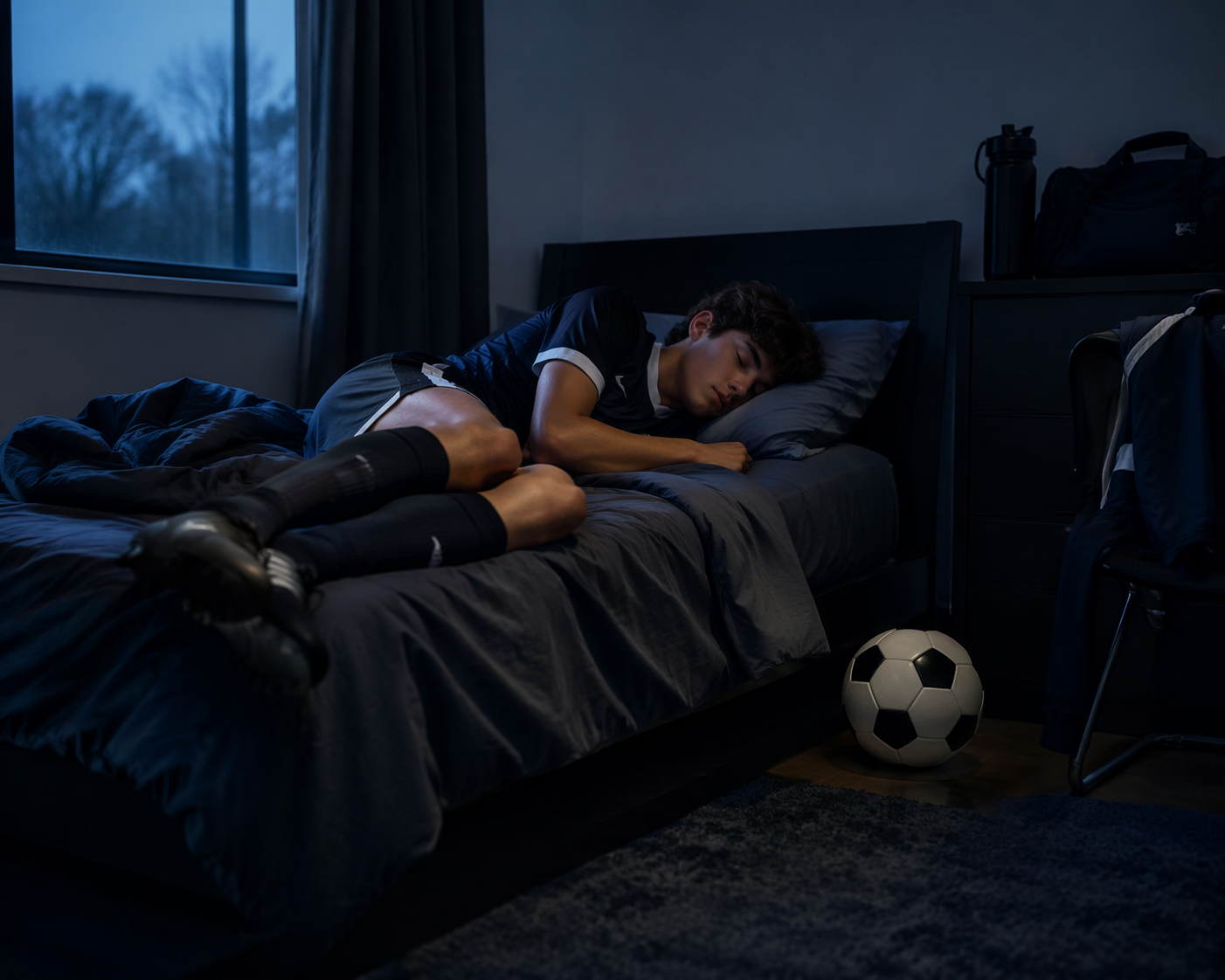
The most useful adolescent-specific study followed 112 athletes ages 12 to 18 for 21 months. Researchers found that athletes who slept fewer than 8 hours per night were 1.7 times more likely to sustain a sports-related injury than those who slept 8 or more hours. Each additional year of age, measured by grade in school, also independently increased injury risk.[1]
That “fewer than 8 hours” threshold is not a magic border between safe and unsafe. It is a practical marker from the study: once nightly sleep dropped below that level, injury risk was noticeably higher in this group of adolescent athletes. The finding does not prove that short sleep alone caused the injuries. It does show that insufficient sleep traveled with injury risk strongly enough that ignoring it would be careless.
The age finding is worth sitting with. Older middle-school and high-school athletes usually get more homework, later practices, harder training, more travel, more social pressure, and earlier wake times that do not politely adjust around any of it. In other words, the schedule often gets heavier at the exact age when the athlete is being asked to compete more seriously.
A 2019 systematic review and meta-analysis gives the Milewski finding more context. Across included studies, adolescents with chronic sleep deprivation had higher odds of sports or musculoskeletal injury, with a pooled odds ratio of 1.58. The authors also noted heterogeneity across studies, meaning the research did not measure sleep and injury in perfectly identical ways.[2]
That is not a reason to shrug. It is a reason to be precise. The current evidence is strongest for an association between chronic sleep deprivation and higher injury risk, not for a guarantee that adding an hour of sleep will prevent a sprained ankle next Saturday. But youth sports makes plenty of decisions on less perfect information than this, especially when the intervention is low-risk and the possible upside is a healthier season.
Why a Tired Athlete Becomes an Easier Athlete to Injure
The injury connection makes more sense when sleep is treated as part of the body’s control system. Sports injuries do not happen only because a field is uneven or an opponent lands badly. They also happen when an athlete is late to react, lands with worse mechanics, loses coordination under fatigue, or pushes sore tissue that has not recovered well.
Sleep deprivation has been linked with impaired psychomotor performance, decreased neuromuscular coordination, reduced growth hormone secretion involved in tissue repair, and higher perceived exertion. Those are not abstract sleep-lab details. They are the difference between cutting cleanly and cutting late, absorbing a landing well and collapsing inward, recognizing fatigue and compensating with sloppy movement.[3]
A tired athlete may also feel a normal drill as harder than it should be. When perceived exertion rises, mechanics can deteriorate before the athlete or coach notices. The teenager still looks tough. The practice still gets finished. The cost shows up later as a cranky knee, a pulled muscle, a sore back, or an overuse problem that has been accumulating quietly.
None of this makes sleep a magic switch. A well-rested athlete can still get injured. A tired athlete can still play brilliantly. But chronic sleep debt narrows the margin for error, and youth sports already operates with plenty of narrow margins: fast growth, packed schedules, uneven recovery habits, and adults who sometimes mistake constant availability for resilience.
Sleep Works With the Rest of Recovery, Not Instead of It
One useful study of elite adolescent athletes makes this point clearly. Athletes who slept 8 hours or less on weekdays had a 2.25 times higher injury hazard when short sleep was combined with poor nutrition. The important lesson is not that sleep alone explains injury. It is that recovery behaviors stack, and poor recovery habits can make each other more costly.[4]
That distinction matters for families. If a teenager is under-sleeping, under-fueling, practicing hard, and playing weekend tournaments, the problem is not a character flaw. It is a recovery math problem. The body is being asked to adapt without being given enough time or material to do the repair work.
Sleep should sit beside warm-ups, strength training, hydration, nutrition, load management, coaching quality, and return-to-play protocols. It should not be used to blame an injured athlete. It should be used to spot a preventable weakness in the system before the athlete is the one paying for it.
Start With a One-Week Sleep Diary, Not a Family Argument
Most families are bad at estimating sleep from memory. Parents remember when the bedroom door closed. Teenagers remember when they meant to go to sleep. Neither number is necessarily actual sleep.
A one-week sleep diary changes the conversation. It shows where sleep is really being lost: late practices, homework pileups, phone use, caffeine, early transportation, weekend schedule drift, or long naps that make bedtime harder. It also gives coaches and parents something more useful than “you look tired.”
| What to track | Why it matters |
|---|---|
| Lights-out time | Shows when the sleep opportunity actually begins |
| Estimated time to fall asleep | Separates being in bed from sleeping |
| Wake time | Reveals whether early school or travel is compressing recovery |
| Practice or game end time | Connects late physical arousal with delayed sleep |
| Caffeine or energy drink timing | Finds stimulants that may still be affecting bedtime |
| Phone or screen cutoff | Shows whether the wind-down routine is real or only intended |
| Naps | Helps distinguish useful short recovery from naps that disrupt bedtime |
The diary does not need to be beautiful. A notes app, paper calendar, or shared spreadsheet is enough. The goal is to compare the athlete’s actual sleep opportunity with the 8-hour threshold that showed up in the adolescent injury study, then look for the two or three schedule changes most likely to survive the season.[1]
The Sleep Habits Most Likely to Survive a Sports Season
A perfect sleep routine that collapses after three days is not a routine. For young athletes, the best plan is usually boring, repeatable, and protected by adults who understand that recovery is part of training.
Keep Bedtime and Wake Time as Consistent as the Schedule Allows
A consistent bedtime and wake time is the anchor habit. It helps the athlete’s body predict when to wind down and when to be alert. Weekend sleep-ins can feel necessary after a hard week, but big swings also make Sunday night harder, which can start the next school week with another sleep deficit.
This is where adults have to be honest about the calendar. If practice ends late three nights a week and the bus comes early, the athlete may not be failing at discipline. The schedule may simply not leave enough room for recovery. In that case, the first fix is not another lecture; it is looking for earlier homework blocks, adjusted transportation, fewer optional late commitments, or a conversation with the coach when the pattern is chronic.
Use a 30- to 60-Minute Screen Curfew
A screen curfew works best when it is treated as equipment management, not moral failure. The phone goes on a desk, charger, or hallway spot 30 to 60 minutes before bed. The athlete can still pack the bag, shower, stretch lightly, read, listen to quiet audio, or finish a low-stimulation task.
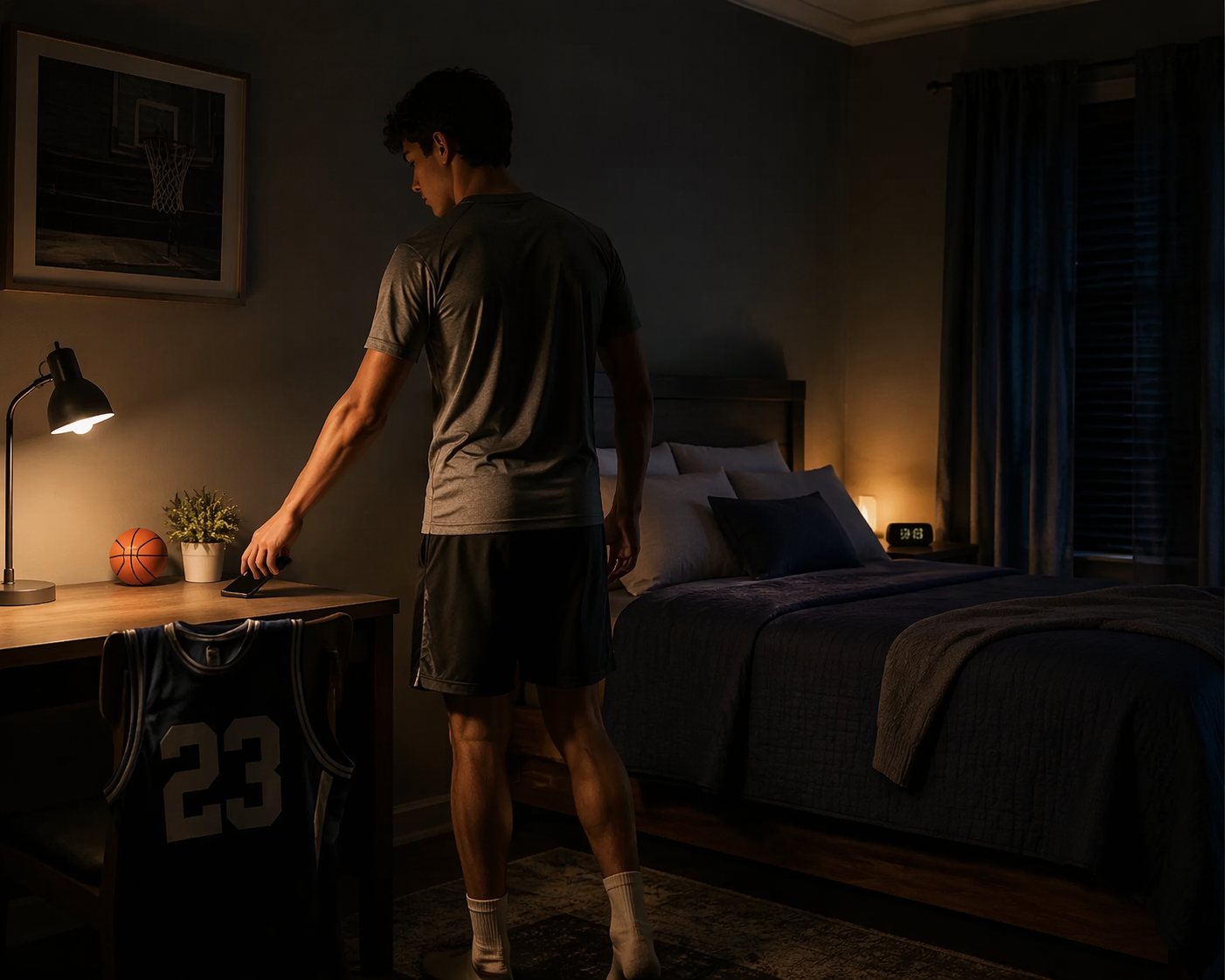
The point is not that one text message ruins recovery. The point is that interactive screens are very good at stealing the first hour of sleep while everyone in the house pretends bedtime already happened. For an athlete hovering below 8 hours, that hour is not small.
Cut Off Caffeine After 2 PM
Caffeine and energy drinks deserve a clear cutoff because they are easy to rationalize during long school days and tournament weekends. A simple rule is no caffeine after 2 PM. That includes coffee drinks, energy drinks, caffeinated pre-workout products, and some sodas or teas.
The athlete who needs caffeine to survive the afternoon may be showing the schedule’s problem, not solving it. If caffeine is covering chronic sleep debt, the diary will usually show it.
Make the Bedroom Cool, Dark, and Quiet
The bedroom does not need a wellness makeover. Keep it cool, ideally around 65 to 67°F, dark enough that light is not signaling wakefulness, and quiet enough that sleep is not constantly interrupted. Blackout curtains, a fan, a white-noise machine, or moving the phone out of reach are all practical changes.
This part is simple, so it should stay simple. Fix the obvious friction. Do not let bedroom perfection become another project that delays the routine.
Use Short Post-Practice Naps Carefully
A 20- to 30-minute nap after practice can help a sleep-deprived athlete get through homework and family life without crashing completely. The catch is timing. A late-afternoon or evening nap can push bedtime later, especially for teens who already struggle to fall asleep.
The nap should be brief, early enough not to interfere with bedtime, and used as a backup tool rather than the main recovery plan. If a teenager needs long naps most days, the night schedule needs attention.
What Coaches and Parents Can Change
Young athletes are often told to manage sleep like adults while living inside schedules built by adults. That is why sleep education cannot stop at the bedroom door. Parents control transportation, device rules, and household rhythms. Coaches control practice times, tournament expectations, team culture, and whether fatigue is treated as data or as weakness.
- Ask about sleep when an athlete has recurring soreness, repeated minor injuries, or unusually slow recovery.
- Build one week of sleep tracking into preseason or return-from-injury planning.
- Avoid praising athletes for playing through obvious exhaustion as if fatigue has no physical cost.
- Treat late practices and early school mornings as a recovery conflict, not as a teenager’s personal failure.
- Discuss sleep alongside nutrition, hydration, strength work, and load management instead of saving it for crisis moments.
The most useful question is not “Are you getting enough sleep?” Most teenagers know the expected answer. Ask instead: “How many hours did you actually sleep last night?” Then ask it without turning the answer into a courtroom scene.
The Fair Bottom Line
Sleep is not a replacement for warm-ups, strength training, hydration, nutrition, good coaching, safe progression, or proper return-to-play decisions. The research includes association-based limits, and studies vary in how they measure sleep deprivation and injury. A sleep plan will not make youth sports risk-free.
But the case is strong enough to act on. In adolescent athletes, sleeping fewer than 8 hours has been associated with substantially higher injury risk, and broader research supports the connection between chronic sleep deprivation and sports or musculoskeletal injury.[1][2] The mechanisms also make practical sense: tired bodies react more slowly, coordinate less cleanly, repair less effectively, and experience effort differently.[3]
If a youth sports program is serious about injury prevention, sleep should not be a private afterthought. It should be named, tracked, coached, and protected, especially for athletes whose schedules make chronic sleep debt look normal.
References
- Chronic lack of sleep is associated with increased sports injuries in adolescent athletes, Journal of Pediatric Orthopaedics, 2014, link
- The Association Between Sleep and Injury in Adolescent Athletes: A Systematic Review and Meta-analysis, PMC, 2019, link
- Sleep and the Young Athlete, Sports Health, 2022, link
- Too little sleep and an unhealthy diet could increase the risk of sustaining a new injury in adolescent elite athletes, Scandinavian Journal of Medicine & Science in Sports, 2017, link


Comments
Join the discussion with an anonymous comment.