
If you smoke or vape and your sleep has started to feel strangely thin, the answer is not just “stress” or “getting older.” In a NHANES analysis of 30,269 adults, heavier smoking was associated with 1.73 times higher odds of insufficient sleep, 1.99 times higher odds of reported sleep problems, and 1.91 times higher odds of snoring compared with non-smoking patterns in the dataset.[1]
That does not mean every bad night is caused by cigarettes, or that a single survey can prove what happened in one person’s bedroom at 3 a.m. But the dose-response pattern matters. The more smoking exposure people reported, the more sleep trouble showed up. The curves flattened above roughly 30 cigarettes per day, but that is better read as a likely small-sample problem at the extreme end, not as a hidden threshold where sleep suddenly stops getting worse.[1]
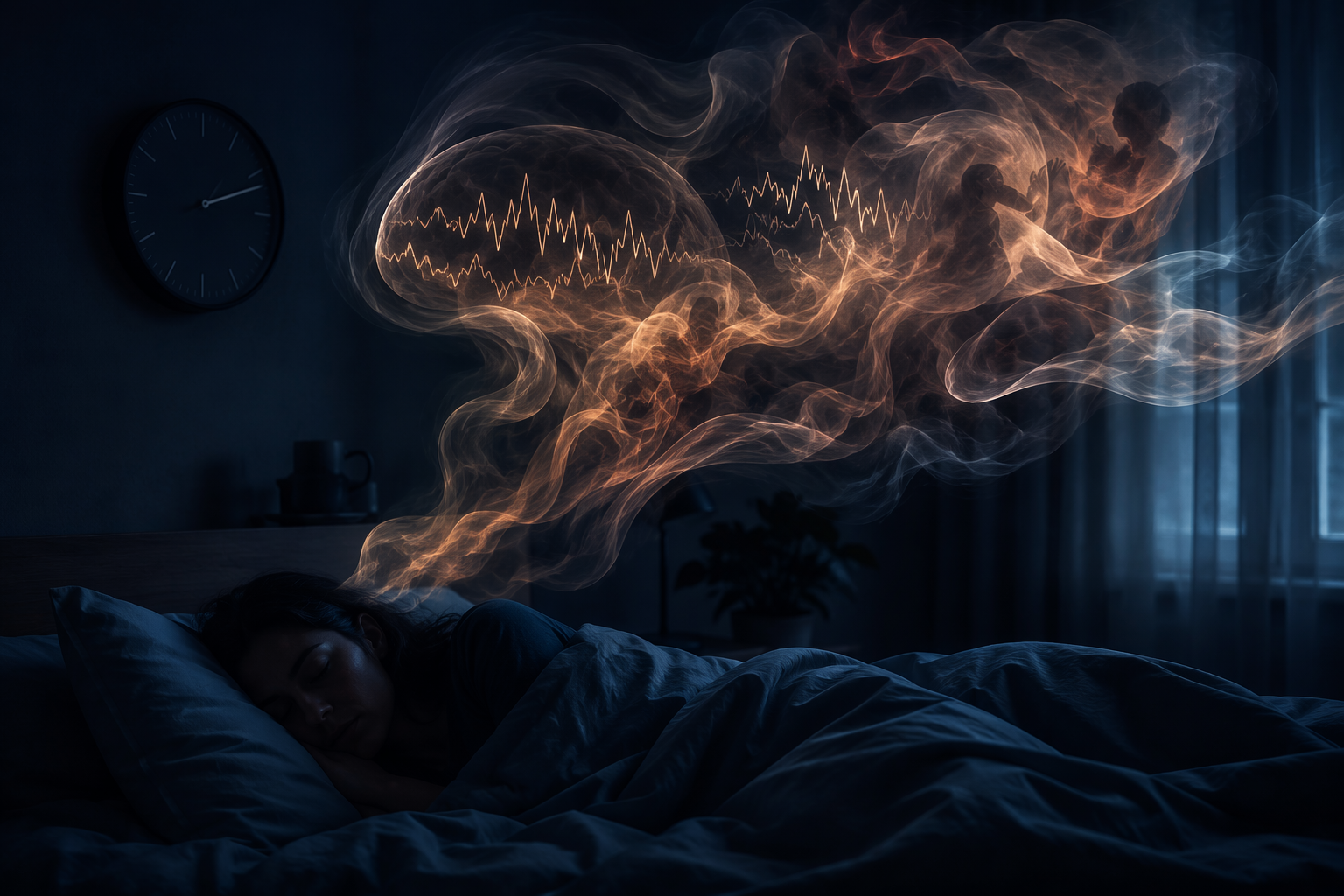
The useful question is not whether smoking is “bad.” Most smokers have heard that sentence until it has lost its edge. The more useful question is why something that can feel calming in the moment can still leave sleep shallower, breathing noisier, and the next morning more craving-heavy.
Nicotine can feel calming while keeping the sleeping brain on lighter duty
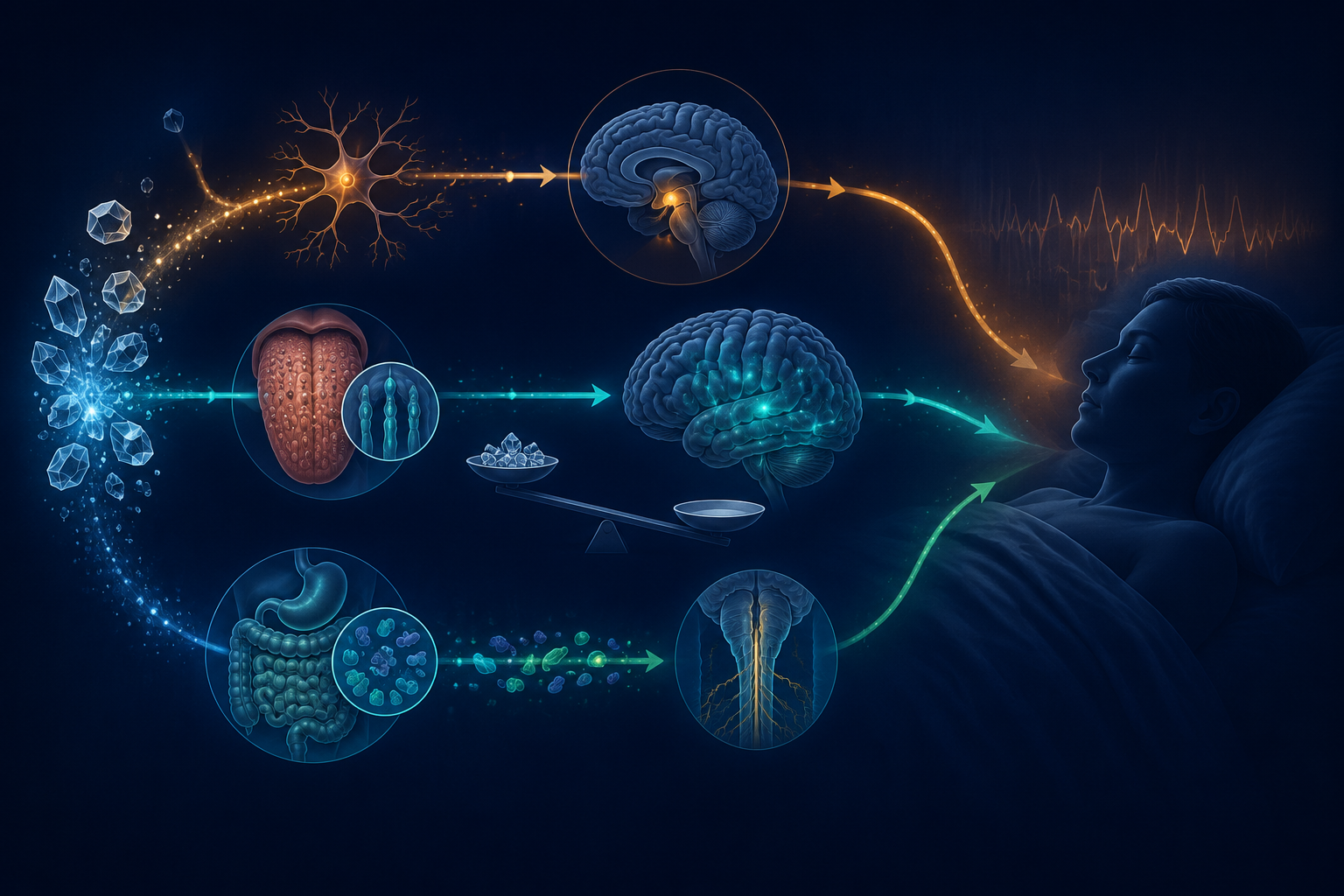
Nicotine is the first contradiction to sort out. A cigarette, vape, pouch, or other nicotine source can feel like relief because it quiets withdrawal, gives the hands something familiar to do, and marks a pause in the day. Biologically, though, nicotine is still a stimulant. That difference between subjective relief and physiological activation is where a lot of night-time confusion starts.
A 2024 systematic review of 151 studies found that nicotine exposure is linked with measurable changes in sleep architecture: less slow-wave N3 sleep, less REM sleep, and more time in lighter N1 and N2 sleep stages, with dose-dependent effects observed in polysomnography-based evidence.[2]
That architecture matters because “I was asleep” is not one state. N3 is the deep, slow-wave sleep people often mean when they say they slept hard. REM is involved in dreaming and several forms of emotional and cognitive processing. N1 and N2 are lighter stages, easier to fragment. A person can spend enough hours in bed and still wake up feeling as if the night never reached its deeper gears.
This is why the last nicotine of the evening is not a small detail. It may shorten the distance between stress and relief, but it also keeps the nervous system working against the timing sleep needs. Nicotine can interfere with circadian regulation and arousal systems at the same point in the day when the body is supposed to be lowering alertness. The result is not always dramatic insomnia. Sometimes it is a more irritating version: falling asleep, waking often, dreaming oddly, or sleeping through the night and still feeling under-recovered.
Smoke does not have to wake you fully to disturb your sleep
The second pathway is mechanical and inflammatory rather than purely neurological. Cigarette smoke irritates the nose, throat, and lower airways. Inflamed tissue narrows the passages air has to move through at night. Once that happens, the sleep problem may show up less as “I can’t fall asleep” and more as snoring, dry mouth, morning headache, or a bed partner saying breathing sounded rough.
That makes the NHANES snoring signal important. Heavy smokers did not only report insufficient sleep and general sleep problems; they also had 1.91 times higher odds of snoring.[1] Snoring is not automatically sleep apnea, and a survey cannot diagnose sleep-disordered breathing. Still, snoring is a clue that the airway is part of the story, not just the mind racing before bed.
This is one reason the link between smoke exposure and sleep quality should not be reduced to a simple stimulant story. Nicotine can alter the sleeping brain’s stage pattern, while smoke exposure can make the airway more reactive and noisy. One person notices wired wakeups. Another notices snoring and unrefreshing sleep. A third notices both and assumes the problem must be anxiety, weight, alcohol, allergies, or age. Those can matter too, but smoke has its own route into the night.
Vaping belongs in the nicotine pathway, but dual use looks especially rough
Vaping should not be treated as identical to cigarettes, but sleep does not give it a free pass. If the vape contains nicotine, it still feeds the same stimulant and withdrawal cycle. The route is cleaner in some ways than combusted tobacco, but the sleeping brain does not only care whether something was burned. It also cares whether nicotine arrived close to bedtime, during a night waking, or first thing in the morning after fragmented sleep.
Evidence summarized by Truth Initiative, including Merianos et al. 2023, links nicotine vaping with insufficient sleep, restlessness, nightmares, and daytime fatigue in adolescents and adults. The same body of evidence flags dual use — cigarettes plus vapes — as the highest-risk pattern.[3]
Dual use makes sense as a sleep problem because it can stretch nicotine access across more situations. Cigarettes may remain tied to breaks, driving, alcohol, or social rituals. Vapes can slip into the couch, bed, bathroom, or half-awake interval after a 2 a.m. wakeup. The exposure becomes easier to maintain and harder to notice.
| Exposure | Likely sleep pathway | Common night or morning clue |
|---|---|---|
| Cigarettes | Nicotine stimulation plus smoke-related airway irritation | Light sleep, snoring, unrefreshing sleep |
| Nicotine vaping | Nicotine stimulation and withdrawal timing | Restlessness, later sleep onset, daytime fatigue |
| Dual use | More sustained nicotine exposure across contexts | More chances for sleep disruption and next-day craving |
| Cannabis | Sleep-onset relief for some users, with stage and efficiency concerns in frequent use | Falling asleep faster but not necessarily sleeping better |
Cannabis is the place where the story gets easiest to oversimplify
Cannabis deserves its own lane because many people use it for exactly the symptom this article is about. They are not imagining the first part: cannabis can feel like it helps with sleep onset. If someone is anxious, uncomfortable, or conditioned to expect a long fight with the pillow, the sedating effect can seem like proof that cannabis is helping sleep quality.
The problem is that sleep onset is only the front door. In Winiger et al. 2020, cannabis users often expected sleep benefits, but frequent use — especially edible use — was associated with worse sleep efficiency and shorter sleep duration among moderate users in Colorado.[4]
That finding should be kept narrow. It does not prove that every cannabis product worsens every person’s sleep, and the Colorado sample limits how far the results can be generalized. It also does not erase the fact that some people use cannabis because pain, trauma, anxiety, or withdrawal has already made sleep feel fragile. But it does challenge the common shortcut: “I fell asleep faster, so it improved my sleep.”
The more careful reading is that cannabis may help with one part of the night while complicating others. Frequent use can be associated with poorer sleep efficiency, shorter duration, and altered sleep-stage distribution.[4] If the next morning feels dull, heavy, or oddly unrested despite an easier bedtime, that contradiction is not rare enough to dismiss.
Secondhand smoke can enter the bedroom too
The sleep-smoke connection is not limited to the person holding the cigarette. In a 2023 study of 390 non-smoking university students in Bangladesh, secondhand smoke exposure was associated with 1.61 times higher odds of poor sleep quality; among males, the odds were about two times higher.[5]
That study is cross-sectional, single-country, and based on a relatively small university sample, so it should not be stretched into a universal estimate. Its value is simpler: it shows that smoke exposure may matter for sleep even when the exposed person is not using nicotine by choice. For shared homes, dorms, cars, and bedrooms, that distinction is not academic.
Bad sleep can make the next cigarette feel more necessary
The maintenance loop is the part that deserves more respect than it usually gets. Smoking can disturb sleep, but poor sleep can also make smoking harder to resist. Purani et al. 2019 found that poor sleep quality is linked with stronger nicotine withdrawal symptoms, cravings, and total smoking urges.[6]
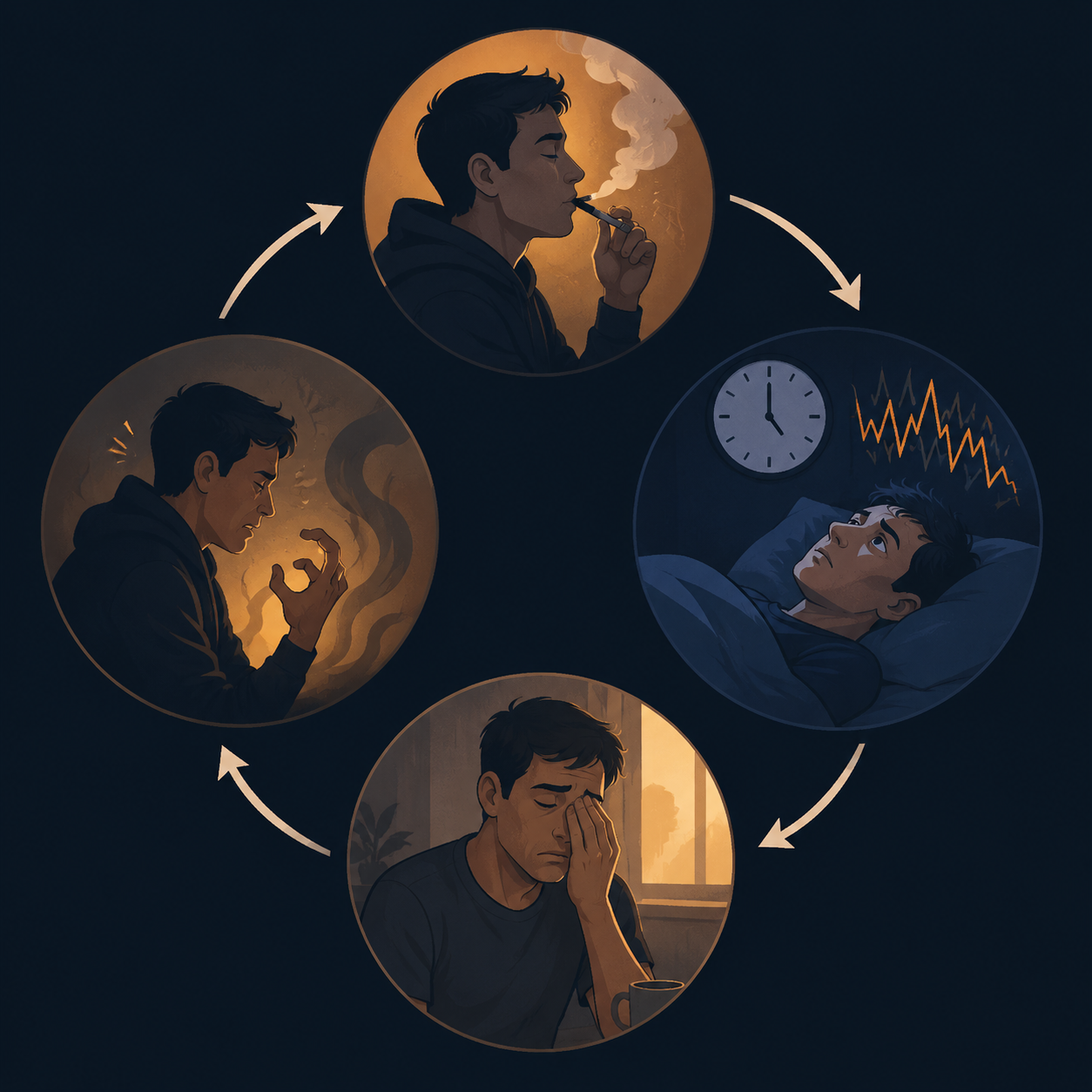
That changes how a rough morning should be interpreted. The first cigarette after a bad night is not just a character flaw wearing a jacket. It may be the nervous system asking for relief after lighter sleep, more awakenings, or withdrawal that started before the alarm. Nicotine then gives quick relief while helping set up the next round of sleep disruption.
This loop also explains why bedtime-only advice often disappoints. A person may move the last cigarette earlier and still wake up craving. Another may quit vaping at night but compensate heavily in the morning. Someone using cannabis for sleep may get faster sleep onset but still lose sleep efficiency. The behavior is not floating separately from the sleep problem; it is being reinforced by it.
What to watch if sleep is the reason you care
The most useful self-observation is not a moral inventory of whether you “should” smoke. It is a timing map. Track when nicotine or cannabis enters the day, where sleep fragments, and what the next morning demands from you. The pattern is often more persuasive than another warning label.
- Notice whether the last nicotine exposure is close to bedtime, during nighttime awakenings, or immediately after waking.
- Separate falling asleep from staying asleep, sleep depth, dream quality, snoring, and morning recovery.
- Treat new or worsening snoring, gasping, or witnessed breathing pauses as airway clues, not just annoying noise.
- If cannabis seems to help, ask whether it improves the whole night or mainly the first 30 minutes of getting to sleep.
- Watch for the morning-after link: poor sleep, stronger cravings, more nicotine, then another poor night.
None of this promises that stopping cigarettes, vapes, or cannabis will make sleep normalize overnight. Withdrawal can temporarily disturb sleep too, and people often smoke or use cannabis for reasons that deserve more than a shrug: stress, pain, boredom, grief, social connection, or the need to get through one more shift. But the sleep evidence gives a concrete reason to take the habit seriously now, not only as a future disease risk.
Smoking and vaping do not merely coexist with poor sleep. They can make sleep lighter, breathing rougher, and mornings more craving-driven. Once that cycle is visible, the question changes from “Why don’t I have more willpower?” to “Which part of this loop is keeping the next bad night alive?”
References
- Association between smoking and sleep disorders: a cross-sectional study of NHANES 2005-2018. Frontiers in Psychiatry, 2024.
- The Effects of Nicotine on Sleep: A Systematic Review and Meta-Analysis. PMC, 2024.
- How does vaping nicotine impact sleep?. Truth Initiative.
- Cannabis use and sleep: expectations, outcomes, and the role of frequency. PMC, 2020.
- Association of secondhand smoke exposure with sleep quality among non-smoking university students. Scientific Reports, 2023.
- Sleep quality in cigarette smokers: associations with smoking-related outcomes and exercise. PMC, 2019.
Comments
Join the discussion with an anonymous comment.