The first sleep question about Reflect Orbital’s approved space mirror satellite is not whether a beam from orbit would look spectacular. It is whether the planned light would reach the eye at intensities the human circadian system already knows how to use. In July 2026, the FCC approved a demonstration involving Eärendil-1, part of Reflect Orbital’s plan to test orbital mirrors that redirect sunlight to Earth at night; TIME reported a roadmap that begins with two satellites in 2026 and scales, in the company’s stated ambition, toward 50,000 by 2035.[1]
That makes the “space mirror satellite effect on sleep” a biological question before it is a lifestyle question. Sleep is not protected only by closing an app, wearing a mask, or promising to go to bed earlier. It is protected by darkness reaching the retina, and by public decisions that decide how much artificial light gets added to the night.
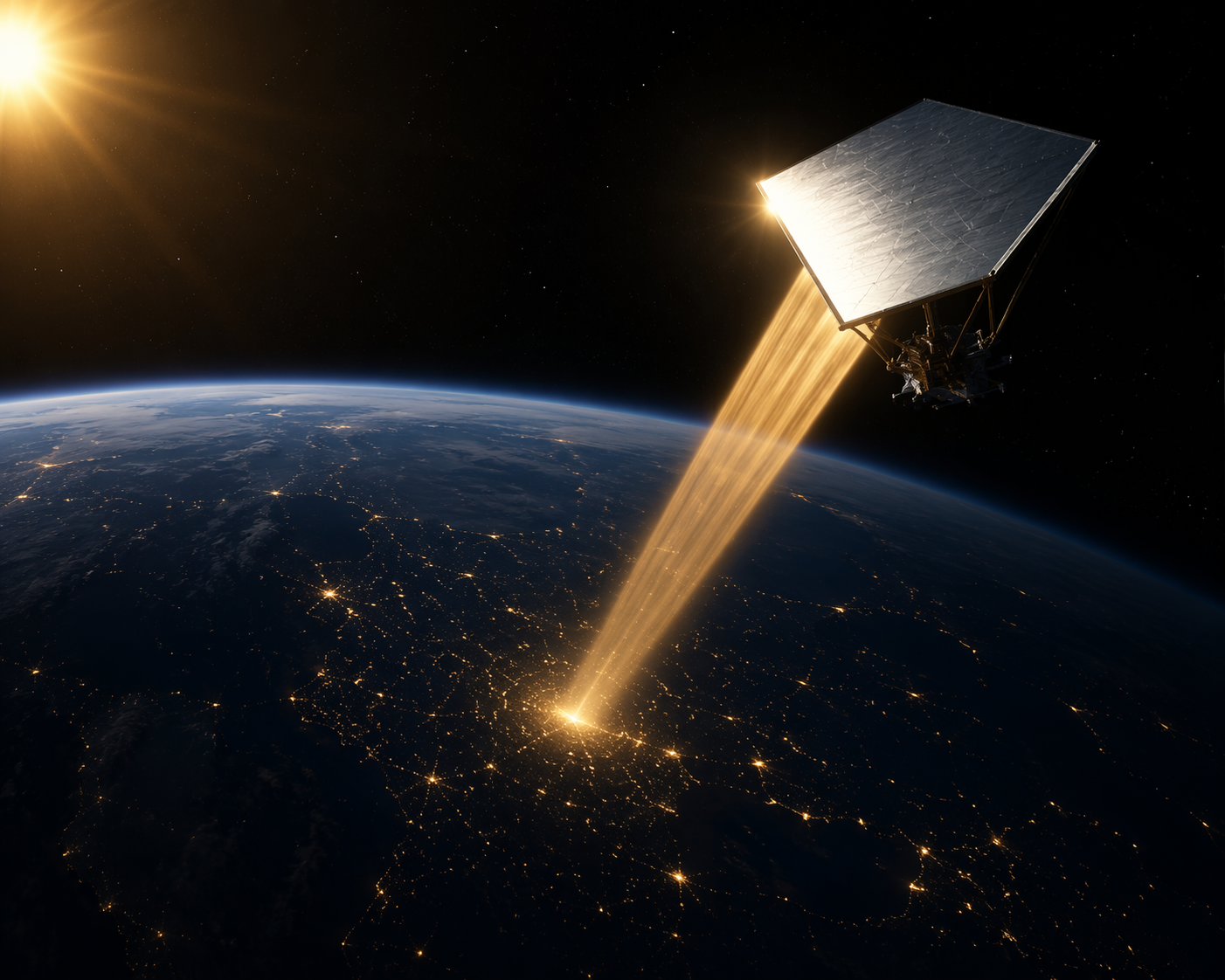
The proposed illumination levels are the reason sleep scientists are paying attention. TIME described Reflect Orbital’s intended ground spots as roughly 5 kilometers wide and adjustable from full-moon-like illumination to daylight-like illumination, with figures running from about 0.1 lux to 36,000 lux.[1] DarkSky International, responding to the project, cited an initial planned range of 0.8–2.3 lux and warned that this is several times brighter than a full moon and within a range relevant to melatonin suppression.[2]
Those numbers are not a sleep diagnosis. Eärendil-1 has not yet launched, no peer-reviewed study has measured people sleeping under an orbital mirror, and the actual ground-level exposure will depend on targeting, duration, weather, scattering, local geography, windows, and human behavior. But the numbers are not too small to matter just because they sound small. Lux is a visual-light measure; biology often reacts long before a person would call a room bright.
The Warning Is About Circadian Biology, Not Just a Brighter Sky
In April 2026, The Guardian reported that presidents of the European Biological Rhythms Society, World Sleep Society, Australasian Chronobiology Society, and Society for Research on Biological Rhythms had warned regulators about satellite mirror plans, representing more than 2,500 researchers in over 30 countries.[3] Their concern was not merely that night would look less natural. The letter warned that orbital reflectors could alter “the biological clock regulating human sleep, hormone secretion, and broader health,” and stated that “circadian disruption is not mere inconvenience; it is a physiological mechanism driving major adverse health consequences.”[3]
That distinction matters because a public conversation can slide too easily into scenery: dark skies, wilderness, stargazing, astronomy, the romance of the Milky Way. Those are real losses when night is brightened. They are not the whole health question. The brain’s clock does not wait for a person to notice that the sky has changed before it begins processing light.
Northwestern Now’s coverage of expert testimony made the same point in more direct biological terms: circadian systems can be sensitive to light levels far below what people typically perceive as bright.[4] This is the point missed by any reassurance that talks only about glare, visibility, or whether a beam would be annoying. Annoyance is conscious. Circadian signaling is not.
Why 0.8–2.3 Lux Belongs in a Sleep Conversation
The planned initial range cited by DarkSky, 0.8–2.3 lux, sits in an awkward zone for public understanding.[2] It is low compared with office lighting, street lighting, or daylight. It is high compared with many natural night conditions. And it is close enough to established circadian-response ranges that dismissing it as “dim” is not scientifically careful.
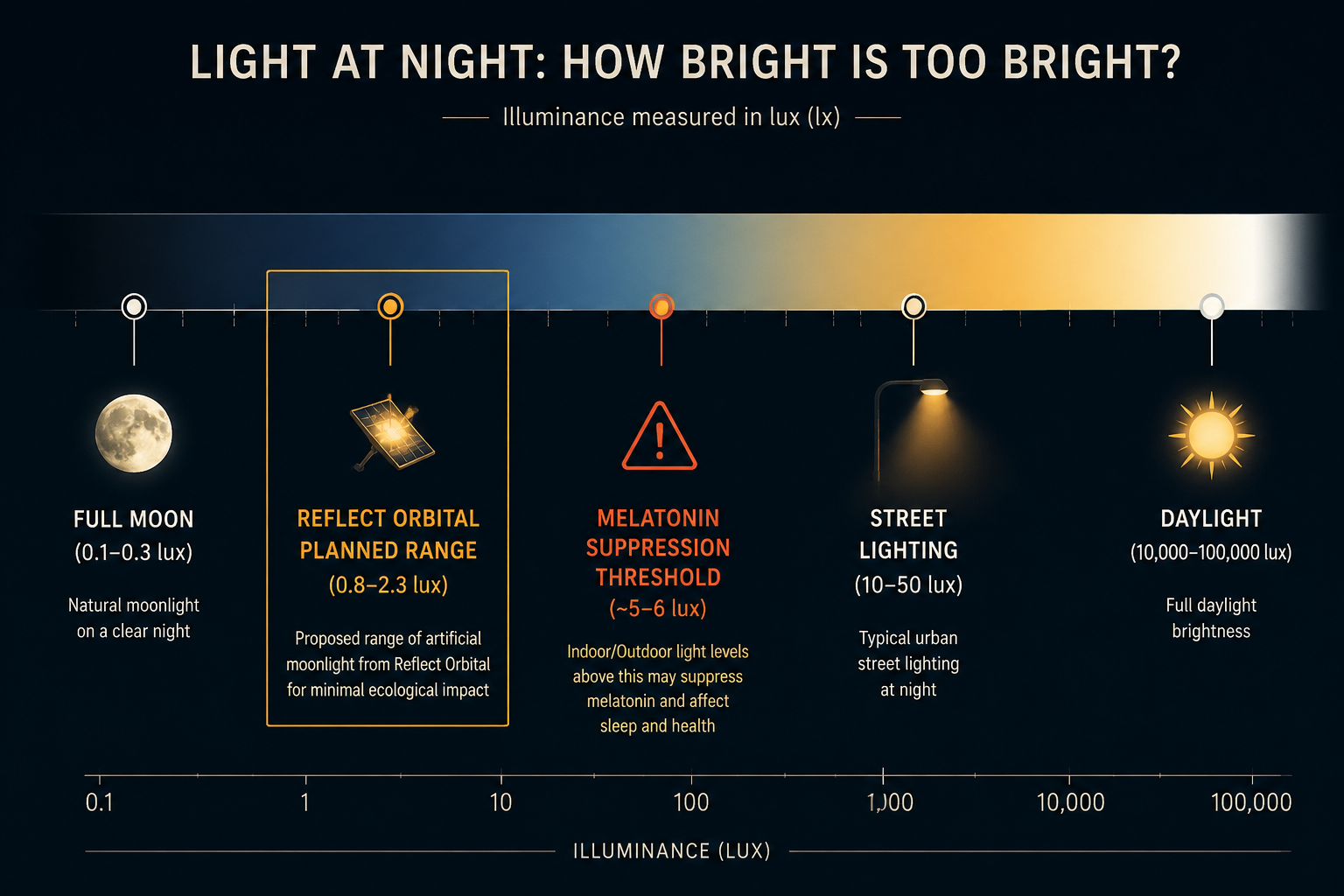
A full moon is often used as the comforting comparison, but it should not be allowed to do more work than it can carry. TIME reported a lower-end full-moon-equivalent figure of 0.1 lux in its overview of Reflect Orbital’s brightness range.[1] DarkSky described the 0.8–2.3 lux range as several times brighter than a full moon.[2] Whether a person experiences that as beautiful, eerie, useful, or barely noticeable does not answer the physiological question.
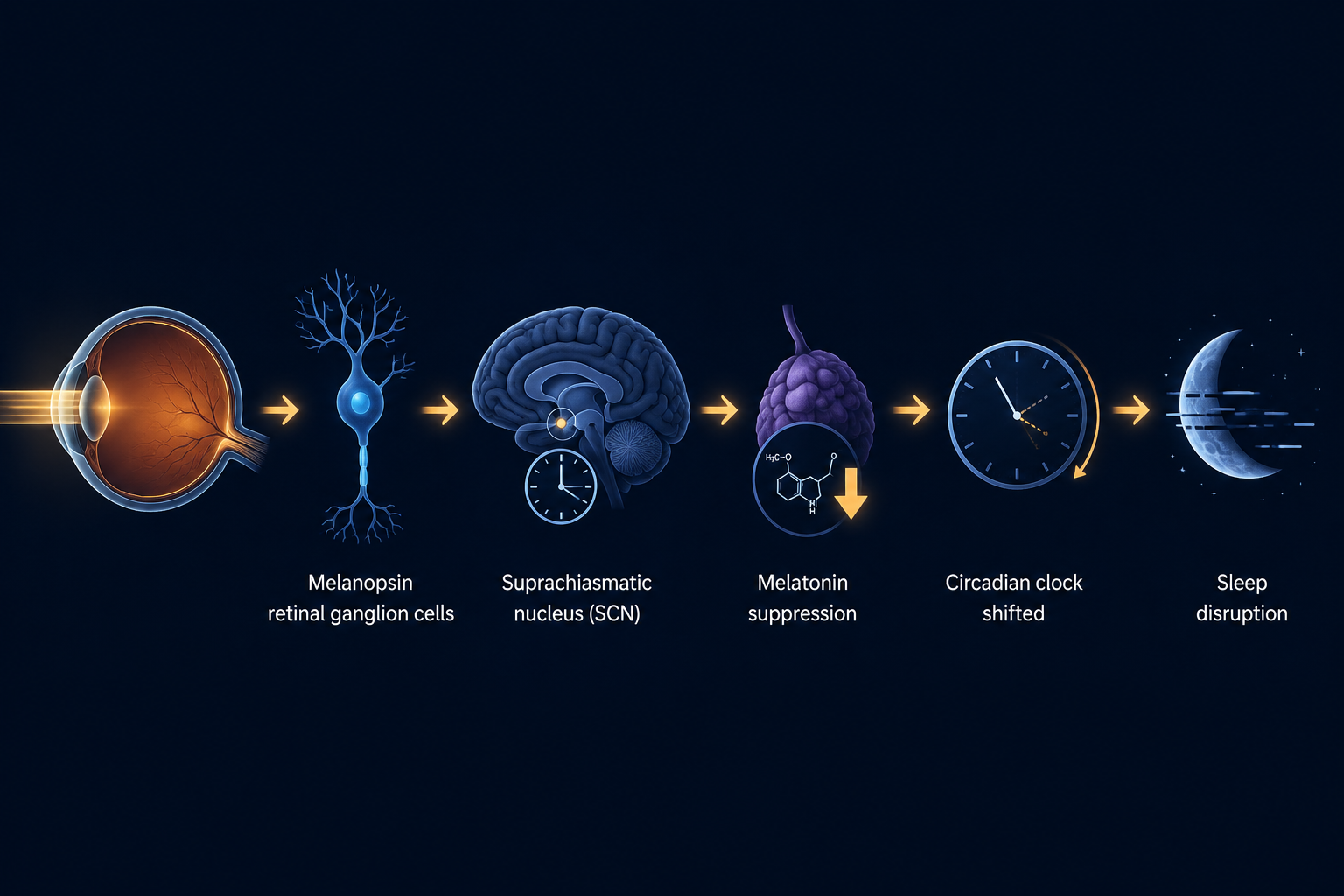
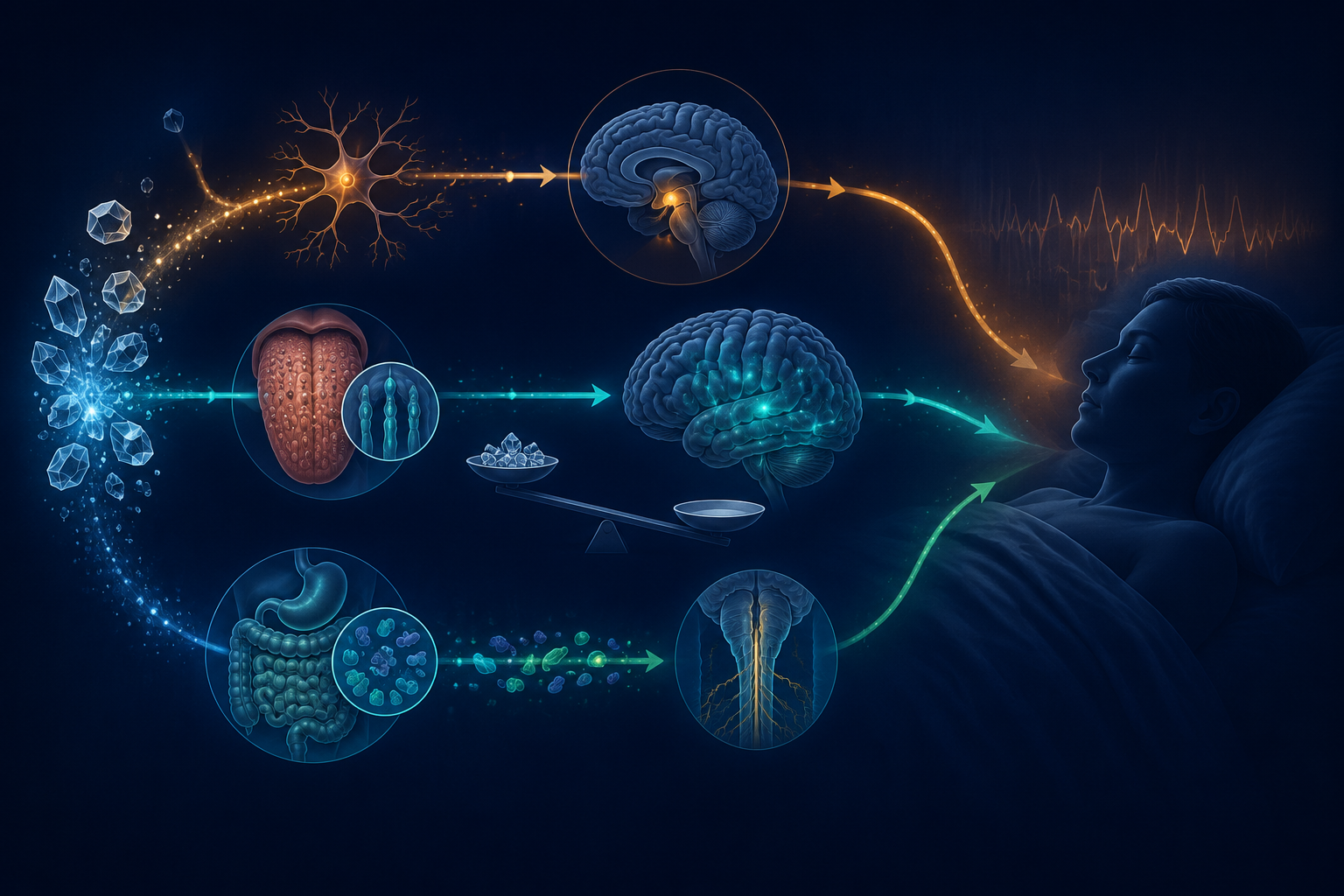
The relevant pathway is well established. Light enters the eye; intrinsically photosensitive retinal ganglion cells, containing melanopsin, help signal light information to the suprachiasmatic nucleus, the brain’s central circadian clock; that clock coordinates timing signals including melatonin secretion; light at the wrong biological time can suppress melatonin and shift circadian phase.[5]
Blume and colleagues, reviewing effects of light on human circadian rhythms, sleep, and mood, describe melatonin suppression at low illuminance levels, including thresholds around 5–6 lux under relevant conditions.[5] A proposed 0.8–2.3 lux exposure is below that threshold figure, but it is not in another universe. It is within the same low-light territory where timing, spectrum, pupil size, duration, angle of exposure, prior light history, and individual sensitivity can decide whether the body treats the light as biologically meaningful.
This is where “brighter than a full moon” becomes more than a visual comparison. The issue is not that moonlight reliably ruins sleep. It is that an engineered system designed to add controllable, repeatable, scalable light to the night may create exposures that overlap with known mechanisms of melatonin suppression and clock shifting. A single brief pass, a targeted service area, a cloudy night, and a bedroom with curtains are different situations. Public-health analysis has to care about the distribution of exposures, not just the most convenient version.
| Light Level Or Claim | Why It Matters For Sleep |
|---|---|
| Full-moon-like illumination around 0.1 lux | Useful as a familiar reference point, but not a safety boundary. |
| Reflect Orbital initial range cited as 0.8–2.3 lux | Several times brighter than a full moon and close enough to low-light circadian-response ranges to warrant evaluation. |
| Melatonin-suppression thresholds around 5–6 lux | Shows that biologically meaningful effects can occur at levels far below ordinary indoor brightness. |
| Street-lighting and daylight-equivalent scaling claims | Move the project from a narrow demonstration into a potentially much larger artificial-light-at-night intervention. |
These comparisons are not a ranking from safe to dangerous. Circadian response is not controlled by lux alone. Blue-enriched light has different biological potency than warmer light. Exposure shortly before habitual sleep is different from exposure early in the evening. A beam aimed at a solar farm is different from light scattered through a residential area. Still, the comparison is enough to show why sleep scientists object to treating the project as if it were only a question of visual nuisance.
A Demonstration Satellite Is Small; the Roadmap Is Not
If the only fact on the table were one unlaunched satellite, the sleep concern would be narrower. The larger concern comes from the scaling ambition attached to it. TIME reported Reflect Orbital’s plan beginning with two satellites in 2026 and scaling to 50,000 by 2035, with adjustable 5-kilometer ground spots and a brightness range described from full moon to full noon.[1]
That does not mean 50,000 satellites will exist, or that every planned brightness level will be used over sleeping communities. A company roadmap is not the same thing as deployed infrastructure. But a technology that begins by proving orbital light delivery and describes later operation at street-lighting or daylight-equivalent levels cannot be evaluated only as a curiosity in the sky.
Reflect Orbital presents the project as a way to deliver sunlight on demand, including targeted service and containment of light within selected areas.[6] That is the fairest version of the promise: extra light where a customer wants it, when sunlight would otherwise be unavailable. If such a system could truly illuminate only the intended site, with predictable spectra, durations, and negligible spillover, the sleep question would become more localized and easier to regulate.
But containment is precisely the unresolved part for sleep. The night sky and atmosphere are not a sealed optical cable. Light can scatter. Weather can change distribution. A beam may be targeted at a commercial service area while bedrooms, hospitals, nursing homes, farms, migration corridors, or other sensitive spaces sit nearby. Until independent measurements exist under real operating conditions, containment remains a claim to be tested, not a reason to skip the sleep evaluation.
What Light At Night Does To the Body
The core mechanism is not exotic. Humans evolved with a strong daily light-dark signal: brighter days, darker nights. The circadian system uses that contrast to time sleep propensity, hormone rhythms, temperature rhythms, alertness, and many other physiological processes. Artificial light at night weakens the contrast. If it arrives at the wrong circadian time, it can suppress melatonin and shift the clock later or earlier, depending on timing.[5]
Melatonin is often described too casually as a sleep hormone, as if it simply knocks people out. Its more important role here is timing. Evening melatonin rise tells the body that biological night is underway. Light during that window can blunt the signal. If repeated often enough, poorly timed light can help push sleep later, fragment sleep, or make the body’s internal night misalign with social schedules.
The phase-response curve matters. Light exposure before the body’s temperature minimum tends to delay the circadian clock; light after that point tends to advance it.[5] In ordinary terms, late-evening and early-night light are not interchangeable with light near dawn. A space mirror system that supplies illumination on demand would need to be understood not only by brightness, but by timing. A 10 p.m. exposure and a pre-dawn exposure can have different biological implications.
Duration also matters. A momentary glint is not the same as sustained illumination. A person awake outdoors is not the same as someone asleep behind curtains. A child’s bedroom, an intensive-care unit, a night-shift worker’s daytime sleep period, and an older adult’s lightly shaded room are not the same exposure setting. These differences do not erase the risk. They define what the risk assessment should measure.
The FCC Approval Did Not Settle the Sleep Question
The July 2026 approval is easy to misread. A regulator saying a demonstration may proceed is not the same as a regulator saying the biological exposure is safe. TIME reported the FCC approval and noted the agency’s position that it lacked authority to evaluate environmental impacts on sleep and ecosystems.[1] That is a large sentence hiding inside a procedural event.
A process built to assess communications, orbital operations, interference, licensing, or other space-system questions can allow a sleep-relevant exposure to pass through without ever being examined as a sleep exposure. The gap is not necessarily that officials ignored evidence placed squarely inside their mandate. It is that the mandate may not have been built for a private system that proposes to add biologically active light to the night environment from orbit.
This is how public-health risks often become visible late. The harm category does not match the approval category. A satellite can be assessed as a satellite, a beam as an engineering feature, and brightness as an operational parameter, while the body receives it as a timing signal. Nobody needs to be villainous for the wrong question to be asked.
The formal warnings from sleep and biological-rhythm societies were therefore not a demand for perfect certainty. They were a demand that an established pathway be evaluated before the exposure scales.[3] That is a modest standard. It asks for real-world measurements, transparent assumptions, biologically relevant light metrics, timing analysis, spillover analysis, and independent review before orbital lighting becomes infrastructure.
Astronomy and Ecosystems Are Context, But Sleep Is Its Own Risk
Much of the public alarm around brighter satellites has understandably come from astronomers and dark-sky advocates. Satellite brightness can interfere with observations, and broader light pollution can change the character of the night sky. Astrobites placed Reflect Orbital in a wider discussion of proposed satellite systems that threaten dark and quiet skies.[7] That context is useful, but it should not absorb the sleep issue into a general complaint about losing darkness.
Ecosystem concerns also deserve attention. The Guardian’s reporting on the scientists’ warning included potential effects on ecosystems as well as human sleep.[3] Many species use light-dark cycles for navigation, feeding, reproduction, and seasonal timing. Human beings are not separate from that biology. We are simply very good at pretending that our bedrooms are private exemptions from environmental change.
For a person trying to understand personal sleep risk, though, the central point is narrower: low-level light at night can be biologically active, and the planned exposure levels are close enough to established circadian findings that they require direct assessment. The fact that the same technology may also concern astronomers or ecologists does not dilute the sleep concern. It confirms that darkness has been serving multiple systems at once.
What Remains Untested
The strongest version of the sleep concern still has boundaries. There is no peer-reviewed study showing that Eärendil-1 has caused insomnia, because the demonstration satellite has not yet launched. There is no field study measuring melatonin in people exposed to Reflect Orbital beams through real windows in real neighborhoods. There is no independent dataset showing exactly how much light would spill outside a target area under different atmospheric conditions.
Those unknowns cut both ways. Actual exposure could be lower, shorter, or more contained than critics fear. It could also be more biologically relevant than a simple lux estimate suggests, depending on spectrum, timing, repetition, and scattering. A sleep-safe assessment would not rely on either assumption. It would measure.
- Ground-level illuminance inside and outside the intended service area, not only at the center of the beam.
- Spectral composition of the reflected light, because melanopsin-sensitive pathways do not respond to all wavelengths equally.
- Timing and duration of exposures relative to local night and typical sleep periods.
- Atmospheric scattering, cloud effects, and repeated exposure patterns across communities.
- Health-relevant outcomes such as melatonin suppression and circadian phase shifting, not only visibility or customer-area targeting.
That assessment would also separate adoption from effectiveness. A company can demonstrate that it can aim reflected sunlight at a location without demonstrating that nearby residents, patients, wildlife, or shift workers receive no biologically meaningful exposure. It would account for the gap between attitude and biology: people may say they like brighter nights or useful orbital lighting, while their circadian systems still respond to the light. And it would distinguish a single demonstration from a scaled network, because repetition and geographic reach change the public-health calculation.
The Right Order of Questions
There is a tempting way to talk about orbital mirrors: wait for the launch, see whether people complain, then decide whether sleep was affected. That is the wrong order for a system designed to manipulate night at scale. Complaints are a poor biological instrument. Many people do not know why they slept badly. Many cannot control outside light. Some of the most vulnerable sleepers—children, hospitalized patients, older adults, night-shift workers trying to protect daytime sleep—are least able to participate in a public comment process after the fact.
The more careful conclusion is also the more useful one. Reflect Orbital’s approved demonstration does not prove a sleep disaster. It does place planned illumination levels near light intensities already known to interact with melatonin and circadian timing. The FCC approval did not evaluate that pathway as a sleep and health issue. Before “sunlight on demand” becomes a service model, the public deserves evidence about what that sunlight does when the body is expecting night.
References
- A Space Mirror Will Test Turning Night Into Day. What To Know About the Controversial Project, TIME, July 14, 2026.
- Organizational Statement: Reflect Orbital, DarkSky International.
- Satellite mirror plans could disrupt sleep and ecosystems worldwide, scientists say, The Guardian, April 5, 2026.
- A brighter night sky could damage health and well-being, Northwestern Now, March 2026.
- Effects of light on human circadian rhythms, sleep and mood, Somnologie.
- Reflect Orbital, Reflect Orbital.
- Two satellite proposals threaten dark and quiet skies worldwide, Astrobites, February 2026.
Comments
Join the discussion with an anonymous comment.