
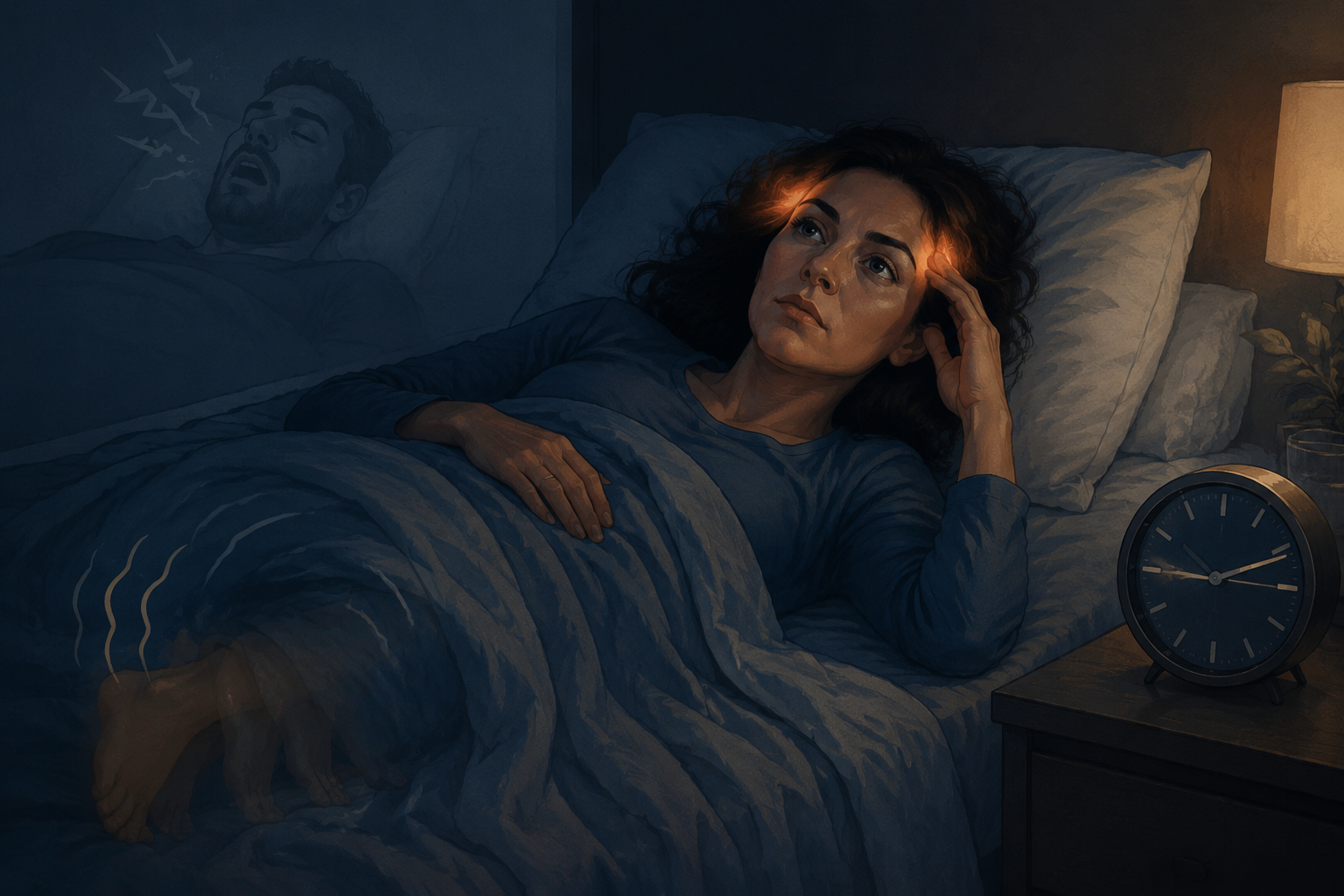
A woman can have clinically meaningful obstructive sleep apnea and still not sound like the person in the old stereotype. She may not be told she snores. No one may have witnessed her stop breathing. She may not even describe herself as sleepy. What she does say is more like this: I wake up at 3 a.m. and cannot settle. I get morning headaches. I sleep long enough and still feel wrecked. My mood is different. My brain is slow.
That pattern deserves to be taken seriously. In population-based research summarized in a major review of obstructive sleep apnea in women, up to 40% of women with an apnea-hypopnea index above 15 — a range commonly used for moderate-to-severe OSA — did not report any of the three classic symptoms: snoring, witnessed apneas, or daytime sleepiness.[1] That does not mean every tired woman has sleep apnea. It means the absence of the classic triad is not enough to close the file.
The Symptom Pattern That Often Gets Missed
Sleep apnea symptoms in women often appear as a cluster rather than one dramatic sign. A single morning headache, one restless night, or a stretch of irritability can come from many places. The clue is repetition: symptoms that keep returning despite reasonable sleep habits, mood treatment, thyroid testing, menopause explanations, or insomnia advice.
Reviews of women and OSA repeatedly describe more insomnia, fatigue, mood symptoms, morning headaches, nightmares, restless legs, palpitations, nocturia, and reflux-like nighttime symptoms than the traditional checklist tends to emphasize.[1][2] These are not softer symptoms. They are just easier to misfile.
Insomnia or Waking in the Middle of the Night
Many women with sleep apnea do not lead with “I fall asleep all day.” They lead with “I cannot stay asleep.” Breathing disruptions can fragment sleep enough to cause repeated arousals, but the person may remember only the waking, not the breathing event that came before it. The result can look like chronic insomnia: light sleep, frequent awakenings, long awake stretches after 2 or 3 a.m., or the sense that the body never fully powered down.
This matters because insomnia treatment alone may not touch the driver if obstructed breathing is part of the pattern. Sleep apnea can disturb sleep architecture — the normal cycling through sleep stages — even when the night appears, from the outside, to contain enough hours.
Morning Headaches
Morning headaches are one of the symptoms that should raise suspicion when they travel with unrefreshing sleep, nighttime waking, or snoring that is quieter than the stereotype. Women with OSA have been described as reporting morning headaches and tension-type headaches more often than men in clinical literature.[1][2]
The practical question is not whether the headache “proves” apnea. It does not. The question is whether the headache belongs to a night pattern: waking with a dull pressure, needing time to clear in the morning, or pairing with dry mouth, restless sleep, or unexplained fatigue.
Fatigue Despite Enough Time in Bed
Fatigue is one of the easiest symptoms to minimize because it has so many plausible explanations. Work, caregiving, depression, anemia, thyroid disease, perimenopause, menopause, chronic pain, and medication effects can all belong in the conversation. Sleep apnea belongs there too, especially when the fatigue feels out of proportion to the number of hours slept.
Some women do not describe irresistible sleepiness. They describe heaviness, low stamina, needing extra recovery after ordinary tasks, or never waking restored. That distinction can affect whether a clinician thinks of OSA, because many screening conversations still lean heavily on daytime sleepiness.
Mood Changes: Anxiety, Depression, Irritability, Anger
Women with sleep apnea are often treated first for anxiety, depression, or stress. Sometimes that is the right diagnosis. Sometimes it is incomplete. Fragmented sleep can make emotional regulation harder, and repeated nighttime arousals can leave the nervous system feeling overactivated before the day has started.
The symptom becomes more relevant to sleep apnea when mood changes arrive with morning headaches, nocturia, waking gasping, heart racing at night, or a bed partner’s comment that breathing sounds irregular. It is also worth noting when mood treatment helps somewhat but does not restore sleep or daytime functioning.
Brain Fog and Concentration Problems
Brain fog is easy to dismiss because it sounds imprecise. But patients usually know what they mean: slower word finding, worse short-term memory, difficulty finishing tasks, more mistakes, or the feeling of moving through the day with a delay. Sleep apnea can contribute by repeatedly interrupting sleep continuity, even if the person is unaware of most arousals.
This is one place where symptom overlap becomes especially unfair. Brain fog is also common in perimenopause and menopause, and many readers will recognize themselves in both categories. A good evaluation does not force a choice between hormones and breathing too early; it asks whether both could be contributing. For more on that overlap, see guides to perimenopause-related sleep disruption and menopause sleep problems beyond hot flashes.
Nocturia: Waking to Urinate
Waking once to urinate can be ordinary. Waking repeatedly, especially when it appears alongside snoring, morning headache, dry mouth, or unrefreshing sleep, should not be treated only as a bladder issue. Nocturia is among the symptom domains reported more heavily by women with OSA in both review literature and newer sex-difference data.[1][3]
This symptom often gets routed to fluid intake, aging, pelvic floor changes, urinary symptoms, or menopause. Those possibilities may be real. The point is to add nighttime breathing to the differential when the whole night looks disrupted.
Nightmares, Vivid Dreams, or Waking With a Jolt
Some women describe vivid dreams, nightmares, or abrupt awakenings rather than obvious choking. A breathing-related arousal may be remembered as fear, a bad dream, or a sudden body alarm. That does not make every nightmare a breathing problem, but it does make the timing and pattern useful: repeated awakenings, racing heart, dry mouth, gasping, or a sense of being startled awake deserve mention.
This can overlap with nocturnal panic. If the main experience is waking with terror, chest tightness, or a racing heart, it may help to compare the features of nocturnal panic attacks and sleep anxiety while still asking whether sleep apnea has been ruled out with the right test.
Palpitations or a Racing Heart at Night
A racing heart at night can be frightening, and it deserves medical attention on its own terms. Cardiac rhythm issues, panic, reflux, medications, alcohol, thyroid disease, and other causes may need evaluation. Sleep apnea should be part of the conversation when palpitations happen after abrupt awakenings, with gasping, sweating, dry mouth, or repeated sleep disruption.
This is a good example of why the checklist is not a diagnosis. The same symptom can point in several directions. The pattern decides whether sleep testing should be on the route.
Nighttime Heartburn or Reflux-Like Symptoms
Heartburn at night may be treated as a digestive problem, and often it is. It can also appear in the same symptom cluster as sleep apnea. If reflux-like symptoms occur with awakenings, choking sensations, coughing, dry mouth, or morning fatigue, it is worth describing the whole night rather than only the burning sensation.
Restless Legs or Restless Sleep
Restless legs and sleep apnea are different conditions, but they can coexist, and restlessness can also be the word someone uses when sleep is repeatedly interrupted. Women with OSA have been reported to present with restless legs symptoms among other less classic complaints.[1] If the bed looks disturbed, the legs feel active, and the day still begins with exhaustion, the sleep evaluation should not stop at one label too quickly.
A Quick Checklist to Bring to an Appointment
Use this as a pattern-finding tool, not a self-diagnosis. The more items that cluster together, the more reasonable it is to ask specifically about obstructive sleep apnea.
- I wake up during the night, especially repeatedly or for no clear reason.
- I wake with headaches, dry mouth, or a heavy feeling in my head.
- I get enough time in bed but do not wake refreshed.
- My main daytime symptom is fatigue, low stamina, or brain fog rather than obvious sleepiness.
- I wake to urinate more than seems typical for me.
- I have nightmares, vivid dreams, abrupt awakenings, gasping, or a racing heart at night.
- My mood, anxiety, irritability, or concentration has changed along with my sleep.
- Someone has noticed snoring, pauses, irregular breathing, mouth breathing, or restless sleep, even if it is not loud or constant.
- I have been treated or evaluated for insomnia, depression, anxiety, thyroid problems, menopause symptoms, fibromyalgia-like pain, or fatigue without a full explanation.
If you track sleep with a wearable, bring the information as context, not as a verdict. Consumer devices may flag breathing disturbances or oxygen changes, but they do not replace a diagnostic sleep study. If you are considering that route, read more about whether an Apple Watch can detect sleep apnea before treating the result as reassurance or proof.
Why Women Are So Often Told It Is Something Else
The missed diagnosis problem is not just about individual clinicians overlooking individual patients. Sleep medicine inherited a template that was built around the patients most visible in early clinical settings: men with loud snoring, witnessed apneas, and obvious daytime sleepiness. Reviews of gender differences in OSA note that sleep clinic samples have shown male-to-female ratios around 8–10:1, while community prevalence studies suggest a much narrower ratio, closer to 2–3:1.[2] In other words, the clinic waiting room did not represent the whole population.
That gap changes what everyone learns to recognize. If most diagnosed patients look a certain way, screening questions and clinical instincts drift toward that picture. Women whose symptoms are insomnia, fatigue, headaches, mood changes, nocturia, or brain fog can be sent down other pathways first.
A 2021 review focused on evaluation of OSA in female patients in primary care describes under-recognition in women and notes that common screening tools may be less accurate when women present without the classic symptom profile.[4] This does not make screening useless. It means a low-risk label from a generic questionnaire should not automatically outweigh a persistent, suspicious symptom pattern.
The scale of underdiagnosis is difficult to pin down precisely. A widely repeated estimate says as many as 90% of women with sleep apnea may be undiagnosed, but that figure depends on the population studied and the threshold used to define OSA.[5] It is best read as a warning about magnitude, not as a measurement that applies neatly to every clinic or age group.
Newer data continue to push against the old assumptions. A preliminary study presented at the 2026 SLEEP meeting analyzed 502 adults and found that, at similar AHI scores, women reported greater symptom burden than men across nocturia, headache, nightmares, sleep disturbance, anxiety, anger, fatigue, depression, and cognitive function, while snoring and Epworth Sleepiness Scale scores were similar between sexes.[3] Because this was conference data, it should not carry the same weight as a fully peer-reviewed paper. Still, it fits the clinical pattern many women describe: the burden is real even when the stereotype is absent.
Menopause Can Complicate the Picture Without Explaining Everything
Perimenopause and menopause can genuinely disrupt sleep. Hot flashes, night sweats, mood changes, changing menstrual patterns, urinary symptoms, and insomnia can all belong to that transition. It would be just as careless to call every midlife sleep problem apnea as it is to call every one “just hormones.”
The better question is what has actually been evaluated. If a woman in her 40s, 50s, or 60s develops fragmented sleep, morning headaches, nocturia, rising blood pressure, worsening fatigue, or a bed partner’s concern about breathing, menopause should not block a sleep apnea assessment. Johns Hopkins notes that postmenopausal women are two to three times more likely to have sleep apnea than premenopausal women.[6]
That increased likelihood does not mean menopause causes every case or that hormone status alone can diagnose anything. It means the overlap should widen the evaluation, not narrow it.
How to Ask for the Right Evaluation
The most useful appointment language is specific. “I’m tired” is true, but it is often too easy to route into stress, mood, or lifestyle. A clearer version is: “I’m concerned about obstructive sleep apnea because I have unrefreshing sleep, repeated awakenings, morning headaches, nocturia, and brain fog, even though I do not know if I snore.”
If there are nighttime events, name them plainly: waking gasping, waking with a racing heart, dry mouth, choking sensations, reflux-like awakenings, nightmares, or someone noticing irregular breathing. If you have been treated for insomnia, anxiety, depression, thyroid disease, menopause symptoms, or chronic fatigue without enough improvement, say that too. The sequence matters because it shows this is not one bad week of sleep.
| What to Bring Up | Why It Helps |
|---|---|
| Symptoms that happen during sleep or immediately on waking | They point the conversation toward the night, not only daytime fatigue. |
| Morning headaches, dry mouth, nocturia, gasping, palpitations, or reflux-like awakenings | These details may be more useful than simply saying you are tired. |
| Bed partner observations, even if snoring is mild | Irregular breathing, pauses, or restless sleep can matter even without loud snoring. |
| Prior evaluations or treatments that did not resolve the problem | This helps show why another pathway is reasonable. |
| Wearable sleep or oxygen trends, if available | They can support the conversation but should not replace diagnostic testing. |
Home Sleep Test or In-Lab Sleep Study?
Many patients start with a home sleep apnea test because it is simpler and more accessible. Home testing can be appropriate for some people with a high likelihood of uncomplicated moderate-to-severe OSA. The limitation is important: many home tests estimate breathing events over recording time rather than confirmed sleep time. If you are awake for long stretches, the test can make the event rate look lower than it really is during sleep.
That limitation matters for women who present with insomnia, frequent awakenings, or subtler breathing patterns. A negative home sleep apnea test should not automatically end the evaluation when symptoms persist. Ask whether an in-lab polysomnogram is appropriate, especially if your symptoms remain unexplained, the home test did not capture a typical night, or the result conflicts with what you and your clinician are seeing.
An in-lab study can measure sleep stages, arousals, oxygen levels, breathing effort, body position, limb movements, and other signals in a more complete way. It is not necessary for every person, but it can be the right next step when the story is more complicated than the home test can answer.
What This Checklist Can and Cannot Do
This checklist cannot diagnose sleep apnea. It also cannot separate apnea from menopause, anxiety, depression, insomnia disorder, thyroid disease, medication effects, alcohol effects, pain, caregiving strain, or other medical conditions by itself. Those distinctions require a clinician and, when appropriate, sleep testing.
What it can do is prevent the wrong kind of certainty. If your symptoms keep getting explained one at a time while the nighttime pattern is ignored, bring the pattern back into the room. Ask directly whether obstructive sleep apnea has been adequately evaluated in light of how it can present in women. For a broader next step after symptom recognition, see this sleep apnea symptoms, diagnosis, and treatment FAQ or the dedicated sleep apnea in women FAQ.
The point is not to make every symptom mean apnea. The point is to stop requiring women to match a male-derived stereotype before their sleep-disordered breathing is considered.
References
- Obstructive Sleep Apnea in Women: Specific Issues and Interventions, BioMed Research International, 2016.
- Gender Differences in Obstructive Sleep Apnea and Treatment Implications, Sleep Medicine Reviews, 2008.
- Women with sleep apnea report greater symptom burden than men, SLEEP 2026.
- Evaluation of OSA in Female Patients in Primary Care, PMC, 2021.
- Sleep Apnea Symptoms in Women, ResMed, 2024.
- How Does Menopause Affect My Sleep?, Johns Hopkins Medicine.
Comments
Join the discussion with an anonymous comment.