
Recovery from cyclospora can feel strangely unfair: you are exhausted, you are in bed longer than usual, and still your body keeps waking you up. Sometimes it is obvious why—urgent diarrhea, cramps, a hot unsettled abdomen. Other times the diarrhea is improving, but you wake as if you spent the night fighting the flu. The CDC explicitly notes that fatigue may continue after gastrointestinal symptoms have stopped, which is one of the more useful sentences for anyone wondering whether they are “doing recovery wrong.”[1]
The better question is not just “How do I sleep more?” It is “Which part of this infection is interrupting sleep tonight?” With cyclosporiasis, three different pathways can be involved: diarrhea that wakes you with urgency, fluid and electrolyte loss that shows up as cramps or restless legs, and immune activation that leaves sleep feeling non-restorative.
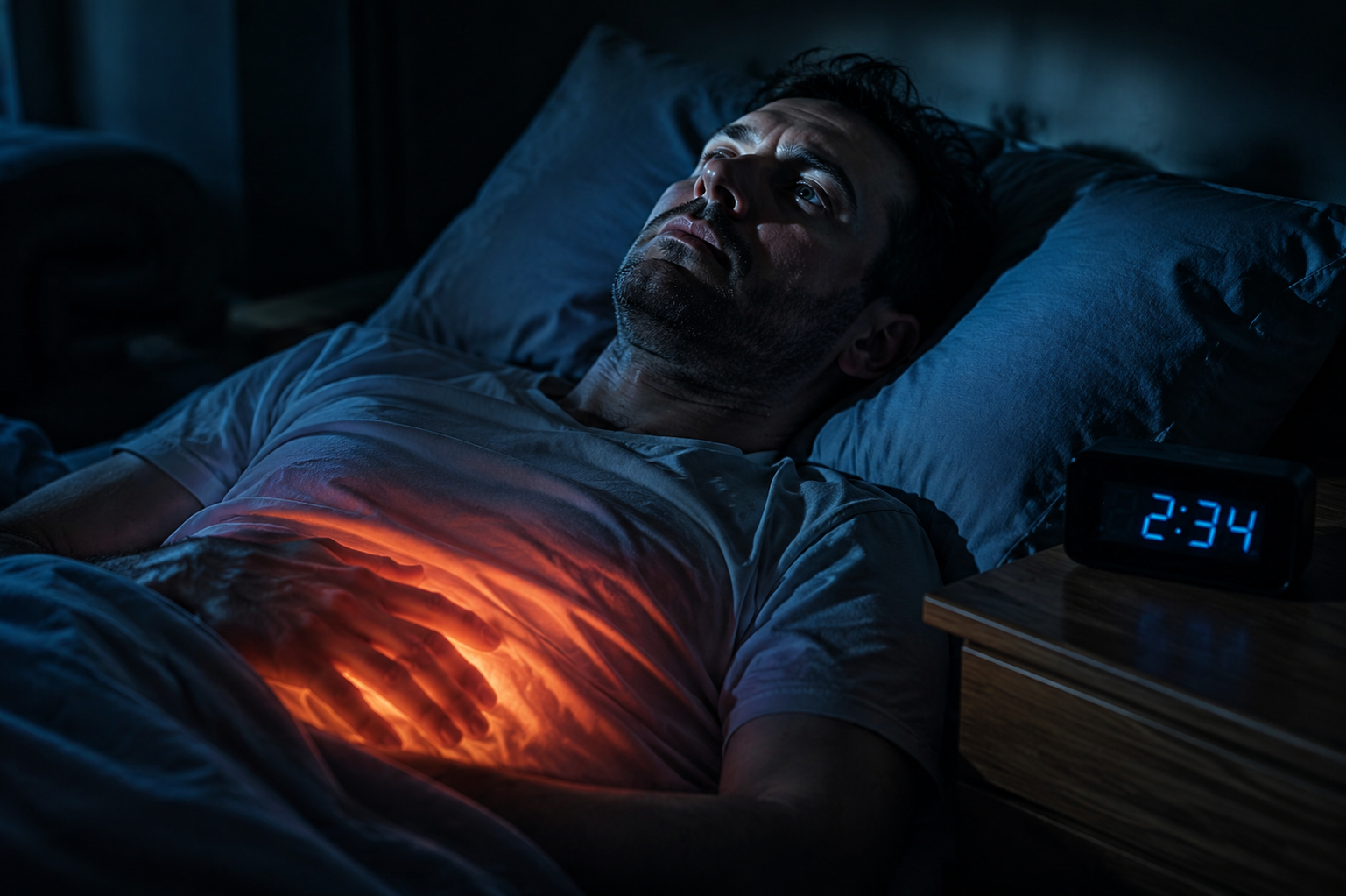
The Three Sleep Problems Hiding Inside One Infection
Cyclosporiasis is not just a generic “upset stomach.” Cyclospora infects the small intestine, and the CDC’s clinical overview explains that the infection interferes with the small intestine’s ability to reabsorb water.[2] That matters at night because the barrier to sleep is often not worry, poor bedtime discipline, or too much screen time. It is a gut that keeps pulling you awake.
| What wakes you | Likely driver | What helps most tonight |
|---|---|---|
| Sudden bathroom urgency, watery diarrhea, repeated 2 a.m. awakenings | Small-intestine water handling is disrupted, so stool remains loose and urgent | Plan hydration earlier, keep bathroom access easy, protect sleep blocks between episodes |
| Leg cramps, restless legs, muscle twitching, waking thirsty or weak | Fluid and electrolyte losses from diarrhea | Use oral rehydration rather than plain water alone; contact a clinician if symptoms suggest dehydration or significant electrolyte imbalance |
| Sleeping for hours but waking drained, achy, hot, or flu-like | Systemic immune activation and post-infectious fatigue | Lower expectations for performance, pace daytime activity, and treat sleep as recovery support rather than proof of full restoration |
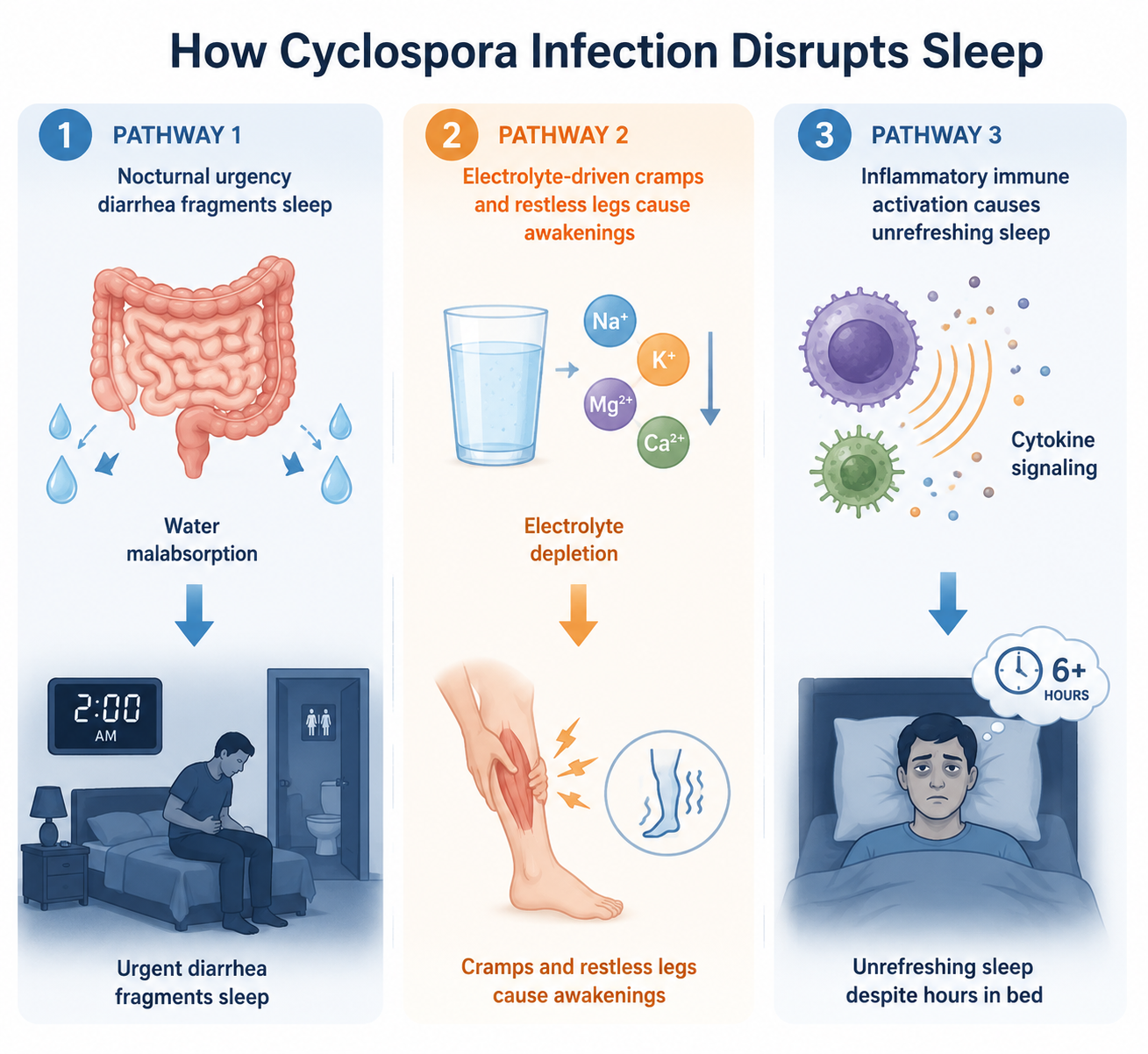
A PubMed-sourced fatigue review summarizes three overlapping mechanisms behind severe fatigue in cyclosporiasis: fluid and electrolyte loss, intestinal lining damage with malabsorption, and systemic immune activation.[3] That framework is useful for sleep, too, as long as it is not overstated. Large studies have not directly measured sleep architecture during cyclosporiasis. The sleep explanation here is a careful application of known cyclospora physiology and broader infectious-disease sleep knowledge, not a claim that cyclospora-specific sleep trials have mapped every stage of the night.
When Diarrhea Becomes a Sleep Fragmentation Problem
The first and most concrete sleep disruptor is nocturnal diarrhea. If your intestine is not reabsorbing water normally, stool can stay loose, frequent, and urgent. Even if you fall asleep quickly, each episode forces a full awakening: light on, bathroom trip, cleanup, water, back to bed, then the uneasy wait to see whether another wave is coming.
That kind of night is not simply “less sleep.” It is repeatedly broken sleep. The body may never get a long, stable stretch before the next abdominal signal arrives. This is why someone can honestly say they were in bed for ten hours and still feel as if they slept in scraps.
The practical response is to reduce the number of decisions you have to make half-awake. Put water or oral rehydration within reach. Clear the route to the bathroom. Use soft lighting if you need it. Keep a change of clothes or clean underwear nearby if urgency has been unpredictable. None of this cures the infection, but it lowers the amount of adrenaline and embarrassment attached to each awakening.
Hydration timing also matters. Chugging large amounts right before bed can make the night more restless, especially if nausea or urgency is already present. A steadier approach usually works better: drink regularly through the day and early evening, then keep smaller amounts available overnight so you can replace losses without turning bedtime into a second stomach challenge.
Anti-diarrheal medication deserves caution. It can be tempting to treat loperamide or a similar anti-motility drug as a sleep tool, but infectious diarrhea is not the same as ordinary loose stool after a heavy meal. If you have fever, blood in stool, severe abdominal pain, worsening symptoms, dehydration, or are unsure whether medication is appropriate for your situation, contact a clinician rather than trying to immobilize the gut for the sake of one night’s sleep.
Cramps and Restless Legs Are Not a Moral Failure to Relax
The second pathway is easier to miss because it may no longer feel like a bowel symptom. After repeated diarrhea, you may notice calf cramps, twitching, restless legs, weakness, headache, thirst, or a wired-but-depleted feeling. Those symptoms can wake you even when the bathroom trips are slowing down.
This is where “drink more water” can be too vague. Diarrhea does not remove only water; it can also disturb electrolyte balance. The fatigue review’s fluid-and-electrolyte mechanism is relevant here, but the sleep-specific part is an inference: electrolyte-related cramping and muscle irritability are plausible reasons for repeated awakenings during cyclosporiasis recovery, even though cyclosporiasis sleep-stage studies have not directly measured this pattern.[3]
For overnight management, oral rehydration is often more targeted than plain water alone. A commercial oral rehydration solution, or a clinician-recommended equivalent, gives the gut water plus salts and sugar in a form designed for diarrheal fluid loss. Sports drinks are not the same thing, and very sugary drinks can bother some recovering guts.
- If cramps are mild, prioritize steady oral rehydration through the day and keep a small amount beside the bed.
- If you feel dizzy, very weak, confused, unable to keep fluids down, or are urinating much less than usual, treat that as a medical issue rather than a sleep issue.
- If you take diuretics, heart medications, kidney medications, or have a condition affected by sodium or potassium, ask a clinician before aggressively changing electrolyte intake.
- If leg symptoms continue after diarrhea has clearly resolved, do not assume cyclospora explains everything; persistent cramps or restless legs may need a separate evaluation.
This is also where the advice to “just lie still and breathe” can become irritating. A cramping calf at 3:00 a.m. is not a mindset problem. It is a body problem, and the safer answer is to correct losses, watch for dehydration, and get help if the symptoms suggest more than routine recovery.
Why Sleep Can Feel Unrefreshing Even After the Bathroom Trips Ease
The third pathway is the one people often doubt in themselves. The diarrhea is better, maybe the cramps are quieter, but the body still feels heavy, achy, warm, and depleted. You sleep, wake, and immediately know you are not restored.
This is where the CDC’s fatigue statement matters. Fatigue can outlast the gastrointestinal symptoms of cyclosporiasis.[1] The fatigue review’s immune-activation mechanism gives a plausible reason: infection can trigger systemic inflammatory signaling, and that signaling can produce the same kind of sickness behavior people recognize from viral illnesses—low energy, malaise, body heaviness, and sleep that does not feel cleanly restorative.[3]
That does not mean every tired morning is dangerous. It does mean you may need to stop using “hours slept” as the only measure of recovery. During this phase, sleep is part of the repair environment. It may not immediately feel like repair.
The useful adjustment is daytime pacing. If you had a broken night from diarrhea, plan the next day as if you are recovering from an infection, not as if you merely stayed up late. Keep meals gentle if your gut is still reactive. Avoid stacking errands, workouts, alcohol, and late work into the same day just because stool frequency is improving. A body can be past the worst bathroom phase and still not be metabolically back to normal.
Treatment Helps, but the Sleep Timeline Can Lag
The current interest in cyclosporiasis is not abstract. Stanford Medicine’s July 2026 expert commentary placed the illness in the context of a diarrheal outbreak, which helps explain why more people are suddenly comparing notes about symptoms that do not feel like a routine stomach bug.[4]
Treatment expectations need the same precision as sleep advice. Cleveland Clinic notes that most people treated with antibiotics feel better in one to two weeks.[5] That is reassuring, but “better” does not always mean one perfect night followed by normal energy. If fluid balance, intestinal irritation, and immune activation are settling at different speeds, sleep may improve unevenly.
Cyclospora is commonly treated with trimethoprim-sulfamethoxazole, but diagnosis and treatment decisions belong with a clinician, especially if symptoms are severe, prolonged, or occurring in someone who is pregnant, immunocompromised, older, or medically fragile. For sleep purposes, the key point is simpler: targeted treatment may shorten the active infection, but your nights can still be affected while the gut and fluid balance recover.
If Sleep Stays Disrupted After the Parasite Is Cleared
There is a boundary where the question changes. If the infection has been treated or cleared but bloating, gas, abdominal pain, urgency, or irregular bowel habits keep waking you, the problem may no longer be active cyclosporiasis alone. It may be post-infectious gut sensitivity.
A 2023 PubMed-indexed case report described what the authors identified as the first documented case of Cyclospora-induced post-infectious irritable bowel syndrome.[6] One case report does not prove that this is common after cyclospora. It does show that persistent bowel symptoms after clearance are medically plausible, not automatically anxiety or bad sleep habits.
The often-cited estimate that post-infectious IBS affects about 10% to 20% of people after severe gut infections comes from broader post-infectious IBS literature, not cyclospora-specific trials.[3] That distinction matters. It is a reason to take persistent symptoms seriously, not a reason to assume that one in five cyclospora patients will follow the same course.
If this is the phase you are in, overnight tactics change. The goal is less about preparing for acute diarrhea and more about identifying triggers, keeping meals predictable, and working with a clinician if pain, bloating, urgency, or bowel irregularity is repeatedly fragmenting sleep. More melatonin will not fix a gut that is still sending alarm signals.
When to Stop Managing It as a Bad Night
Most sleep disruption during cyclospora recovery makes sense once you separate the drivers: urgent watery stool, fluid and electrolyte loss, and inflammatory exhaustion. The response should match the driver. Bathroom planning helps nocturnal urgency. Oral rehydration helps fluid loss. Pacing helps the drained, flu-like recovery phase.
Medical care becomes more important than sleep optimization if symptoms are persistent or worsening, if you have signs of dehydration, blood in stool, fever, severe abdominal pain, inability to keep fluids down, or if sleep remains disrupted after treatment because gut symptoms have not truly settled. Sleep usually improves as fluid balance, gut lining recovery, and immune activation settle. If it does not, the answer is not stricter bedtime hygiene; it is a closer look at the infection, hydration status, treatment response, or post-infectious gut sensitivity.
References
- Signs and Symptoms of Cyclosporiasis — CDC — https://www.cdc.gov/cyclosporiasis/signs-symptoms/index.html
- Clinical Overview of Cyclosporiasis — CDC — https://www.cdc.gov/cyclosporiasis/hcp/clinical-overview/index.html
- Does Cyclospora Cause Severe Fatigue? — Inciteful Med — https://incitefulmed.com/resources/questions/does-cyclospora-cause-severe-fatigue/
- Cyclosporiasis diarrheal outbreak: What experts say — Stanford Medicine — July 2026 — https://med.stanford.edu/news/insights/2026/07/cyclosporiasis-diarrheal-outbreak-what-experts-say.html
- Cyclosporiasis — Cleveland Clinic — https://my.clevelandclinic.org/health/diseases/17957-cyclosporiasis
- Cyclospora-induced post-infectious irritable bowel syndrome — PubMed — 2023 — https://pubmed.ncbi.nlm.nih.gov/37494655/



Comments
Join the discussion with an anonymous comment.