
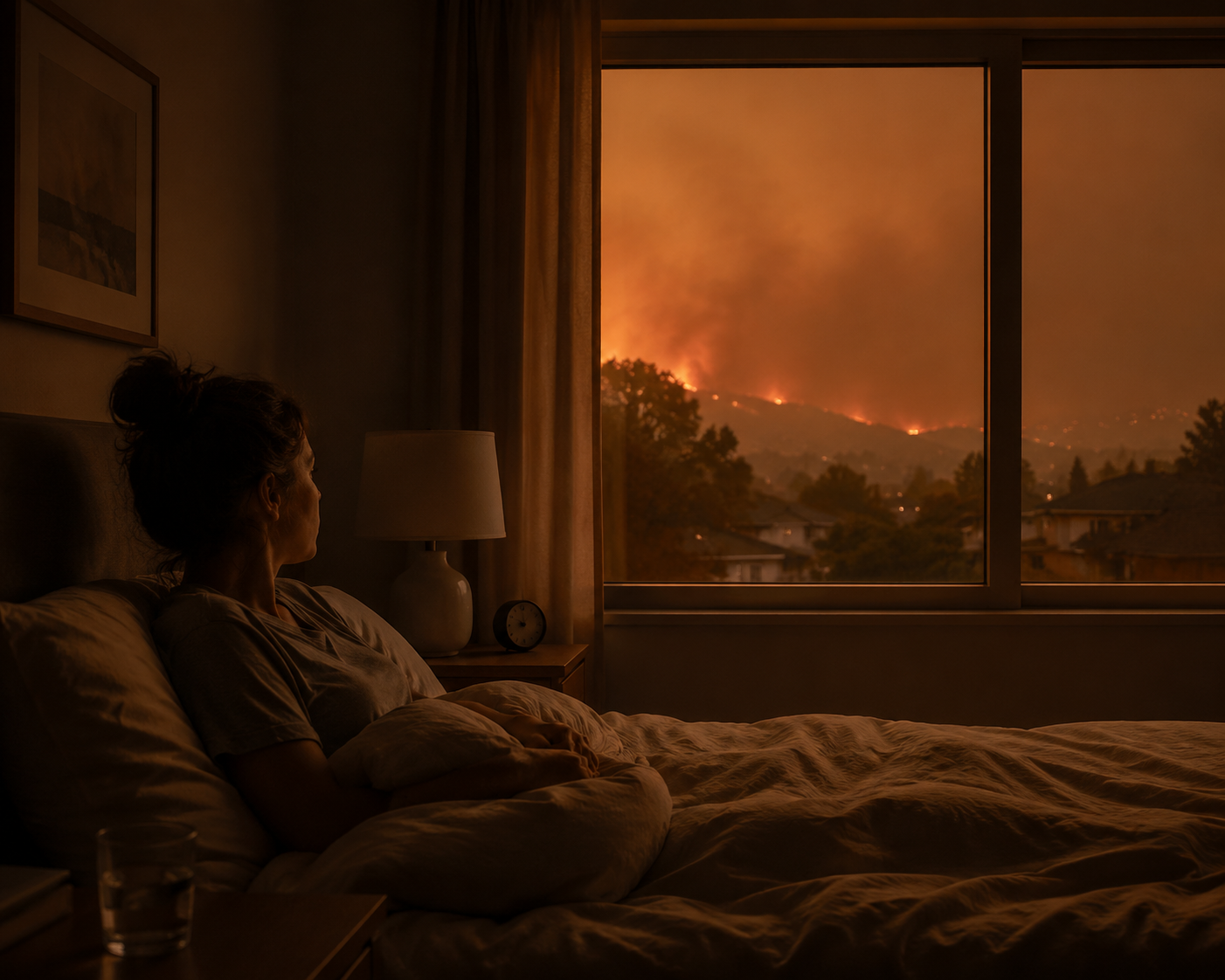
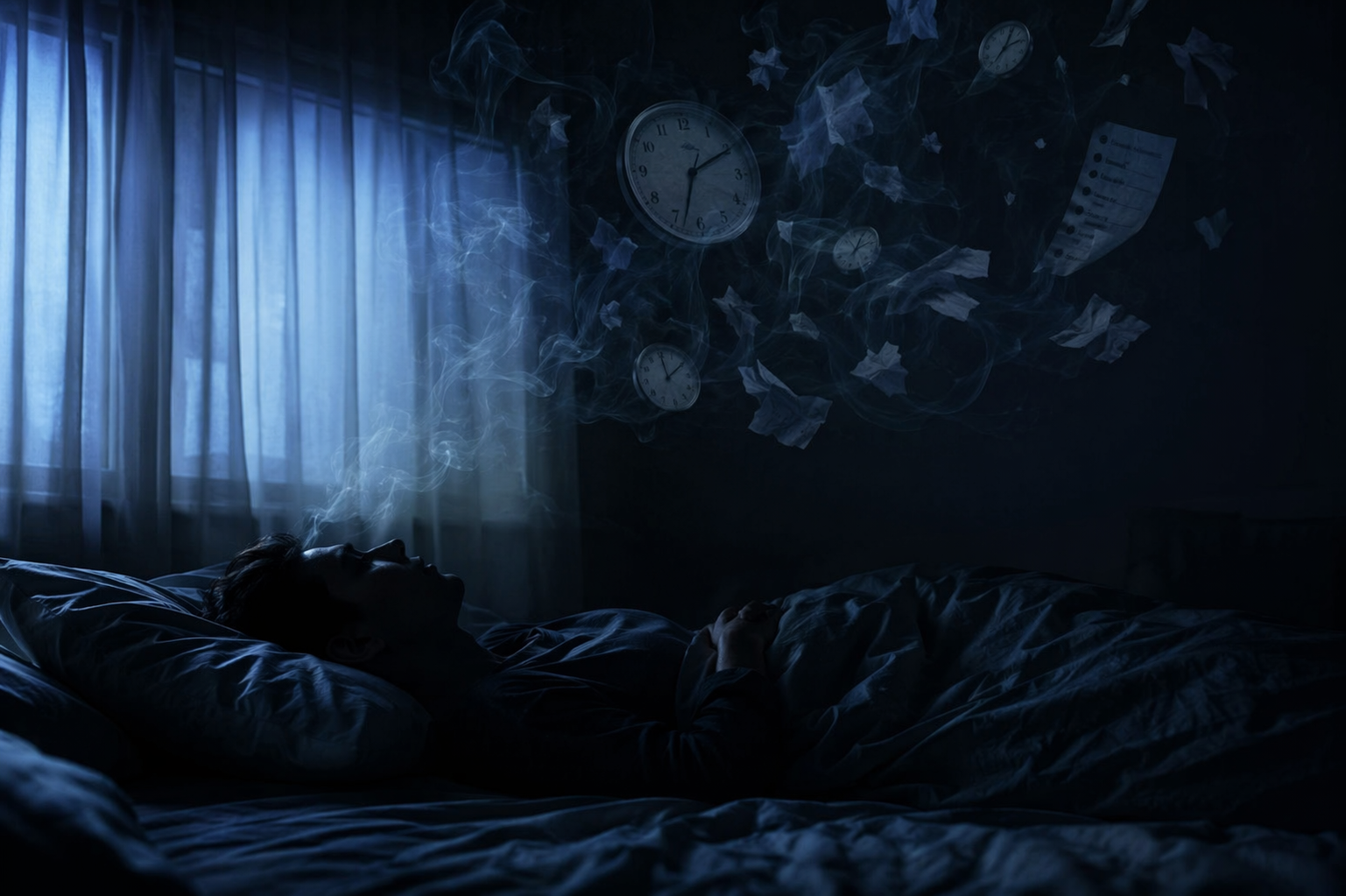
The fire can be out, the evacuation order lifted, and the bedroom still does not feel safe at night. That is the part of wildfire smoke and sleep quality that is easy to miss: sleep often remains disturbed after the visible emergency has ended. Some people return to their own beds and still wake from nightmares. Others are no longer watching flames on the ridge but lie awake with their body behaving as if it is still on alert.
Calling that “just stress” is too vague to be useful. The available research is not large enough to settle every mechanism, but it is strong enough to show that insomnia and nightmares after wildfire exposure are common, measurable, and clinically relevant — especially when PTSD symptoms are also present.
Insomnia After Wildfire Exposure Is Not a Rare Complaint
A systematic review of five studies on wildfire-related sleep disturbance found that 63% to 72.5% of wildfire survivors reported insomnia symptoms by self-report, while 43.6% met clinical diagnostic criteria for insomnia. The same review notes that this is well above the roughly 30% insomnia rate often cited for the general population, though the exact comparison depends on how insomnia is measured [1].
| Sleep outcome | What the wildfire literature found | Why the distinction matters |
|---|---|---|
| Self-reported insomnia | 63% to 72.5% of survivors reported insomnia symptoms | Captures the survivor’s experience, but may include a wide range of severity |
| Clinically diagnosed insomnia | 43.6% met diagnostic criteria | A narrower measure, but one that points more directly toward treatment need |
| Nightmares | 33.3% to 46.5% of survivors reported nightmares | Important because nightmares can maintain nighttime fear even after daytime danger has passed |
The measurement issue matters. A self-report questionnaire and a clinical diagnostic threshold are not interchangeable. If a study asks whether someone is having sleep trouble, it will usually capture more people than a formal insomnia diagnosis. That does not make the broader number meaningless; it means the number is measuring distress, not necessarily the full clinical disorder.
Nightmares show the same pattern of being too common to dismiss. Across the wildfire studies reviewed, 33.3% to 46.5% of survivors experienced nightmares. In one comparison, nightmares were reported by 46.5% of survivors with PTSD and 12.3% of those without PTSD [1]. That gap is not subtle. It also does not mean nightmares belong only to PTSD; it means that when PTSD symptoms are present, nightmare screening should not be optional.
Why PTSD and Insomnia Can Keep Each Other Going
Sleep problems after a wildfire are often described as if they sit downstream from trauma: the disaster happens, the person develops PTSD symptoms, and poor sleep follows. The literature is messier than that. The systematic review describes a bi-directional relationship: sleep disruption predicts PTSD symptoms, and PTSD symptoms also predict sleep disruption [1].
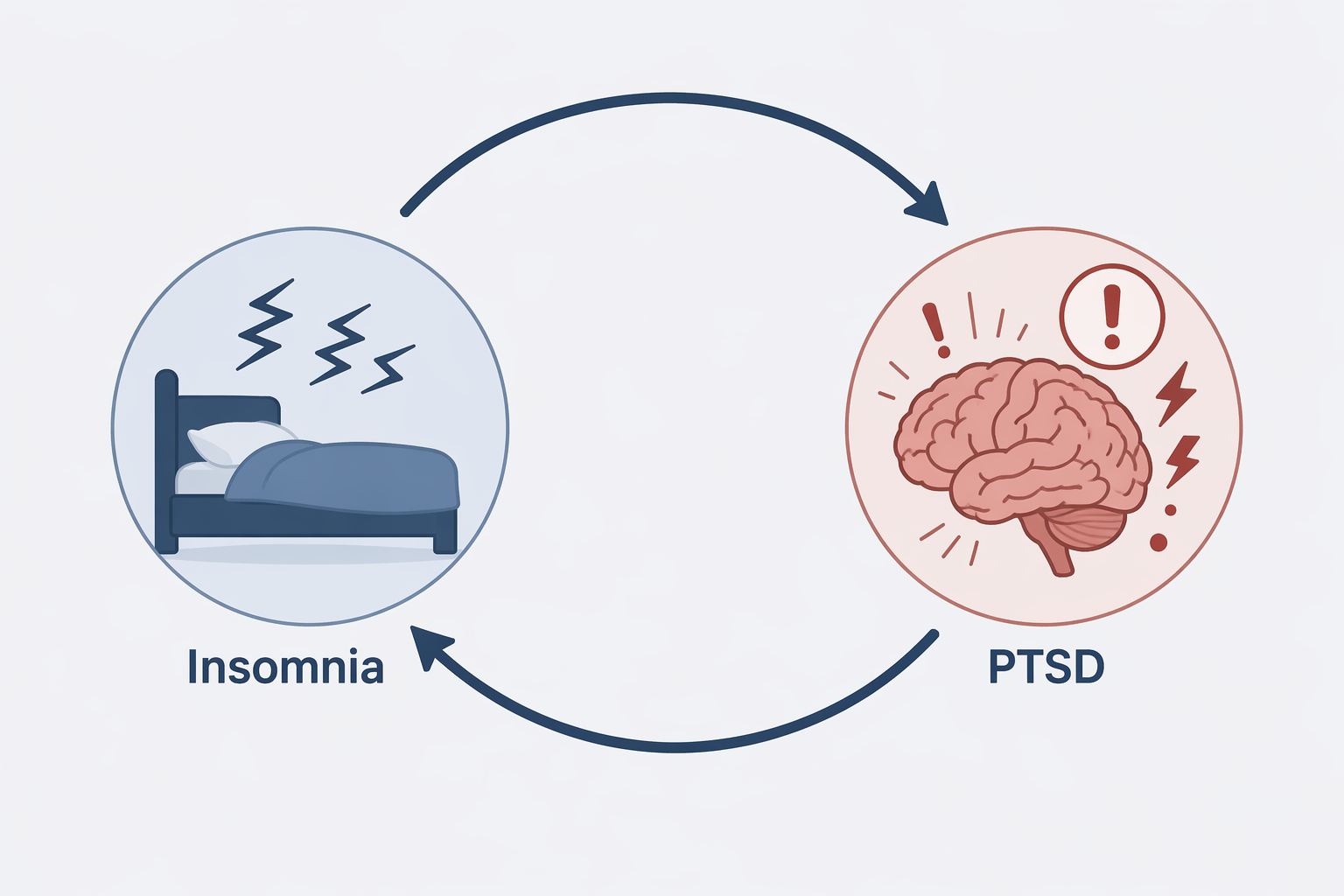
Clinically, that loop is easy to recognize. A person who sleeps lightly, wakes often, or fears nightmares has fewer chances to recover physiologically overnight. The next day may bring more irritability, more startle response, more intrusive memories, and more avoidance. Those daytime symptoms can make bedtime feel less like rest and more like exposure to another round of threat monitoring.
This is why “wait and see” can be a poor default when insomnia persists after a wildfire. Waiting may be appropriate for a few bad nights during an acute emergency. It is a different matter when sleep disturbance continues for weeks or months, especially with nightmares, hypervigilance, panic at bedtime, or avoidance of sleep. At that point, insomnia is not merely a symptom being carried along by PTSD; it may be one of the conditions helping maintain the PTSD symptom pattern.
The review found that sleep disturbances can last at least 1 to 10 months after wildfire exposure, and childhood sleep problems after wildfire may persist or worsen over time [1]. That time window is long enough for habits, fear responses, and family routines to reorganize around poor sleep.
Smoke Exposure Changes Who Counts as Affected
The most important smoke-specific finding is not that wildfire survivors sleep badly. It is that smoke exposure predicted insomnia even after accounting for other trauma factors, including evacuation status and property loss. In a follow-up survey of 126 wildfire survivors, smoke exposure was a statistically significant independent predictor of insomnia, with β = 0.17 and p < .05 [2].
That finding deserves attention because it widens the clinical field of view. A person may not have lost a home. They may not have evacuated. They may not have a dramatic story of direct flame exposure. If they spent days or weeks in smoke, and their sleep changed afterward, the current evidence does not support brushing them aside as unaffected.
The same study also found a proximity pattern: directly exposed survivors had significantly worse sleep quality than indirectly exposed survivors, with p < .001, suggesting a dose-response relationship between exposure and sleep problems [2]. That does not turn proximity into destiny. It does make exposure history more useful than a simple yes-or-no question about whether someone was “in the fire.”
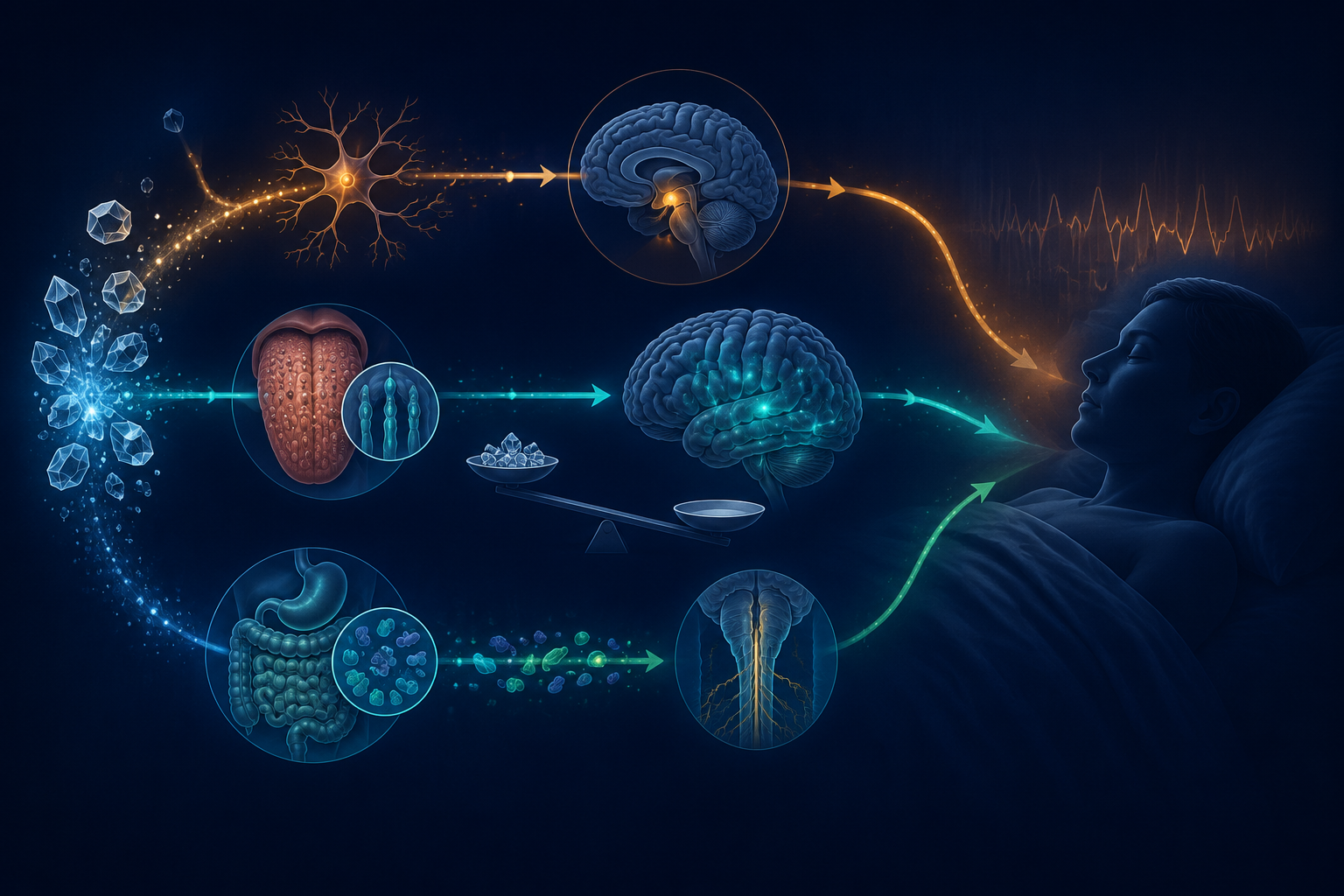
The caution is just as important. The smoke-predictor evidence comes from a single cross-sectional survey, not a longitudinal trial or repeated prospective study. It can show association after statistical adjustment; it cannot prove that smoke exposure caused insomnia [2]. Smoke may act through multiple pathways, including physical irritation, disrupted routines, perceived danger, and trauma-related arousal. The available data do not cleanly separate all of those mechanisms.
Direct Exposure, Indirect Exposure, and the People Who Get Missed
Post-disaster systems naturally prioritize people with visible losses: injuries, destroyed homes, emergency shelter needs, displacement, or financial crisis. They should. But sleep screening cannot stop there if smoke exposure itself is associated with insomnia after other trauma factors are considered.
A smoke-exposed person who stayed home may feel as if they do not have permission to report serious symptoms. This is a common clinical trap after disasters: the survivor compares their own experience with someone else’s larger loss and downgrades symptoms that still need care. Insomnia does not become harmless because someone else’s loss was worse.
For clinicians and public health workers, the practical question is not only “Did you evacuate?” or “Was your property damaged?” It is also: Did smoke enter the home? How many nights did sleep change during the smoke event? Did nightmares begin or worsen? Is the person avoiding bedtime, sleeping in fragments, or waking in a state of alarm? Are PTSD symptoms present alongside insomnia?
- Screen for insomnia symptoms separately from general distress, because self-reported sleep disturbance may not be volunteered.
- Ask about nightmares directly, especially when PTSD symptoms, hypervigilance, or bedtime fear are present.
- Include smoke exposure in the history, even when there was no evacuation, injury, or property loss.
- Reassess sleep after the acute event, because persistence over months is documented in the wildfire literature.
Children May Show the Same Problem Differently
Children exposed to wildfires may not describe insomnia the way adults do. The systematic review reports elevated separation anxiety, nightmares, and bedtime resistance in children after wildfire exposure [1]. A child who refuses to sleep alone, stalls at bedtime, or repeatedly wakes a caregiver may be showing a post-disaster sleep problem rather than simple defiance or a temporary family inconvenience.
This distinction matters because the intervention target may be different. Adult screening can ask about sleep onset, wake time, nightmares, and daytime impairment. Child screening may need to include caregiver observations: new clinginess at night, fear of separation, repeated checking behaviors, bedtime panic, or worsening nightmares. The review also notes that childhood sleep problems after wildfire may persist or worsen over time, so early reassurance should not replace follow-up [1].
What the Current Evidence Can and Cannot Say
The evidence base is still small. The 2021 systematic review included five studies, with study sample sizes ranging from 13 to 725 participants [1]. The insomnia prevalence range is wide when different measurement methods are grouped together, and most available studies focus on major wildfire or bushfire events rather than recurrent, lower-grade seasonal smoke exposure.
That limitation should narrow the claim, not erase it. The research does not prove that every smoke event causes insomnia, nor does it show that smoke is the only or primary pathway for every survivor. It does show that post-wildfire insomnia and nightmares are common, that sleep and PTSD symptoms can reinforce each other, and that smoke exposure has been identified as an independent predictor of insomnia in one adjusted cross-sectional study [1][2].
Readers interested in another post-disaster sleep pattern may find the related article on sleep after earthquake anxiety useful, but wildfire smoke adds a specific screening question: exposure may matter even when the person was not displaced or visibly injured.
The Clinical Point Is Screening, Not Reassurance
After a wildfire, sleep should not be treated as a soft afterthought once physical safety is restored. Persistent insomnia and nightmares are part of the health picture. They can last beyond the acute event, they are more common among people with PTSD symptoms, and they may help keep trauma symptoms active.
The practical response is straightforward: ask about sleep, ask again after the smoke clears, and take persistent insomnia or nightmares seriously enough to evaluate and treat. Smoke exposure does not have to be framed as a proven single cause of insomnia to be clinically relevant. It only has to be recognized as a risk signal that can identify people who might otherwise be told to wait for sleep to fix itself.
References
- A Systematic Review of the Impact of Wildfires on Sleep Disturbances — PMC, 2021.
- Prevalence and Predictors of Sleep and Trauma Symptoms in Wildfire Survivors — ScienceDirect, 2023.

Comments
Join the discussion with an anonymous comment.