
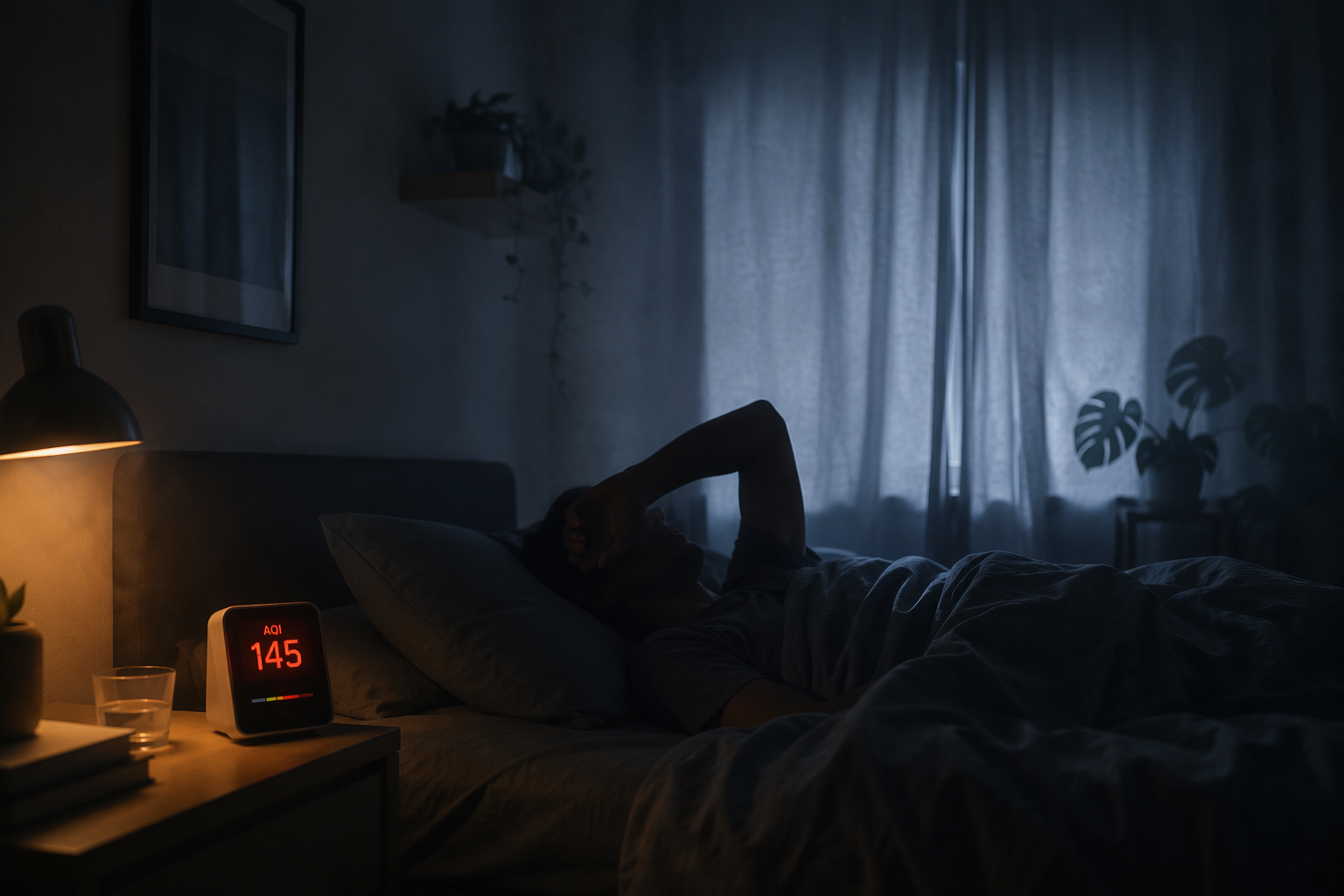
During a smoke event, bad sleep can feel strangely disproportionate. You may have shut the windows, checked the air purifier, skipped the evening walk, and gone to bed on time. Still, your chest feels a little tight, the room feels sealed off, the phone keeps pulling you back to the air-quality map, and sleep arrives thinly or not at all.
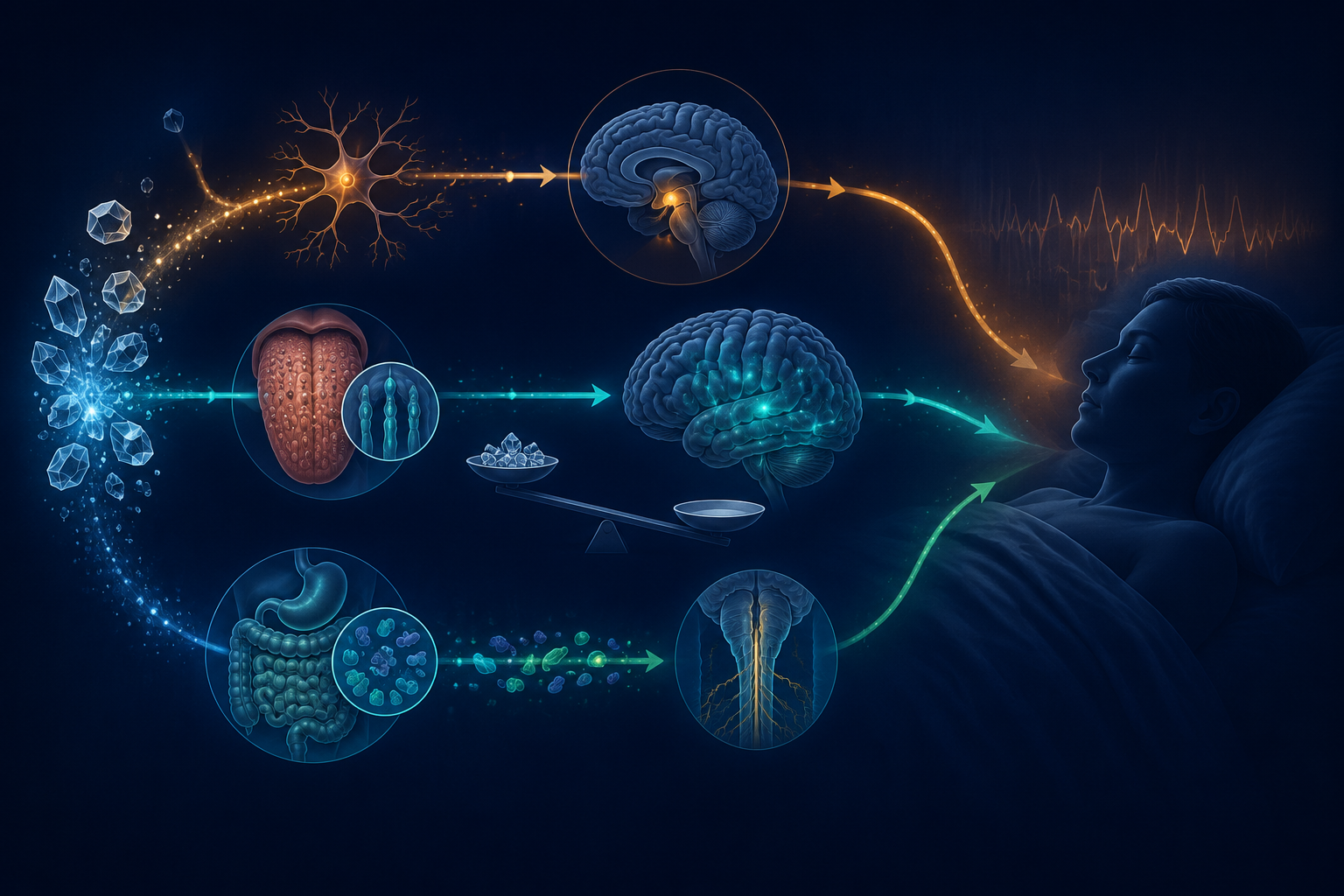
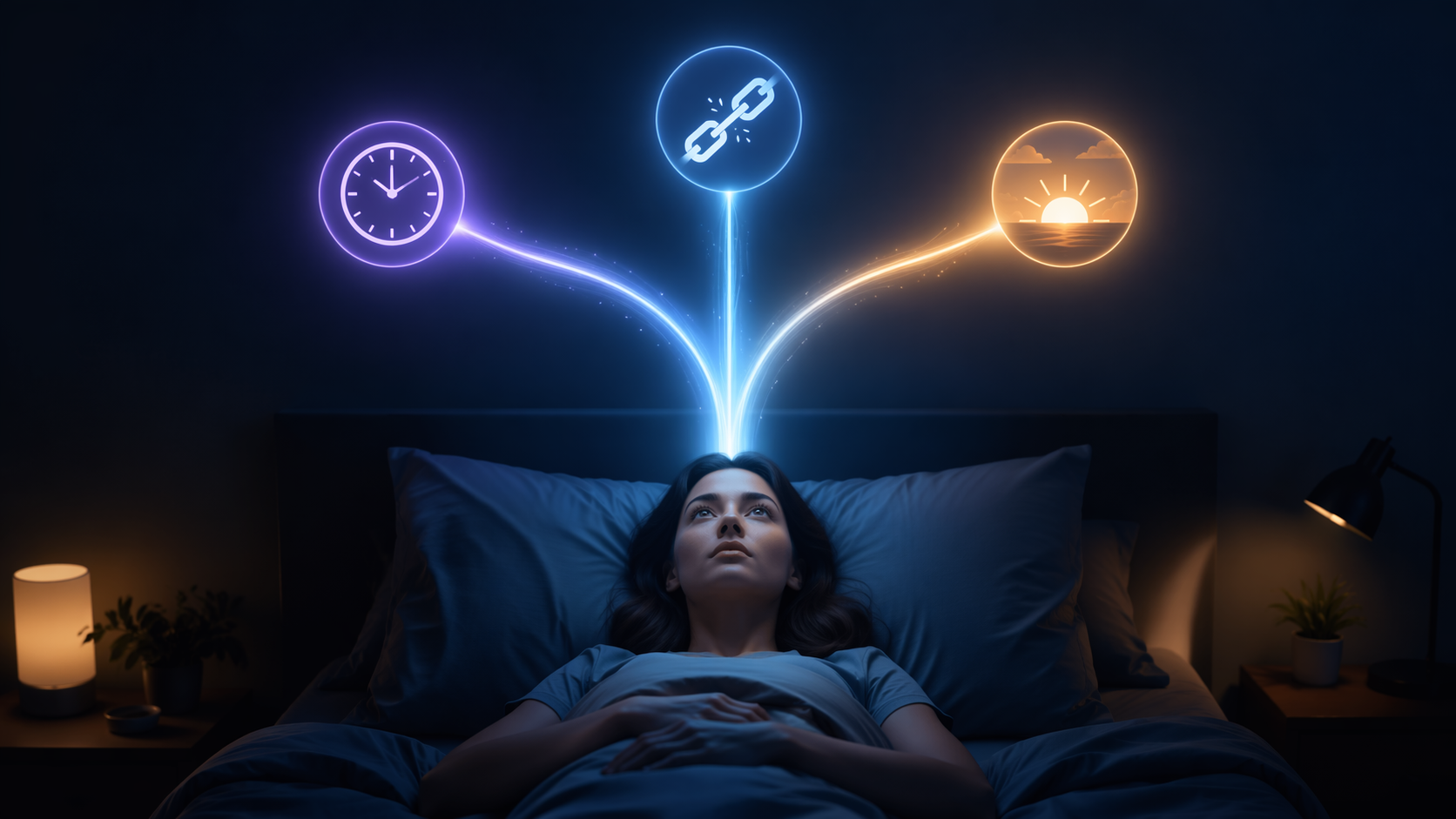
That pattern is not just “smoke is uncomfortable.” Wildfire smoke affects sleep through three overlapping pathways: a physiological pathway that can irritate the airway and disturb breathing during sleep, a psychological pathway that keeps the brain watchful, and a behavioral pathway that strips away the daily cues that normally help the body settle at night.
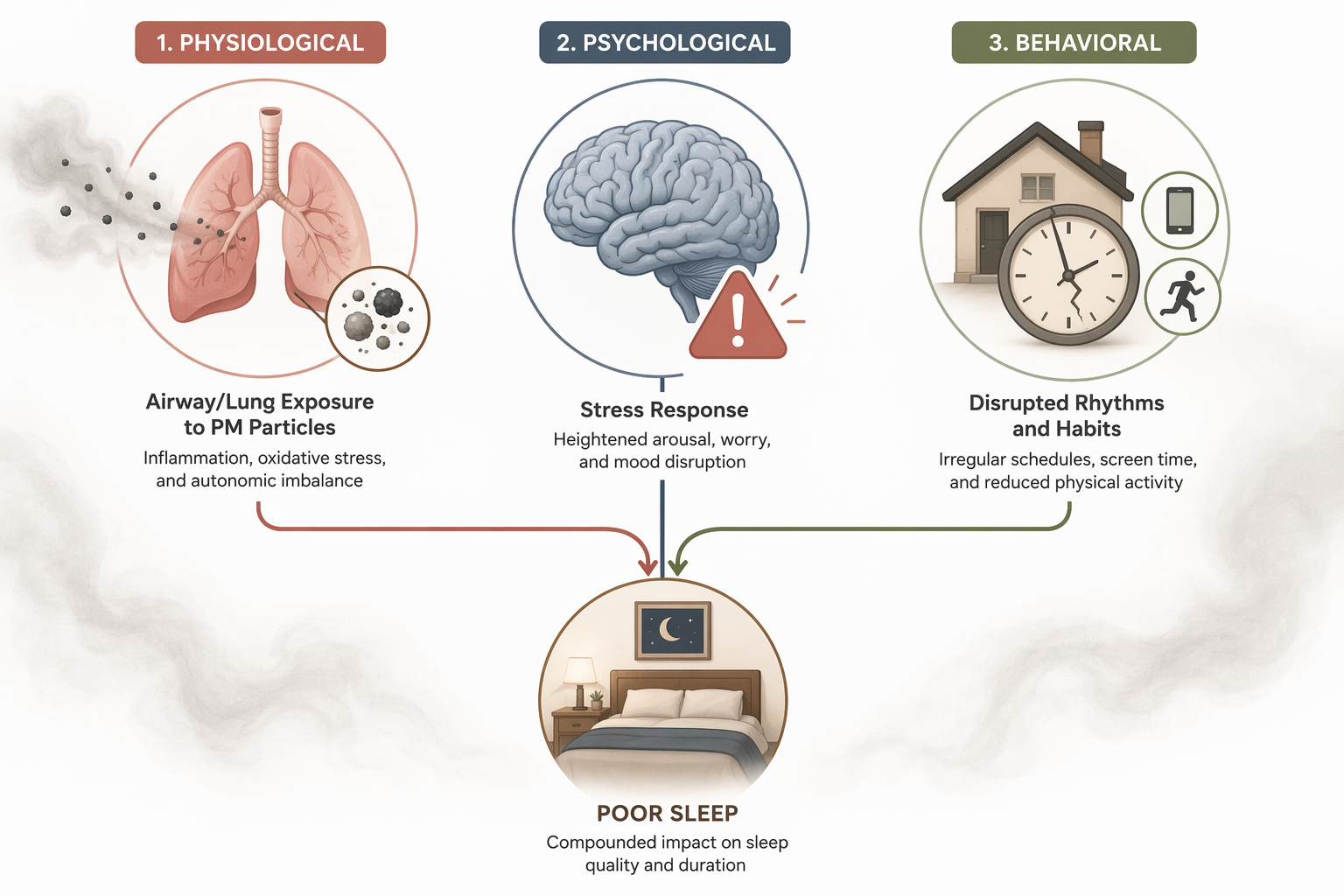
| Pathway | What changes during smoke events | How it can show up at night |
|---|---|---|
| Physiological | Fine particles and other pollutants irritate airways and may affect breathing stability | Snoring, coughing, mouth breathing, more awakenings, less efficient sleep |
| Psychological | Smoke signals danger, uncertainty, past loss, evacuation memories, or health fear | Hypervigilance, insomnia, nightmares, repeated checking, early-morning waking |
| Behavioral | People stay indoors, move less, lose daylight exposure, and become more isolated | Weaker sleep timing, more screen time, less sleep pressure, irregular routines |
The Physiological Pathway: Smoke Makes Sleep Breathing More Fragile
The most literal route from smoke to poor sleep runs through the airway. Wildfire smoke contains fine particulate matter, including PM2.5, small enough to be inhaled deeply. Sleep already narrows the airway, changes muscle tone, and reduces conscious control over breathing. Add airway irritation, congestion, coughing, or inflammation, and a night that was previously stable can become lighter and more broken.
The strongest sleep-specific signals do not all come from wildfire-only studies, and that distinction matters. In a 2024 study of children in low-income urban Boston neighborhoods, indoor PM2.5 at or above 15.6 μg/m³ was associated with 3.53-fold higher odds of objectively measured sleep-disordered breathing compared with lower exposure; the study was not a wildfire study, but the authors discussed its relevance as wildfire smoke increasingly affects indoor air quality far from the fire line.[1]
Adult data point in the same general direction, though again through air pollution rather than wildfire exposure alone. In a study across seven U.S. urban areas, summer increases in PM10 were associated with a 12.9% increase in the respiratory disturbance index and a 1.2% decrease in sleep efficiency.[2] A 1.2% change in sleep efficiency can sound small on paper. In a bedroom, it may be the difference between a night that feels continuous and one broken by brief arousals the sleeper barely remembers.
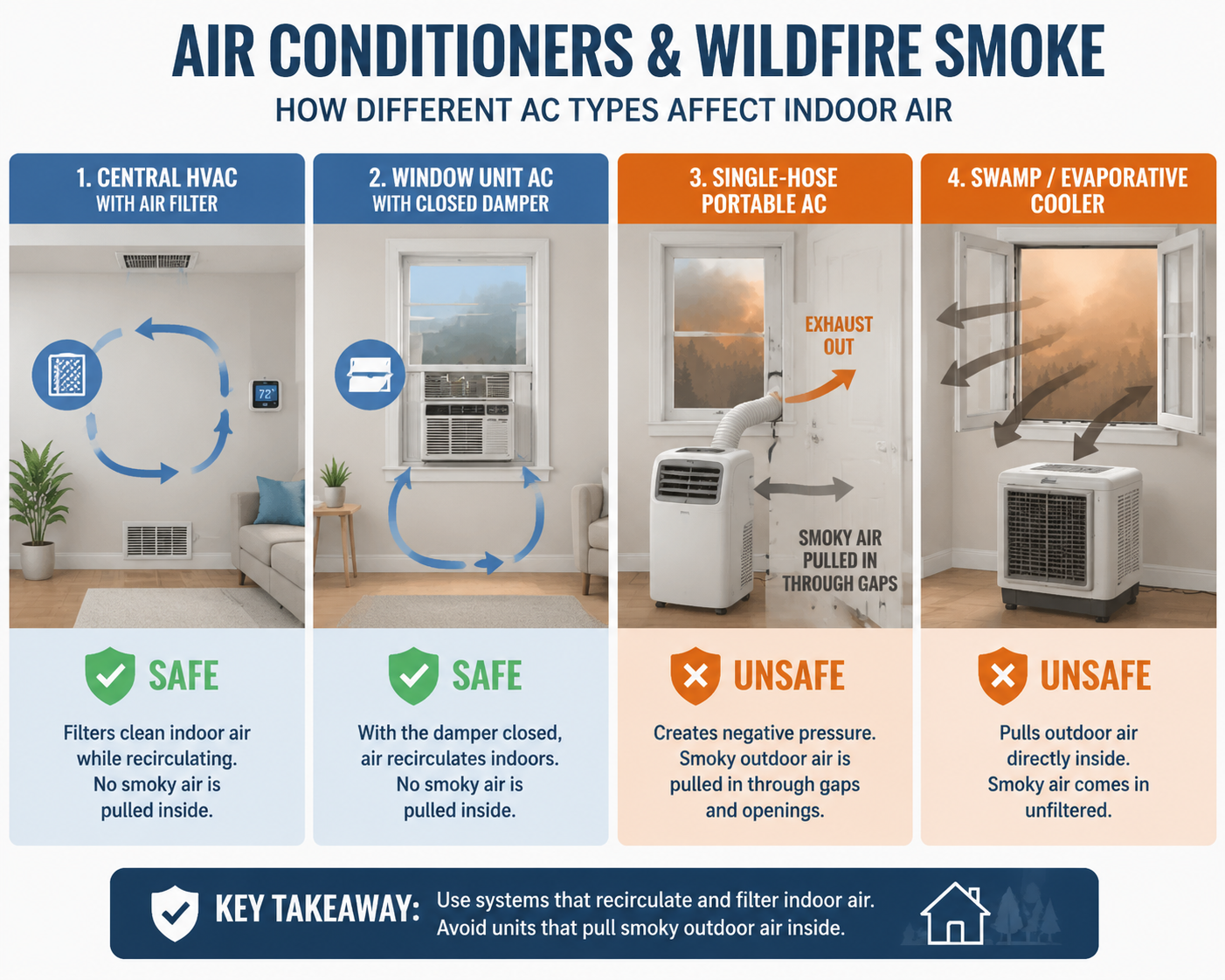
This is where many public health messages become too tidy. Closing windows and filtering indoor air are important, but indoor air is not automatically clean just because the house is sealed. Particles can infiltrate. Filters can be undersized, poorly placed, or overdue for replacement. Bedrooms can trap heat, carbon dioxide, odors, and anxiety along with cleaner air. The person lying awake is not necessarily failing at prevention; they may be sleeping inside a system that has become harder to stabilize.
The respiratory pathway can also be uneven. A healthy adult may notice only a dry throat and lighter sleep. Someone with asthma, chronic rhinitis, obstructive sleep apnea, pregnancy-related congestion, or a child’s smaller airway may have less margin. The research does not prove that every smoke-filled week causes sleep-disordered breathing, and it does not let us separate every chemical component of wildfire smoke from other pollution sources. It does support a narrower, useful conclusion: particle pollution is associated with measurable changes in sleep breathing, and wildfire smoke is a major episodic source of those particles.
The body does not need a dramatic asthma attack to sleep poorly. Slight nasal swelling can push a person toward mouth breathing. A scratchy cough can trigger micro-awakenings. More respiratory effort can make sleep feel less restorative even when total time in bed looks normal. If a sleep tracker reports more restlessness during smoke days, it may be detecting the downstream effects of a respiratory system working harder than usual, not simply “stress.”
The Psychological Pathway: Smoke Can Keep the Brain on Watch
Smoke is not only an inhaled exposure. It is also a signal. It changes the color of the sky, cancels school activities, makes the air smell wrong, and turns ordinary decisions into risk calculations. Even when flames are far away, the body may read smoke as evidence that the environment is unstable.
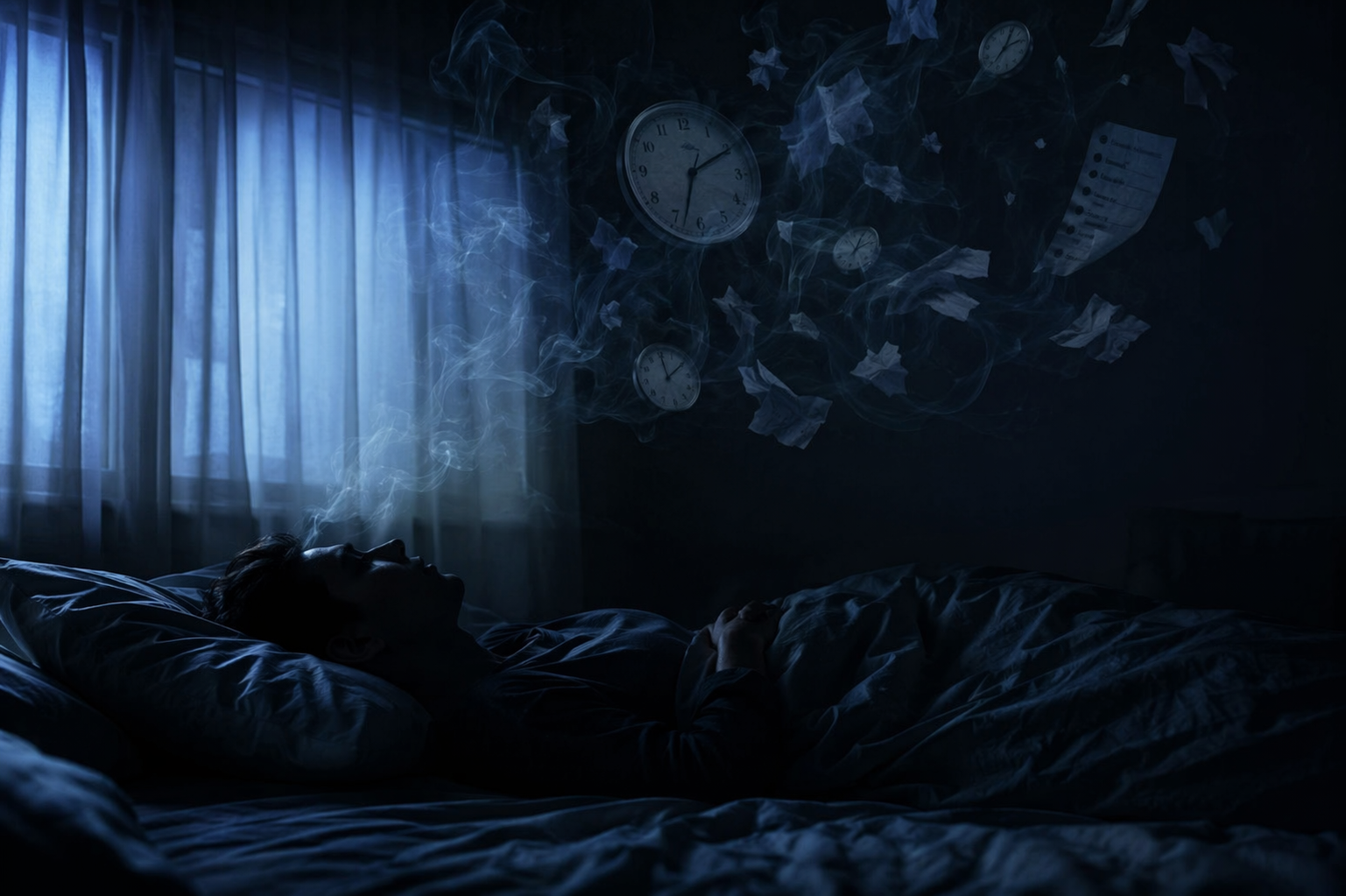
That matters for sleep because sleep requires a degree of permission. The brain has to stop scanning. During wildfire season, many people do the opposite: they check evacuation zones, watch wind shifts, compare air-quality apps, listen for sirens, worry about older relatives, or wonder whether the sore throat is just smoke or something else. The bedroom becomes less like a refuge and more like a monitoring station.
In people directly affected by wildfires, the sleep burden can be large. A systematic review of wildfire survivors found insomnia prevalence ranging from 43.6% when clinically diagnosed to 72.5% by self-report, and nightmares ranging from 33.3% to 46.5%.[3] The review included only five eligible studies, so it should not be treated as a precise estimate for every smoke-exposed community. It does show that after fire exposure, sleep disturbance is not a minor complaint sitting beside the “real” health effects. For many survivors, it is one of the ways the event continues.
Smoke-only experiences can also disturb sleep, even when the fire itself is distant. During the 2019–2020 Australian bushfire smoke event, 37% of respondents reported disrupted or poor sleep.[4] That figure does not tell us which share was driven by coughing, anxiety, heat, media exposure, or disrupted routines. It does tell us that widespread smoke can enter daily life deeply enough for sleep to become part of the public health picture.
The mental-health evidence gives this pathway more weight. A 2025 analysis reported that a 10 μg/m³ increase in wildfire-specific PM2.5 was linked with increased emergency department visits for depression, anxiety, and mood-affective disorders.[5] A scoping review of wildfire smoke and mental health also found evidence of effects on mental health and well-being, while emphasizing that the literature is still developing and varies by population, exposure measure, and outcome.[6]
For the sleeper, the practical distinction is simple: a night of wildfire-smoke insomnia may not feel like ordinary worry. It may include threat monitoring, body monitoring, and memory. Someone who has evacuated before may smell smoke and replay the earlier night. Someone with a child who wheezes may lie awake listening for breath sounds. Someone living far from flames may still feel trapped by the sky outside. For a deeper look at this route, see why wildfire smoke keeps your brain on high alert at night. If the pattern is mainly anxious rumination after lights out, the tools in what to do when anxiety keeps you up at night may be more relevant than another round of air-quality checking.
The Behavioral Pathway: Smoke Shrinks the Day That Prepares You for Sleep
The behavioral pathway is less dramatic than airway inflammation or nightmares, but it is often the part people can feel building over several days. Smoke pushes life indoors. Walks disappear. Commutes change. Children miss outdoor play. Gyms may feel less accessible. Social plans are canceled. Daylight exposure drops because windows stay covered or the sky stays dim. By bedtime, the body has had fewer cues telling it when to be alert and when to power down.
Sleep depends on pressure and timing. Pressure builds partly through waking activity. Timing is reinforced by light, meals, movement, work, school, and social contact. A smoke advisory can weaken several of those signals at once. The result may be a person who is tired but under-stimulated, worried but sedentary, bored but scrolling, and physically unready for sleep.
- Less outdoor activity can reduce sleep pressure, especially for people whose normal routine includes walking, cycling, yard work, or outdoor labor.
- Less morning light can blur circadian timing, particularly when smoke coincides with summer heat, closed shades, or long periods indoors.
- More time indoors can increase screen use, news checking, snacking, and irregular naps.
- Social isolation can remove the small anchors — school drop-off, errands, dinner with friends, evening classes — that keep days from sliding.
This pathway is easy to dismiss as “sleep hygiene,” but that phrase can make the problem sound voluntary. During smoke events, people are often making rational choices: staying indoors, reducing exertion, keeping children inside, avoiding exposure. The sleep cost comes from losing stabilizing inputs, not from laziness or poor discipline. When heat and smoke arrive together, the disruption can be even sharper; summer heat and wildfire smoke create a triple threat to sleep explains that combined seasonal burden in more detail.
Why the Pathways Usually Pile Up
In real life, these pathways rarely arrive one at a time. A person may breathe through an irritated nose, skip exercise because the air is unsafe, and then lie down with a nervous system still tracking the emergency. Each pathway makes the others more potent.
Consider a typical smoke week. On the first day, the main issue may be physical: a scratchy throat, mild cough, or heavier breathing. By the second or third day, the routine starts to erode. The morning walk is gone. The child is restless. The room is closed up. By night, worry attaches itself to every sensation. A normal dry throat becomes a reason to check the air-quality index again. One awakening becomes evidence that something is wrong. Sleep becomes a test the body is expected to pass under conditions that have changed.
This compounding is why a single fix may help but not fully restore sleep. Better filtration may reduce particle exposure but leave a person doomscrolling evacuation updates. Anxiety tools may reduce checking but not solve a hot, sealed bedroom. A consistent wake time may help the circadian system but not quiet coughing. The useful question is not only “How smoky is it?” It is “Which pathway is most active tonight, and which other pathway is feeding it?”
A broader explainer on why wildfire smoke disrupts your sleep covers several converging routes. The three-pathway frame adds a triage lens: breathing, vigilance, and routine each deserve attention because they fail in different ways.
Why This Is Becoming Harder to Treat as a Side Issue
Sleep disruption is not usually the first public health headline during wildfire season, and acute respiratory and cardiovascular risks deserve urgent attention. But smoke exposure is becoming common enough that sleep cannot remain an afterthought. Climate Central reported that per-person wildfire smoke exposure was four times higher during 2020–2024 than during 2006–2019.[7] For older adults, one 2024 analysis estimated that wildfire smoke causes about 10,070 premature deaths and 191,541 excess emergency department visits annually among Americans over 65.[8]
Those numbers are not sleep statistics, and they should not be treated as if they prove a direct insomnia burden. They do explain why more people are trying to sleep through smoke days, smoke weeks, and smoke seasons. The bedroom is one of the places where the exposure becomes personal: the air is managed, the windows are closed, the body is tired, and the mind still has to decide whether the night is safe.
Reading Your Own Smoke-Night Pattern
The three pathways are not diagnoses, but they can help you interpret what is happening. If the night is dominated by coughing, congestion, snoring, wheezing, dry mouth, or repeated breathing-related awakenings, the physiological pathway deserves priority. Indoor air quality, filtration, room choice, and medical guidance for asthma, sleep apnea, or other respiratory conditions may matter more than generic sleep tips.
If the main pattern is fear, repeated checking, intrusive memories, nightmares, or feeling unable to let your guard down, the psychological pathway is probably carrying much of the load. Cleaner air still matters, but the nervous system may also need a plan for information limits, reassurance routines, and anxiety management before bed.
If sleep drifts later each night, naps stretch longer, movement disappears, meals slide, and the day feels shapeless, the behavioral pathway may be weakening the scaffolding around sleep. In that case, the target is not perfection. It is restoring enough light, movement, timing, and social contact — safely and within smoke limits — for the body to recognize the difference between day and night.
Most smoke-event insomnia contains more than one of these patterns. That is the central practical point: wildfire smoke can disturb the airway, alert the brain, and collapse the routine in the same week. Protecting indoor air is necessary. It is also incomplete if the person in that indoor air is frightened, inactive, isolated, and listening to their own breathing until dawn.
References
- Indoor particulate matter and sleep-disordered breathing in children, Sleep Health, 2024,
- Associations of PM10 with sleep and sleep-disordered breathing in adults from seven U.S. urban areas, American Journal of Respiratory and Critical Care Medicine, 2010,
- Post-traumatic stress disorder and sleep disturbances following wildfire exposure: a systematic review, 2021,
- Physical and mental health effects of bushfire and smoke in the Australian Capital Territory 2019–20, 2021,
- Exposure to wildfire smoke linked with worsening mental health conditions, Harvard T.H. Chan School of Public Health, 2025,
- The mental health and well-being effects of wildfire smoke: a scoping review, 2022,
- Climate Change Worsens Wildfire Smoke, Climate Central, 2025,
- The Health Consequences of Wildfire Smoke, NBER, 2024,

Comments
Join the discussion with an anonymous comment.