
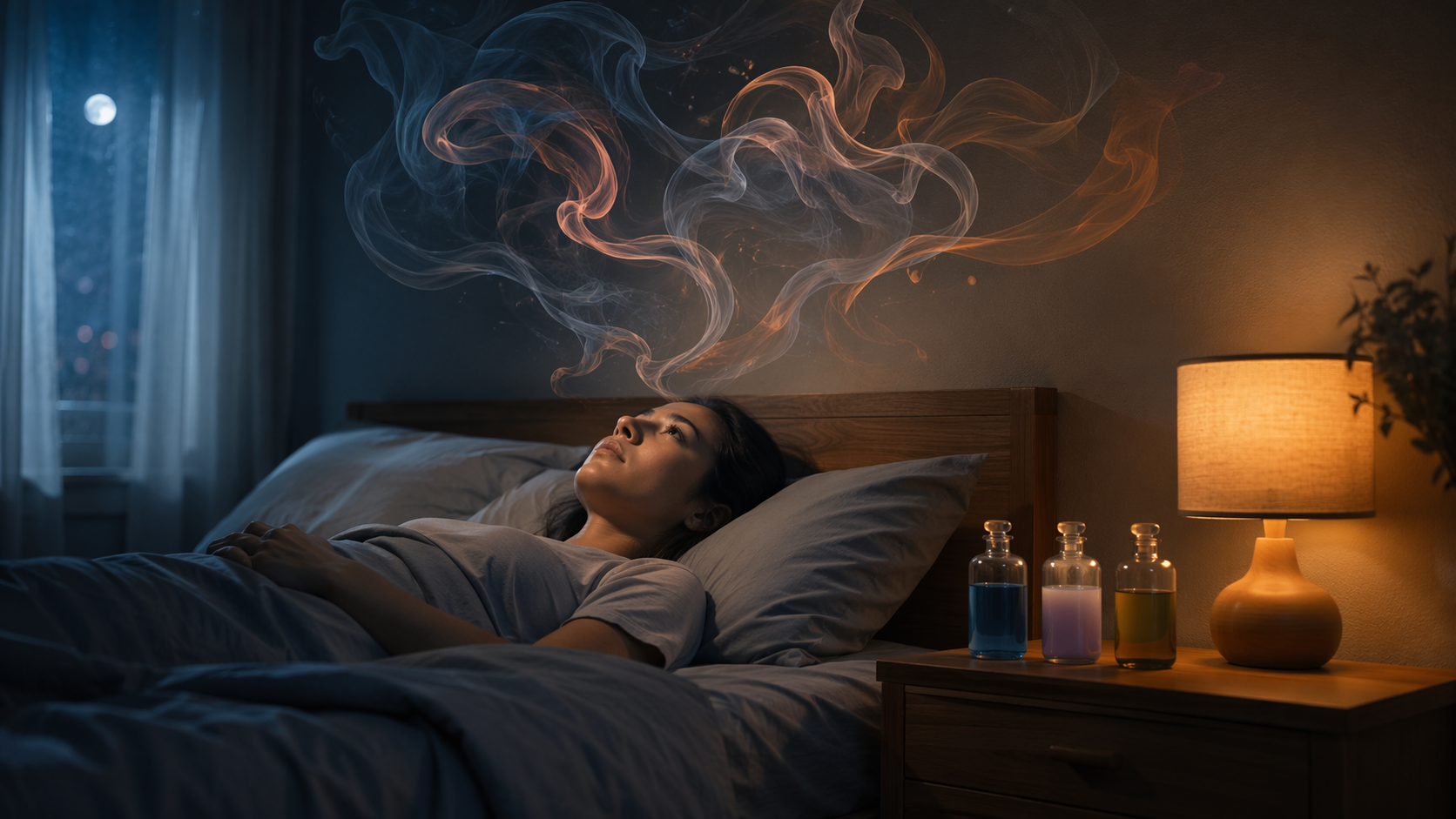
The maddening part of a smoky night is that you may not feel short of breath. You shut the windows, you run the purifier if you have one, you lie down tired, and still the night breaks into pieces: a dry throat at 1 a.m., a racing pulse at 3 a.m., one more look at the AQI map before dawn. That does not mean you are imagining it. Wildfire smoke can disturb sleep through more than the obvious route of coughing or congestion.
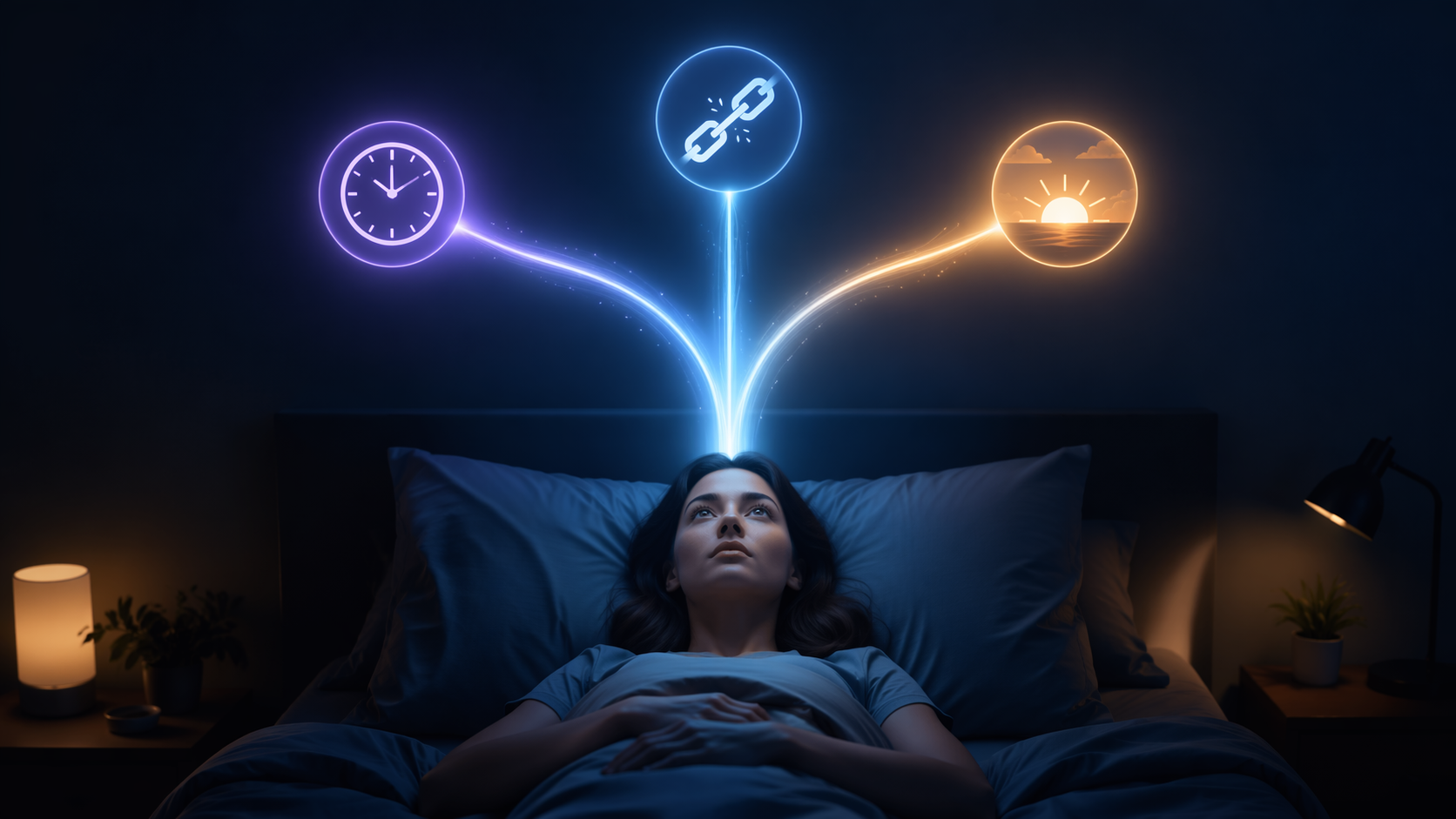
The useful way to think about sleeping during wildfire smoke is not as a single trick, but as three jobs happening at once. First, reduce what reaches your airways. Second, calm the body systems that particulate matter can activate even when your breathing feels “fine.” Third, keep the smoke event from turning bedtime into an all-night monitoring shift.
Why Smoke Can Wake You Up Even When You Can Breathe
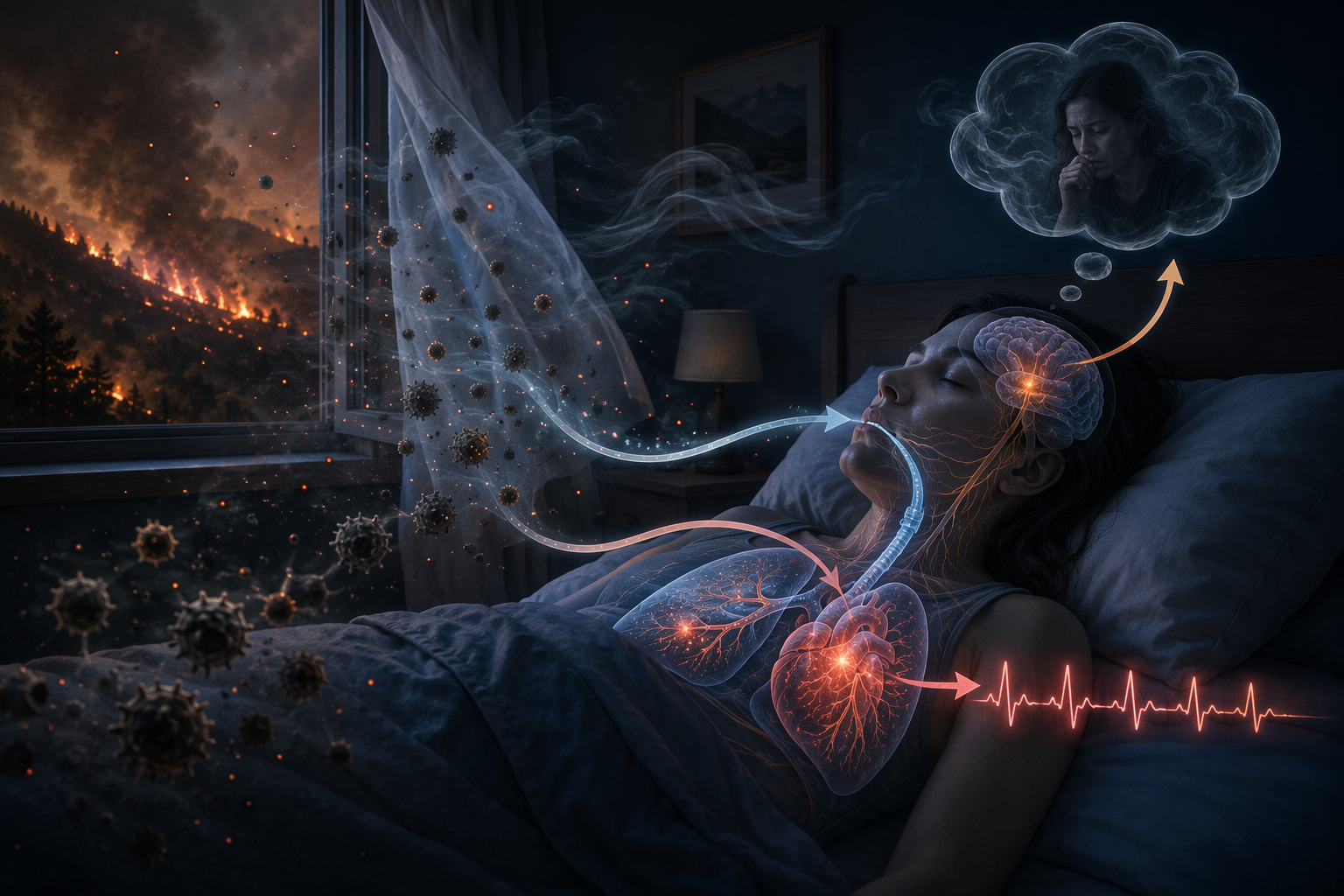
Wildfire smoke contains fine particulate matter, often discussed as PM2.5, small enough to get deep into the respiratory system. The first pathway is the familiar one: irritated nose, throat, sinuses, and lower airways. A dry cough, postnasal drip, chest tightness, asthma symptoms, or snoring can all make sleep lighter and more fragmented. People with asthma, chronic lung disease, heart disease, older adults, children, pregnant people, and anyone already vulnerable to respiratory irritation have less margin when smoke enters the room at night, according to Sleep Foundation guidance on smoke and sleep disruption.[1]
The second pathway is less visible. In a 2025 controlled study, rats exposed for one hour to eucalyptus biomass smoke at PM2.5 concentrations of 632–904 µg/m³ had suppressed REM and NREM sleep and elevated blood pressure.[2] That is not a human bedroom study, and those concentrations represent acute peak exposure rather than ordinary background levels across every smoke day. Still, the finding gives physical shape to something many people recognize: smoke exposure can appear as bodily arousal, not just airway irritation. The body may behave as if it is under threat even when you are lying still.
The third pathway is psychological, and it should not be brushed off as merely “stress.” Smoke events change what people do at night. They check maps. They wonder whether the toddler’s room is worse than the hallway. They decide whether to tape a window, text an older parent, move a pet, cancel work, or leave. During the 2019–20 Australian Capital Territory bushfire season, 37% of surveyed residents reported disrupted sleep, 45.3% reported anxiety, and 21.4% reported depression.[3] That survey does not prove that anxiety caused every sleep problem, but it does show that sleep disruption and emotional strain arrived together for many residents.
A separate 2025 JAMA Network Open study of California wildfire smoke found that each 10 µg/m³ increase in wildfire-specific PM2.5 was associated with increased emergency department visits for depression, anxiety, and mood disorders up to 7 days after exposure, with higher-risk patterns reported for women, children, young adults, and Black and Hispanic individuals.[4] Emergency visits are not the same thing as nightly sleep quality, but they are a warning against treating smoke-night anxiety as a personal weakness. The event itself can load the nervous system.
Make One Room Do the Work
On a smoky night, “indoors” is too vague. The useful unit is the bedroom, or whatever room you can make into the cleanest sleeping zone. A whole home may leak. A rental may have old windows, a loose door, a bathroom fan that backdrafts, or a wall unit that pulls in outdoor air. The room where someone is trying to sleep needs its own plan.
Portable HEPA filtration is the most practical first move when it is available. A 2023 discussion of portable purifiers for wildfire smoke mitigation reported that HEPA air purifiers can reduce indoor PM2.5 by approximately 50–80%.[5] That range is encouraging, but it is not a magic number you can paste onto every bedroom. The result depends on the size of the room, the purifier’s clean air delivery rate, how long it runs, whether the filter is installed correctly, and how much smoke keeps leaking in.
This is where many otherwise sensible smoke guides get too casual. A purifier that is undersized for the bedroom will still make noise and still consume power, but it may not exchange the air fast enough to matter much before morning. A unit placed behind a chair or half-blocked by bedding will not perform as designed. A filter that has been used through several smoke seasons may be far less useful than its label suggests. The device should be matched to the room, run continuously during the smoke period, and placed so air can move freely through the intake and outlet.
| Bedroom air-control move | What it is meant to change |
|---|---|
| Run a HEPA purifier sized for the room | Lowers indoor PM2.5 when the device has enough capacity and airflow |
| Keep windows and exterior doors closed during smoke | Reduces new outdoor particle entry |
| Limit bathroom fans, range hoods, and other exhaust when they pull smoky replacement air inside | Avoids creating pressure that draws smoke through leaks |
| Seal obvious gaps temporarily where safe and practical | Slows smoke movement into the sleeping zone |
| Use a DIY box-fan filter only as directed by safety guidance | Creates a lower-cost filtration option when commercial units are not available |
Closing the window is not just a comfort preference. In a study of low-income homes at the wildland-urban interface, indoor PM2.5 could approach outdoor levels when windows were open during wildfire seasons.[6] That finding matters because it punctures a common bedtime compromise: cracking a window because the room feels stuffy. During smoke, that small opening can turn the bedroom from shelter into a slow intake.
If you cannot cool the room without opening a window, the choice becomes harder and more unequal. Heat also disrupts sleep and can be medically dangerous. In that situation, the best answer may not be a better bedtime habit; it may be a cleaner public space, a friend’s filtered room, a cooling center, a library, a community clean-air shelter, or medical advice for someone with heart or lung disease. Household tactics should not be used to pretend everyone has the same housing, money, or safe options.
If You Do Not Have a HEPA Purifier
The U.S. EPA describes indoor air steps for wildfire smoke, including using portable air cleaners and improving filtration where possible.[7] It also discusses research on DIY air cleaners, including box-fan filter designs often called Corsi-Rosenthal boxes, as a lower-cost way to reduce particles indoors.[8] This option deserves mention because cost is not a side issue during smoke season; it decides who gets cleaner air at bedtime.
A DIY cleaner still needs care. Use current safety instructions from the EPA or local public health agencies, choose compatible filters, do not leave improvised electrical setups where children or pets can knock them over, and do not assume a homemade unit can clean a large, leaky room on its own. If the only workable clean room is small, that may be a feature, not a failure: a smaller room is often easier to filter.
Build the Night Around the Cleanest Air Window You Can Create
The bedroom does not become cleaner the moment you close the door. It needs time. If you have filtration, start it before bedtime rather than waiting until you are already coughing under the covers. Keep the bedroom door mostly closed so the purifier is not trying to clean the hallway, kitchen, and stairwell too. If there is a visible gap under the door and smoke smell is moving through the home, a rolled towel can slow the exchange; dampening it may help it conform to the gap, but it is not a substitute for filtration.
Before bed, do the small, unglamorous inspection that actually changes the night: Is the window latched? Is the purifier on its higher setting early enough to clean the room, then adjusted only if the noise prevents sleep? Is the filter seated correctly? Is the air intake clear of curtains? Is the bedroom door being opened every few minutes by people looking for chargers, pajamas, or pets? A clean-room plan fails most often through ordinary household traffic.
- Pick the smallest comfortable sleeping room you can cool safely.
- Close windows before smoke levels rise, not after the smell is already inside.
- Run filtration continuously through the evening and overnight if the device is safe for that use.
- Reduce door opening once the room is being cleaned.
- Avoid activities in the sleeping room that add particles, such as burning candles or incense.
A monitor can be useful if you already own one and understand its limits. It can also become the object you stare at instead of sleeping. For many households, the more useful rule is simpler: when outdoor smoke is high, treat the bedroom as a protected zone and stop reopening the system unless safety requires it.
Help the Airways Without Turning Bedtime Into a Medical Project
Once the room air is as controlled as you can make it, the next layer is the body. Smoke can dry and irritate the nose and throat, and that irritation can keep pulling you toward lighter sleep. The goal is not to medicate every sensation. It is to reduce the small triggers that keep waking you up.
Saline nasal rinsing or spray before bed may help some people clear irritants and thin mucus. Use sterile, distilled, or previously boiled and cooled water for rinses, and clean the device as directed. A rinse done carefully at 8:30 p.m. is very different from a frantic experiment at 2 a.m. when you are already awake and annoyed.
Humidity is another small lever. Very dry air can make an irritated throat feel worse, while too much humidity can encourage mold or make the room uncomfortable. If you use a humidifier, keep it clean and aim for comfort rather than a swampy room. The point is to reduce irritation, not add another indoor-air problem.
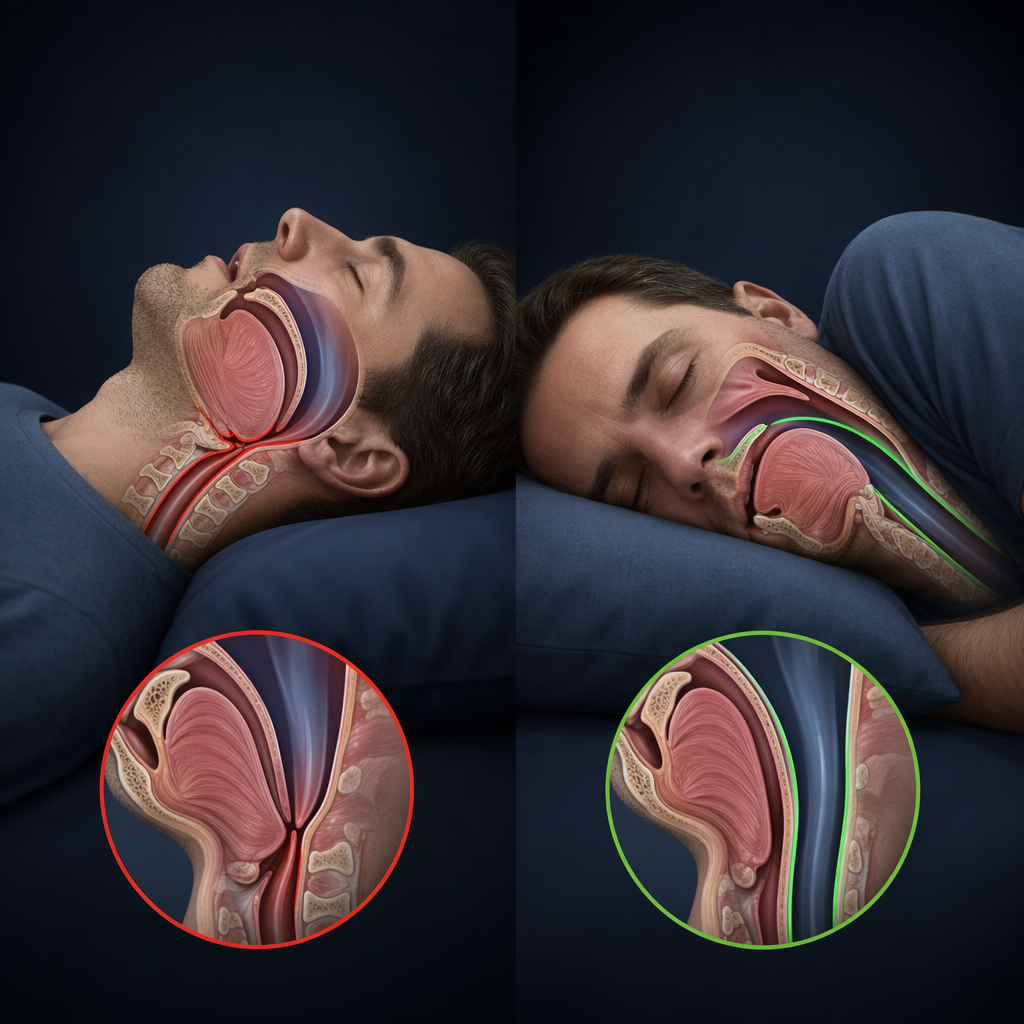
Sleep position can also matter. Elevating the head slightly may reduce postnasal drip or reflux-like irritation for some people. Side sleeping may be easier for people whose snoring or airway resistance worsens on their back. These are modest adjustments, but modest is not useless during smoke season. One fewer awakening is worth taking seriously.
There is a line where home care should stop being the plan. Wheezing, chest pain, severe shortness of breath, blue lips, confusion, worsening asthma symptoms, or oxygen concerns need medical guidance urgently. People who use inhalers, CPAP, oxygen, or heart and lung medications should follow their clinician’s smoke-event plan rather than improvising changes at bedtime.
Lower the Nighttime Alarm Load
The psychological layer begins before the lights go out. Smoke makes people vigilant for good reasons. Conditions can change, evacuation alerts matter, and vulnerable family members may need checking. The mistake is letting that vigilance run without boundaries when there is no new decision to make.
A bedtime smoke boundary should separate safety monitoring from doom monitoring. Check the sources you trust at a planned time. Decide what alert would actually require action overnight. Turn on emergency notifications if they are relevant in your area. Then stop refreshing general smoke maps in bed. The nervous system does not distinguish neatly between “I am gathering information” and “I am staying on threat watch.”
For parents and caregivers, the boundary may need to be visible. Write down the overnight plan: which room is the clean room, which device stays on, which window stays closed, who gets checked and when, what alert changes the plan. A written plan keeps the same decisions from being remade every time someone wakes up.
Isolation is part of the smoke burden too. People stop walking outside, cancel visits, keep children indoors, and lose the ordinary cues that tell the body the day is over. If the event lasts more than a night or two, cleaner shared spaces can protect more than lungs. A library, community center, school clean-air room, or friend’s filtered living room can give the body daylight, movement, and social contact without adding smoke exposure. That is not a luxury add-on for mental health; it can be part of keeping sleep from unraveling.
A Practical Smoke-Night Routine
A routine helps because smoke nights punish improvisation. The exact timing can change, but the order matters: air first, body second, information last.
- Late afternoon or early evening: choose the sleeping room, close windows, and start filtration before bedtime.
- One to two hours before bed: reduce traffic through the clean room and avoid adding indoor particles.
- Before washing up: check the forecast, AQI, and emergency alerts once, then decide what would require action overnight.
- At bedtime: use saline care, humidification, medications, CPAP, or other health routines exactly as appropriate for you.
- After lights out: keep the phone out of repeated AQI-checking reach unless you are waiting for a specific safety alert.
This is also the point to be honest about noise. Some people sleep better with the purifier on high because the air is cleaner and the sound is steady. Others need to run it high earlier, then lower it to a tolerable setting for sleep. The right setting is not the one that looks best in a product manual; it is the one that keeps the room meaningfully filtered and still lets the person in the bed sleep.
If several people share a home, put the most vulnerable sleeper in the cleanest room when possible: the person with asthma, the older adult, the pregnant person, the child, or the person whose symptoms are already flaring. Fair does not always mean everyone gets an equal slice of imperfect air. Sometimes it means the highest-risk person gets the best-protected space.
What Not to Overpromise
No bedroom routine can make wildfire smoke harmless. A HEPA purifier can reduce particles; it cannot fix a severely leaky building by itself. A towel under a door can slow air movement; it cannot create a sealed clean room. A nasal rinse can reduce irritation; it cannot treat an asthma attack. A bedtime news boundary can lower arousal; it cannot remove the real uncertainty of a nearby fire.
That is why the layered approach matters. Smoke reaches sleep through airways, autonomic arousal, and fear. If you only address one layer, the others can still keep you awake. If you reduce particle exposure, soothe irritated airways, and stop the night from becoming an endless hazard scan, you have changed the conditions under which sleep is trying to happen.
The realistic goal on a smoke night is not perfect sleep or perfect control. It is a bedroom with less particulate load, a body with fewer irritation triggers, and a nervous system that is allowed to stand down unless there is a real alert to answer.
References
- “Wildfires and Smoke: How to Protect Your Sleep” — Sleep Foundation.
- “Sleep disruption from inhalation of biomass smoke: a basis for coincident hypertension?” — Springer Nature, Particle and Fibre Toxicology, 2025.
- “Physical and mental health effects of bushfire and smoke in the Australian Capital Territory 2019-20” — PMC, 2021.
- “PM2.5 from 2020 California Wildfires and Mental Health-Related Emergency Department Visits” — JAMA Network Open, 2025.
- “Portable Air Purifiers to Mitigate the Harms of Wildfire Smoke for People with Asthma” — PMC.
- “Impact of outdoor air pollution on indoor air quality in low-income homes during wildfire seasons” — Shrestha et al., 2019.
- “Wildfires and Indoor Air Quality (IAQ)” — US EPA.
- “Research on DIY Air Cleaners to Reduce Wildfire Smoke Indoors” — US EPA.

Comments
Join the discussion with an anonymous comment.