
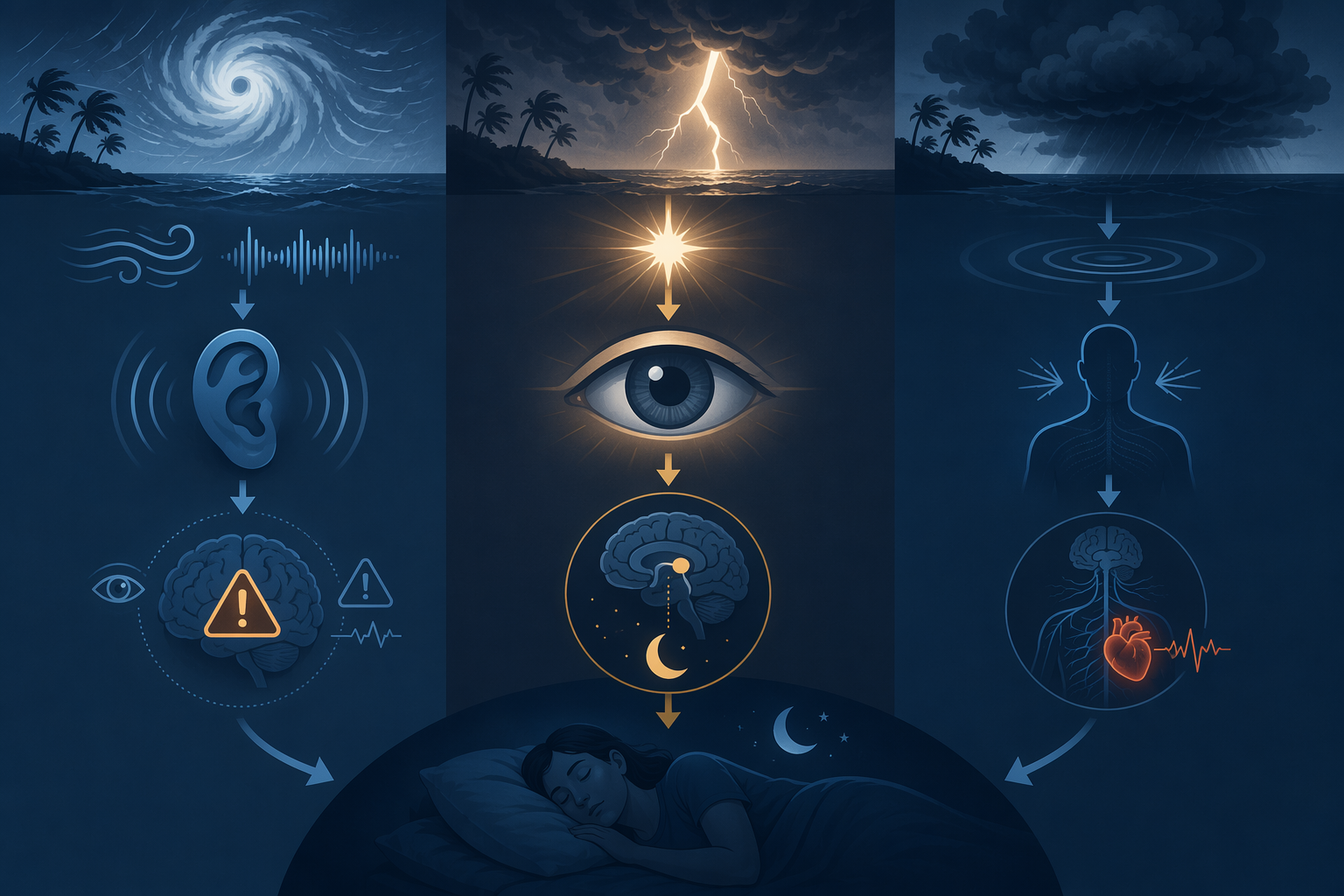
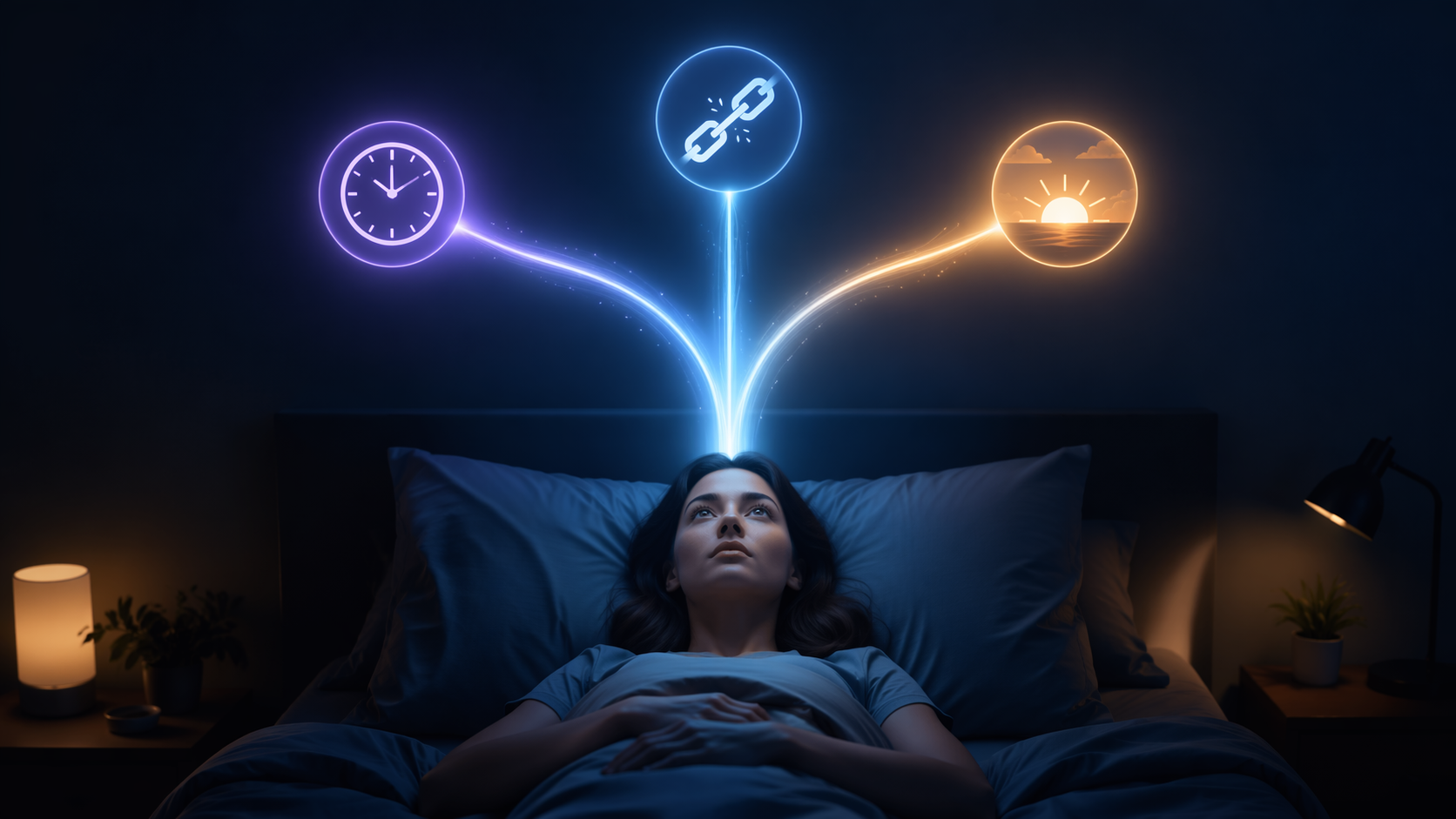
When a tropical storm is close enough to rattle windows, the usual sleep advice starts to feel thin. You may need your phone nearby for alerts. You may be listening for a change in the wind. The room may flash white every few minutes, then go dark again. The goal is not to recreate an ordinary night; it is to reduce the three things most likely to keep your brain on watch: noise, light, and anxiety.
That distinction matters. Earplugs will not calm a racing heart. An eye mask will not make a flood warning irrelevant. Deep breathing will not make a banging shutter quieter. To sleep during a tropical storm, match the countermeasure to the pathway, while keeping enough awareness to respond if conditions change.
Start With Safety, Because It Changes the Sleep Plan
If there is an active evacuation order, flooding risk, tornado warning, or any instruction from local officials to move, sleep is not the first problem to solve. Follow the warning first. If flooding is part of your situation, use a safety triage approach like deciding whether you can sleep during a flood warning before trying to settle down.
During active storm conditions, avoid any strategy that makes you too slow to wake, hear alerts, or move safely. That includes sedating sleep aids unless a clinician has specifically advised otherwise for your circumstances. Low-dose melatonin is sometimes discussed as a safer alternative, but even that belongs in a medical conversation if you have health conditions, take medications, are pregnant, or may need to respond quickly overnight.
Carbon monoxide belongs in the same safety boundary. Generators, grills, and camp stoves should never be used indoors or within 20 feet of windows, and a working carbon monoxide detector should be part of any storm sleep plan when backup power or fuel-burning equipment is in use.[1]
Barrier 1: Wind Noise Keeps the Brain Listening for Threat
Wind noise is not just annoying sound. It is irregular, rising and falling, full of bangs, creaks, and pressure changes. That pattern is hard for the sleeping brain to ignore because it carries possible information: a branch cracking, a loose object hitting the house, a window frame shifting. Even when nothing dangerous is happening in the room, the soundscape keeps asking the nervous system to check.
One sleep-industry estimate puts hurricane wind noise at roughly 100 decibels or more, with earplugs reducing sound by about 25 to 30 decibels.[2] Treat those numbers as practical estimates, not primary audiometric measurements. Still, they explain why “just relax” is poor advice. A bedroom exposed to storm noise can sound closer to a work site than a sleep setting.
The safest aim is not silence. It is lowering the sharpest peaks while preserving emergency awareness. If you block every sound and bury the phone across the room, you may reduce arousal at the cost of response time. If you leave every sound unbuffered, you may spend the night jolting awake at each gust. The middle ground is controlled masking plus reachable alerts.
| Noise problem | Better storm-night response | Safety boundary |
|---|---|---|
| Gusts, rattling, roof noise, or debris sounds keep startling you | Use white noise, a fan if power is stable, or low-volume steady audio to reduce contrast | Keep weather alerts audible and the phone within reach |
| Every outside sound feels like a possible emergency | Use one earplug, lower-noise ear protection, or sleep headphones at modest volume | Do not block both ears if you are the only adult responsible for alerts |
| The room is too quiet between gusts, making each sound feel bigger | Add a consistent background sound before trying to sleep | Have a battery backup if you rely on an electronic sound source |
White noise can be useful because it reduces contrast. The crash is still there, but it does not leap out of total silence. A fan can serve the same purpose when power is stable; the evidence and tradeoffs are covered more fully in sleeping with a fan on. The storm-night caveat is obvious but important: a fan is not a plan if the power may go out, and extension cords or improvised electrical setups are not worth the risk.
Some people already know they sleep better with background sound. One internal survey reported that 38% of Americans said they cannot sleep in silence; that is not peer-reviewed sleep epidemiology, but it does fit the practical reality that silence can make unpredictable sounds feel louder.[3]
If you use earplugs, consider the role you have that night. A person sleeping in a home with another alert adult may be able to use stronger sound reduction. A person alone, caring for children, or watching changing warnings should be more conservative: one earplug, lower-rated protection, or a mask-and-noise setup that softens sound without sealing it away. Emergency alerts should use sound, vibration, and screen notifications when possible.
Barrier 2: Lightning Turns Darkness Into Repeated Alarm
Lightning is disruptive for two reasons. The obvious one is the sudden flash. The less obvious one is that light reaching the eye can affect the circadian system through melanopsin-containing retinal ganglion cells, the pathway involved in signaling light to the brain’s clock and suppressing melatonin.[2] In a storm, the problem is not only brightness; it is contrast. A pitch-black room that suddenly flashes white gives the brain another reason to reorient.
Blackout curtains, shades, and an eye mask can help if they are already available. Triple-weave blackout fabric is often recommended for limiting outside light, though curtains alone will not solve noise or fear. The more storm-specific move is to reduce the contrast between darkness and lightning. A dim nightlight can make flashes feel less abrupt because the room is not going from black to bright in an instant.[4]
That does not mean flooding the room with light. Use the least light that lets you orient safely. If the power is out, a red-filtered flashlight or red lantern is preferable to a bright white beam because red-shifted light is less likely to suppress melatonin than shorter-wavelength light.[2] Keep it aimed downward or away from the bed. The goal is safe navigation without telling the brain it is morning.
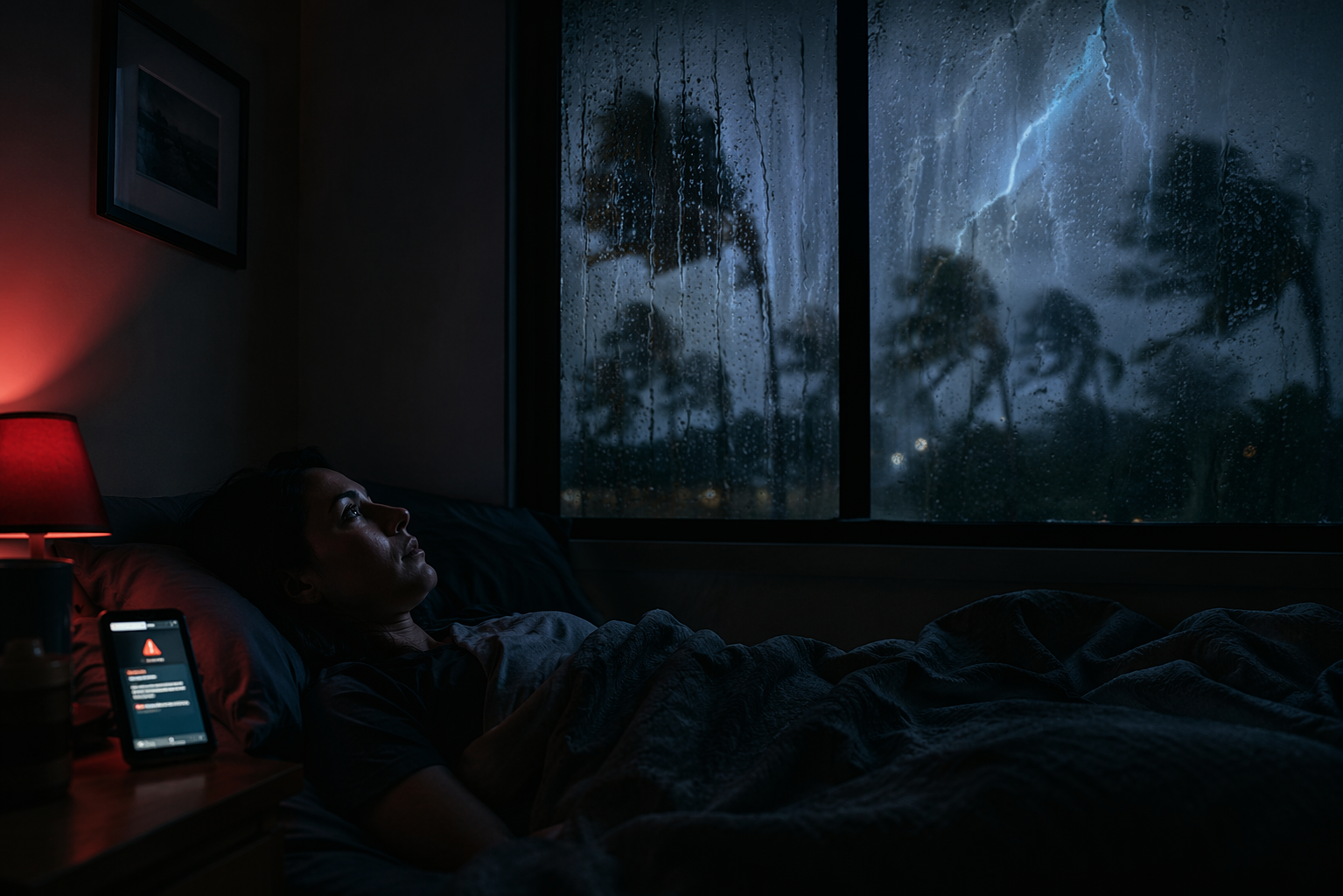
A simple setup is enough: curtains closed, phone face down but alerts on, a dim red or warm nightlight low to the floor, and a clear path to shoes, glasses, medication, children’s rooms, or the safest interior space. Do not make the room so dark that a nighttime alert turns into fumbling.
Barrier 3: Anxiety and Body Arousal Keep Sleep Light
Storm anxiety is not a character flaw. It is the body responding to uncertainty, noise, pressure changes, and possible threat. The person lying awake may be doing something adaptive: listening, checking, keeping the household ready. The problem is when that vigilance stays high after the necessary checks are done.
Physical discomfort can add fuel. Cleveland Clinic headache specialist Dr. Emad Estemalik has described how barometric pressure drops before storms may allow tissues to expand, stimulating pain-sensitive nerves and contributing to storm-related headaches.[5] If your head starts aching as the weather changes, it may be harder to sleep for a bodily reason, not because you failed to calm down correctly.
The mental-health evidence also supports taking storm arousal seriously. A 2020 meta-analysis of 17 studies found a 19.8% point prevalence of anxiety within 12 months of extreme weather exposure, though the included evidence was focused on UK flood-exposed populations rather than U.S. tropical storm nights.[6] That limitation matters; it does not give a precise risk estimate for tonight. It does show that extreme weather exposure and anxiety can be linked in more than a passing way.
For a deeper mechanism view, including thermoregulation, pressure, melatonin, and stress pathways, see how severe weather disrupts sleep. If the fear persists beyond the storm itself, hurricane anxiety and sleep disruption is the more focused route.
Prepare Before Bed So Your Brain Stops Assigning Tasks
An anxious brain often keeps rehearsing because something is unresolved. Before lying down, do the concrete checks once: charge the phone and battery pack, turn on emergency alerts, place shoes and a flashlight where you can reach them, move loose outdoor items if it is still safe to do so, identify the safest interior room, and agree on who wakes whom if an alert sounds.
Preparedness guidance from the National Weather Service and anxiety guidance from the Anxiety and Depression Association of America both support planning ahead as a way to reduce the stress load before severe weather arrives.[7][8] The useful part is not making a perfect plan. It is giving your nervous system fewer open loops to monitor at 2 a.m.
Limit Weather Coverage Without Cutting Off Alerts
There is a difference between receiving warnings and watching dramatic coverage on a loop. Live radar, damage footage, and repeated worst-case phrasing can keep the threat system activated long after you have the information you need. Baylor College of Medicine psychiatrist Dr. Asim Shah has advised reading weather updates rather than watching coverage as one way to reduce anxiety amplification.[9]
A workable boundary is to choose one or two reliable alert sources, check them at planned intervals if conditions allow, then stop scrolling. Keep Wireless Emergency Alerts on. If local officials use a county app or text alert system, use that. Let alerts interrupt you; do not make yourself the alert system by refreshing every few minutes.
Use Calming Techniques That Preserve Responsiveness
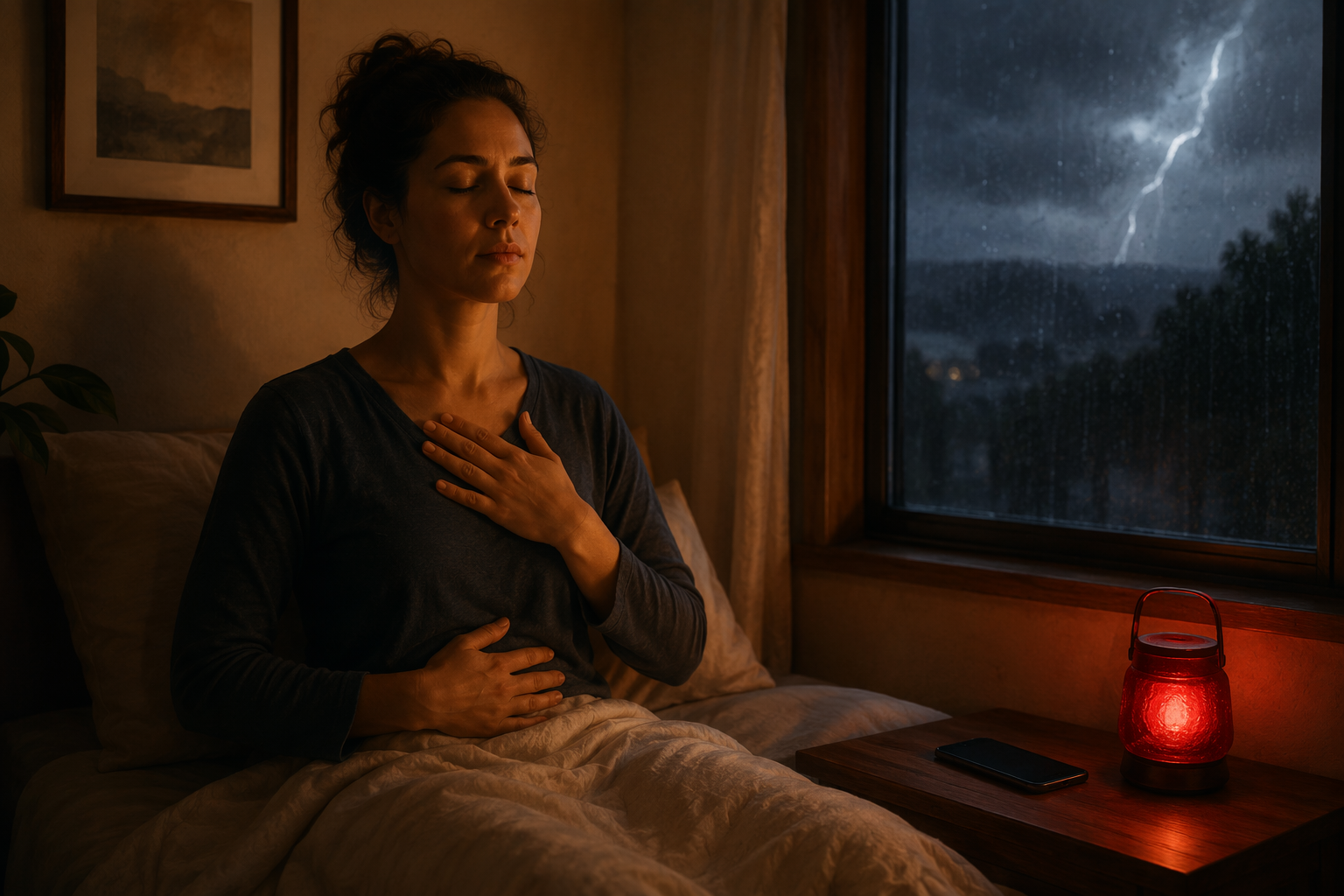
The best storm-night calming techniques are reversible. They lower arousal without dulling judgment. They should make it easier to rest, not harder to respond.
- 5-4-3-2-1 grounding: Name five things you can see, four you can feel, three you can hear, two you can smell, and one you can taste. University of Miami experts recommend this kind of sensory grounding for anxiety because it brings attention back to the present environment.[10]
- 4-7-8 breathing or box breathing: Use a slow pattern for a few rounds, then return to normal breathing. These are general anxiety-management tools applied to a storm context, not storm-specific sleep treatments.
- Progressive muscle relaxation: Tighten and release one muscle group at a time, especially the jaw, shoulders, hands, abdomen, and feet. It gives the body a physical off-ramp from bracing.
- Cognitive shuffling: Think of neutral words or images in loose sequence, such as apple, lamp, paper, shoe. The point is to give the mind something boring and non-threatening to do.
If uncertainty itself is the trigger, the same mechanism shows up in other severe-weather watches. The explanation in why you cannot sleep during a tornado watch may help you recognize why the brain treats “maybe” as something to monitor. For a more practical set of grounding and breathing options, use calming storm anxiety during a tornado watch; the weather hazard is different, but the arousal pattern can feel similar.
What a Responsible Sleep Goal Looks Like Tonight
On an active storm night, measuring success against a normal seven- or eight-hour sleep target can make a hard night feel like a failure before it starts. One expert recommendation cited by Amerisleep frames three to five hours of broken sleep as a more realistic goal during active tropical storm conditions.[2] That is opinion-based guidance, not a measured benchmark from storm-sleep studies, but it is a useful expectation reset.
If other adults are present and warnings are active, consider shifts: one person rests while another remains alert, then trade. If you are alone, make the alert system reliable enough that you are not trying to stay half-awake all night. Phone charged, volume on, alerts enabled, flashlight placed, shoes nearby, path clear. Those details are not fussy; they are what allow rest to feel permissible.
After the storm passes, most people will gradually return to ordinary sleep routines. If insomnia continues and the bed starts to feel like a place for replaying the storm, a structured approach such as CBT-I for post-disaster sleep anxiety may be more useful than adding more storm-night hacks.
The decision frame is simple. Reduce noise, but do not lose alerts. Reduce light, but do not make the room unsafe to navigate. Calm the nervous system, but do not sedate yourself out of responsiveness. Accept partial sleep as a legitimate outcome when the environment is genuinely unstable.
References
- Storm Sleep Safety and Carbon Monoxide Guidance, CDC, cited by Nest Bedding, June 2026.
- How to Sleep During a Hurricane, Amerisleep.
- Internal Sleep Survey on Silence and Sleep, Tom's Guide.
- Low-Contrast Technique for Lightning and Sleep, Dreams.co.uk.
- Barometric Pressure and Storm Headaches, Cleveland Clinic.
- The Impact of Extreme Weather Events on Mental Health in the United Kingdom, International Journal of Environmental Research and Public Health, 2020.
- Hurricane Safety and Preparedness Guidance, National Weather Service.
- Managing Anxiety During Weather Emergencies, Anxiety and Depression Association of America.
- Weather Anxiety Advice From Dr. Asim Shah, Baylor College of Medicine.
- Grounding Techniques for Anxiety, University of Miami.
Comments
Join the discussion with an anonymous comment.