
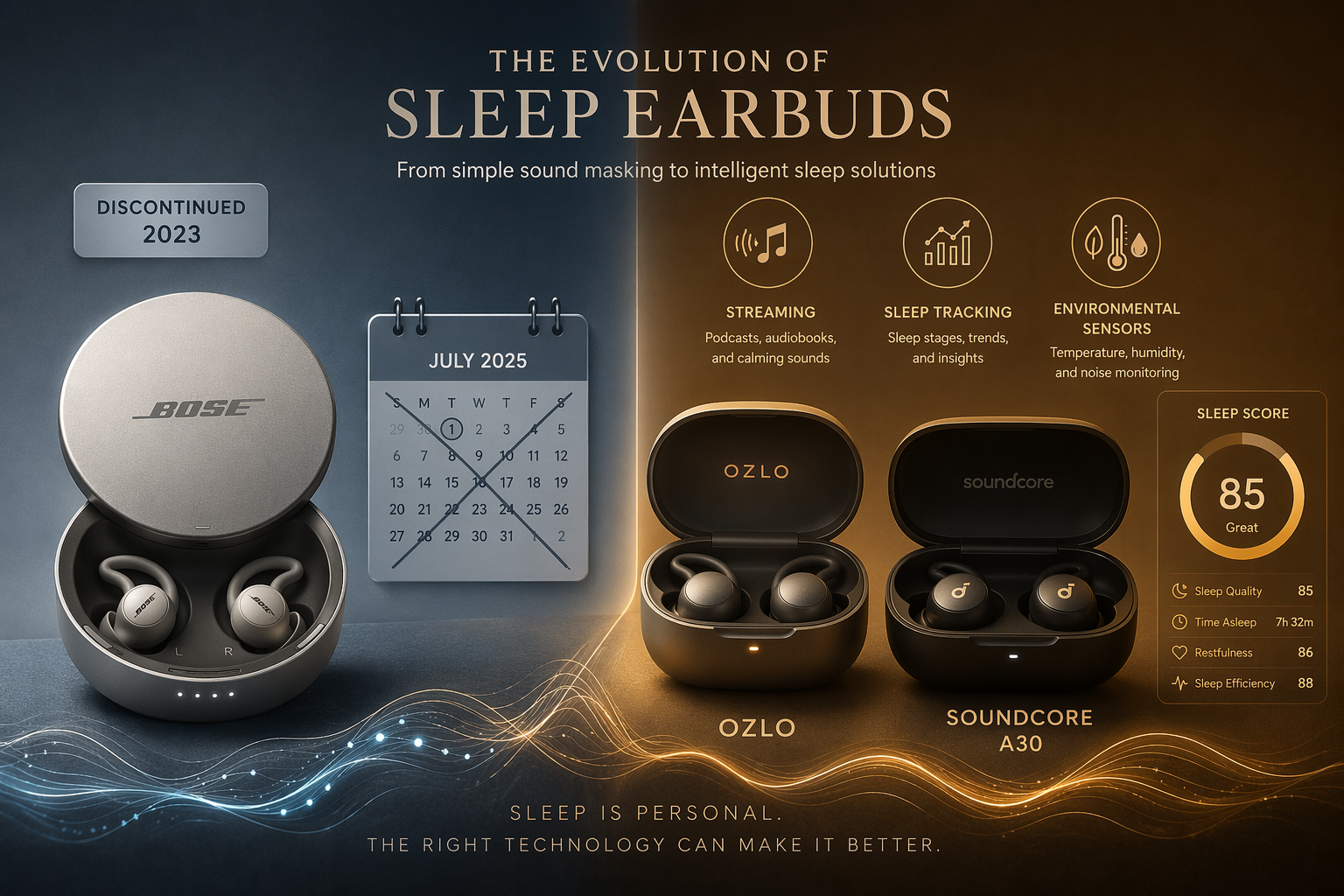
The Bose Sleepbuds II Were a Sleep Aid, Not a Sleep Tracker
When Bose released the Sleepbuds II in September 2020, the company made an explicit design decision: these were not headphones, they were not fitness trackers, and they were not sleep monitors. The official press release stated the product was "optimized for one thing — better sleep, all night, every night" through proprietary noise-masking technology, not through data collection or biometric analysis.
The Sleepbuds II contained no accelerometers, no heart rate sensors, no photoplethysmography (PPG) LEDs, and no temperature sensors. They were, in effect, tiny standalone media players that stored 35 preloaded sound tracks locally and played them through silicone ear tips designed for side-sleeping comfort. As TechRadar's 2021 review confirmed, they could not stream music, take calls, or track a single sleep metric. The only feedback loop was subjective: users either felt more rested or they did not.
This design philosophy — intervention without measurement — is increasingly rare in the 2026 sleep tech landscape. Nearly every wearable sleep device now collects some form of biometric data, and the absence of any tracking in the Sleepbuds II is precisely what makes them a useful starting point for understanding what earbuds can and cannot do when they attempt to add sleep monitoring.
What Modern Successors Claim: Ozlo and Soundcore
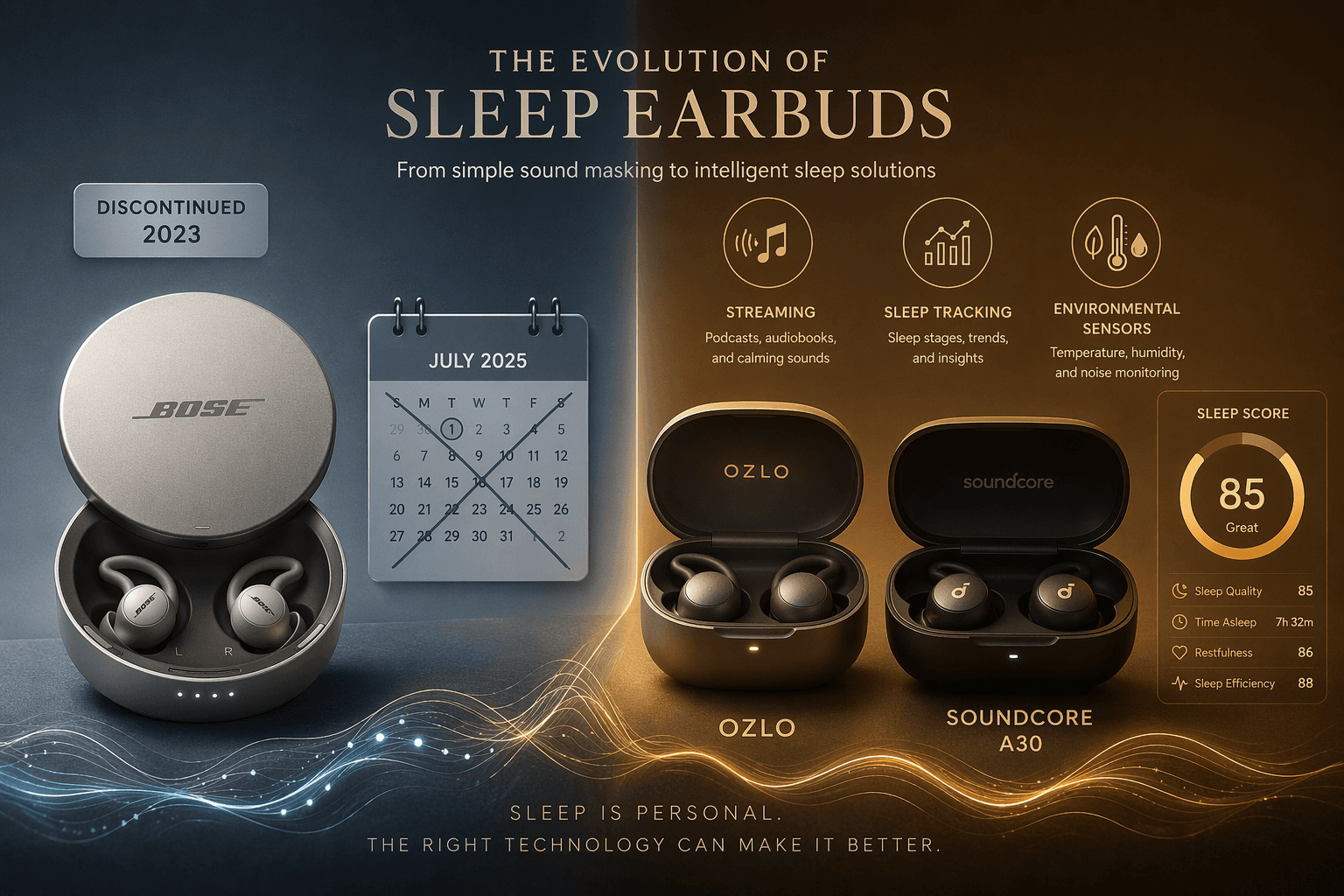
After Bose discontinued the Sleepbuds II in 2023, three former Bose engineers formed a company called Ozlo and acquired the Sleepbuds trademark. Their product, the Ozlo Sleepbuds, represents the most direct attempt to evolve the concept — and it adds sleep tracking as a headline feature.
Ozlo's Approach: Movement and Respiration as Sleep Proxies
According to The Verge's August 2023 report, the Ozlo Sleepbuds include "biometric sensing technology to monitor your movement and respiration while you lay in bed to determine when you've fallen asleep and help understand your sleep stages." The charging case adds environmental sensors for light, sound, and temperature. Ozlo's own comparison blog states the buds use "sleep-sensing technology that detects when users fall asleep and seamlessly transitions from streaming to noise masking."
Critically, Ozlo's tracking relies on movement and respiration proxies — not heart rate, not heart rate variability, and not electroencephalography (EEG). The company has not published peer-reviewed validation data comparing its sleep stage classification against polysomnography (PSG), the gold standard for sleep measurement. As of early 2026, the sleep tracking feature was still described as being in beta.
Soundcore's Approach: Movement-Based Sleep Quality Scoring
Anker's Soundcore division offers a different take. The Sleep A20 (Wirecutter's top pick as of mid-2026) and the newer Sleep A30 Special both include sleep tracking, but the methodology is even more limited. Wirecutter's review notes that "the earbuds can track your sleep, but the data may not be as in-depth as that of formal sleep-tracking devices." The tracking is primarily movement-based, generating a sleep quality score rather than staging sleep into light, deep, and REM categories.
The A30 Special adds active noise canceling and adaptive snore masking, and its charging case can monitor and analyze snoring sounds. But like Ozlo, Soundcore has not released PSG validation data for its sleep staging algorithms.
- Ozlo Sleepbuds: Movement + respiration sensing; sleep stage estimation; case-based environmental monitoring; no published PSG validation
- Soundcore Sleep A30 Special: Movement-based sleep quality scoring; snore detection via case; no published PSG validation
- Soundcore Sleep A20: Movement-based tracking; longer battery life (14h vs. 9h); no sleep stage classification
The Validation Benchmark: What Published PSG Studies Show for Wearables
To evaluate earbud-based tracking claims, we need a reference point. The most relevant benchmark comes from a 2024 peer-reviewed study conducted by Brigham and Women's Hospital and Harvard Medical School (PMCID: PMC11511193), which tested three consumer wearables against PSG in 35 healthy adults aged 20–50.
| Device | Four-Stage Sleep Staging Sensitivity | Kappa Agreement vs. PSG | Key Limitations Noted in Study |
|---|---|---|---|
| Oura Ring Gen3 | 76.0–79.5% | 0.65 (substantial) | No significant difference from PSG for TST, wake, light, deep, REM, WASO, or sleep efficiency |
| Fitbit Sense 2 | Not reported as sensitivity | 0.55 (moderate) | Overestimated light sleep by 18 min; underestimated deep sleep by 15 min |
| Apple Watch Series 8 | Not reported as sensitivity | 0.60 (moderate) | Underestimated deep sleep by 43 min; overestimated light sleep by 45 min; data loss for 6 participants |
The Oura Ring's 76–79.5% four-stage sensitivity represents the current best-in-class among consumer wearables. Even so, that means roughly one in four sleep stage classifications is incorrect. Fitbit and Apple Watch performed worse, particularly in distinguishing light from deep sleep.
Now consider the sensor gap. Oura uses a combination of PPG (heart rate, HRV), accelerometry (movement), and temperature sensors. Earbuds like Ozlo and Soundcore lack PPG entirely — they cannot measure heart rate or HRV, two of the most important signals for distinguishing REM from light sleep and for detecting wake periods. They rely on movement and respiration proxies, which are significantly less informative for sleep staging.
For a deeper dive into the Oura Ring's validation data, see our dedicated analysis: How Accurate Is the Oura Ring for Sleep Tracking? A Data-Driven Analysis of PSG Validation Studies.
What Earbuds Can Realistically Measure vs. What They Cannot
The gap between what earbuds can measure and what clinical sleep staging requires is not a minor detail — it is a fundamental sensor limitation. Understanding this distinction is essential for anyone evaluating whether earbud-based sleep tracking will meet their needs.
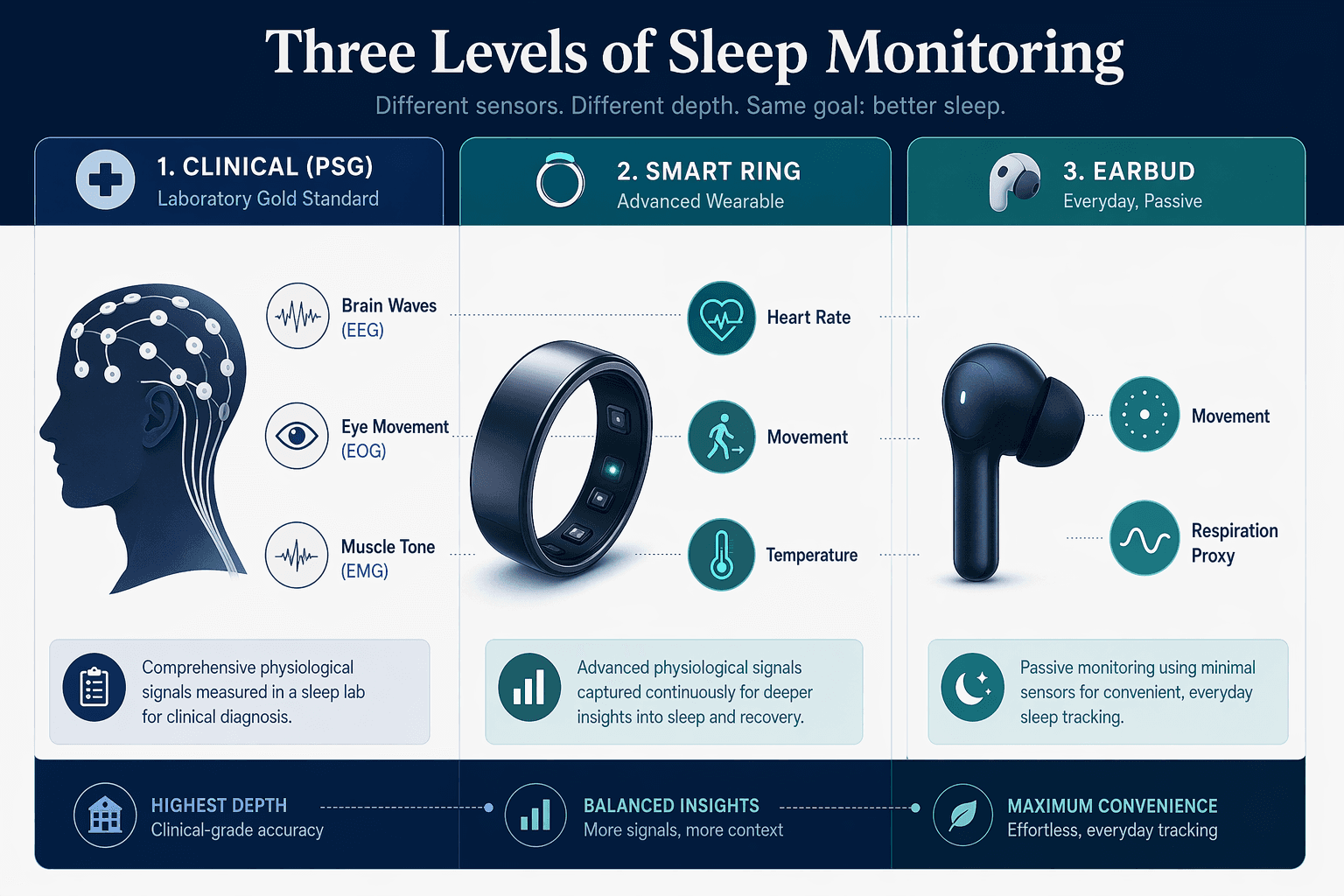
| Measurement | PSG (Gold Standard) | Ring-Based Tracker (e.g., Oura) | Earbud-Based Tracker (Ozlo, Soundcore) |
|---|---|---|---|
| Brain wave activity (EEG) | Yes — direct measurement | No | No |
| Eye movement (EOG) | Yes — direct measurement | No | No |
| Muscle tone (EMG) | Yes — direct measurement | No | No |
| Heart rate / HRV | Yes (ECG) | Yes (PPG) | No — no optical sensor |
| Movement / actigraphy | Yes (supplementary) | Yes (accelerometer) | Yes (accelerometer) |
| Respiration rate | Yes (multiple methods) | Derived from HRV | Proxy via movement |
| Body temperature | Yes | Yes (NTC thermistor) | No (case only for ambient) |
| Blood oxygen (SpO2) | Yes | Yes (PPG) | No |
The practical consequence is that earbud-based systems are limited to sleep/wake classification and coarse movement-based sleep quality scoring. They cannot reliably distinguish between light sleep, deep sleep, and REM — the three-stage classification that most sleep tracking consumers expect. When Ozlo claims to "help understand your sleep stages," the methodology is based on movement and respiration proxies, not on the physiological signals that define each stage.
For context on how wrist-based trackers compare, see our Apple Watch Sleep Tracking Review and WHOOP Band Sleep Tracking Review, both of which include PSG validation data that earbud-based systems have not yet matched.
Practical Recommendations: Earbuds as Intervention Tools, Not Diagnostic Devices
The evidence points to a clear conclusion: sleep earbuds excel at their primary function — noise masking for better sleep onset and maintenance — but their tracking capabilities remain unvalidated and sensor-limited. The smartest approach for evidence-minded readers is to treat earbuds as intervention tools and pair them with a validated tracker for sleep data.
- Use sleep earbuds for noise masking: If your primary sleep disruption is environmental noise (a snoring partner, street traffic, a barking dog), earbuds like the Ozlo or Soundcore A20/A30 are excellent tools. Their noise-masking and passive noise-blocking capabilities are well-documented and do not require validation studies.
- Do not rely on earbud sleep staging: The movement-based sleep quality scores from earbuds may provide a rough sense of whether you slept well or poorly, but they cannot reliably measure sleep architecture. Treat any stage-level data from earbuds as experimental.
- Pair with a validated ring or under-mattress tracker: For reliable sleep stage data, use a PSG-validated device like the Oura Ring alongside your sleep earbuds. The ring handles the measurement; the earbuds handle the intervention.
- Consider an under-mattress sensor as an alternative: If you dislike wearing anything on your finger or wrist, an under-mattress tracker (like Withings Sleep or Sleep Number's sensor) can provide validated sleep/wake and heart rate data without any wearable conflict with earbuds.
The Bose Sleepbuds II taught us that a device can improve sleep without measuring a single metric. Modern successors are trying to add measurement, but the sensor gap between an earbud and a clinical sleep study remains wide. Until earbud manufacturers publish PSG validation data comparable to what ring-based and wrist-based trackers have produced, the prudent position is to view earbud sleep tracking as a promising beta feature — not a reliable diagnostic tool.

Comments
Join the discussion with an anonymous comment.