
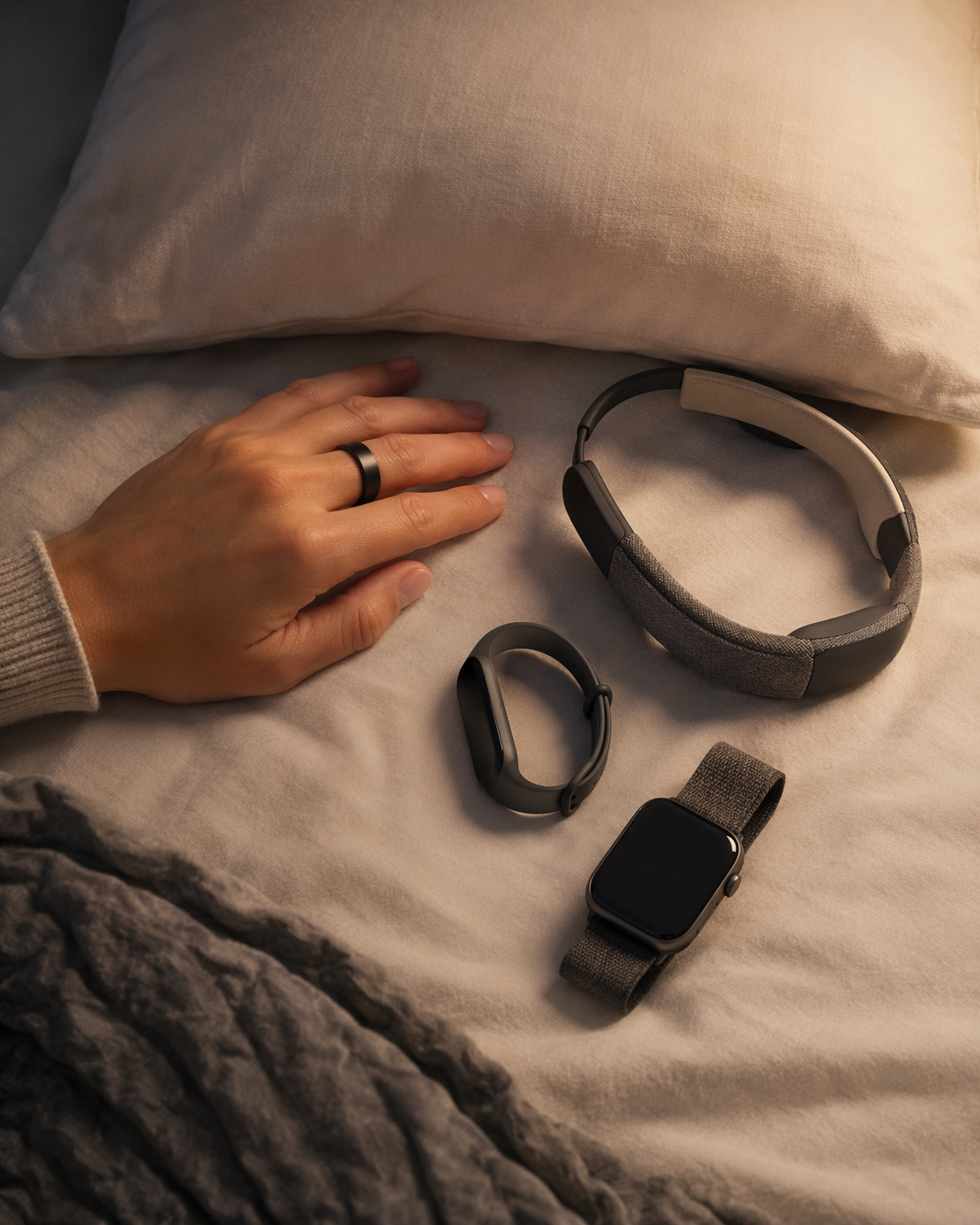
At bedtime, the best wearable sleep tracker is not the one with the most impressive lab-adjacent accuracy claim. It is the one that is still on your body after the lights go out, after you roll onto your side, after your hand gets warm under the duvet, after the charger is across the room, and after the novelty has worn off.
That sounds obvious until you watch people shop for sleep trackers. They compare sleep-stage charts, heart-rate variability dashboards, recovery scores, and proprietary algorithms, then discover that a bulky watch catches on the pillow or a headband feels tolerable only on the first enthusiastic night. Sleep data is longitudinal by nature. A tracker that misses two or three nights a week because it is charging, uncomfortable, or annoying will often tell you less than a slightly less ambitious device you barely notice.
The quick form-factor answer
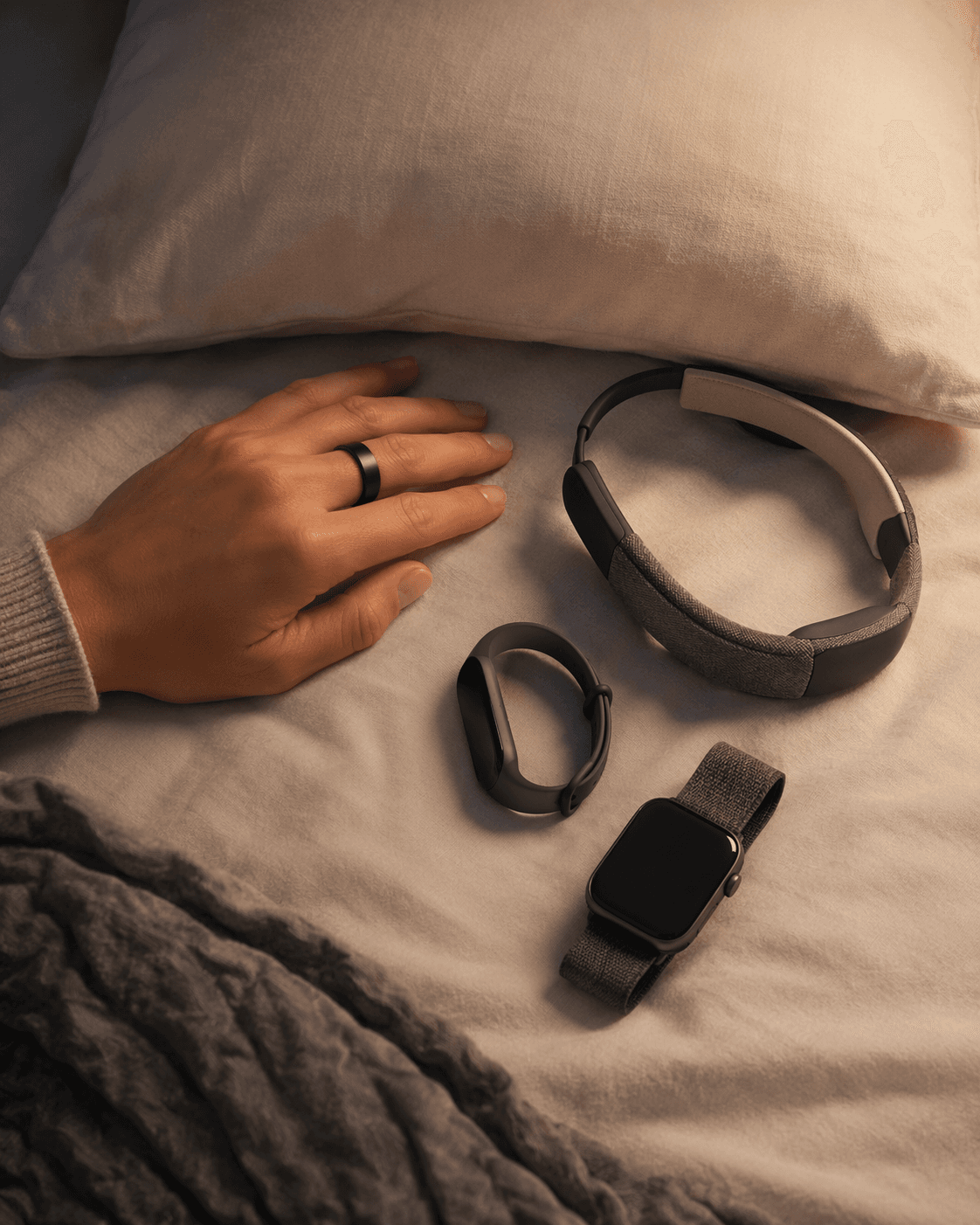
If you want the shortest practical answer: most people deciding between a ring, smartwatch, wristband, and EEG headband should start with a ring or a minimalist wristband. A smartwatch can work beautifully if you already love wearing it and charge it reliably. An EEG headband is a more specialized choice for people who care enough about sleep-stage physiology to tolerate more bedtime gear.
| Form factor | Best fit | Main strength | Main friction point |
|---|---|---|---|
| Smart ring | People who want sleep tracking to disappear into the night | Comfort, passive wear, multi-day battery life | Ring fit, finger swelling, ecosystem and subscription differences |
| Minimalist wristband | Athletes or recovery-focused users who can tolerate a dedicated band | Continuous wear, long battery life, no distracting screen | Subscription cost and dense data interface on some platforms |
| Smartwatch | People already committed to an Apple, Garmin, or similar watch routine | Broad health, fitness, notifications, and app ecosystem | Size, screen presence, and frequent charging |
| EEG headband or sleep mask | People prioritizing sleep-stage measurement over low-friction wear | Closer access to brain-activity signals than PPG wearables | Comfort, cost, and limited independent validation in the available review material |
That table is an orientation tool, not a ranking. The real decision is about the way the device behaves in your life. A tracker’s data quality comes from two places at once: the sensor and the human. A clean sensor signal is useful only on nights when the device is actually worn.
Comfort is not a soft metric
The most persuasive evidence in favor of rings is not that every ring is automatically more accurate than every watch. It is that independent review panels keep arriving at the same ordinary-sounding observation: the best rings are easy to sleep in.
Sleep Foundation rated the Oura Ring 4 at 9.1 out of 10 for comfort in its 2026 sleep tracker testing, with testers emphasizing how little they noticed it overnight.[1] Wirecutter also named Oura Ring 4 its top sleep tracker pick for 2026, and ZDNET likewise highlighted it among the best sleep trackers of 2026 with comfort as a recurring reason it stood out.[2][3]
One review panel can overfit to its own testers. Three separate panels saying roughly the same thing is harder to wave away. It does not mean Oura will fit every hand, or that a ring is ideal for someone whose fingers swell at night, or that comfort can be universalized from a panel. It does mean the comfort signal is strong enough to matter when choosing a device for repeated overnight wear.
This is where sleep tracking differs from step counting. You can tolerate a slightly irritating device during a workout because the session has a beginning and an end. Sleep is different. The tracker has to coexist with your preferred sleep position, your bedding, your skin temperature, your partner, and your half-awake impatience. If the device asks for attention at 2:00 a.m., it has already lost part of the job.
Battery life is a behavior problem, not just a spec
Daily charging sounds harmless on a product page. In real use, it creates gaps. The watch goes on the charger during a shower, then stays there. Or it charges before bed, but not quite long enough. Or the user decides tonight is not worth the bother because the battery is low and the pillow is already calling.
That is why the battery spread across current sleep-tracking form factors matters so much. Apple Watch Series 11 is described in the 2026 review material as roughly a 24-hour device, which means sleep tracking generally depends on a daily charging habit.[1] Oura Ring 4 runs about 5 to 8 days, Whoop 5.0 about 14 days, and Galaxy Ring about 7 days, while Galaxy Ring also avoids a subscription model in the available smart-ring coverage.[1][4][5]
A person who already charges an Apple Watch predictably may not experience this as friction. Plenty of people have made that routine invisible. But for a tired person trying to build a consistent sleep record, a device that can stay on through most of the week removes a failure point. That is not a minor convenience; it changes the odds that the data will exist.
Whoop is the cleanest wristband example of this logic. It has no screen, is lighter than a full smartwatch, and its roughly 14-day battery life supports continuous wear in a way that daily-charge watches do not.[1][3][4] The tradeoff is not comfort so much as commitment: Whoop’s subscription is reported at $30 per month or $240 per year, and its recovery-focused interface can feel dense for users who only wanted a calm sleep trend.[4]
For readers leaning toward that route, a dedicated WHOOP Band Sleep Tracking Review is more useful than treating it as just another wrist device. It behaves differently from a smartwatch because it removes the screen and makes continuous wear the center of the product.
Why the body location changes the data
Most mainstream rings, watches, and bands estimate sleep from indirect signals: heart rate, heart-rate variability, movement, skin temperature, breathing-related patterns, and device-specific algorithms. They are not watching the brain move through sleep stages. They are inferring state from body signals that tend to change with sleep and wake.
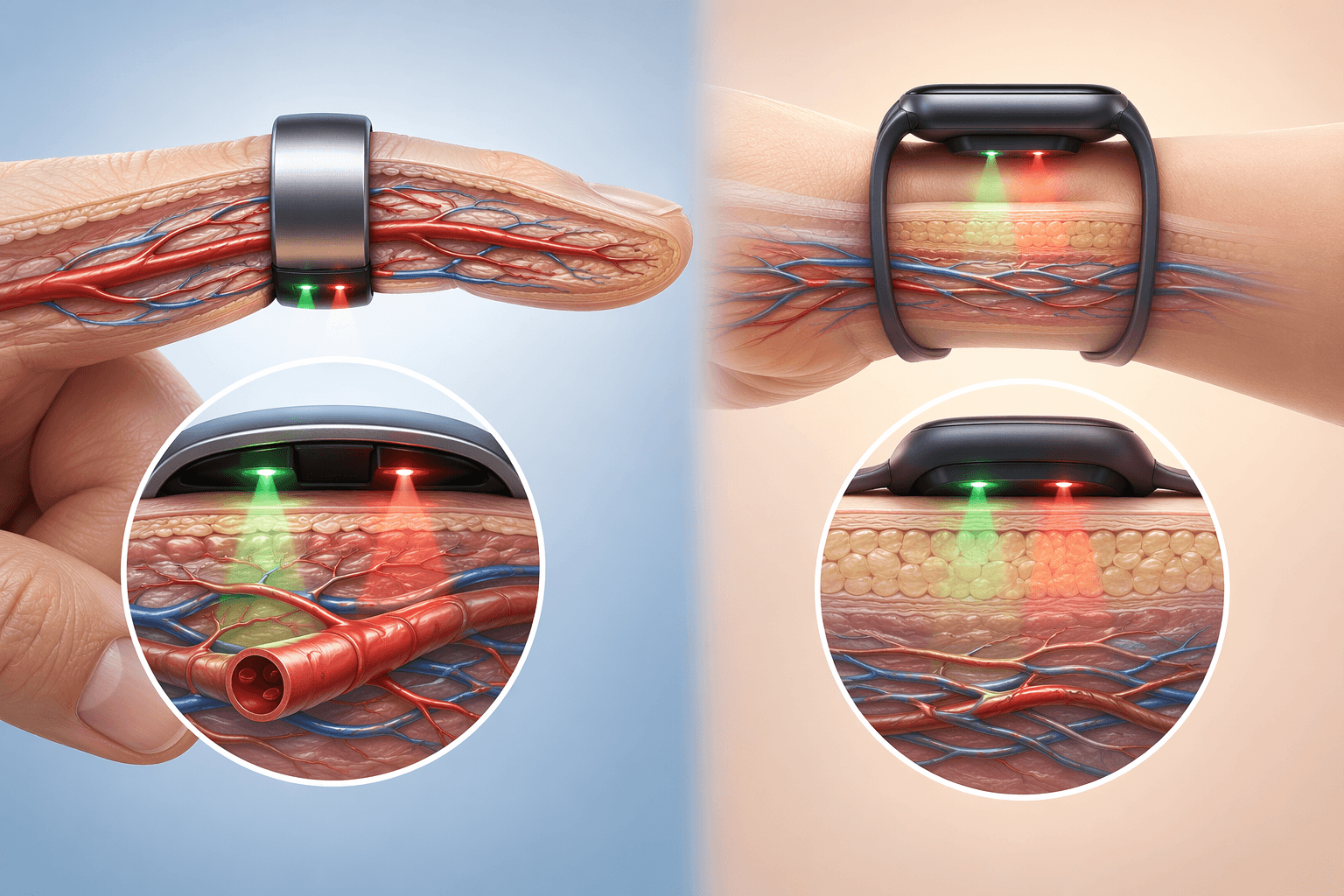
This is where sensor placement becomes interesting. Enthusiast discussions in communities such as r/SmartRings and r/Biohackers often point to the finger’s closer arterial access as a reason rings may get cleaner nocturnal photoplethysmography, or PPG, signals than wrist devices in some situations.[6] That should be treated as a plausible mechanism, not a clinical verdict. Reddit threads are not validation studies. Still, the argument fits what many users notice: a snug, stable ring can be less exposed to wrist flexion, strap looseness, and arm movement during sleep.
Wrist devices have their own advantages. They can house larger components, broader smartwatch features, and familiar optical sensor arrays. The problem is that the wrist is an unruly overnight site. A watch can slide, press into the mattress, loosen as the strap shifts, or become noticeable when the sleeper bends the wrist under a pillow. A minimalist band reduces some of that bulk, which is why Whoop occupies a useful middle ground: it keeps the wrist location but strips away the glowing screen and smartwatch casing.
The screen matters more than spec sheets admit. A watch is not just a sensor platform; it is a small daytime computer. Even when sleep mode silences it, the wearer knows it is there. For some people, that ecosystem is the point. For others, the best bedtime interface is no interface at all.
Rings: the strongest default for low-friction sleep tracking
A good ring wins by being boring at the right moment. It does not ask you to fasten a strap, dim a screen, or remember a charging ritual every night. It sits where a piece of jewelry would sit and quietly collects a record over time.
Oura Ring 4 is the obvious reference point because the comfort findings converge across Sleep Foundation, Wirecutter, and ZDNET.[1][2][3] But the more useful conclusion is broader than one brand: the ring form factor is well suited to sleep because it combines passive wear, multi-day battery life, and a sensor location that may be favorable for overnight PPG signals.
Galaxy Ring complicates the decision in a helpful way. It offers about 7 days of battery life and no subscription in the available 2026 smart-ring coverage, making it a cleaner ongoing-cost proposition for some users.[5] Its constraint is ecosystem fit: it is Android-only and less feature-rich than Oura in the research material, which makes it more of a middle path than a universal alternative.
The ring caveats are real. Sizing matters. A ring that is loose enough to spin may compromise sensing; a ring that is tight enough to bother you will not last. Finger swelling can turn a barely-there tracker into an object you want off your hand. People who dislike jewelry may never adapt. But compared with watches and headbands, rings ask relatively little of the sleeper once the fit is right.
Smartwatches work best when you already wanted the watch
The smartwatch case is strongest for someone who is already wearing one all day. If an Apple Watch or Garmin is your calendar, workout recorder, notification filter, safety device, and health dashboard, adding sleep tracking may be almost free behaviorally. You already accept the object on your wrist.
The weak point is continuity. A roughly 24-hour Apple Watch battery means sleep tracking competes with charging time.[1] Some users solve this with a stable routine: charge while showering, during dinner, or at a desk. Others gradually create a sleep dataset full of blank nights. The difference is not technical sophistication; it is habit reliability.
Smartwatches also bring the most daytime value. That matters. A person who loves the Apple Watch ecosystem and never forgets to charge it may get more total benefit from one integrated device than from adding a separate ring. The mistake is assuming that a feature-rich daytime device is automatically the most sustainable nighttime device.
Minimalist bands: less elegant than rings, easier than watches
A screenless wristband is not as physically invisible as a ring, but it avoids the main smartwatch distractions. Whoop’s appeal is not just its recovery model; it is the way the hardware tells the user, “leave me on.” The long battery life, lack of display, and athlete-oriented continuous-wear culture all support compliance.[1][3][4]
That makes the band category especially good for people who already think in training load, recovery, and strain. For them, a nightly sleep score is not an isolated curiosity; it is part of a performance loop. For a more casual sleeper, the same richness can feel like homework, especially when paired with an ongoing subscription.
This is also where sleep scores can become misleadingly authoritative. Different devices weigh inputs differently, and two trackers can turn the same messy night into different-looking judgments. If the number starts to feel like a verdict, step back and read a plain-language sleep score explainer before changing your bedtime around a proprietary grade.
EEG headbands are closer to sleep staging, but farther from ordinary habit
Headbands and smart sleep masks belong in a different mental category. Devices such as Muse S Athena, listed at $400, and Bía Smart Sleep Mask, listed at $380 to $419, use brain-activity-oriented technologies such as EEG and fNIRS rather than relying only on peripheral PPG inference.[1][4] That is a meaningful distinction. Brain activity is closer to the physiology used to stage sleep than heart rate and movement alone.
But closer does not mean easier. A headband or sleep mask occupies the face and head, exactly where many people are most sensitive at night. It can shift with side sleeping, add warmth, or feel like equipment at the moment when equipment is least welcome. The available review material also does not establish broad independent clinical validation for these current consumer devices, so their sleep-stage promise should not be inflated beyond the evidence.
For a self-experimenter who truly wants more direct sleep-stage signals and is willing to pay more, an EEG-style device may be worth considering. For the average person trying to build a months-long sleep habit, it is the form factor most likely to turn bedtime into a setup process.
The practical choosing rule
Choose the form factor by the failure mode you are most likely to have.
- If you abandon devices because they feel bulky at night, start with a ring.
- If you already wear a smartwatch constantly and charging is automatic for you, use the smartwatch.
- If you train seriously and want recovery data in one continuous system, consider a minimalist wristband.
- If sleep staging detail matters more than comfort and cost, consider an EEG headband or mask with realistic expectations.
If you are still deciding whether you want something on your body at all, compare the broader landscape of mats, bedside radar, and other options in this sleep monitor form-factor comparison. Earbuds are another edge case, and they deserve their own treatment; for that, see the guide to whether sleep earbuds track sleep accurately.
Once the form factor is settled, then it makes sense to compare metric-level strengths: heart-rate accuracy, wake detection, sleep-stage agreement, respiratory signals, recovery scoring, and temperature trends. Use a metric-specific sleep and fitness tracker accuracy guide for that next layer. Accuracy questions are sharper after you know what you will actually wear.
What the best wearable sleep tracker should—and should not—do
For most readers, the best wearable sleep tracker is likely to be a ring or minimalist wristband because those forms remove the most common barriers to consistent overnight use. A smartwatch is the right answer when the watch is already part of your life and charging does not create missing nights. An EEG headband is a specialist tool for people willing to trade comfort and simplicity for closer proximity to sleep-stage physiology.
None of these devices should be treated as a diagnostic instrument or a nightly performance judge. In 2025, the World Sleep Society recommended using consumer wearable sleep data as an awareness tool for pattern recognition, rather than as a diagnostic device or performance benchmark.[7] That guidance is the healthiest frame for every form factor here. Let the tracker reveal patterns you would otherwise miss. Do not let it become one more thing keeping you awake.
References
- Best Sleep Trackers of 2026 — Sleep Foundation
- The 2 Best Sleep Trackers of 2026 — Wirecutter
- The best sleep trackers of 2026 — ZDNET
- Best Sleep Trackers of 2026 — CNET
- The Best Smart Rings We've Tested for 2026 — PCMag
- Reddit community discussions on smart rings and biohacking — Reddit
- World Sleep Society recommendation on consumer wearable sleep data — Sleep Medicine — 2025

Comments
Join the discussion with an anonymous comment.