
If you started Keytruda and now find yourself awake at 3 a.m., it is reasonable to ask whether the drug is involved. The careful answer is: it can be. Keytruda’s official side-effect information lists “trouble sleeping (insomnia),” especially when pembrolizumab is given with certain chemotherapy regimens.[1] A large meta-analysis of immune checkpoint inhibitor trials also found a modest increase in insomnia risk compared with placebo.[2] But that does not mean every new sleep problem on Keytruda is caused by Keytruda. Sleep disruption is already very common in people with cancer, with the National Cancer Institute describing insomnia prevalence across cancer populations in a wide 30% to 75% range.[3]
That distinction matters because the next step is different. If the drug is one contributor, your oncology team may adjust timing, review combination medicines, treat related symptoms, or monitor for immune-related side effects. If pain, steroids, anxiety, diarrhea, nocturia, sleep apnea, or treatment stress is driving the problem, blaming Keytruda alone can delay the thing that would actually help.

What the best trial evidence actually says
The strongest single evidence source is a 2022 meta-analysis by Kiss and colleagues in Frontiers in Oncology. It pooled 54 phase 3 trials including 37,352 patients treated with immune checkpoint inhibitors. Across those trials, the reported incidence of insomnia was 8.3%, and checkpoint inhibitors were associated with higher odds of insomnia than placebo, with an odds ratio of 1.49.[2]
Those numbers are useful, but they need careful handling. The 8.3% figure is not the same as saying only 8.3% of all cancer patients on immunotherapy have trouble sleeping. Trial adverse-event reporting usually captures insomnia that is reported, recognized, and coded during the study period. It may reflect new or worsened insomnia more than the full background burden of poor sleep. A patient who was already sleeping badly before treatment may not appear in the data the same way as someone whose insomnia clearly began after treatment.
It is also not a pembrolizumab-only number. The meta-analysis covered immune checkpoint inhibitors as a group. Keytruda, whose generic name is pembrolizumab, belongs to the PD-1 inhibitor class. In the same analysis, CTLA-4 inhibitors had higher insomnia risk than PD-1 inhibitors, with an odds ratio of 1.36 for CTLA-4 inhibitors compared with PD-1 inhibitors.[2] So the evidence supports a class-level signal that includes drugs like Keytruda, while stopping short of giving a clean, drug-specific insomnia rate for pembrolizumab alone.
| Evidence point | What it means | What it does not prove |
|---|---|---|
| 8.3% insomnia incidence across checkpoint inhibitor trials | Insomnia was reported often enough to be a recognized adverse event in large phase 3 trial data | It does not measure total sleep-problem prevalence among all patients receiving Keytruda |
| Odds ratio 1.49 versus placebo | Checkpoint inhibitors were associated with a modestly higher insomnia risk than placebo | It does not prove that Keytruda is the sole cause of an individual patient’s insomnia |
| PD-1 class included pembrolizumab | The signal is relevant to Keytruda because Keytruda is a PD-1 inhibitor | It is not a large prospective sleep-quality study of pembrolizumab monotherapy |
The most honest reading is not dismissive and not alarmist: Keytruda can plausibly contribute to insomnia, and trial data show a modest increased risk for checkpoint inhibitors. But the evidence does not let us look at one sleepless week and confidently declare the drug to be the only cause.
Why attribution gets messy during cancer treatment
Cancer treatment compresses many sleep disruptors into the same weeks: scan results, infusion days, steroid prescriptions, pain flares, bathroom trips, fatigue that leads to daytime napping, and the mental noise of waiting. That is why the NCI’s 30% to 75% insomnia range is so important.[3] It keeps the question grounded. Many patients enter immunotherapy already vulnerable to poor sleep, even if the problem becomes more obvious only after a new treatment starts.
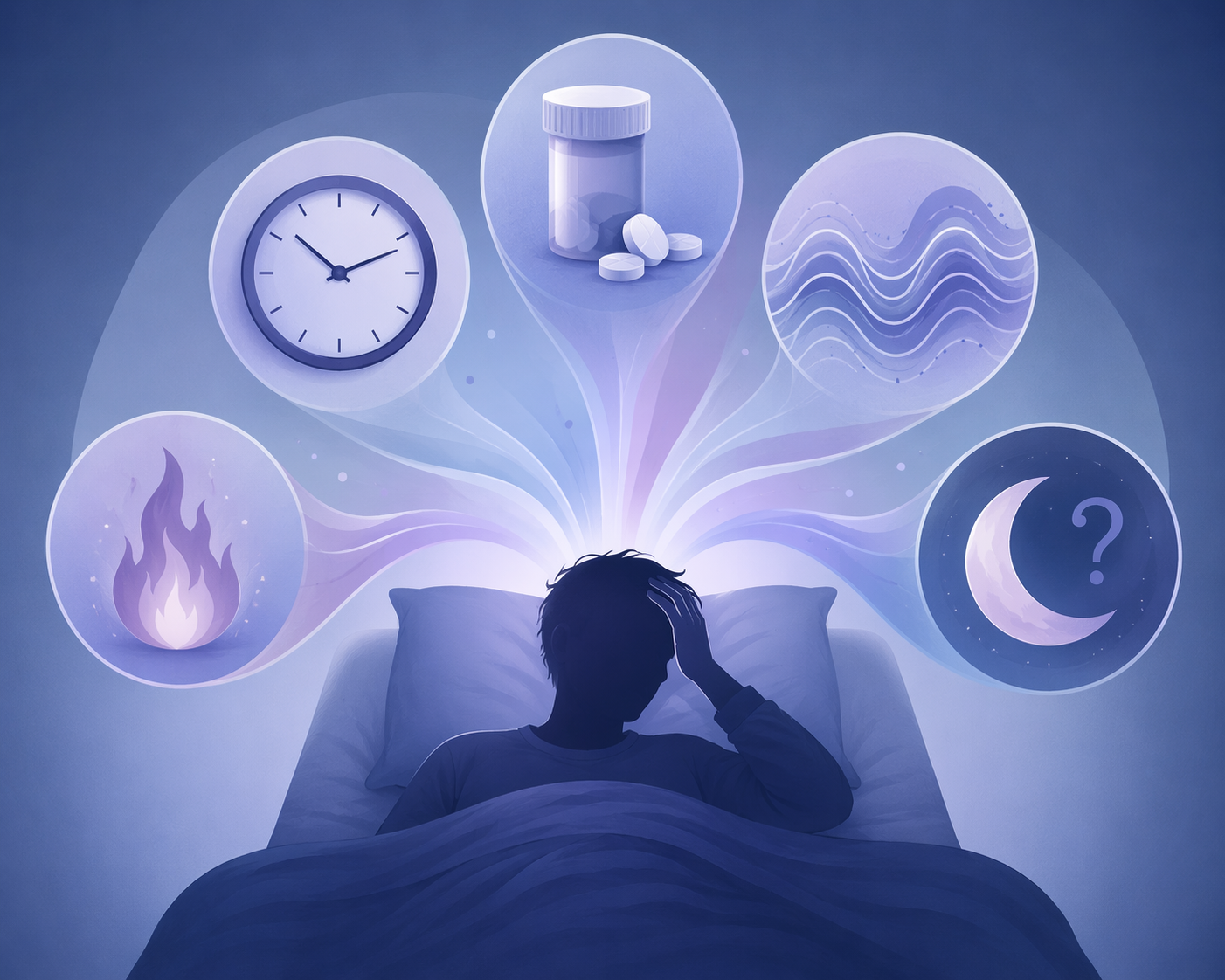
Timing still matters. A sleep problem that begins within days of a new infusion schedule, a steroid change, or a chemotherapy combination deserves to be reported as such. So does insomnia that appears alongside new diarrhea, shortness of breath, rash, fever, worsening pain, mood changes, or unusual fatigue. The point is not to create a courtroom case against one cause. It is to give the oncology team enough pattern information to decide what needs attention.
Patterns worth writing down before you call
- When the insomnia started: before Keytruda, after the first infusion, after a dose change, or after another medication was added.
- What kind of sleep problem it is: trouble falling asleep, repeated awakenings, early-morning waking, or sleep that feels unrefreshing.
- What happens at night: pain, coughing, diarrhea, reflux, hot flashes, urination, itching, anxiety, or racing thoughts.
- What changed around the same time: steroids, chemotherapy, anti-nausea medicines, pain medicines, caffeine, naps, hospital stays, or scan-related stress.
- What the insomnia is doing during the day: falls, confusion, missed meals, inability to drive safely, worsening fatigue, or inability to function.
Steroids deserve special mention because they are common in oncology care and can be activating. If dexamethasone or another steroid is taken later in the day, some patients feel wired at bedtime. Pain can do the opposite kind of harm: it may not feel dramatic enough to mention at every visit, but it can wake someone every hour. Diarrhea can fragment the night and then feed daytime exhaustion; if that pattern is familiar, the connection between diarrhea, poor sleep, and fatigue is worth taking seriously rather than treating each symptom as separate.
There is also a quieter form of misattribution: expecting sleep to normalize immediately once a scan is done, an infusion is over, or a crisis has passed. The nervous system often lags behind the calendar. For some people, sleep stays disrupted after acute medical stress, even when the obvious emergency has ended. That does not make the insomnia imaginary; it means the body may still be responding to threat, uncertainty, symptoms, and treatment routines.
How Keytruda could affect sleep
Keytruda works by blocking PD-1, a checkpoint protein that can restrain immune responses. That immune mechanism is central to why pembrolizumab can help some cancers, and also why immune-related side effects are watched closely. Sleep is not separate from immune signaling. A 2023 review in Frontiers in Oncology described connections between immunotherapy, sleep, and circadian rhythms, including circadian clock regulation of PD-1 and PD-L1 expression.[4]
That kind of biology makes sleep disruption plausible, but it should not be oversold. Circadian regulation and immune activation are not the same thing as a definitive study showing that pembrolizumab monotherapy worsens sleep quality by a specific amount on validated sleep instruments. The mechanism helps explain why the signal is believable; it does not replace patient-level assessment.
Inflammation can disturb sleep in more than one direction. Symptoms can wake a person; poor sleep can make pain, mood, and fatigue harder to tolerate; fatigue can increase daytime rest and weaken the next night’s sleep drive. This is the same kind of bidirectional pattern seen in other condition-specific sleep problems, where immune or neurologic stressors affect sleep while poor sleep amplifies the burden. The useful question is not only “Did Keytruda cause insomnia?” but “What loop is keeping this insomnia going?”
Sometimes sleep improves on immunotherapy
One small counterpoint is worth keeping in view. In a 2023 pilot study of 49 patients with non-small cell lung cancer, Zarogoulidis and colleagues reported that patients with PD-L1 expression of at least 80% who responded rapidly to immunotherapy had improved sleep disturbances within the first 4 months.[5] This is not a broad promise that immunotherapy improves sleep, and it is not generalizable to all cancer types or all Keytruda patients. The study was small and specific.
Still, it matters because it protects against a common oversimplification. Treatment can worsen sleep through side effects, medication schedules, or immune symptoms. Treatment can also improve sleep if it reduces tumor-related symptoms, eases breathing, lowers pain, or gives a patient enough response to feel less physically threatened. In real life, both forces can exist in the same person at different points in treatment.
Patient-reported toxicity research points in the same practical direction: people receiving immune checkpoint inhibitors do report fatigue and insomnia. Moffitt Cancer Center described fatigue and insomnia as the most common patient-reported toxicities among head and neck cancer patients receiving ICIs in research presented by Jim and colleagues in 2020.[6] That does not outweigh the larger meta-analysis, but it validates what patients often say plainly: the sleep problem is not a footnote when you are the one awake.
When to contact your oncology team
Do not stop or change Keytruda on your own because of insomnia. The safer move is to report the sleep change and bring the pattern. Oncology teams are used to sorting side effects by timing, severity, associated symptoms, and risk. They can also decide whether a symptom needs routine management, medication review, lab work, urgent assessment, or monitoring for an immune-related adverse event.
A call is especially important if insomnia appears with new or worsening diarrhea, severe fatigue, shortness of breath, chest symptoms, fever, confusion, mood changes, severe pain, or any symptom your treatment team has told you to report. Insomnia by itself may not be the most dangerous side effect on the list, but insomnia plus a new systemic symptom can be part of a larger clinical picture.
For the conversation, a short sleep log is more useful than a perfect theory. Note bedtime, wake time, number of awakenings, naps, infusion dates, steroid timing, new medications, pain level, bathroom trips, and daytime impairment. If you use a wearable, bring trends rather than obsessing over one night’s score. The goal is to help your clinician see whether the sleep problem clusters around treatment days, symptom flares, medication timing, or anxiety-heavy waiting periods.
The evidence supports a middle position: Keytruda is linked to insomnia and may modestly raise risk, but a new sleep problem during cancer treatment is often multifactorial rather than purely drug-induced. That is not a vague answer; it is the answer that keeps the most treatable causes on the table while still taking the drug signal seriously.
References
- KEYTRUDA® (pembrolizumab) side effects. Keytruda.
- Insomnia in patients treated with immune checkpoint inhibitors: A systematic review and meta-analysis. Frontiers in Oncology. 2022.
- Sleep Problems. National Cancer Institute.
- Sleep and circadian rhythm in cancer patients receiving immunotherapy. Frontiers in Oncology. 2023.
- The improvement of sleep disorders in cancer patients under immunotherapy. 2023.
- Head and Neck Cancer Patients Report Fatigue, Insomnia from Immunotherapy. Moffitt Cancer Center. 2020.





Comments
Join the discussion with an anonymous comment.